
No sugar coating, but a nuts & bolts list of the best AI agent frameworks in 2026!
These are the frameworks around which developers are placing big bets: LangChain, MetaGPT, and others. No matter what stage you are at, be it your first attempt with any AI project or your tenth, this blog can help you avoid the poorly suspended sales gimmicks and find the tools that would make a difference.
Let’s dive in to learn the top 15+ AI agent frameworks in descending order, their languages, their key features, etc.
Kicking off with…
What are AI Agent Frameworks?
Toolkits, libraries, and pre-built modules that aim to make it easier to build, deploy, and scale intelligent autonomous agents (i.e., software that perceives the world around them, makes decisions, and takes actions independently, without needing constant human supervision) are called AI agent frameworks.
Such frameworks allow companies and application developers to carry out all kinds of automation, augment their decision-making, and integrate intelligent systems into their apps in a way that can be achieved without extensive AI knowledge.
The current AI agent development frameworks are used to create everything from chatbots and virtual assistants to more complex solutions related to enterprise automation and multi-agent systems.
15+ Top AI Agent Frameworks in Descending Order
Find out the top 15+ AI Agent Frameworks in descending order based on performance, scale-up, and industry adoption. Advanced automation, intelligent decision-making, and so on are the next phase of AI innovations achieved with the help of these frameworks.
1. LangChain

LangChain is the industry-leading open-source, modular top AI agent framework to support developers in creating smart, large language model (LLM)-based agent chains combining memory, tools, and connectors to external services. Its modular nature has very high levels of flexibility, allowing developers to create a mix and match components like language model, data connectors, and custom processing workflow using very little engineering effort.
LangChain excels in production settings, whereby it helps with higher levels of workflow, maintaining persistent memory, and sophisticated tools utilization patterns. It has an imposing library of integration functions and a robust open source community, and thus is a good fit for creating research assistants, chatbots, and poly-tool AI actors. The framework uses Python predominantly, and in JavaScript and TypeScript.
☑️ Key features
- Modular chains and memory
- Large integration library
- Strong open-source community
- Advanced workflow support
Language: Python
Best For: Research assistants, chatbots, and multi-tool AI agent development frameworks.
✅ Examples
- Building a sophisticated chatbot that retains conversational context over long dialogues.
- Research assistants who synthesize and summarize large document datasets stored within a centralized document management system for efficient access and version control.
- Multi-step automated workflows combining text generation, data retrieval, and API calls.
Typical Use Cases/Industries
- Retail: automatic customer support and individual recommendations.
- Medical: reservation and family diagnostic assistance robot.
- Finance: automation of fraud detection and compliance.
- Education: individual tutoring and automation of grading.
- Enterprise: data analytics and document summary processes.
Discover our LangChain Development Services
2. MetaGPT

MetaGPT is an AI framework of the future that aims to model an entire software development team, wholly driven by large language models (LLMs). The structure prescribes the kind of GPT-based roles that will work collaboratively to use the simple one-line requirement and deliver detailed outputs such as user stories, competitive analysis, technical requirements, data structures, APIs, and documentation.
The very logic underlying MetaGPT is the idea that Code = SOP(Team), so that Standard Operating Procedures (SOPs) are implemented and run off patterns to operate, coordinate, and leverage the activity of these language-model agents to act according to the model of a consolidated software firm.
☑️ Key Features
- Role-based GPT agents simulating a software development team
- Automatic creation of user stories, analyses, requirements, and docs
- End-to-end software development workflows with AI project managers
- SOP-driven coordination for seamless agent collaboration
Language: Primarily Python
Best For: Software development automation, custom AI application development, research assistance, and AI-driven project management.
✅ Examples
- Autonomously creating detailed blueprints of software projects based on insignificant provision prerequisites.
- Getting AI agents to jointly develop APIs and documentation of the system architecture.
- Automating software project management actions such as sprint planning and issue tracking with the help of MetaGPT agents.
Typical Use Cases / Industries
- Software Engineering Companies: Automation of the entire cycle of software development, speeding up the release of products.
- Business Automation: Creation of AI-enabled systems to simulate organizational functions to automate the process.
- Research & Development: Developing multidimensional project requirements with the help of multi-agent collaboration.
3. AutoGen (Microsoft)

AutoGen Microsoft: An Advanced AI Agent Framework. With AutoGen, Microsoft has built an agent framework that makes multi-agent orchestrations possible through event-driven conversations in an asynchronously scalable manner. It enables live, collaborative dialogue between agents and uses a free and developer-friendly API.
AutoGen is LLM-agnostic, can be coupled with a variety of language models, and is focused on enterprise automation, real-time multi-agent interactions, and teamwork driven by AI. It allows using Python and .NET languages to support various enterprise conditions.
☑️ Key features
- Multi-agent orchestration
- Event-driven conversations
- Scalable and asynchronous
- LLM-agnostic
Language: Python, .NET
Best For: AI agent development frameworks in enterprise automation, real-time agent interplay, and AI-driven collaboration.
✅ Examples
- Orchestrating multiple AI agents that simulate real-time team meetings or brainstorming sessions.
- Automating customer service workflows with dynamic handoffs between specialized AI agents.
Typical Use Cases / Industries
- Corporate workflows require real-time AI collaboration.
- Automated customer support and sales assistance.
- Enterprise process automation with dynamic agent interactions.
4. CrewAI
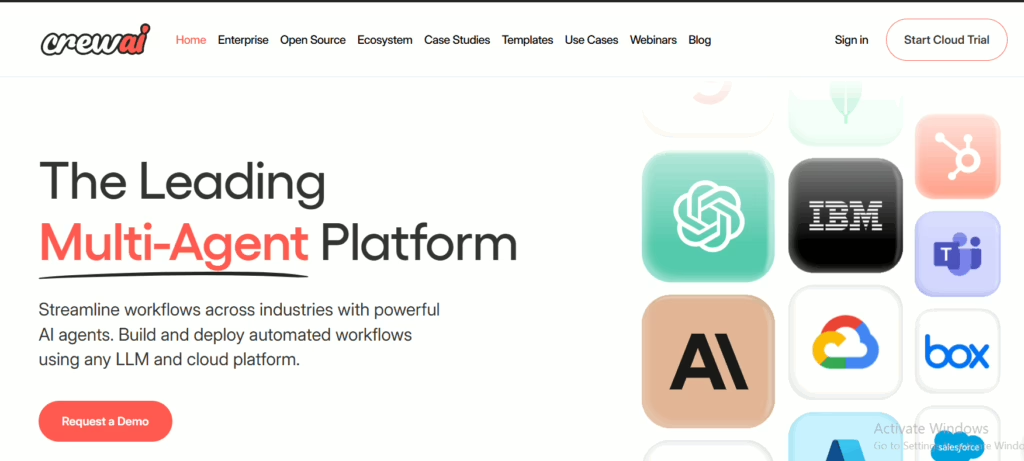
CrewAI is a team, role-based system that is developed using a lightweight code built on Python, where each AI agent should be specialised and operate in an environment of coordinated teams. CrewAI is known as an easily installed system and supports multiple agents at the same time, which enables quick prototyping and testing of the highly complex multi-agent workflow, where logical division of labor and effectiveness of collaboration are of paramount importance.
Its lightweight orchestration makes it deployable and iteratable in a short time, and the developers and teams should use it in case they want to process content, analyze it, or conduct some research where the differentiation of responsibilities can be useful, but the rapid formation of collaborative arrangements is a necessity. The lightweight nature of the architecture makes the framework easy to perform both experimentally and in production.
☑️ Key features
- Role-based multi-agent teams
- Fast collaborative setup
- Simple orchestration
- Lightweight and flexible
Language: Python
Best For: Team-based workflows, popular AI agent frameworks in 2026, and fast prototyping of content and analysis agents.
✅ Examples
- Workflow automation where separate agents handle content generation, fact-checking, and editing.
- Rapid prototyping of AI systems for document analysis and reporting.
Typical Use Cases / Industries
- Marketing: collaborative content creation.
- Research: rapid prototyping of multitask AI workflows.
- Reporting: automated multi-agent data crunching.
5. LangGraph
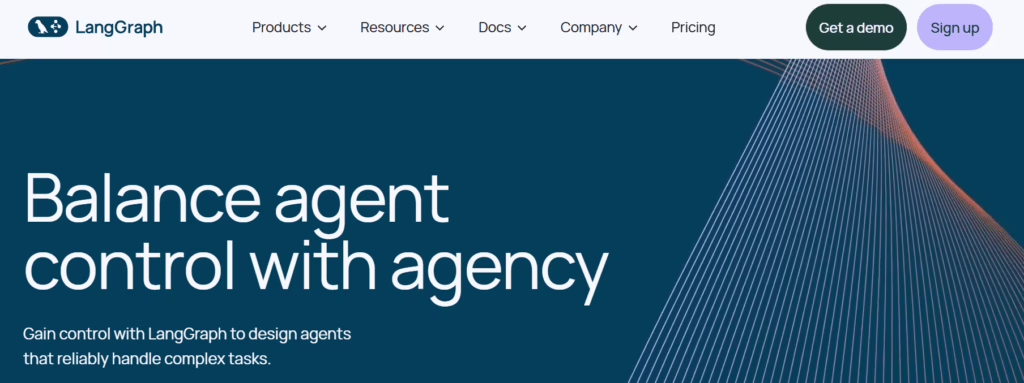
LangGraph was designed to perfectly fit the use case of developers who want to develop ever-more complex, stateful AI workflows that require fine-grained control over process forks, state processing, and all-encompassing debugging. The LangGraph planner incorporates the capability to plan complex multi-step scenarios leveraging a graph and directed acyclic graph (DAG) based workflow engine, needed to reason out a complex task that requires a lot of decisions to be made.
It offers strong interconnection and compatibility with LangSmith and the absence of an OpenAI platform, which enables improved debugging and fine-tuned branch logic control. This makes LangGraph the first choice of enterprises and developers to create AI systems that are required to maintain persistent states, recover gracefully in critical business systems, and follow complex conditional flows.
☑️ Key features
- Graph/DAG workflow engine
- Branching logic
- Advanced debugging
- LangSmith and OpenAI compatibility
Language: Python
Best For: Complex, multi-step scenario planning, advanced error handling, and decision-heavy agent framework builds.
✅ Examples
- Creating an AI that self-manages multi-step customer service cases with fallbacks and branching paths.
- Creating autonomous choice makers in economic or legal firms that need conditional reasoning.
Typical Use Cases / Industries
- Financial services require layered decision logic.
- Legal automation with condition-driven workflows.
- Enterprise-grade AI systems need stateful process tracking.
6. OpenAI Agents SDK
OpenAI Agents SDK is a very simple-to-use Python library devoted to the construction of multi-agent AI pipelines, through creation in a provider-neutral style. It uses in-line tracing and even behavior guardrails, which impose transparent, yet safe, execution of agents, allowing a developer to monitor and debug.
The SDK supports more than 100 large language models, so that the model development and deployment are extremely flexible. The fact that it has a small learning curve and fits well into the OpenAI ecosystems also makes it promising to developers seeking to create customized, transparent, and scalable multi-agent workflow building blocks that can be used to develop mobile applications in diverse realms like finance, education, and research.
☑️ Key features
- Multi-LLM support (100+)
- Integrated tracing
- Safety controls
- Minimal learning curve
Language: Python
Best For: Custom workflows, top AI agent frameworks for developers needing transparency and flexibility across various LLMs.
✅ Examples
- Creating domain-specific AI assistants that blend multiple LLMs for robustness.
- Transparent workflow audit systems that track agent actions for compliance.
Typical Use Cases / Industries
- Research and development teams need cross-model capabilities.
- Educational applications require safe and explainable AI.
- Financial and healthcare workflows demand compliance.
7. Semantic Kernel

Semantic Kernel is a multi-language (Python, C#, Java) framework of AI agent development framework designed by Microsoft with the enterprise requirement at heart and uniting state-of-the-art skill orchestration, enterprise connectors, and a heavy compliance emphasis to support safe and scalable workflows. It enables the composition of complicated multi-skill AI agents embedded within business-critical systems such as CRM and ERP.
Security-first design The security-first design approach adopted by Semantic Kernel means that it can be used to automate business logic in compliance-dominated sectors such as healthcare, investment, and finance. Its multi-language capability and secure design are used to enable organisations to deploy AI capabilities into the enterprise architecture deep end.
☑️ Key features
- Multi-language: Python, C#, Java
- Skill orchestration
- Business connectors
- Secure, compliant design
Language: Python, C#, Java
Best For: Large-scale enterprise automation, multi-skill AI agents, and process integrations.
✅ Examples
- Customer onboarding is to be automated using AI agents to integrate with the business systems.
- Orchestration of multi-skill agent workflows in support of complex workflows across enterprise departments.
Typical Use Cases / Industries
- Healthcare and finance require regulatory compliance.
- ERP and CRM automation in large organizations.
- Manufacturing and logistics with complex integrated workflows.
8. LlamaIndex Agents

LlamaIndex Agents are experts in retrieval augmented generation (RAG) workflows and enable efficient AI agent orchestration with direct seamless integration to vector databases for the fast retrieval of relevant knowledge. This Python-based framework, mostly suitable for high-knowledge domains, such as document QA, dynamic knowledge search, and contextual AI dialogue.
By combining strong vector database queries with huge language models, LlamaIndex Agents deliver advanced data federation & quick contextual reasoning, describing the top option for prevalent industrial & SA self-stateful conditions: ongoing huge doc governance systems & self-actuated heavy-smart & research staff.
☑️ Key features
- Retrieval-augmented generation (RAG)
- Powerful database integration
- Fast and efficient lookups
- Easy pairing with LLMs
Language: Python
Best For: Knowledge management, dynamic search agents, and best AI agent frameworks for data fusion.
✅ Examples
- Implementing AI agents for enterprise knowledge bases that support context-rich queries.
- Building document indexing and conversational search systems with real-time vector retrieval.
Typical Use Cases / Industries
- Legal and academic research requires detailed document analysis.
- Corporate knowledge bases and help desk automation.
- Data-intensive industries such as insurance and consulting.
Learn More: AI in Mobile App Development Guide
9. AgentFlow

AgentFlow is easy to master, graphical, low-code framework to develop AI agents where users can create workflows by dragging and dropping, monitor the progress, and iteratively edit them. It promises to reduce the barrier to entry because using it, business users and non-technical teams will be able to quickly prototype and deploy multi-agent workflows without having to develop deep programming expertise.
Unlike any existing AI agent tool, AgentFlow democratizes AI agent development, allowing humans to visually supervise real-time workflows and enabling completely non-technical individuals to create and adapt AI agents with smooth integration capacities, which makes it uniquely suited to automate regular business functions like marketing campaigns, HR onboarding, and customer interaction throughout small and medium businesses.
☑️ Key features
- No-code/visual builder
- Workflow monitoring
- Drag-and-drop integration
- Rapid iteration
Language: Visual interface, Python backend
Best For: Business process automation and popular AI agent frameworks for non-coders.
✅ Examples
- Automating business process workflows without extensive software development.
- Empowering citizen developers in organizations to create AI-powered tools rapidly.
Typical Use Cases / Industries
- SMEs and startups are automating operational tasks.
- Marketing, HR, and customer engagement automation.
- Enterprises are pursuing citizen developer initiatives.
10. PromptFlow
PromptFlow is an agent pipeline building tool using visualization and artifacts native integration with Microsoft Azure, designed to build, prototype, and deploy agent workflows at cloud scale. It enables users to quickly compose complex multi-agent flows and create and manipulate data with a drag-and-drop visual editor drawing on the tools offered by Azure machine learning, providing high speed of experimentation and scalability.
This framework is perfect in an agile organization that aims to leverage cloud-native AI innovation and the integration to perform at scale with Azure ML and Cognitive Services in commercial finance, retail, and SaaS applications.
☑️ Key features
- Visual workflow editor
- Azure ML connections
- Stepwise prototyping
- Fast deployment
Language: Python, Visual tools
Best For: Azure-first enterprises need agile, cloud-scale AI agent frameworks.
✅ Examples
- Azure-based multi-agent customer support systems with iterative prompt refinement.
- Cloud-scale AI experiments combining multiple Azure AI services.
Typical Use Cases / Industries
- Finance and insurance leveraging Microsoft cloud AI.
- Retail businesses are adopting cloud-based customer engagement.
- SaaS companies are integrating Azure AI pipelines.
11. Phidata
Phidata provides a generative Python environment meant to compose, iterate, and develop the workflows of complex LLM-based agents quickly. Its creativity and compositional logic, and multi-LLM support allow it to pioneer and rapidly prototype with experimental AI assistants.
Phidata targets research labs, innovation centres, and rapid development squads that require a flexible and developer-friendly set of tools to work on innovative AI-powered applications, such as creative content production to exploratory data analytics, in an iterative and corrective manner.
☑️ Key features
- Adaptive, compositional logic
- Multi-LLM support
- Quick-iteration cycles
- Developer-centric
Language: Python
Best For: Experimental research, creative agent logic, and best AI agent frameworks for fast-moving teams.
✅ Examples
- Creating experimental AI assistants that learn with input from the developers.
- To generate creative writing agents or data analysis generators.
Typical Use Cases / Industries
- Academia and research labs are testing new AI paradigms.
- Startups innovating on generative AI applications.
- Agencies are creating customized creative AI solutions.
12. Atomic Agents

Atomic Agents is a lean Python library that is optimized towards easy initialization of script-based multi-agent systems and simple automations. It targets programmers who value simplicity and reliability over complexity, and promotes quick construction of simple automation of common tasks, data gathering, and simple multi-agent orchestration patterns.
Small overhead and clean design of the framework mean it is welcome when creating prototypes, startups, and when something simple and efficient must be used to control agents with few needs on the complexity of coding complexity.
☑️ Key features
- Minimalist design
- Quick multi-agent setup
- Simple coding
- Fast execution
Language: Python
Best For: Scripting, small automation tasks, and lean AI agent frameworks.
✅ Examples
- Automating repetitive small workflows, such as email parsing or report generation.
- Creating prototype agent scripts for scheduled data collection tasks.
Typical Use Cases / Industries
- Startups and small businesses need fast automation.
- Personal projects requiring quick AI prototypes.
- Developers are looking for lightweight agent frameworks.
13. Smolagents

Smolagents is a small-code, high-code Python AI agent library designed to support developers’ needs to write their own proof-of-concept prototypes and to integrate them immediately using direct code, without an API on top.
It has a small footprint and an adaptable scripting platform that lets technical users create automation bots and agents in days rather than months, with complete control over both behavior and integration. Easy to use when automating single-time tasks and technical testing, Smolagents can be easily integrated with other developer pipelines to perform iterations and testing swiftly.
☑️ Key features
- Tiny, focused codebase
- Flexible scripting
- Rapid POCs
- Easy integration
Language: Python
Best For: Hands-on automations, one-off scripting, and developers who want total control.
✅ Examples
- Rapid coding of bot purposes into social media automation.
- Proof-of-concept AI assistants that are quickly created by developers with custom abilities.
Typical Use Cases / Industries
- Freelancers and developers are crafting custom automation scripts.
- Technical teams are exploring rapid agent prototyping.
- Experimental workflows in tech startups.
Explore More: AI App Development Cost Estimation
14. Rasa
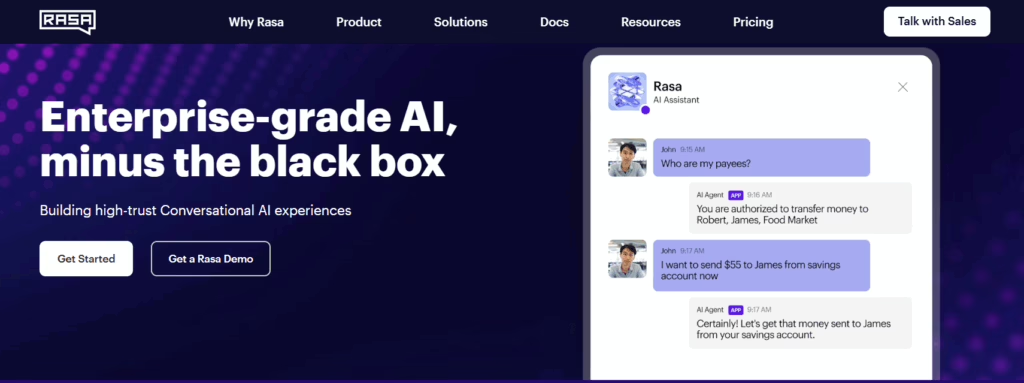
Rasa is one of the best open-source conversational AI platforms that aims to provide sturdy natural language understanding (NLU) and dialogue management. It is at the enterprise level in that it is suitable to be used within the enterprise, backed with security provisions of on-premises deployment, large-scale plugin support, and total orchestration of conversation flows.
Rasa is the framework of choice when it comes to developing custom chatbots and virtual assistants with a high need for security and compliance, usually found in the banking, insurance, and healthcare sectors, where privacy and minimum secrecy are paramount.
☑️ Key features
- Advanced conversational NLU
- Robust on-premises options
- Full orchestration control
- Wide plugin support
Language: Python
Best For: Secure chatbots, enterprise virtual assistants, and the most popular AI agent frameworks for conversation-heavy environments.
✅ Examples
- Building enterprise virtual assistants with sensitive data privacy requirements.
- Developing customer support chatbots with custom NLU and dialogue management.
Typical Use Cases / Industries
- Banking and finance with strict data privacy needs.
- Healthcare chatbots and telemedicine assistants.
- Businesses require fully customizable dialogue flows.
15. Strands Agents

Strands Agents is a serverless and AWS-native AI agent framework that is tightly integrated with Bedrock and Google Vertex AI. It has been designed cloud-first enterprise and provides scalable and automated AI workflows based on serverless architecture patterns.
It provides enterprise-level scalability and fault tolerance to orchestrate complex tasks of agents, and thus organizations relying on AWS and Google Cloud to automate their supply chain, finance, and scale their cloud analytics to large volumes can benefit.
☑️ Key features
- AWS/Vertex compatibility
- Serverless architecture
- Cloud orchestration
- Enterprise scalability
Language: Python
Best For: Serverless automation, cloud agent workflows, and AWS-centric AI deployments.
✅ Examples
- Coming up with cloud-first, scalable AI agent workflows in financial or other logistics sectors.
- Serverless automation pipelines to be built in AWS environments.
Typical Use Cases / Industries
- Cloud-first enterprises in retail and finance.
- Organizations are leveraging serverless architectures for AI.
16. Pydantic AI

Pydantic AI is a type-safe, validated framework built on the ideas of FastAPI, focused on the developer experience, and building dependable, maintainable workflows of AI agents. With data validation and scheme definition being stringent, Pydantic AI is the best fit for regulated industries where there is a need to be safe, predictable about the automation and aspects of conversation agents. It allows teams to build type-safe, validated workflows with remarkable transparency and durability to support enterprise-level AI applications.
☑️ Key features
- Strong typing
- FastAPI-style developer DX
- Structured validated logic
- Safe pipeline creation
Language: Python
Best For: Type-safe workflows, validated agent pipelines, and reliable Python-centric agent applications.
✅ Examples
- Building validated, type-safe conversational workflows with guaranteed data correctness.
- Creating predictable, error-resistant AI pipelines for regulated industries.
Typical Use Cases / Industries
- Healthcare and finance with compliance needs.
- Software teams are building maintainable AI pipelines.
- Companies are prioritizing data safety and reliability.
Build smarter AI agents today and transform your workflow.
How to Pick an AI Agent Framework
Selecting the right AI agent framework greatly influences your project’s scalability, development speed, and long-term maintainability.
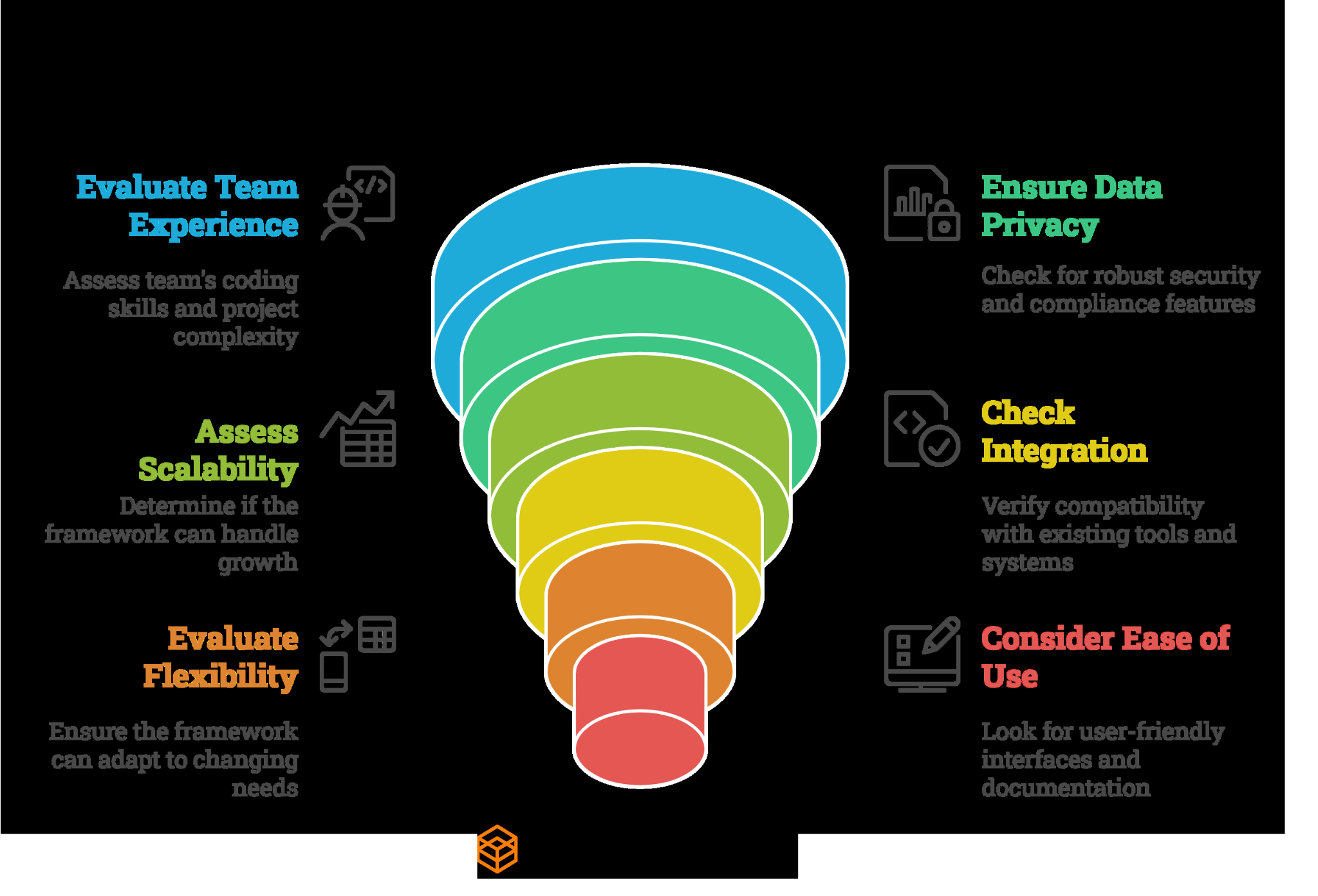
1. Team Experience & Complexity
There are AI agent frameworks at the low-code level designed to be developed by the business side, and those that are highly customizable are designed to be developed by highly competent developers. Evaluate the level of your use case and the experience you and your team have with code-centric solutions to consider whether the versatility of code-centric or the ease of a more visual, guided builder is what you require.
2. Privacy and Security of Data
Strong security is compulsory in regulated industries in particular. The most effective AI agent systems 2of 025 have end-to-end encryption support, control access, and implementations such as GDPR and HIPAA compliance. Choose the frameworks that have good reputations in terms of being privacy-respecting, particularly when processing sensitive business or customer data.
3. Scalability & Performance
A proof-of-concept agent can soon fall far behind demand. Some of the best frameworks to use as an AI agent are high-performing and can scale vertically (adding more resources to each agent) and horizontally (adding more agents concurrently), so your solution remains fast and reliable as user numbers or data volumes grow, which is why AI development companies pay close attention to this aspect when comparing AI agent frameworks.
4. Integration & Interoperability
Your agents have to operate in a gaggle of ready-to-use tools, databases, APIs, and business applications. Open source AI agent platforms can be more extensible and can update more quickly, but enterprise-oriented alternatives can have turnkey integrations to tools such as Salesforce, Slack, or AWS. When you do finally get to a short list of AI agent development frameworks, you should look at seamless integration capabilities.
5. Flexibility & Customizability
Things are not always the same, nor are needs. The newest AI agent frameworks are modular and enable you to simply plug in new models, algorithms, or bespoke business logic as they are needed- none of this rip and replace migrations. Another distinction in comparison guides of the best AI agent frameworks to future-proof your own platform is flexibility.
6. Ease of Use & Developer Experience
An easy-to-learn user experience, well-documented, with an active community, OOB tools- lets you get up to speed fast and complete things in minimal time. The leading AI agent frameworks provide either good-looking UIs or workflow visualizers or straightforward APIs, enabling adopters, technical and not.
7. Cost, Licensing & Vendor Support
Compare ongoing costs: Many open-source AI agent frameworks are free and community-supported, while enterprise versions may offer SLAs, support, or premium integrations. Weigh these options against your project’s longevity, anticipated scale, and the cost of migrating later.
Let’s summarize the Table: Top Factors in Choosing an AI Agent Framework
| Factor | Why It Matters |
| Complexity & Expertise | Match framework complexity to your team’s skillset and project needs |
| Data Privacy & Security | Ensure safety for sensitive or regulated data |
| Scalability | Meet future performance demands as your system grows |
| Integration | Fit seamlessly into your existing tech stack and workflows |
| Flexibility | Stay ready for new features, models, and algorithms |
| Ease of Use | Speed up onboarding and reduce manual errors |
| Cost & Support | Balance initial cost, long-term value, and vendor backing |
The proper selection of an AI agent framework, such as the top AI agent frameworks, open source AI agent frameworks, and even the most popular AI agent frameworks, can be the difference between automation potential.
Key Components of an AI Agent Framework
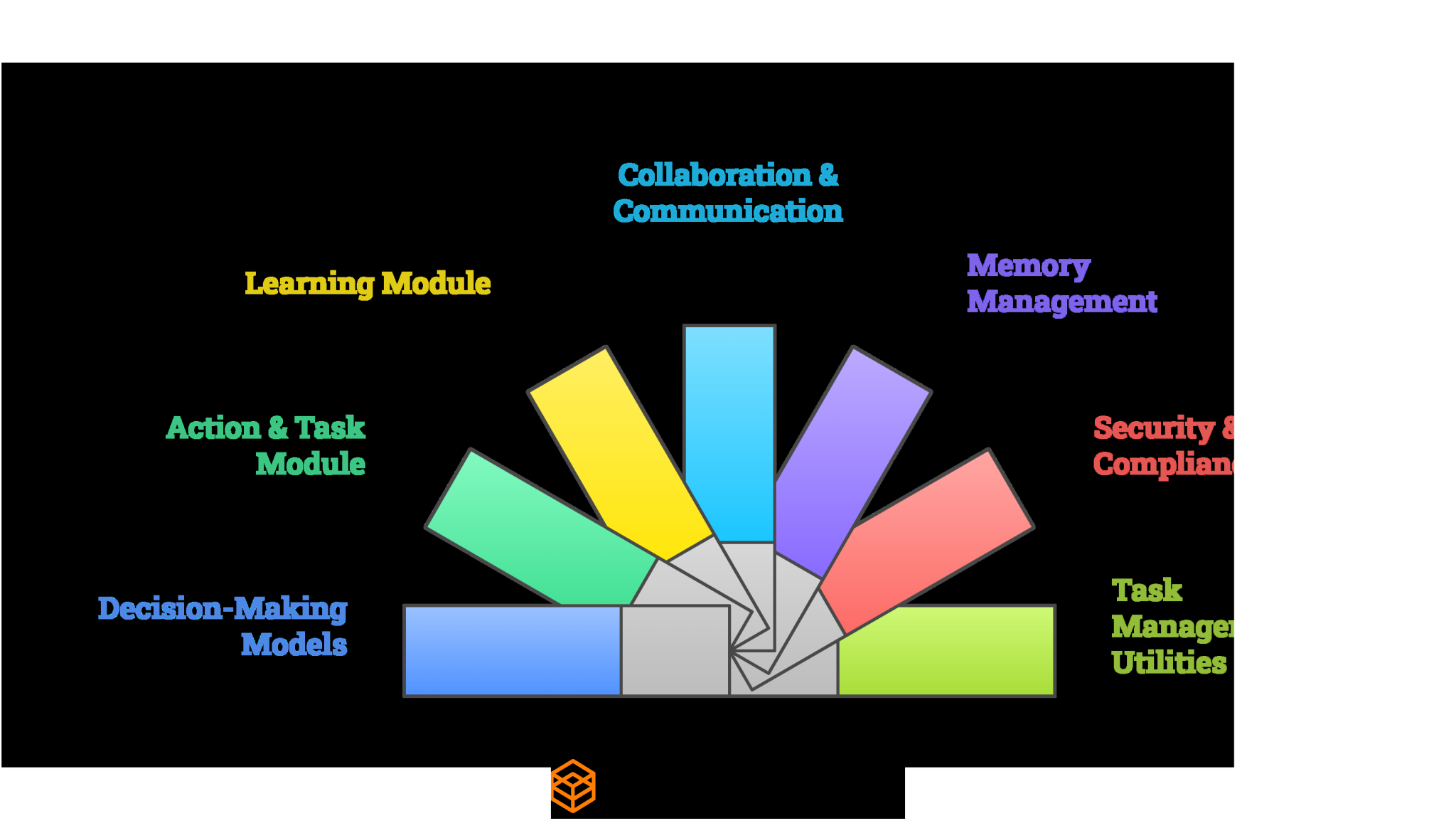
The best AI agent frameworks combine several advanced components to make agents smarter, more autonomous, and easier to integrate:
Model Context Protocol (MCP) and Framework Interoperability , What Changed in 2026
Until late 2024, choosing an AI agent framework felt like picking a walled garden. LangGraph agents could not easily call CrewAI’s tools. AutoGen integrations had to be rewritten for OpenAI Assistants. Every framework had its own connector contract, its own tool specification, its own memory layer. Switching cost was a real tax on teams.
The Model Context Protocol (MCP) , open-sourced by Anthropic in November 2024 and now supported natively across OpenAI, Google, Microsoft, and every major open-source agent framework , changed that. MCP standardises how an LLM-backed agent discovers tools, calls them, and consumes structured results. If your framework is MCP-aware, it can plug into any MCP server: Salesforce, HubSpot, SAP, Snowflake, GitHub, internal APIs, thousands of community-built connectors.
This changes the selection criteria in 2026 meaningfully:
- MCP-native frameworks are now the default safe choice for enterprise builds. OpenAI Agents SDK (launched March 2025), LangGraph, CrewAI, and AutoGen all ship MCP support. Frameworks without it are a deprecation risk.
- Vendor lock-in concerns dropped , because MCP lets you swap the underlying LLM (GPT-5, Claude Sonnet 4.6, Gemini 2.5, Llama 3.3) without rewriting your tool layer. Your framework + MCP server investment transfers.
- Integration time collapsed , teams using MCP-native patterns report 60-80% faster time-to-first-production-agent compared with 2024 custom-connector builds. Our AI integration services team has seen this across 20+ enterprise agent deployments in the last 12 months.
Practically speaking: if you are picking a framework today, MCP support is a hard requirement, not a nice-to-have. If you already have an agent running on a pre-MCP framework, plan a migration within the next 12 months. The cost of staying on a non-MCP stack compounds every quarter as the ecosystem standardises around the protocol.
For context on how this pairs with retrieval and vertical applications, see our RAG development services (grounding agents in your data) and generative AI development (the broader foundation-model layer).
Key Components of an AI Agent Framework” class=”wp-image-18905″/>1. Decision-Making Models
The AI agent learn by machine learning or using rules to make evaluations and decide the best actions. Higher-level agent models in the top AI agent frameworks may learn from their own experience and occasionally make their thinking clear.
2. Action & Task Module
Performs activities like automation of workflows, device control, or business integration as observed in the most recent AI agent framework of 2026.
3. Learning Module
Allows forgetting, learning, able to refine behavior and choices in response to feedback and historical information, which is critical in the more popular AI agent systems.
4. Collaborating & Communication Procedures
Make agents collaborate with other agents, other systems, or humans to facilitate multi-agent workflows and platform integration-important in open source agent frameworks as well.
5. Memory Management
Makes sure that agents have context: history and previous interactions with a user, so that they can have intelligent discussions and generate the same result every time.
6. Security & Compliance
Guards data protection and integrity in operations, particularly when integrated with the enterprise systems through AI agent development frameworks.
7. Task Management Utilities
The hands that plan, observe, and perform action steps which is vital both in an elementary and complicated architecture of a given AI agent.
Bonus Visit: AI Agents in Healthcare
Benefits of Using an AI Agent Framework
AI agent frameworks deliver transformative value for both technical and business teams. Here’s how the most popular AI agent frameworks in 2026 can upgrade your organization:
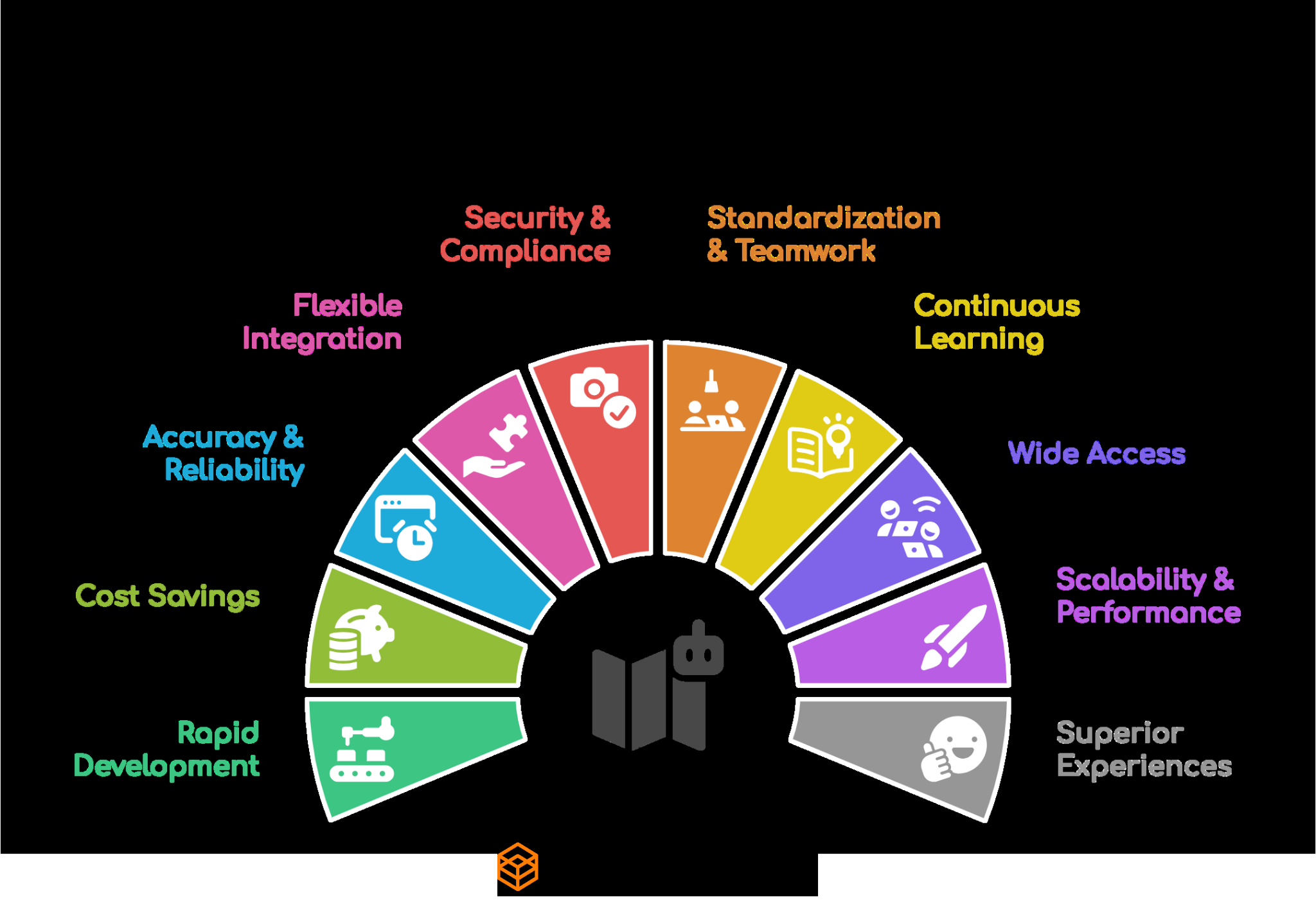
1. Rapid Development Cycles
Having ready-made modules, reusable components, and templates of workflow, you can save time-to-market and streamline the launch, which is one of the reasons why the top AI agent frameworks are preferred by high-performance teams.
2. Large Savings on Costs
Using a combination of general-purpose building blocks provided by existing open source AI agent frameworks, or high-value solutions, engineering effort is minimal, duplicate coding effort is eliminated, and the cost of both prototyping and deployment production is reduced.
3. Accuracy, Consistency & Reliability
Fine-grained logic, in-built memory, and auto-taught modules will generate agents that consistently produce business-accurate results, which are other essential advantages of any AI agent frameworks comparison, and are well explained in an AI agent development guide.
4. Flexible Incorporation with Programs
AI development frameworks are accompanied by strong API and third-party tool integration that enables its agents to readily integrate into existing CRMs, business systems, and data pipelines through the option of plug-and-play.
5. Increased Security & Compliance
In the case of regulated industries, systems provide security validation and verification channels, compliance-based applications, and access controls, providing you with a sense of security as you manage sensitive automation processes.
6. Standardization & Teamwork
Using the top AI agent frameworks ensures code is more maintainable, easier to document, and fosters better teamwork, making onboarding and collaboration smoother as your projects expand.
7. Continuous Learning & Optimization
Agents instrumented with self-learning and analytics are iteratively improved and adapted to changing uses. Learning with and by users, they internalize knowledge during use one reason why the best AI agent frameworks are relied upon in future-proof automation and why AI software development services increasingly focus on such adaptive capabilities.
8. Wide Open Access to All Teams
The current user/ programmer gap level is made up by low-code software and friendly interfaces, which are used by technical and non-technical users and democratize innovation, and allow any unit to roll out their process requirements with the help of AI agent frameworks.
9. Scalability & High Performance
The latest AI agent frameworks and AI agent development stacks will be able to scale up user traffic, access bigger scales of data, and coordinate more agent groups, and your automation can scale up without hitching with business demands.
10. Superior Customer & Employee Experiences
Automating repetitive or complex tasks with the most popular AI agent frameworks allows teams to focus on strategy while delivering fast, reliable service to customers.
By investing in the right AI agent frameworks, organizations ensure maximum efficiency, scalability, and innovation as smart automation reshapes the global digital landscape. Now learn how you can pick an AI agent framework.
Start your AI agent development journey with us today!
Conclusion
The implementation of AI agent systems is gaining momentum and becoming popular in the world very quickly due to their increased significance and effect in the industry. Statista’s recent data offered a portrayal that the worldwide AI agents market is estimated to be just about 7.38 billion dollars in the year 2025, and that the market is bound to expand at an incremental pace of 44.8% as CAGR and to attain nearly the overall summation of 47.1 billion dollars by the year 2030.
Besides, 88% of organizations are in the process of exploring or piloting AI agents nowadays, with 51% engaged in the research and 37% conducting trials in practical situations.
Secondly, executives predict that within ten years, in 2031, the general population will start using AI agents instead of ordinary sites or applications. Increasingly, companies are striving to move forward in terms of integration and modernization, and almost half of the organizations expect to achieve an upgrade of AI workflows within 3 years, which can become a trend in the industry.
These tendencies explain the importance of selecting the most appropriate AI agent frameworks in 2026 and the most prominent AI agent frameworks by enterprises that plan to remain on the edge. Appropriate AI developer platforms enable businesses to automate demanding work, enhance customer encounters, and attain scalable innovation in a safe, effective framework.
With the rise in the demand for intelligent, autonomous systems, the competitive edge in an AI-first world can only be achieved with investment in the top AI agent frameworks, which can become future-proof in 2026 onwards.
Choose The Best: ScalaCode
Leveraging Scalacode along with the most common AI agent libraries, organizations can decrease the amount of time to deploy their software, cut budget, and scale up intelligent automation with confidence.
Using the power of Scalacode, an AI agent development company, businesses can make the most of the quickly developing AI agents industry, not only investing in the best AI agent frameworks, but also unlocking disruptive possibilities.
ScalaCode, in combination with major frameworks, is paving the way to a new era of smart automation that will transform customer interaction, improve operational efficiency on a new level, and enable a new competitive edge.
Frequently Asked Questions
Accuracy and Relevance: To what degree does the agent learn, infer, and act accurately on inputs to the user, including context management between time interactions?
Task Completion Rate: the number of workflows or objectives with multiple chunks that the agent can accomplish without the aid of a human operator.
Response Time: Quickness and promptness in responding to the right response or in performing tasks.
User Satisfaction: Surveys, sentiment, or directly giving a rating by the users.
Adaptability: an agent will adhere to the lessons of interactions and become better through time.
Robustness: How the agent can manage any errors, input, or complicated situations with elegance.
Which AI agent frameworks support Model Context Protocol (MCP) in 2026?
As of early 2026 the major frameworks with native MCP support are OpenAI Agents SDK, LangGraph, CrewAI, AutoGen, Haystack 2.x, and Anthropic’s own agent SDK. Open-source frameworks like Semantic Kernel and DSPy added MCP adapters during 2025. If you are evaluating a framework that still does not support MCP, treat it as a deprecation risk , the ecosystem is standardising fast and non-MCP frameworks will fall behind on integration breadth, talent availability, and tooling.
How do I choose between OpenAI Agents SDK, LangGraph, and CrewAI for an enterprise build?
Short answer based on what we see in 2026 enterprise projects: OpenAI Agents SDK for teams going deep on the OpenAI stack (GPT-5, Assistants API, vision, voice) and wanting the lowest-overhead production path. LangGraph when you need explicit state-machine control, complex branching, or deterministic recovery from mid-workflow failures , best for compliance-heavy or operationally critical agents. CrewAI for multi-agent orchestration where a team of specialised sub-agents collaborates on a task , most natural mental model for business users designing workflows. Many serious 2026 builds use two of these: LangGraph for the core control flow, CrewAI or Agents SDK for the specialised sub-agent layer. The right choice depends on your team’s existing fluency and whether your workflow is more stateful or more collaborative. Our AI agent development services can benchmark frameworks against your specific use case.