
Have you ever thought about how sometimes companies seem to know precisely what you want before you even speak? The ‘strange’ ability of a company to be able to predict customer needs is primarily attributed to the powers of AI in CRM.
Powered by AI, predictive analytics unlocks any historical data that could possibly be applied to unlock patterns to inform action in the future. Organizations can access any customer information purchase histories to online behavior to come up with valuable insights about a customer’s preferences and trends.
This not only helps to craft personalized marketing strategies but also ensures that such strategies result in higher levels of engagement and retention.
This blog covers how AI is elevating predictive analytics for CRM systems, helping businesses with the level of decision-making that really matters.
The Rise of AI in CRM
The emergence of AI in CRM is of course a paradigm shift in the way businesses reach their customers. While initial CRM systems basically worked as databases for holding customer information for management and tracking purposes, with growing expectations from customers, businesses realized that they needed more dynamic solutions.
To that effect, they infused AI-related technologies to analyze what customers wanted and ideally were exhibiting. Today, Artificial Intelligence improves CRM systems by including predictive analytics.
This enables organizations to predict what they shall need and thus tailor their marketing strategies to meet their customers’ needs. It provides companies with the ability to have a relationship with the customer based on real-time data analyses, thereby enhancing the way customers are treated.
Therefore, improving customer satisfaction and loyalty. Machine learning and natural language processing have opened many scopes for handling inquiries, simplifying communication, and resolving problems effectively.
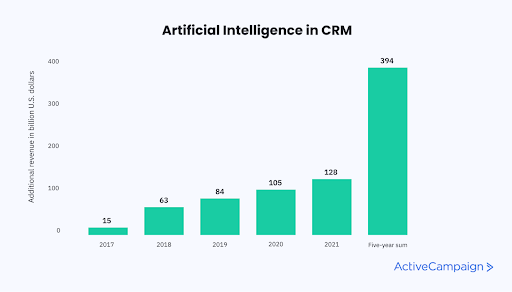
The enhanced adoption of AI in CRM will allow organizations in the U.S. to achieve around $394 billion in the next five years.
Chatbots and virtual assistants, for these purposes, can offer more meaningful and timely communications toward the demands of such an increasingly digital marketplace.
The concept of customer engagement optimization does not simply help businesses make effective decisions but also endows the organization with data-driven decision-making to spur growth and performance. And that’s why the demand for AI development services is increasing so much. Let’s have a look at the role of AI in customer experience.
The Role of AI in Customer Experience
It uses the data of multiple business arenas such as sales and marketing and develops personal experiences for the customer. Leadership requires an immense need to align with expectations and set immense goals towards AI adoption and encourages designers to work with AI and align the user for efficient usage of the same.
-
Customer Trust is the Foundation
Trust is a basis for the effective implementation of AI. Many business leaders have ethical concerns and issues with trust related to generative AI. CEOs must therefore lead the way: be empathetic, follow ethical practices, and be able to personalize their reach to customers to be in a better position to build trust.
-
Reinventing Employee Experience
Most executives believe generative AI will change or extend job roles while supplementing them. Instead, its value will be in automating complex tasks, making the human-machine partnership work effectively with both employees and needs.
Read more: Top AI Trends to Look in 2024
Benefits of AI in CRM
Here are some core advantages of Artificial Intelligence in CRM:
1. Reporting and Predictive Analytics
AI greatly enhances the capacity of an organization to analyze data. Machine learning algorithms help AI to dig deep into pieces of historical customer data with the purpose of discerning data patterns and trends.
In return, this makes it possible for businesses to predict sales more accurately and thus to be one step ahead of customer needs. For example, AI can predict seasonal buying patterns, hence enabling organizations to stock up on the same in plenty.
The second area is predictive analytics, in which it helps businesses understand which demographics to use for conversion, thus guiding proper marketing strategies. The integrated intelligence would lead toward a better representation of how customers are going to behave, maybe making all the difference in strategic decisions.
2. More Personalization
In terms of customer satisfaction and loyalty, personalization is the new buzz. AI looks at customer data-whatever they have purchased, whatever they’ve looked at, and their preferences-to deliver a customized experience.
For instance, online businesses can recommend additional products that a customer has bought in the past or browsed at least once. This customization will not only improve the way one engages with customers but also increase the conversion rate.
Additionally, AI makes the marketing communication personalized in a way that each piece of content sent to a customer is tailor-made to interest their activities and engagements on the platform, whether through email, social media channels, or in-app notifications.
3. Increased Automation
AI is complementary to automation, which increases operational efficiency. It pays off routine questions from customers, giving human agents lots of time to solve complex issues. AI-based platforms such as chatbots or virtual assistants provide an operation of 24/7, instant response, even instant support.
This impacts on the level of customer satisfaction because the wait times are reduced and the service provided is fast. Additionally, AI can take over mundane routine tasks such as data entry and routing tickets that save on processing time and minimize the error common with human limitations. AI frees up employees’ time for more strategic initiatives as it handles repetitive tasks. Overall productivity improves.
4. Focus on Sentiment Analysis
A vital area in the social media hub today is understanding customer sentiment, where customer loyalty is achieved by maintaining a good brand reputation. AI has tools that can perform text analysis from a customer review, social media posts, and surveys to gauge what’s in the public’s mind about a brand or product.
Real-time monitoring using this technology allows companies to address adverse comments quickly and proactively resolve complaints from customers. An organization can better tailor its products and services based on the patterns of common sentiments that do emerge. This fruitful sentiment analysis leads to successful retention of customers for a long period.
5. Enhanced Lead Scoring
This AI-based technology is helpful in refining the lead scoring process. It scrutinizes the demographic and behavioral information along with the level of engagement of the lead before taking a score. By applying such analysis, AI can rate leads with a probability of conversion and hence direct sales teams toward more valuable prospects.
Such a strategy would increase productivity by directing efforts toward valuable leads as well as make the feasibility of successful closure higher. In addition, AI can learn from past interactions and improve its scoring models over time to be more accurate and relevant.
6. Unstructured Data Management
The biggest problem with CRM is the manual handling of unstructured data. As most sources are digital in their sources, from social media to emails or even customer feedback, it arises from there. Technologies like NLP and ML help in organizing and analyzing these complicated data sources.
Therefore, AI enables businesses to know the needs and preferences of customers by extracting valuable insights from unstructured data. This feature allows the organization to access information that otherwise would lie unrevealed, thereby informed action and focused marketing strategies.
Learn More: AI in Education
Challenges of AI in CRM
Though AI in CRM has its merits, this application does come with certain challenges that are worth consideration.
-
Time and Cost
It is lengthy and costly to integrate AI with a CRM system. The right kind of setup can be quite resource-heavy in the beginning depending upon the scope of the organization and their specific needs.
Businesses need to invest accordingly in the right kind of technology, infrastructure, and training to implement it in the proper manner. Effective teamwork is required during this phase to cope with whatever issues arise in the initial periods. In addition, maintenance and update at regular intervals may also cost in terms of finance and human resources, and therefore, an organization has to budget in advance.
-
Cybersecurity Issues
At the same time, it is a bigger responsibility to address and safeguard the sensitive customer data where AI is increasingly being used. Companies, in this respect, not only must ensure compliance to data protection regulations but also follow best practices in protecting personal information.
Hefty financial and reputational damage will certainly be incurred when data breaches happen due to the lack of strong security safeguards. Organizations also have to be transparent to customers about how their data would be used and stored, especially so that trust and confidence in the CRM system could be achieved.
-
Maintain Equilibrium Between AI and Human Touch
Automation is now highly possible with AI that can really make things happen in an easy way and improves efficiency. So, this remains essential to keep the balance between automatic services and human touch.
Excess utilization of AI triggers the loss of personal touch and eventually gets eliminated since the majority of customers prefer getting hold of a human being during customer service. This must be accounted for that an organization should ensure that during demands, customers must have hold of human agents.
The mechanism is such that a company can remind customers that AI is to assist them instead of replacing human interactivity. In reminding them, companies would preserve a connection and trust with the customer, therefore adding up to greater customer satisfaction overall.
Examples of how AI can be applied in use cases related to CRM include but are not limited to the following applications:
Use-Cases of AI in CRM
AI can scan through gigantic volumes of customer data to provide actionable insights, automate repetitive tasks, and personalize the customer experience. Here are some use cases of AI in CRM:
1. Business Intelligence
AI tools can give organizations insight into all the departments across. For instance, the sales can provide historical analysis with trends to apply in future strategies while marketing can fine-tune the efforts done towards targeting through the analysis of behavior patterns of customers in real-time.
The customer service teams can use AI insights for better support through the knowledge and anticipation of what customers would need. In a nutshell, AI business intelligence enables a company to make informed data-driven decisions that drive growth.
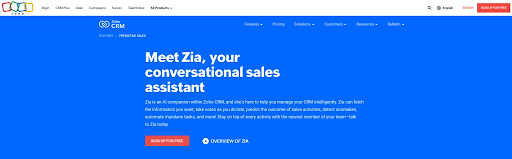
With the Zia AI CRM tool, Zoho users can get the information they’re searching for in their CRM faster. They can chat with or contact Zia to get the solutions they require however works best for them.
2. Customer Service
AI bots and virtual assistants increasingly dominate the customer service domain. The AI tools can provide solutions to recurring queries, solve problems, and provide useful information with absolutely no human interaction.
Business organizations can thus provide longer periods of extended 24/7 customer support, reducing the response time significantly. This will also present an opportunity for AI tools to escalate the complex issues to human agents if necessary, thereby ensuring that customers receive the right kind of support.
3. Data Management
AI plays a very critical role in keeping clean and accurate customer data. That is to say that through the process of auto-filling, cleaning, and enriching data, AI provides organizations with the premises for doing all aspects of CRM work. Accuracy about data has an effect on performance when it comes to marketing, sales forecasting, and customer engagement-all impacting its performances.
4. Efficiency of IT
In CRM, AI can automatically carry out most IT routine work, for example, ticket routing, system diagnostics, and data backups. This way, even at the IT department level, it streamlines processes that unlock more strategic effort on the part of IT departments-a step towards the whole organization achieving higher efficiency. Moreover, AI can quickly and most systematically identify and try to fix such problems in the most stable environments of IT systems.
5. Marketing Personalization
Their personalization efforts towards customers are strongly debated in the favor of AI-powered CRM. With AI, one can take full advantage of customer data to examine their segmentation and tailor individualized marketing messages according to personal preferences and behavior. The campaigns get more relevance with high engagement and conversion rate. A/B testing and adjustment of marketing strategies in real-time, based on customer responses, are possible through AI.
6. Lead Management
The automation of qualification and scoring enhances lead management because AI algorithms make assessments about characteristics and behaviors of leads in order to try to isolate those who are most likely to convert. Modern sales CRM software also helps businesses automate pipeline tracking, lead nurturing, and follow-up activities more efficiently. It enables sales teams to spread efforts in the right directions. These processes improve response times while increasing the chances for successful conversions.
7. Predictive Customer Analytics
Customer behavior prediction capabilities also exist for AI, wherein a business will foresee customer needs, preference, and behavior based on historical data information. Organizations will, in turn, better design their offerings and adopt marketing strategies to meet those needs based on predetermined levels of potential demand, thereby improving the customer’s satisfaction level.
For example, a tool called Salesforce-Einstein GPT creates AI-generated emails, provides data insights, delivers predictions and suggestions for sales reps, and routes customer service requests based on tone.

8. Optimization of a Process
It may be possible for AI to determine the areas of a business process that require optimization through analysis of its workflows and performance metrics. As bottlenecks and areas of room for improvement are identified, therefore, the organizations will be able to streamline their operations and consequently increase overall productivity. Optimization not only improves internal processes but also goes on to help improve the customer experience.
9. Sales Optimization
AI technology can reshape the sales scenario by predicting patterns and automatically executing workflow. The analysis of past sales interaction data and customer behavior may help AI unveil high-value prospecting and the next best steps to advise a sales team. This targeting strategy further strengthens the sales approach, thereby making chances for better conversion and greater revenue.
Future of AI in CRM
The hyper-personalized demand of customer experience will continue to expand, therefore making AI in CRM even more important as the need for further advancement into unimaginable levels of personalization in marketing and customer service through generative AI set a new standard for the expectations of customers.
Further accelerations in technologies bring about more innovative AI tools for the industry, voice recognition and augmented reality among others, that shall bring a significant difference in changing the game for delivering the customer experience.
If companies have the ability to adjust to these changes and incorporate AI into their CRM strategy, they would prove to be relevant in this fast-changing marketplace. Using AI may allow organizations to enhance customer engagement, improve the efficiency with which they operate, and consequently drive business growth.
Explore More: AI in Software Development
How ScalaCode Can Help You in AI Enable CRM Development?
ScalaCode is a trusted generative AI development company in India with over 10 years of experience in developing cutting-edge solutions. We have expertise in the latest technologies like AI, Machine Learning, Predictive Analytics, and more.
Our team consists of the certified app developers who can work on your project from the beginning till the end. With several projects delivered on time, we’re known for a trusted CRM development company in India.
Parting Thoughts
AI in CRM revolutionizes how businesses interact with their customers, providing tools and insights that enable more informed decision-making and personalized experiences. By harnessing the power of predictive analytics, organizations can anticipate customer needs and preferences, ultimately leading to enhanced satisfaction and loyalty.
Embracing AI in CRM not only enhances operational efficiency but also sets a new standard for delivering exceptional customer experiences in a rapidly evolving market. However, always rely on a trusted app development partner for a successful AI solution. It’s recommended to hire app developers in India for the best deals. Contact us today for more information.
FAQs
Q1. Can AI in CRM help improve customer retention strategy?
Yes, AI can add to retention strategies by predicting customer churn enabling personalized outreach toward issues, and improving satisfaction levels.
Q2. How does machine learning fit in with CRM analytics?
Through historical data tracking, machine learning algorithms identify patterns and trends, hence enabling business decisions that improve their CRM strategizing.
Q3. How does AI support real-time customer insights?
It processes real-time data in huge quantities. This enables businesses to be responsive to the needs of the customers and preferences of people for boosting service quality.
Also Visit: Top Software Development Companies