

A mobile app is an integral part of business, as it boosts engagement, strengthens customer loyalty, and drives higher conversions. However, in this fast-paced world, these factors are not enough to grow your business. This is because today’s customers want a personalized experience and advanced functionalities like voice recognition & augmented reality.
Here, the role of artificial intelligence starts: AI in mobile app development delivers a personalized experience, robust security, and seamless performance. According to a report by Grand View Research, the global mobile artificial intelligence market size is projected to reach USD 84.97 billion by 2030, growing at a CAGR of 28.9% from 2025 to 2030.

This huge growth percentage shows that AI in app development not only provides personalized user experiences by analyzing behavior and preferences but also helps you in increasing engagement and retention rate.
Other than this, there are numerous benefits of integrating artificial intelligence into business applications that we are going to discuss in this guide. Moreover, we also talk about more notable points like real-world use cases, industry-specific use cases, cost estimation for an AI-powered mobile app, and a lot more.
What is The Role of AI in Mobile App Development?
Artificial intelligence in mobile app development brings innovation and creativity to the app by using its subsets, like machine learning, natural language processing, computer vision, etc. In addition to that, AI-based decision-making models in mobile will help you make data-driven decisions for your business.
Moreover, the AI features, like personalization, voice assistants, chatbots, smart cameras, predictive analytics, biometric security, and real-time translation in a mobile app, will help you grow your business exponentially.
Why Use AI in Mobile Apps?
Now you must be wondering what the specific advantages are that convince you to integrate AI in mobile app development. From automating repetitive tasks to boosting user engagement, there are various benefits of integrating AI into your business app that we are going to discuss in this section.

1. Customized User Experiences
AI in mobile apps uses machine learning to study the behavioral habits, preferences, likes, and dislikes of the user in real time. As a result, it provides personalized product recommendations and makes the user journeys smoother.
2. Enhanced Decision-Making Capabilities
Artificial intelligence app development helps in making smarter decisions by using machine learning, deep learning, natural language processing (NLP), and large language models (LLMs). Moreover, these subfields of artificial intelligence can help you detect trends, forecast user needs, and optimize strategies.
3. Automation of Repetitive Tasks
Artificial intelligence for app development can help you automate repetitive tasks by using robotic process automation. With this, one can complete regular time-consuming tasks like sorting data, sending notifications, and responding to simple customer questions in minimal time. Ultimately, AI in mobile apps enhances operational efficiency and reduces reliance on manual efforts.
4. Enhanced App Security and Fraud Detection
An AI system enhances app security and helps you in early fraud detection by analyzing user behavior, transactions, and device data. This includes using behavioral biometrics to spot suspicious patterns, analyzing transactions for anomalies, and using adaptive authentication for extra verification.
5. Boost in User Engagement and Retention
AI boosts user engagement and retention by creating highly personalized and intuitive experiences. Through hyper-personalized content feeds that curate relevant articles, products, and videos based on user interactions, all these activities make the app more valuable and engaging.
Start Your AI App Journey Today | Smarter Apps. Stronger Impact.
Top Use Cases of AI in Mobile App Development
Let’s look at use cases of combining AI and mobile apps to boost productivity, retention, and ROI.
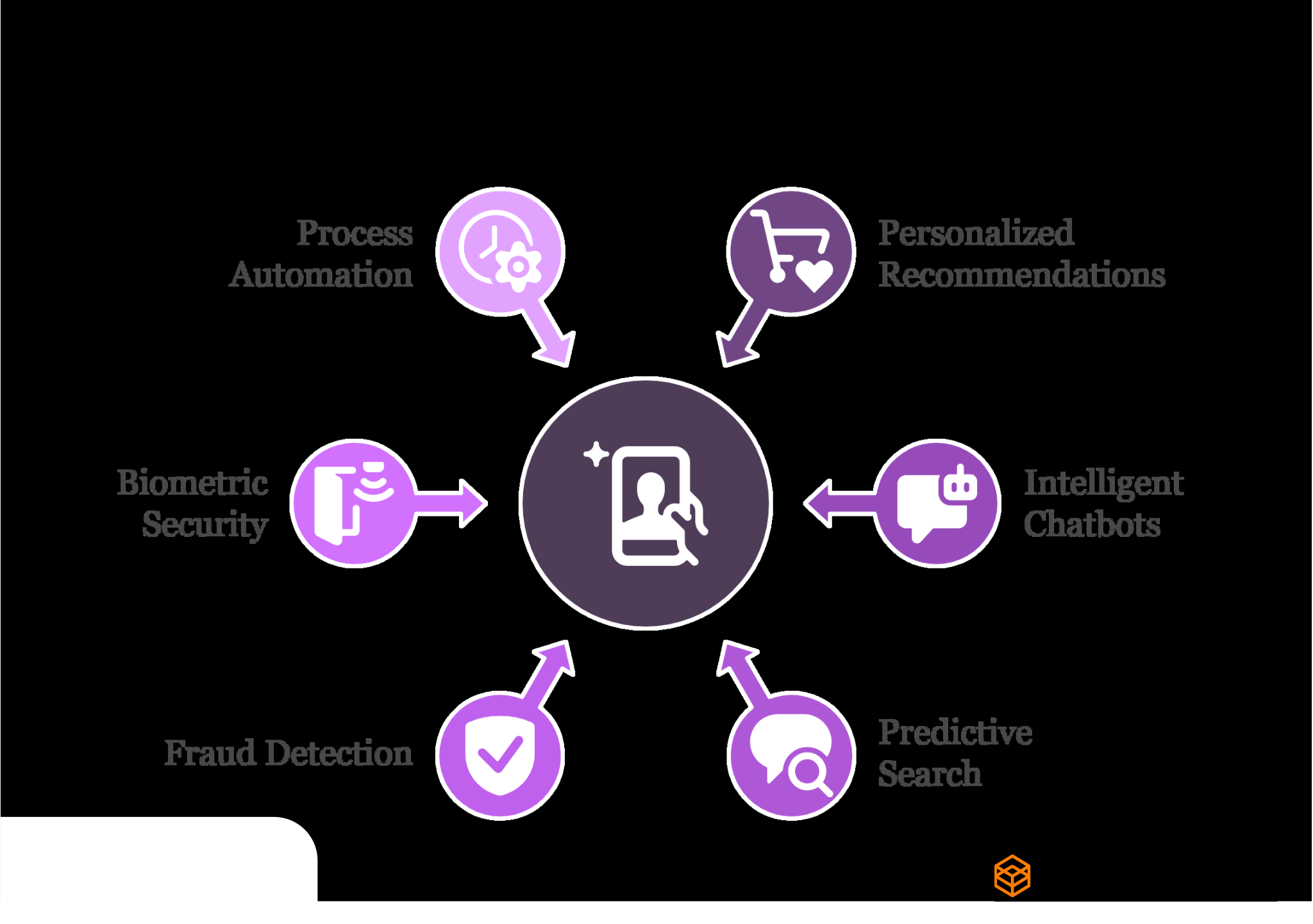
1. Personalized Recommendations
An AI-powered mobile app always keeps an eye on users’ behavior, preferences, and the history of their actions to provide the most relevant solution. Shopify can be an excellent example of an AI-powered app that provides a personalized solution to its users.
2. Intelligent Chatbots
Artificial intelligence in mobile applications uses Natural Language Processing (NLP) that allows AI-enabled chatbots and digital assistants to answer queries in minimal time. For example, Duolingo and Banking apps use AI-powered chatbots to stay connected with their clients 24×7.
3. Digital Voice Assistants
AI in mobile apps offers the facility of digital voice assistant services, where you can use the app without typing or clicking around the application. Google Assistant, Apple’s Siri, and Amazon’s Alexa are some of the top-notch real-life examples of digital assistants.
4. Fraud Detection & Threat Monitoring
AI can find unusual patterns in real-time to identify fraud, mitigate chargebacks, and notify users of questionable activity. This plays a key role in financial and transaction-intensive applications by enhancing security and reducing financial risk.
5. Process Automation
AI in app development helps you automate your regular tasks with AI-powered process automation. This will not only help you in streamlining the workflow, but it will also provide you with extra time to improve productivity.
Technologies Powering AI Mobile App Development
AI in app development is driven by a robust ecosystem of tools, frameworks, and APIs that enable developers to embed intelligence into mobile applications. Below are the key technologies powering today’s most innovative AI-driven apps.
#1. Machine Learning
Machine learning is one of the primary subsets of artificial intelligence technologies that helps in enabling applications to forecast outputs based on collected data. As a result, this technology in mobile applications offers increased user engagement, better retention, and a more adaptive app experience.
#2. Natural Language Processing
AI-based mobile apps leverage NLP (natural language processing) technology that helps applications to understand human language both in text and audio form. Integrating NLP into business apps is beneficial for various purposes, like customer service, product search, and shopping etc.
#3. Generative AI
There are multiple real-world Generative AI use cases and applications that show that generative AI in mobile apps enhances creativity and innovation to deliver fast and fresh. In addition to that, it also helps in automating tasks like content creation, coding, and customer service through intelligent virtual agents etc.
#4. Computer Vision
Computer vision technology in business applications allows apps to interpret and process visual information from images and videos, supporting functionalities like facial recognition, object detection, augmented reality, and visual search. As a result, it improves user interaction with the business.
Industry Applications: How Startups & Enterprises Use AI in Mobile Apps
AI in mobile app development is driving innovation, transforming user experience, and enhancing business impact across industries. Here’s a data-driven overview supported by key metrics and artificial intelligence app examples that helps you understand how AI is crucial nowadays in every industry.
1. Healthcare: AI for Symptom Checkers and Virtual Diagnostics
- According to a report by Deloitte, more than half of respondents (53%) believe generative AI in healthcare could improve access to healthcare, and 46% said it had the potential to make healthcare more affordable.
- Example: Babylon Health offers an AI-powered chatbot for initial symptom checking and virtual consultations.
2. Retail & eCommerce: Product Recommendations and Visual Search
- According to a report by MarketsandMarkets, AI in eCommerce and retail was valued at approximately $31.12 billion in 2024 and is projected to reach $164.74 billion by 2030.

- Example: Amazon uses an AI-driven recommendation engine to boost sales and customer engagement by providing personalized suggestions.
3. Finance: AI-Based Chatbots and Fraud Alerts
- According to a report by MarketsandMarkets, the AI in finance market is expected to grow from USD 38.36 billion in 2024 to USD 190.33 billion by 2030, at a CAGR of 30.6%.

- Example: JPMorgan Chase uses AI chatbots to handle around 200 million customer requests annually.
4. Travel & Hospitality: AI Concierges and Route Planning
- According to a report by Grand View Research, the AI in hospitality and tourism market size was estimated at USD 3,373.0 million in 2024 and is projected to reach USD 13,868.8 million by 2030, growing at a CAGR of 26.7% from 2025 to 2030.

- Example: Hilton Hotels uses AI concierge chatbots to manage over 1 million guest inquiries yearly.
5. EdTech: Adaptive Learning Apps
- According to a report by Grand View Research, the global AI in education market was valued at USD 5.88 billion in 2024 and is projected to reach USD 32.27 billion by 2030, growing at a CAGR of 31.2% from 2025 to 2030.

- Example: Duolingo’s AI-adaptive learning platform personalizes language education for over 500 million users worldwide.
To learn more about this, you can also check out our blog on: AI in Education: Revolutionizing the EdTech Industry.
Talk to Our Experts Today | Build Smarter. Scale Faster.
How to Implement AI in Your Mobile App: A Step-by-Step Guide
Integrating artificial intelligence in mobile apps is not an easy task; it needs experience and expertise. Here in this section, we will discuss the 5 easy steps to integrate AI into your app, but for outcome-focused incorporation, you should hire mobile app developers.

Step 1: Set a Clear Objective
In the first step, you need to define a clear objective to align business goals and user needs. A clear objective will also help you select the desired feature for your application, like personalization, automation, prediction, etc.
Step 2: Choose the Right AI Model
While choosing the right AI model, you can hire mobile app developers; they will guide you on whether you need to choose pre-trained models (e.g., OpenAI GPT, TensorFlow Hub) or custom models with frameworks like PyTorch Mobile. This is important, as the AI model selection must match your business goals.
Step 3: Feed Clean & Relevant Data
AI-based models thrive on clean and quality data; therefore, you must ensure that all the data that you collect to train your AI-based mobile app is of high quality. This will ultimately improve accuracy, help you build data-driven decisions, and reduce bias.
Step 4: Pick The Right Tech Stack
You should choose AI-friendly frameworks like TensorFlow Lite for on-device ML, Core ML for iOS, or cloud-based services like AWS AI, Google AI, and Azure Cognitive Services for scalable AI APIs. Selecting the correct tech stack will determine how effectively AI is integrated into your business application.
Step 5: Test & Optimize
Testing is one of the crucial parts of any app development process, as at this stage, you may find the possible bugs that you can fix early. After making the app live in the real world, you should monitor the app’s performance and optimize the app based on real-time feedback.
Bonus Visit: Top AI App Ideas
Challenges in AI Mobile App Development
While doing artificial intelligence application development, there are some challenges that AI developers can face. Here in this section, we have listed all the possible challenges that developers can face with solutions.

1. Data Privacy & Regulatory Compliance
Challenge: AI in mobile apps uses sensitive data like location, health metrics, and behavior patterns to perform.
Solution: To ensure data security and regulatory compliance, implement on-device processing with TensorFlow Lite/Core ML, end-to-end encryption, federated learning, and tools like AWS Macie or Google Cloud DLP.
2. High Development Costs and Complexity
Challenge: AI integration demands substantial investment for specialized data preparation, custom training, and expert developers. All these factors increase cost by 2-3x compared to standard apps.
Solution: You can utilize pre-trained models to cut down costs.
3. Shortage of AI Talent
Challenge: There’s a growing demand for AI specialists, but a limited supply of experienced engineers. This talent gap slows development and impacts quality.
Solution: Partnering with experienced teams, like ScalaCode, where you can hire AI developers, can help fill this gap quickly and efficiently.
4. Real-Time Performance Constraints
Challenge: AI capabilities, such as real-time suggestions, facial recognition, and voice-based computations, require a rapid process that may slow down app loading time.
Solution: To boost the AI-powered app performance, you can use model quantization and TensorFlow Lite/Core ML for on-device inference.
5. Testing & Iteration is More Complex
Challenge: AI produces non-deterministic outputs, model drift, and device-specific issues that break traditional pass/fail testing.
Solution: You can implement metamorphic testing, self-healing scripts (testRigor), and continuous model monitoring.
Explore More: Top AI Development Companies
Cost Estimation for AI-Powered Mobile App Development
After knowing the multiple business benefits of integrating AI in mobile app development, you may want to know the cost of integration. If yes, then this section belongs to you. Our experts deep dive into the market to curate a cost table that will give you an estimated.
Cost by Development Phase
| Phase | Key Activities | Cost Range (USD) | % of Total Budget |
| Planning & Requirements | Use case validation, tech stack selection | $5,000-$15,000 | 5-10% |
| Data Collection & Preparation | Gathering, cleaning, and labeling datasets | $10,000-$50,000 | 15-25% |
| Model Development & Training | Model selection, training, tuning | $20,000-$100,000+ | 30-40% |
| Integration & App Development | Backend/frontend coding, API integration | $15,000-$80,000 | 20-30% |
| Testing & QA | Functional, performance, model validation | $5,000-$20,000 | 5-10% |
| Deployment & Maintenance | Cloud setup, monitoring, updates (annual) | $10,000-$50,000/year | 15-25% |
Cost by App Complexity
| Complexity | Features | Estimated Total Cost (USD) |
| Basic | 1-2 AI features (e.g., API-based chatbot, image recognition) | $20,000-$50,000 |
| Medium | Custom models, personalization, predictive analytics | $60,000-$150,000 |
| Advanced | Generative AI, computer vision, and real-time processing | $200,000-$500,000+ |
Cost by Developer Region (Hourly Rates)
| Region | Hourly Rate (USD) | Basic AI App | Complex AI App |
| North America | $80-$200+ | $60k-$150k | $200k-$1M+ |
| Eastern Europe | $40-$90 | $25k-$80k | $100k-$400k |
| Asia-Pacific | $20-$60 | $15k-$50k | $70k-$250k |
What Influences AI App Development Cost?
Here are the key cost-driving factors:
1. Type of AI Feature: Basic chatbot vs. real-time image recognition, costs vary significantly based on feature complexity.
2. Custom vs. Pre-Trained Models: Building your own AI model is expensive and time-consuming. Pre-trained models from Google or AWS can cut costs.
3. Data Preparation & Training: Gathering, cleaning, and labeling large volumes of data adds to both time and budget.
4. Development Time & Team Size: A larger or more specialized team (e.g., data scientists, AI engineers) will increase labor costs.
5. Infrastructure: Real-time AI features may require powerful cloud infrastructure or edge computing solutions, which influence recurring costs.
Considering the integration of AI into your HR processes? It’s important to understand the associated costs. Our AI app development cost guide breaks down everything you need to know.
Get a transparent AI App Development Cost Estimation tailored to your project, no surprises, just smart planning.
Conclusion
The idea of using AI in mobile app development is no longer a distant vision of the future; it is a current benefit that can help startups and businesses develop even more intelligent, faster, and more personalized online experiences.
Artificial intelligence in mobile apps empowers apps to do multiple things, like automate tasks, offer personalized experiences to your customers, enhance security, improve performance, and much more. If you want to unleash the power of AI in your business, connect with a reliable AI Development Company, like ScalaCode.
How ScalaCode Transforms Your Mobile Apps with Cutting-Edge AI
ScalaCode is an outcome-focused Generative AI development company. Till now, we have delivered numerous AI solutions. We have 150+ developers who work on your project. Not only this, but we also provide after-launch support services.
Other than that, we provide top mobile app development services. And there are multiple benefits of choosing ScalaCode as your AI development partner:
- End-to-end AI integration
- Custom AI models for your business needs
- Robust, future-proof architecture
- AI-driven user experience optimization
- Faster time-to-market with pre-built AI accelerators
- Dedicated AI & mobile engineering teams
Frequently Asked Questions
Q1. What are the benefits of using AI in mobile app development?
There are multiple benefits of integrating AI in mobile app development; some major ones are given below:
-Automate repetitive tasks and reduce operational costs
-Enable smarter search, recommendations, and navigation
-Enhance app security through biometric and behavioral insights
-Improve app performance with data-driven optimization
Q2. How long does it take to develop an AI-powered mobile app?
The development timeline varies based on the project scope:
-MVP with basic AI (chatbot, recommendation): 6 to 10 weeks
-Mid-level app with predictive analytics: 10 to 16 weeks
-Advanced AI app with custom models: 4 to 6 months
Q3. What AI technologies does ScalaCode use in mobile apps?
We at ScalaCode work with a wide range of tools and platforms:
-Machine learning: TensorFlow Lite, PyTorch, Core ML
-NLP: OpenAI (ChatGPT), Dialogflow, Rasa
-Image/voice: Google ML Kit, AWS Rekognition, Azure Vision
-Generative AI for personalized content and conversational UX
Q4. How much does it cost to build an AI-powered app with ScalaCode?
Costs depend on complexity and features:
-Basic AI integration: $10K-$25K
-Mid-level AI (NLP, predictions): $30K-$60K
-Advanced AI + custom ML models: $80K-$150K+
Q5. How to ensure data privacy and security in AI apps?
Developers can use strong encryption, secure APIs, and strict access controls to ensure data privacy in AI-powered applications. Additionally, they can implement privacy by design, anonymize sensitive data, and follow regulations like GDPR or HIPAA.