Agentic RAG vs Standard RAG: When to Upgrade
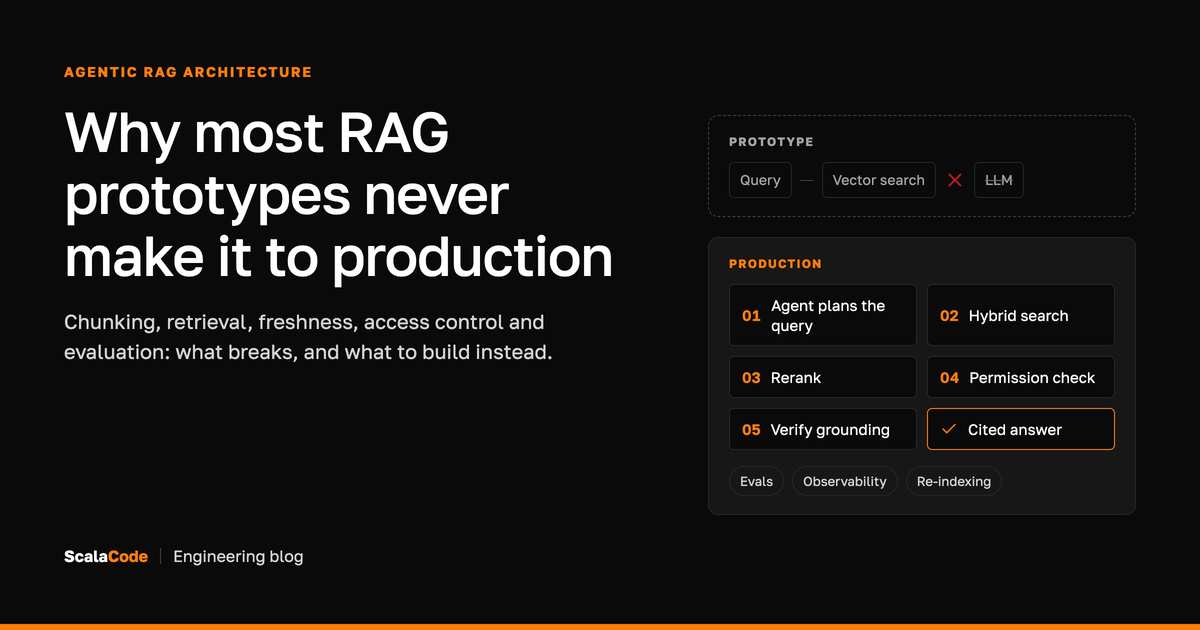
If your production RAG system retrieves documents and answers straightforward questions reliably replacing it with agentic RAG may create more problems than

Introduction
If your production RAG system retrieves documents and answers straightforward questions reliably replacing it with agentic RAG may create more problems than it solves. The decision changes when users ask questions that require searches, information from disconnected systems or evidence verification before an answer can be trusted.
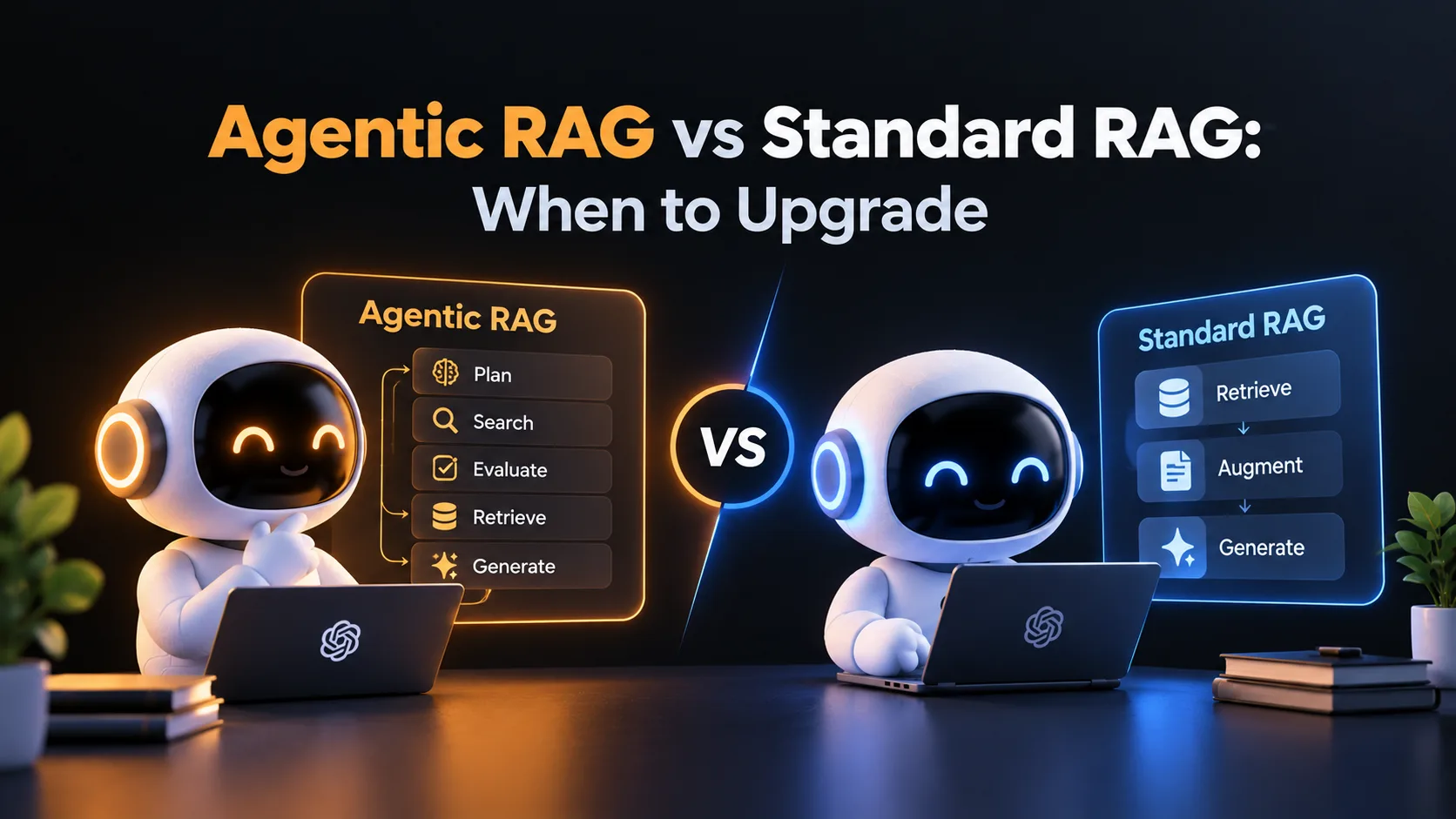
The difference between agentic RAG vs traditional RAG is not simply model intelligence. It is control over the retrieval process. Traditional RAG follows a predefined pipeline while agentic RAG can plan searches, inspect results and retrieve additional evidence when needed. For engineering teams the real question is whether that flexibility improves production outcomes to justify its cost.
What is the Difference Between Agentic RAG and Traditional RAG?
Traditional RAG uses a sequence: retrieve relevant content, add it to the model’s context and generate an answer. On the other hand , an Agentic RAG introduces a decision‑making loop in which an agent can select retrieval tools, break down complex questions, evaluate evidence and repeat retrieval within defined limits.
| Major Factors | Traditional RAG | Agentic RAG |
|
Usually a predefined search step | Dynamic, potentially iterative retrieval |
|
Best for direct, single-step questions | Better suited to multi-step investigations |
|
Often a fixed retrieval path | Can coordinate multiple indexes and tools |
|
Generally more predictable | Higher and more variable |
|
Simpler to monitor and maintain | Requires orchestration, tracing and guardrails |
Microsoft’s architecture guidance describes this distinction in terms of fixed retrieval workflows versus agents that invoke retrieval tools as needed. The important qualification is that agentic RAG does not automatically produce better answers; its advantage depends on the task and implementation.
Is Traditional RAG Always Necessary?
Keep RAG when the majority of production queries can be answered from a single well‑targeted retrieval step. Common examples include internal documentation search, product FAQs, employee policy questions and customer support responses based on established knowledge bases.
Before introducing an agent, investigate the failure mode. Poor chunking, embeddings missing metadata filters, stale documents or inadequate reranking can all undermine a conventional RAG pipeline. An agent cannot reliably compensate for incorrect source data.
Improve the existing system first when failures are primarily caused by retrieval quality, document processing or answer‑generation prompts. Better hybrid search, query rewriting, reranking and citation checks may deliver the required improvement with architectural overhead.
When to Use Agentic RAG?
Agentic RAG becomes worth evaluating when the task requires decisions about what to retrieve rather than simply generating an answer from the first set of results.
- Multi‑hop Questions: Answering requires combining facts from documents, where one finding determines the next search.
- Cross‑system Investigations: The system must consult indexes, databases or approved business tools to assemble a complete response.
- Ambiguous Requests: The agent must clarify intent, reformulate a query or select the appropriate knowledge source.
- Evidence Verification: The system must detect gaps in retrieved evidence and perform another search before responding.
- Workflow‑oriented Research: The task involves gathering information comparing results and producing a recommendation with traceable sources.
The following are the Agentic RAG Benefits: Adaptive retrieval, more flexible source selection and the ability to investigate incomplete evidence. They are benefits, not guarantees; each needs to be demonstrated against representative production queries.
Standard RAG Limitations and Agentic RAG Cost Overhead
Standard RAG can struggle when a single retrieval pass misses a document or when the answer depends on relationships across multiple sources. Its fixed workflow may not recover unless additional query expansion, routing or retry logic has been explicitly implemented.
Agentic RAG addresses some of these limitations but introduces other failure modes. Additional model calls and retrieval operations increase latency and token consumption. Tool selection can be incorrect, repeated searches can return redundant evidence, and errors in an intermediate step can propagate into the final answer. More orchestration also means more complex logging, testing, access control, and incident investigation.
There is no universal cost multiplier for agentic RAG. The overhead depends on the model, retrieval infrastructure, number of iterations, context size, and proportion of queries requiring deeper investigation. Measure actual cost per successfully resolved query not just the price of an individual model call.
How to Upgrade from RAG to Agentic RAG?
A controlled migration is safer than replacing a working architecture outright.
1. Build a Failure Dataset
Collect production queries where answers are incomplete, unsupported or unsuccessful. Categorize retrieval misses separately from generation errors.
2. Establish a Baseline
I will measure answer correctness, retrieval quality, citation support, p95 latency, cost per query and abstention quality.
3. Prototype a Bounded Agent
Expose retrieval as a tool and allow targeted query decomposition, retries, or source selection. Set explicit limits on tool calls, runtime, and token usage.
4. Evaluate Against the Same Queries
Compare traditional and agentic pipelines using identical test cases and human-reviewed outcomes. Include straightforward questions to detect unnecessary agent use.
5. Roll Out Selectively
Route only suitable requests to the agentic path. Monitor failure rates, latency, spend, and user feedback, with a fallback to the established pipeline.
Wrapping Up
To conclude, Traditional RAG remains a choice for predictable questions, with clear evidence. I think Agentic RAG is worth the complexity when production workloads require multi‑step retrieval dynamic tool use or evidence‑driven retries that measurably improve outcomes. I think for mature systems a hybrid architecture is the sensible starting point: keep standard RAG for routine queries and invoke agentic retrieval only when query complexity or retrieval confidence justifies it.
Frequently Asked Questions
Q1. What is the main difference between agentic RAG and traditional RAG?
Traditional RAG generally follows a predefined retrieval-and-generation pipeline. Agentic RAG can plan searches, select tools, evaluate intermediate results, and perform additional retrieval when necessary. This flexibility is most useful for questions that require multiple steps or sources.
Q2. When should you upgrade from standard RAG to agentic RAG?
Consider upgrading when production queries regularly require multi-hop reasoning, dynamic source selection, cross-system investigation, or evidence-driven retries. First rule out problems caused by poor indexing, chunking, embeddings, reranking, or incomplete source data.
Q3. Is agentic RAG more accurate than traditional RAG?
Not necessarily. Agentic RAG can improve performance on complex questions by gathering additional evidence, but it can also select the wrong tool, retrieve irrelevant information, or propagate intermediate errors. Compare both approaches on representative production queries before choosing.
Q4. How much more does an agentic RAG cost?
There is no fixed cost multiplier. Expenses depend on model pricing, the number of reasoning and retrieval calls, context size, and infrastructure. Measure total cost per successfully resolved query alongside latency and answer quality rather than comparing model prices alone.
Q5. Does agentic RAG increase response latency?
It often does because additional reasoning steps and tool calls require more processing and network round trips. The impact depends on the workflow. Set latency budgets, limit unnecessary iterations, and route straightforward queries through the faster standard RAG pipeline.
Q6. Can standard RAG handle multi-hop questions?
It can, particularly when query decomposition, multiple retrieval steps, or deterministic workflows are built into the system. Agentic RAG is useful when the next retrieval step depends on what the system discovers, rather than following a fixed sequence.
Q7. Can you combine traditional RAG and agentic RAG?
Yes. A hybrid architecture can use standard RAG for routine requests and route complex or low-confidence queries to an agentic workflow. This allows teams to control costs while reserving iterative retrieval for cases where it provides measurable value.
Q8. How do you measure whether an agentic RAG upgrade is successful?
Compare both systems on the same evaluation set. Measure answer correctness, retrieval completeness, citation support, p95 latency, cost per resolved query, and failure rates. Define acceptance thresholds before testing and validate results against human-reviewed examples.
Q9. How can you upgrade an existing RAG system without rebuilding it?
Start by analyzing production failures, improving retrieval quality where necessary, and exposing existing search capabilities as controlled tools. Prototype a bounded agent, compare its results with the current pipeline, and deploy it selectively with monitoring, access controls, and fallback behavior.
Q10. Is agentic RAG suitable for every enterprise application?
No. Applications with predictable questions, a single reliable knowledge source, and strict latency or cost requirements may be better served by standard RAG. Agentic RAG is most appropriate when the complexity of the workload justifies the additional orchestration.
Smita
Customer Delight, ScalaCode
Smita heads the Customer Delight unit at ScalaCode and looks after client relationships while projects are under way. She studied computer science and has worked in technology and customer service for more than ten years. Her articles draw on that mix of technical and client-facing work.
Talk through your project with ScalaCode
- 30 minutes with the ScalaCode team
- What is realistic, what it costs and how long it takes
- You decide afterwards whether to build with us