
Legacy software modernization while the business keeps running
ScalaCode moves ageing systems to the web, Android and the cloud one module at a time, while your team keeps using the old one. Recent work includes replacing a DOS stock terminal for RMEPOS stores and moving SHG Group's hospital storeroom handhelds from Windows to Android.


500+ projects shipped since 2012
ISO 9001:2015 certified, Clutch 4.8/5
clients across 45+ countries
Trusted by teams at







Clutch 4.8/533 verified client reviews
GoodFirmsReviewed software partner
ISO 9001:2015Certified delivery process
GDPR compliantData handled under EU rules
What legacy software modernization covers
Most of the risk sits in moving people and data off a system they use every day.
- What is legacy software modernization?
- Legacy software modernization is the process of moving an ageing application to a supported stack, platform or hosting model while preserving the business rules and data it holds. It ranges from rehosting on the cloud to replacing the system module by module or rewriting it, and it includes data migration, integration with current systems and user training.
Related: enterprise software development, cloud and DevOps and API development.
Four reasons legacy projects go wrong
Each one is planned out before the first module moves.
Everything was rewritten before anyone used it
A big-bang rewrite puts all the risk on one launch date. One module moves at a time, and each one is in use before the next starts.
Business rules lived only in the old code
Rules nobody wrote down disappear in the new system. A technical audit reads the code and data model and interviews the people who run the system.
The rollback plan was never tested
An untested rollback tends to fail on the day it is needed. Migrations and rollbacks are rehearsed on copies of production data first.
Staff were handed a new system on a Monday
Adoption suffers when the new screens ignore how people work. We study current workflows, shape screens with wireframes and train staff before rollout.
Legacy systems we modernise
From back-office web apps to handheld devices on a shop floor.
Legacy web apps and portals
Ageing portals rebuilt one subsystem at a time while the old app keeps working, and new features ship on the new stack.
See web application developmentHandheld and device software
DOS and Windows handheld apps moved to Android on rugged devices such as SUNMI and Zebra, with offline work and barcode scanning.
See mobile app developmentMonoliths split into services
One route at a time moves out of the monolith into its own service, so the monolith shrinks while it stays in production.
On-premises to cloud
Applications moved off your own servers to AWS, Azure or Google Cloud in phases, each with its own runbook and rollback plan.
See cloud and DevOpsDatabase modernisation
We move Oracle and SQL Server to managed databases, with change data capture keeping old and new in sync until cutover.
APIs for older systems
An API layer in front of a system that has none, so new apps can read and write its data while it is replaced.
See API developmentNot sure which module to move first?
Describe the system, who uses it and what breaks. We will tell you where we would start and what we would leave alone for now.
Legacy system migration without stopping the business
In most cases the old system stays in use until the new one has proved itself on daily work.
Audit before any plan
We review the code, data model and integration points, and interview the people who know the undocumented rules, before proposing an order of work.
Module-by-module replacement
A routing layer sends each module's traffic to the new system as it is ready. Everything else keeps running on the old one.
Parallel run on high-risk modules
Old and new run side by side for an agreed window, and we compare their outputs before switching over.
Rehearsed data migration
Scripts run first on copies of production data, then in off-peak windows with a tested rollback plan. Change data capture keeps databases in sync for online moves.
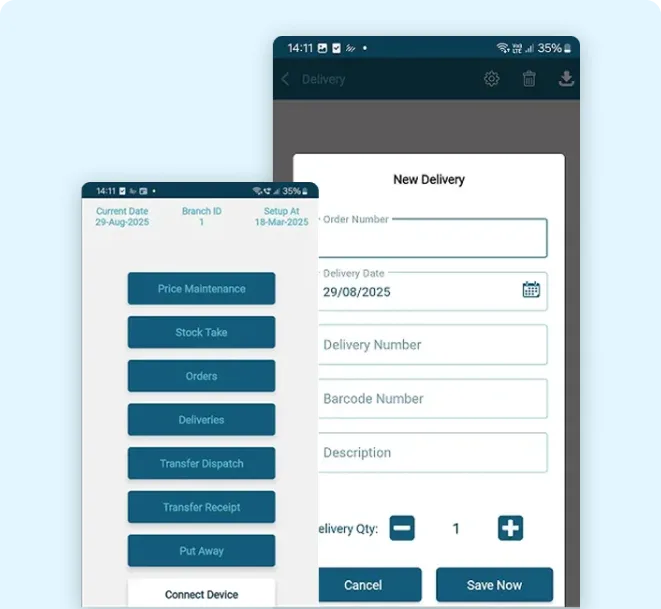
RMEPOS: an Android stock and order app for SUNMI L2S Pro terminals
ScalaCode replaced RMEPOS's DOS-based Unitech HT630 stock terminal with an Android app for rugged SUNMI L2S Pro devices. Store teams handle orders, deliveries, price checks, stock takes and transfers offline, and data syncs with the EPOS system when the device connects.
stock and order operations

Rehost, replace in phases or rewrite
Phased replacement suits most systems that run daily operations. Rehosting and full rewrites each fit narrower cases.
| Replace in phases | Rehost (lift and shift) | Full rewrite | |
|---|---|---|---|
| How it works | One module moves at a time while the old system keeps running | The application moves to the cloud or new servers as it is | A new system is built alongside and everyone switches on one date |
| Risk to operations | Spread across small cutovers, each with a rollback | Concentrated in one cutover window | Concentrated on launch day |
| What it fixes | Code, usability, hosting and integrations, module by module | Hardware and hosting only, while the code stays as it was | Everything, once it ships |
| Cost profile | Spread across phases, each priced on its own | Lowest up front, and running costs can exceed the old hosting | The largest single budget, with nothing in use until launch |
| Best for | Systems in daily use that the business cannot pause | Stable software on hardware that is ending support | Small systems, or code with little worth keeping |
How a legacy modernization project runs
Each phase ends with software your team uses, and the audit sets how many phases the system needs.
Where we move legacy systems to
We pick the target stack on what your team can maintain after handover.
One team, 14 years of shipping
projects shipped since 2012
AI systems running in production
clients across 45+ countries
years building software, since 2012
Legacy modernization cost and engagement models
Modernisation is priced case by case, once a free discovery sprint has mapped the system and its phases. Dedicated engineers start from $1,799 a month, full-time.
Phased project
Scope, milestones and price agreed per phase after the audit. We own delivery of each phase to rollout.
Best for replacing a defined system or set of modules.
Dedicated team
Engineers who work only on your systems, inside your process and tools.
Best for a long migration your IT team runs with us.
Time and materials
Pay for the hours used, with a monthly cap, while the scope is still moving.
Best for audits and rescue work on a system nobody fully understands.
Rated 4.8/5 by the clients we build for
Verified reviews from Clutch and GoodFirms, and clients on camera.
33 verified reviews on Clutch

 Trustpilot review★★★★★
“The application was basically built from scratch, and was complicated, as the software was to be integrated with a certain Medical EHR software.”
 Clutch review★★★★★
“Their team quickly adapted and implemented updates without disrupting operations.”
 GoodFirms review★★★★★
“They translated complex requirements into an intuitive, scalable solution.”
Clutch review★★★★★“They understood the business side of our requirements and often brought up solutions or ideas we hadn't considered.”
GoodFirms review★★★★★“Scalacode delivered a secure, scalable, and efficient platform exceeding our expectations.”
“In our project, we need flexibility, and ScalaCode offers that consistently.”
Clutch review★★★★★“Working with ScalaCode was a rewarding experience. They brought structure, innovation, and a deep sense of partnership to the project, helping us take a meaningful step forward in how we manage and support our growing product ecosystem.”
Legacy software modernization FAQs
Modernisation starts with a free discovery sprint that maps the system and the phases. Ask anything not covered here on the call.
Can we migrate without stopping the business?
In most cases, yes. The old system stays in use while modules move one at a time, high-risk modules run old and new side by side so outputs can be compared before cutover, and each data migration is rehearsed on copies of production data with a tested rollback plan. For RMEPOS, stores had to keep trading while the DOS stock terminal was replaced, so the Android app was delivered in stages.
Should we rewrite from scratch or modernise in phases?
Modernise in phases when the system runs daily operations and the business cannot pause. A full rewrite suits small systems, or code with little worth keeping, because all the risk sits on one launch date. Rehosting on the cloud fixes hardware and hosting but leaves the code as it was. Modernising one system is often the first step of a wider digital transformation.
How much does legacy modernization cost?
Modernisation is priced case by case, once a free discovery sprint has mapped the system and its phases. The size of the system, the volume of data to migrate and the number of integrations drive the cost most.
How long does a legacy system migration take?
It depends on the system. Each phase ends in software your team uses, and the audit sets how many phases there are. The audit takes 1 to 2 weeks for most systems and up to 4 weeks for large or undocumented ones. Larger programmes continue phase by phase after the first release.
What happens to our data during the migration?
Migration scripts are rehearsed on copies of production data, verified, then run in off-peak windows with a tested rollback plan. For online database moves, change data capture keeps the old and new databases in sync, so the cutover window is measured in minutes.
Nobody documented the old system. Can you still migrate it?
Yes. The audit reads the code, data model and integration points and interviews the people who run the system, so undocumented rules are written down before anything moves. On RMEPOS, the team studied the legacy workflows and EPOS data formats before designing the new app. On large codebases, AI code optimization can help map modules and dependencies during the audit.
Can you move old handheld or desktop software to Android or the web?
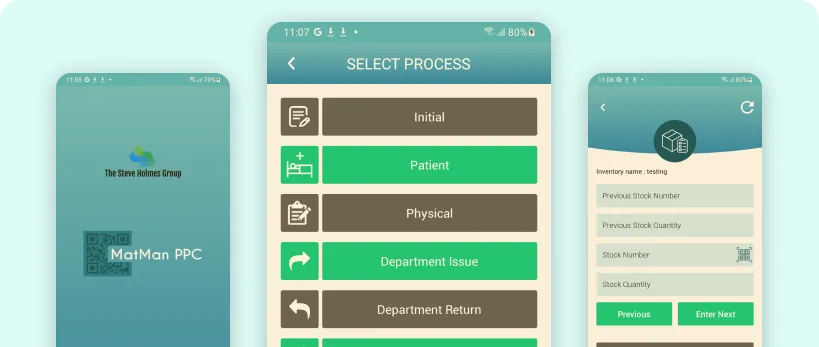
Yes. We replaced RMEPOS's DOS-based Unitech HT630 terminal with an offline-first Android app on SUNMI L2S Pro devices, and moved SHG Group's MEDITECH materials management from Windows handhelds to Zebra Android devices. Desktop and older web software can move to a browser-based app in React or Angular.
Will our staff need training on the new system?
Some, and we plan it into the rollout. Screens are shaped around current workflows with wireframes and mock-ups, new releases go to a pilot group first, and staff training happens before the wider rollout, as it did on the RMEPOS SUNMI devices.
Who owns the code after the migration?
You do, from the first commit. IP assignment is written into the master service agreement and NDAs are standard. We work in your GitHub or GitLab, and handover includes runbooks, recorded walkthroughs and a 30-day question window.
Working with ScalaCode was a fantastic experience, marked by their expertise and support.
Plan your first module in 30 minutes
- 30 minutes with the ScalaCode team
- Which part of the system to move first
- What a phased plan costs and how long it takes