
API development company for the systems your business already runs
ScalaCode builds REST and GraphQL APIs and the integrations behind them, from NetSuite sync for field teams to booking platforms that call a partner's API in real time. Every endpoint ships with authentication, tests and OpenAPI documentation your team can build against.


500+ projects shipped since 2012
Clutch 4.8/5 from 33 reviews

clients across 45+ countries
Trusted by teams at







Clutch 4.8/533 verified client reviews
GoodFirmsReviewed software partner
ISO 9001:2015Certified delivery process
GDPR compliantData handled under EU rules
What API development covers
Most API work is integration work, so the systems on either side decide most of the effort.
- What is API development?
- API development is the design, build, documentation and operation of the interfaces that let applications exchange data and trigger actions in each other. It covers REST and GraphQL endpoints, authentication, webhooks, integrations with platforms such as ERPs, CRMs and payment providers, versioning, and the monitoring that keeps those connections working in production.
Related: web application development, enterprise software development and AI integration.
REST API development and integrations we build
New APIs for your own products, and the connections between the platforms you already pay for.
REST and GraphQL APIs
We build versioned APIs with validation, authentication and OpenAPI documentation in Node.js, Python, Java or .NET.
ERP and CRM integration
Sync with NetSuite, SAP, Salesforce and Microsoft Dynamics through their published APIs, with a log entry for every record that moves.
See enterprise software developmentPayment and SaaS integrations
We integrate Stripe, PayPal, Shopify, Adobe Commerce and industry platforms such as LimoAnywhere, with error handling for every failed call.
Public and partner APIs
APIs your customers and partners build on, with OAuth sign-in, webhooks and generated SDKs.
Mobile app backends
We size APIs for mobile traffic, with pagination, cacheable responses and sign-in that copes with patchy networks.
See mobile app developmentWebhooks and message queues
Event-driven integrations over webhooks, RabbitMQ or Kafka carry updates that must reach several systems reliably.
File-based data exchange
We import and export large flat files for systems that predate APIs, such as POS and stock systems.
APIs for AI agents
MCP servers wrap your REST or GraphQL APIs as typed tools, so AI assistants call them with valid arguments.
See MCP server developmentNot sure your systems can talk to each other?
Send us the list of platforms involved and what has to move between them. We will tell you which connections their published APIs support and where a workaround is needed.
Integration patterns we use, matched to the systems involved
The right pattern depends on how fresh the data must be and what the other system supports.
Real-time API calls
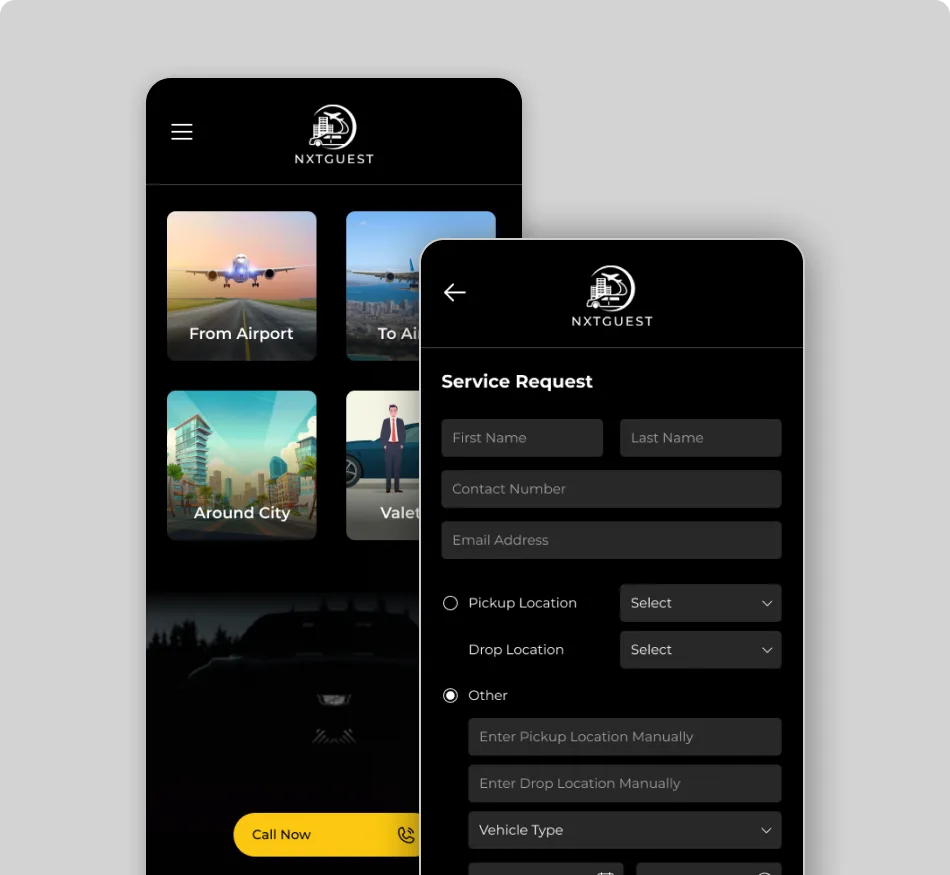
Your app calls the partner API at the moment of use, as the NXTGUEST booking app does to fetch rates and place reservations in LimoAnywhere.
Backend sync with an ERP
A backend you own sits between the apps and the ERP and handles every exchange, as the Node.js service on AWS does for the NetSuite field service apps.
Events and webhooks
A change in one system publishes an event, and each subscriber picks it up from a queue, so a slow consumer never blocks the source.
Offline file exchange
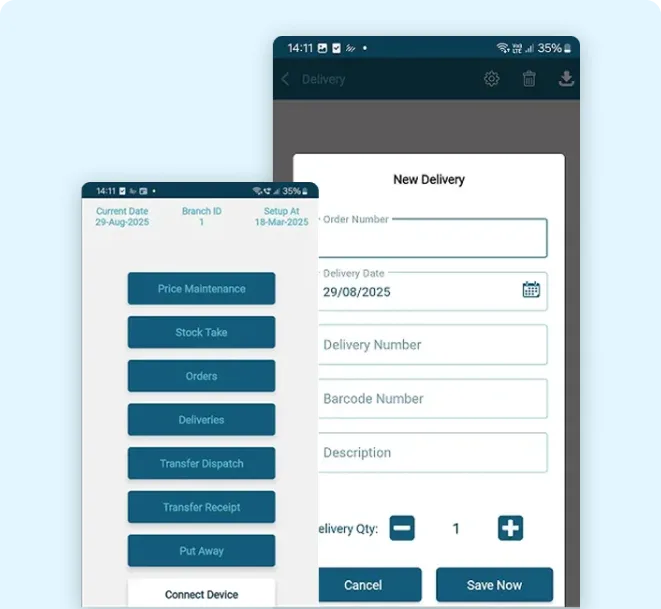
For systems without an API, files are imported and exported on a schedule or on reconnect, as the RMEPOS Android app does with EPOS files of over 100,000 lines.
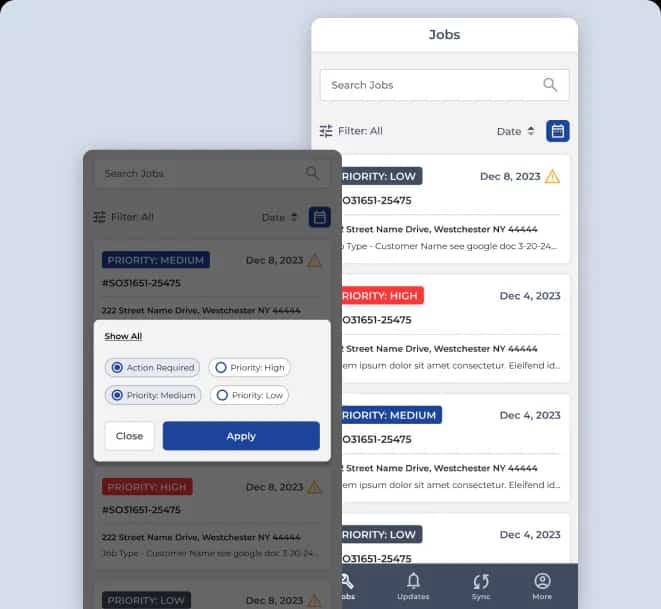
Field service apps integrated with NetSuite: web, Android and iPhone
ScalaCode built web, Android and iPhone apps for a field service company to replace its Service Pro software. Field workers view jobs, complete inspections, add photos and notes, and everything syncs with NetSuite through a secured backend.
apps replacing Service Pro

How we build and ship an API
The API contract is written down and agreed before any code, so your front-end team and partners can start building at the same time.
API security and reliability
An API exposes your data to other systems, so access rules and failure handling are written into the scope during discovery, together with any SOC 2, HIPAA or GDPR requirements.
Authentication and access
Clients sign in through OAuth 2.0 or your identity provider, with scoped credentials per client and role-based access per endpoint.
Validation and rate limits
Every request is validated against the contract, and rate limits protect the API and the systems behind it.
Tested before production
Automated tests run on every change, and every release goes through staging before production.
Logs for every exchange
Request logs and error alerts show which call failed, for which record, and why.
The API stack we work in
Chosen per project, to match the language your team already maintains.
One team, 14 years of shipping
projects shipped since 2012
AI systems running in production
clients across 45+ countries
years building software, since 2012
API development cost and engagement models
API and integration projects start with a free discovery sprint that fixes the scope and price in writing. Dedicated engineers start from $1,799 a month, full-time.

Project-based
Scope, endpoints and price are agreed after discovery, and we own delivery to production.
Best for a new API or a defined set of integrations.

Dedicated team
Engineers who work only on your platform, inside your process and tools.
Best for a platform that keeps adding integrations.
Hire Node.js developers
Time and materials
Pay for the hours used, with a monthly cap, while the scope is still moving.
Best for API audits, fixes and one-off integrations.
Rated 4.8/5 by the clients we build for
Verified reviews from Clutch and GoodFirms, and clients on camera.
33 verified reviews on Clutch

 GoodFirms review★★★★★
“Scalacode delivered a secure, scalable, and efficient platform exceeding our expectations.”
 Trustpilot review★★★★★
“The application was basically built from scratch, and was complicated, as the software was to be integrated with a certain Medical EHR software.”
GoodFirms review★★★★★“Their team proposed an innovative and scalable solution, ensuring seamless data integration with third-party platforms.”
 Clutch review★★★★★
“They understood the business side of our requirements and often brought up solutions or ideas we hadn't considered.”
“The team was professional, reliable, and always friendly, making the entire journey from verification to launch smooth.”
“There is nothing that they haven't been able to do for me, and I am always happy with the results.”
“They are also great in suggesting the most cost effective and most useful solutions for whatever process I am looking at.”
API development company FAQs
Every API project starts with a free discovery sprint. Ask anything not covered here on the call.
How much does API development cost?
The price is fixed after a free discovery sprint. The number of systems to connect, the quality of their APIs and documentation, and the volume of data that moves drive the cost most. Dedicated engineers for ongoing integration work start from $1,799 a month.
How long does it take to build an API?
Discovery takes 1 to 2 weeks and fixes the timeline in writing before the build starts. After that, endpoints ship in two-week sprints, each ending with a demo of working integrations. Third-party platforms with slow sandbox access or approval steps add time, and we flag those during discovery.
Should we use REST or GraphQL?
Use REST for public and partner APIs and for most system integrations, because every client and tool supports it and HTTP caching works with it. Choose GraphQL when one front end needs data from several sources in a single request, such as a mobile app that loads a complex screen. Many products run both.
Can you integrate with SAP, Salesforce, NetSuite or Microsoft Dynamics?
Yes. We connect to SAP, Salesforce and Microsoft Dynamics through their published APIs, and we built web, Android and iPhone field service apps that sync with NetSuite in real time. Discovery maps each integration point, the data each system owns and who approves changes before any code is written.
How do you secure an API?
Authentication uses OAuth 2.0 or your identity provider, each client gets scoped credentials, and access is checked per endpoint. Requests are validated against the API contract, rate limits protect the systems behind it, and every call is logged. SOC 2, HIPAA or GDPR requirements are written into the scope during discovery.
How do you version an API without breaking existing clients?
Breaking changes ship as a new version while the current one keeps serving existing clients for an agreed window, and the OpenAPI document covers both. Additive changes such as new fields go into the current version. Automated tests run on every change and every release goes through staging, so a regression is caught before clients see it.
Can you take over an API another team built?
Yes, after a technical audit. We document the state of the code, the integrations and the risks, then run a three to four week stabilisation sprint before adding new endpoints.
Who owns the code and the API documentation?
You do, from the first commit. IP assignment is written into the master service agreement and NDAs are standard. We work in your GitHub or GitLab, so the code, the OpenAPI documents and the runbooks stay in your accounts.
Working with ScalaCode was a fantastic experience, marked by their expertise and support.
Map your integrations in 30 minutes
- 30 minutes with the ScalaCode team
- Which systems can connect through their published APIs
- What the build is likely to cost and how long it takes