

Artificial intelligence is rapidly redefining the digital shopping experience, making AI in ecommerce the cornerstone of modern online retail. The brands today are not only experimenting with automation, but they are also utilizing advanced AI use cases in ecommerce and discovering new applications of AI in ecommerce.
AI within ecommerce provides hyper-personalized recommendations, automates customer service, optimizes stock, and unlocks a new dimension of operational proficiency.
As AI in ecommerce industry grows, it is no longer enough to keep up to date, but to achieve growth and actual measurable business outcomes. The role of AI in ecommerce would only increase and establish its grounds in the core of future strategy.
Fast Facts: AI in Ecommerce by the Numbers
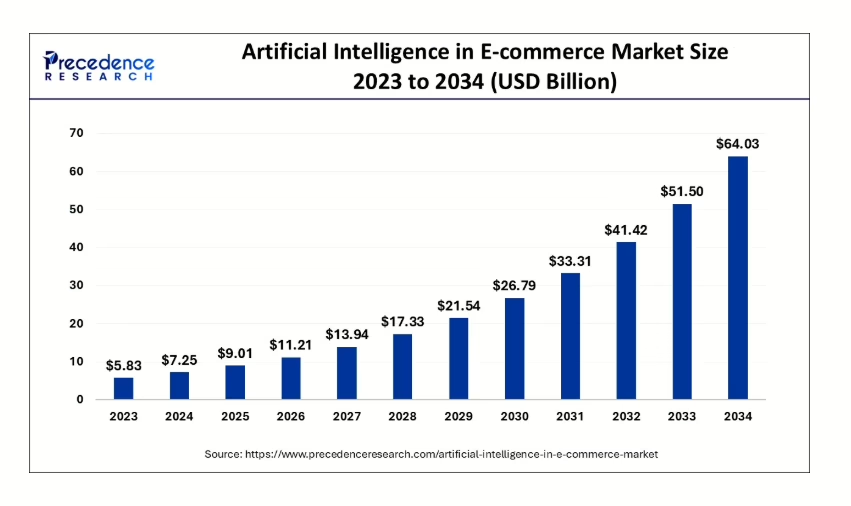
- The AI-enabled ecommerce market is projected to reach $41.42 billion by 2032.
- 89% of companies are using or piloting AI-powered tools in ecommerce.
- 97% of retailers plan to increase their investment in AI in ecommerce this year.
- AI in ecommerce can help brands convert customers 47% faster with smart automation.
- Hyper-personalization powered by AI use in ecommerce lifts returning customer spend by up to 25%.
What is AI in E-commerce?
Artificial intelligence (AI) in ecommerce is the implementation of sophisticated algorithms, machine learning, information analytics, and automation technology so that online retail systems become more intelligent in decision-making by emulating human intelligence. In ecommerce, applications of AI often capitalize on massive data related to browsing history, purchasing, user interaction, etc., to provide individually curated recommendations, business processes, and customer experience.
The most common AI technologies that are applied in ecommerce are chatbots, recommendation engines, visual search, and predictive analytics. The tools automate manual processes, improve the interaction between brands and shoppers, and optimize processes such as inventories and logistics. The outcome is a more dynamic, efficient, and customer-caring online retailing environment.
Real-World Use Cases and Applications for AI in eCommerce
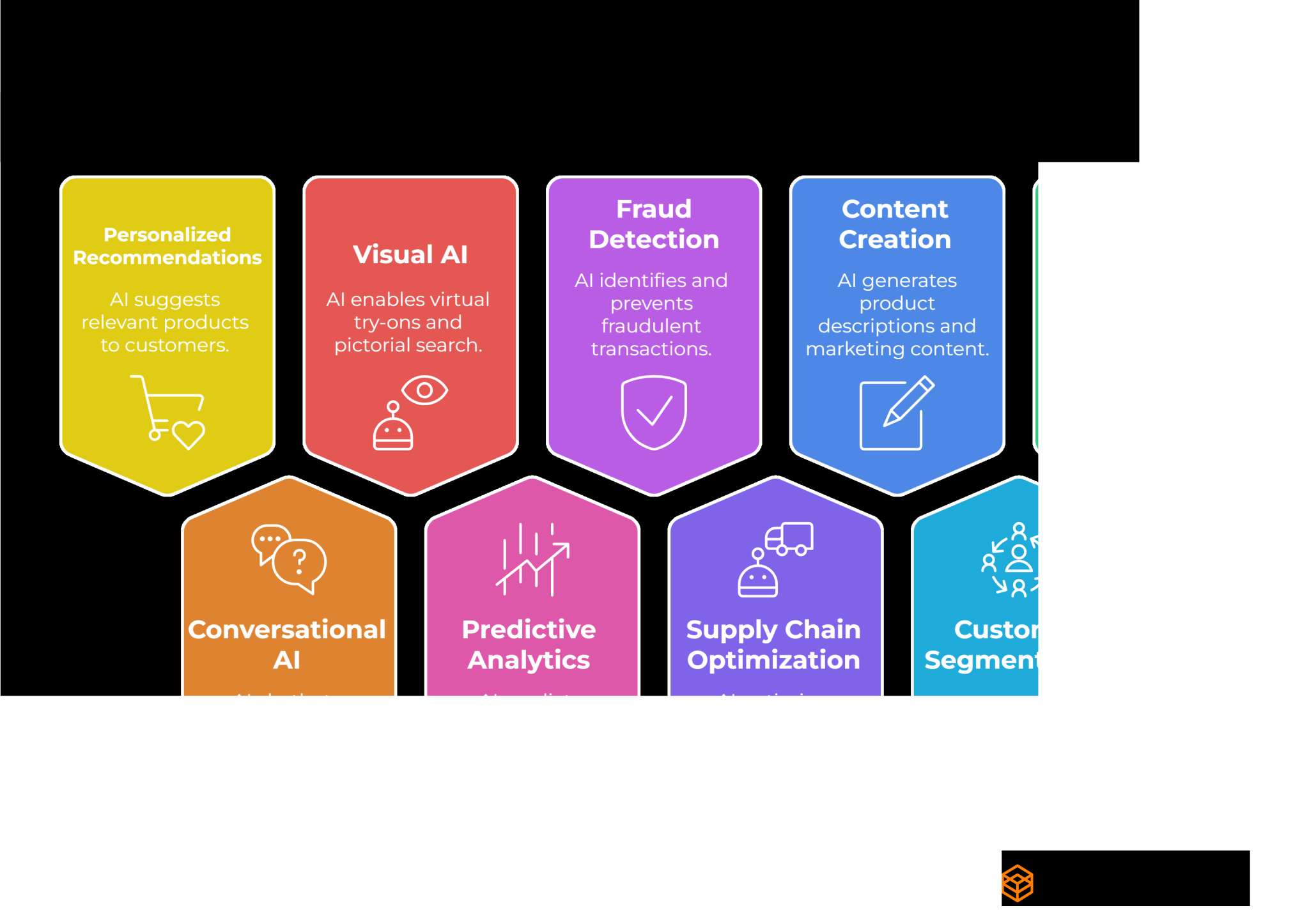
Customer journey AI in eCommerce is being transformed with AI-powered suggestions of relevant products, AI chatbots, pictorial search, and automated stock control. Such applications provide customized experiences to the brands, improve engagement, and enhance conversion rates. Here in this section, we will see the real-world use cases with the application of Artificial Intelligence in eCommerce.
1. Personalized Product Recommendations
Use case
A key use of AI in ecommerce is shopping forms of personalization. Machine learning and the data about the behavior of an individual client allow AI to make highly customized suggestions based on what that customer wants. This increases customer experience and adds a return on investment, as businesses report up to 18% more average orders per cart.
Application
Amazon, a pioneer in the use of AI in ecommerce, powers its entire shopping experience with AI-based recommendation engines. Features like “Customers also bought” and “Frequently Bought Together” account for over 35% of total sales. Retailers often partner with the best AI development services or AI development firms to adopt similar strategies.
Artificial intelligence-based chatbots have changed their face of customer interaction with 24/7 services, recommendations, and after-sales care. Cart abandonment, satisfaction, and up to 30% conversion uplift can be achieved by these AI use cases in ecommerce.

2. Conversational AI & Virtual Assistants
Use case
Artificial intelligence-based chatbots have changed their face of customer interaction with 24/7 services, recommendations, and after-sales care. Cart abandonment, satisfaction, and up to 30% conversion uplift can be achieved by these AI use cases in ecommerce.
Application
Virtual Artist by Sephora and voice AI assistant by Walmart can be perceived as two perfect examples of major brands that use AI agent development services to ensure intelligent, interactive shopping experiences. These tools have assisted Sephora in recording 11 percent more rates of appointment bookings, and Walmart simplified voice reordering. A company interested in developing comparable solutions can find AI Developers and become a client of an e-commerce software development firm.
3. Visual AI & Virtual Try-On
Use case
Product discovery is getting a redo with image recognition and AR-enhanced virtual try-ons. Companies that are applying AI to ecommerce claim a 25% reduction in returns and an increase in engagement rate.
Application
ASOS and Wayfair provide buyers with an opportunity to virtually dress up or find similar products by submitting pictures. These tools, usually developed by the top AI software development services, help to increase customer satisfaction and minimize the post-purchase friction, particularly in such industries as fashion or home decor.
4. Predictive Analytics & Dynamic Pricing
Use case
AI application in ecommerce entails demand prediction, automation of inventory choice, and real-time price alteration. Retailers who used AI in predictive analytics had 25% profit margins and a 50% reduction in stockouts.
Application
Zara incorporates AIs to forecast popular products and set them at optimum prices. In the same way, Amazon adopts dynamic AI algorithms to change the prices of products several times a day. Those retailers who plan to have ecommerce app development costs calculated should make sure they consider such automation from the very beginning of the task, business-wise, with the help of a custom eCommerce development firm.
Bonus Visit: Top AI App Ideas
5. Fraud Detection & Security
Use case
AI can be used in securing transactions as it can detect illegal activities, unconventional behavior, and suspicious payment behaviors in real-time. Artificial intelligence-assisted advanced fraud detection has eliminated up to 90% of the fraud risk.
Application
PayPal and Stripe use real-time AI engines that are used to prevent fraudulent activity before it happens. More compact businesses may adopt such an ability with AI Development Companies or customized ecommerce security AI agent generation services.
6. AI-Driven Supply Chain & Logistics Optimization
Use case
The use of this AI in ecommerce improves logistics, and delays in delivery and control of inventory are reduced. The companies using AI have experienced a reduction in operations costs by up to 20%.
Application
Walmart optimizes delivery by taking advantage of logistics and routing technologies based on AI. They are constructed in collaboration with the best AI development firms, demonstrating the role that AI plays in the physical and digital retail success. Businesses that are interested are free to hire ecommerce developers in order to incorporate such systems into their platforms.
7. Generative AI for Content Creation
Use case
Generative AI for businesses allows describing products, creating banners, commercial blogs, or even advertising creatives automatically. This not only saves time but also allows businesses to scale the content production by 50% or more.
Application
Shopify Magic is an AI-powered tool that generates product descriptions in less than one second, simply by relying on the retailer to provide input, as such descriptions are done using generative AI that is optimized in terms of search engines. Firms can either hire AI Developers or get the supreme AI development services to incorporate such features on their ecommerce sites.

8. AI-Powered Customer Segmentation & Marketing
Use case
One of the most popular AI trends in ecommerce is real-time customer segmentation, enabling a brand to run highly tailored campaigns depending on their shopping history, preferences, and lifetime value estimation.
Application
Sephora has created user segmentation and made trigger-smart offers that perfectly fit into the individual buying patterns with the help of AI. The top brands collaborate with a reliable ecommerce software development firm to integrate AI segmentation into CRM and marketing solutions, which eventually enhances efficiency and Return On Investment.
9. Hyper-Personalized Email and Ad Targeting
Use case
This ecommerce AI use case allows the development of customized email sequences and advertisements depending on the actions of the user. Hyper-personalized campaigns can increase the email open rate by 26% and CTR by a significant 40%.
Application
Both Amazon and Netflix implement AI and are looking to change email content on a real-time basis so that they can provide relevant offers and content based on recent user behavior. This, businesses can imitate by getting BUY CSE AI development enterprises and transferring individualization to their boards through distinctive systems of online purchasing.
Revolutionize shopping experiences, boost sales, and stay ahead of your competitors.
Benefits of Implementing AI in eCommerce
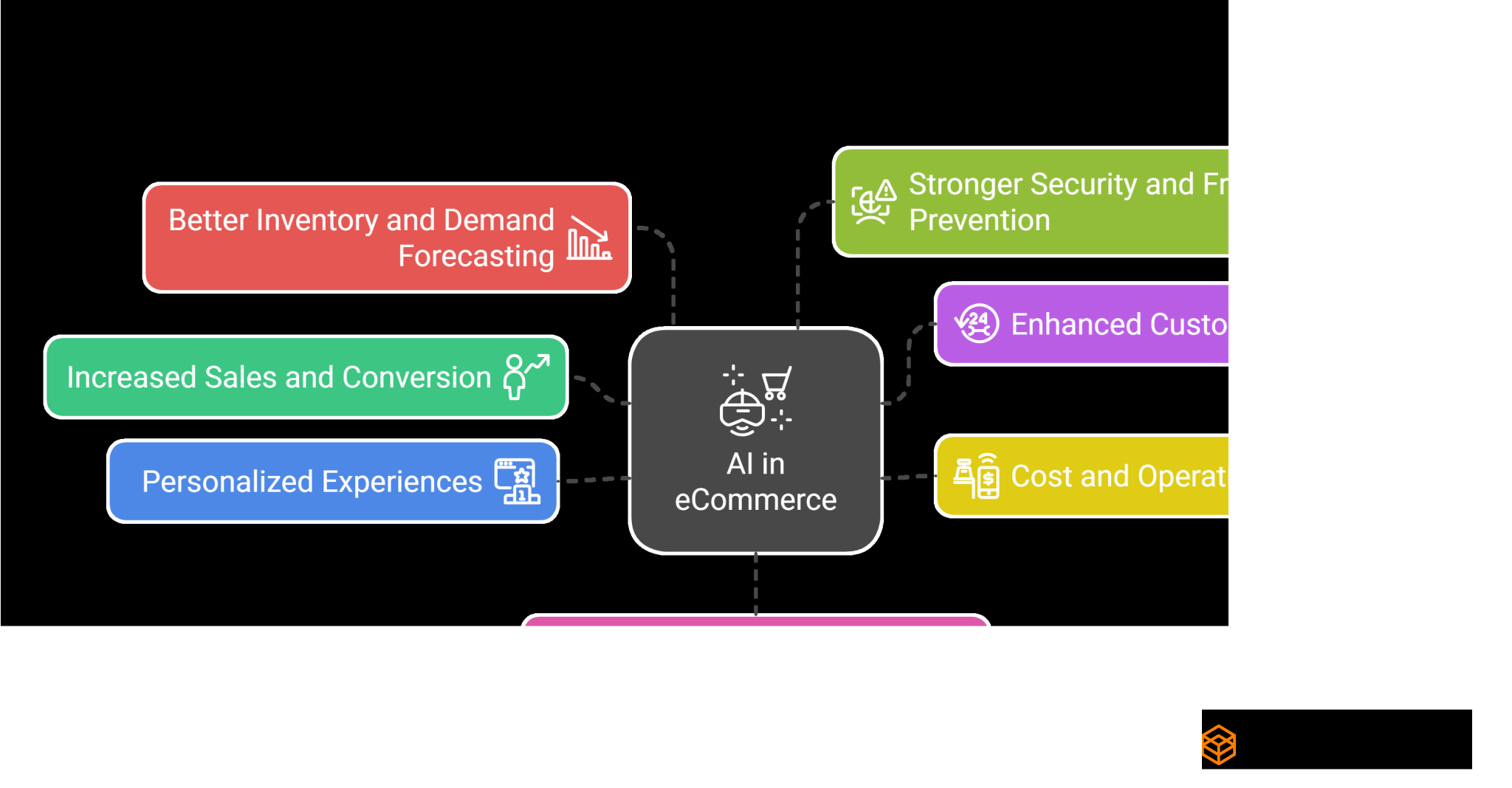
Using AI in eCommerce brings the best customer experiences by providing custom advice and immediate help. It also simplifies the operations through automation of inventory, pricing, and demand plans, and much more; some of them are given below:
1. Increased Sales and Conversion
AI in ecommerce context enhances the personalization of product recommendations, search results, as well as marketing, all of which increase sales. Conversion rates and average order value are raised by data-driven personalization on the basis of customer preferences and customer behavior.
2. Enhanced Customer Service
Virtual assistants and chatbots 24 hours a day and 7 days a week, give immediate answers, simplify the process of eliminating the problem, and can make product recommendations, increasing the level of satisfaction and customer retention.
3. Cost and Operational Efficiency
Replacing manual processes with automation will cut overhead expenses and human errors, not to mention that it allows teams to get on with strategic matters.
4. Personalized Experiences
With AI in ecommerce, restricted to dynamic site experiences, hyper-personalised recommendations, and targeted marketing, everything is a possibility, and more visitors can find their shopping experience more captivating and personalised.
5. Better Inventory and Demand Forecasting
By preventing short and overstock, AI-driven predictive analytics reduces stockouts by 50% and guarantees the increased profitability of an automotive organization.
6. Stronger Security and Fraud Prevention
With the help of AI-oriented fraud detection applications, the transaction pattern is analyzed in real-time, mitigating the risk and enhancing the security of businesses and consumers alike.
7. Scalability and Competitive Advantage
The AI solutions are easy to scale based on business growth, and this means that brands across size scales can play on equal terms and react faster to the changes in the market.
Learn More: Role of AI in Mobile App Development
Steps to Integrate AI in eCommerce
In order to mature AI in eCommerce, it is a good practice to first identify some areas that need to be enhanced using AI, such as personalization or customer support, or inventory. Then either select appropriate AI tools or collaborate with an AI development firm to facilitate implementation and scale.
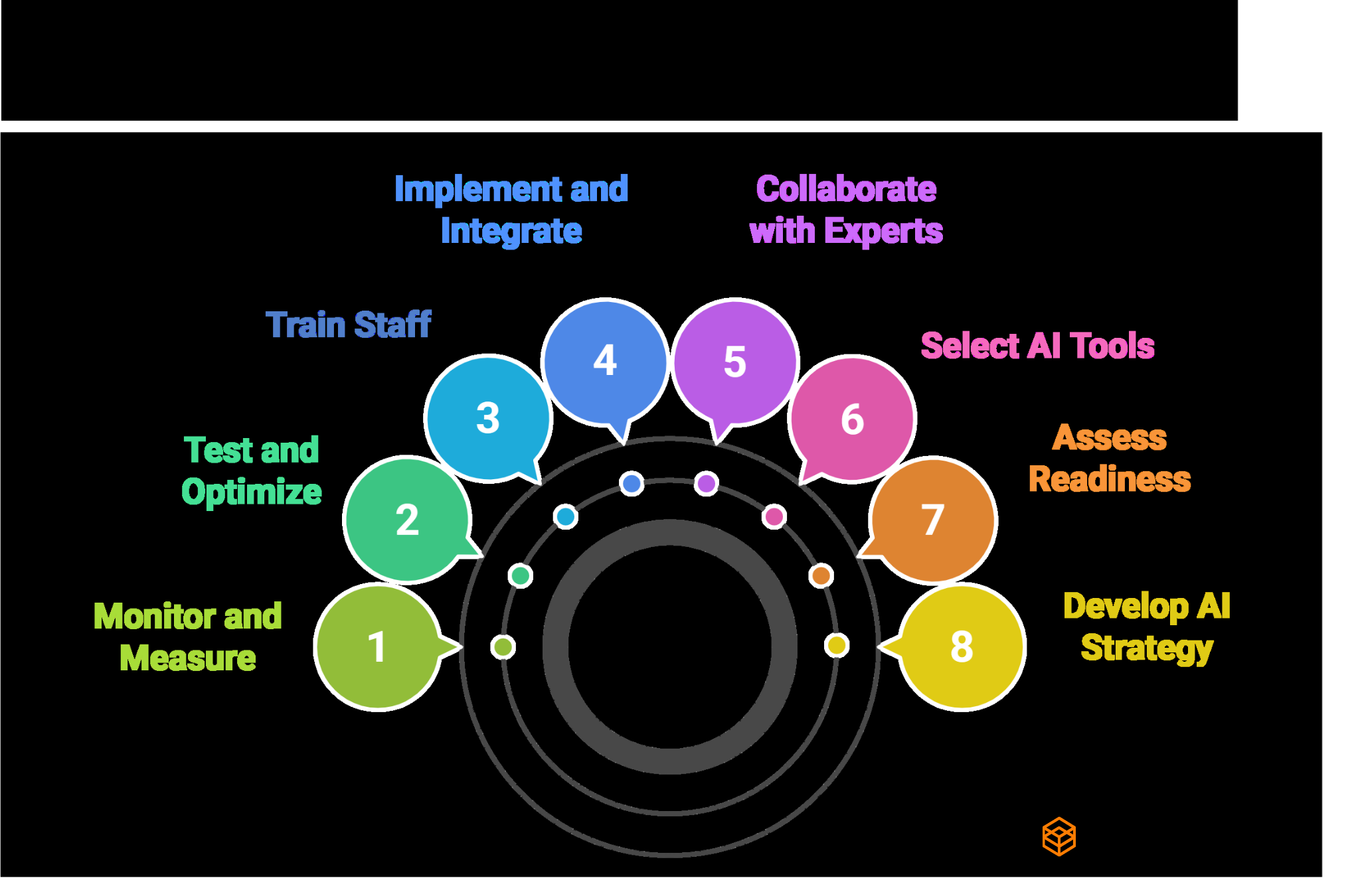
1. Develop an AI Strategy
- Determine the business objectives that will be addressed with AI in ecommerce (e.g., cutting the number of stockouts, conversion rates).
- Focus on cases where the impact can be as high as possible, such as personalization, dynamic pricing, and customer support.
2. Assess Readiness
- Review data quality (at least 12 to 18 months of clean, labeled data).
- Ensure the ecommerce platform supports AI integration and that teams are prepared for process changes.
3. Select the Right AI Tools
- Check the AI systems offered to perform different functions, e.g., recommenders, chatbots, or automated text generation.
- As an alternative, explore no-code alternatives with a scalable format when enough technical resources are not available.
4. Collaborate with Experts
- Work with IT and experienced AI vendors to ensure smooth integration, data migration, and regulatory compliance.
5. Implement and Integrate
- Easy integration of AI tools with corresponding business systems (CRM, inventory, customer service).
- Design Successful Roll-Outs- specify schedules, milestones, and assignments of roles.
6. Train Staff
- Provide comprehensive training for end-users and decision-makers.
- Ensure ongoing support for any technical or workflow challenges.
7. Test and Optimize
- Pilot AI solutions in controlled scenarios to measure impact and fix issues.
- Gather feedback and refine deployments for maximal results.
8. Monitor and Measure
- Measure performance bottom line (conversion, AOV, cost reduction).
- Decide on continuous improvement by means of adjusting strategies based on analytics.
ScalaCode , your partner in innovation and impact.
Top 3 Trends in eCommerce AI
Find out the 3 leading tendencies in AI in the eCommerce scenario, such as hyper-personalization and generative content. Keep your rivals at bay by integrating new AI in ecommerce developments that transform customer experience and operations.
1. Emergence of Generative AI for Content and Conversations
Anticipation of the generative AI represents a new dynamic period in AI in ecommerce, a new era to allow businesses to automate the generation of compelling product messages, snappy blog posts, online advertisements, and even to have natural, life-like dialogues with shoppers.
Generative AI is artificially intelligent software that creates original text in a few seconds with the help of enormous language models and complex machine learning systems, speeding up go-to-market and freeing up human resources at the same time. Chatbots with generative AI in eCommerce customer support can answer difficult questions, recommend personally, upsell in a conversation, and make shopping enjoyable and personal.
- Benefits of AI in ecommerce include scalable content production, authentic communication, and greater customer satisfaction.
- These advancements illustrate how to use AI in ecommerce for both marketing and customer engagement, making content teams more agile and responsive to trends.
2. Proliferation of Computer Vision and AR for Product Discovery
Among the top AI trends in ecommerce growing very quickly in the ecommerce environment is the element of computer vision and augmented reality (AR) to redefine the way products are found and surfed by consumers on the web.
Image-based product searches are enabled by computer vision algorithms: customers upload or take a picture, and computer vision finds similar items before their eyes. AR enables consumers to see how products look at home, e.g., to virtually wear clothing before buying it, or to place furniture in a room and then buy it, eliminating uncertainty and lowering rates of returns.
- It is an application of AI in ecommerce to increase the level of engagement, confidence, and conversion rate since online shopping can become more interactive and tangible.
- Computer vision applications of AI use cases in ecommerce also tell of how is AI used in ecommerce to fill the divide between online and offline retail experiences.
3. Rise of No-Code AI Tools for Democratized Access
On one hand, the future of AI in ecommerce concerns not only the fancies of high technologies, but also extending access. The power of no-code AI platforms gives non-engineering groups the capability to implement, tailor, and explore the use of AI functionality without having to code.
This democratization implies that any brand, regardless of its size, can afford fast and cost-effective implementation of AI-based product suggestions, chatbots, individual flows of marketing activities, and intelligent analytics.
- One of the AI examples in ecommerce as a strategic enabler is no-code solutions that open the path to further adaptation.
- They render the use of AI in ecommerce affordable, jumping over the divide where the companies do not possess significant IT capabilities and offering a basis to transform innovation to scale.
These new advances highlight what AI is in ecommerce at present: it is a rapidly evolving technology domain, which is democratised, flexible, and fiercely focused on generating value at all stages of the customer path.
Explore More: Top Software Development Companies
Recent News & Breakthroughs About AI in eCommerce
- Major platforms are revolutionizing the concept of AI in ecommerce through tool releases. Some prominent releases are Shopify Magic, which auto-generates store content and uses advanced analytics and customer engagement solutions offered by IBM Watson.
- No-code AI, meanwhile, is enabling non-developers to build, tailor, and effectively launch AI-enabled apps and chatbots at scale, diminishing the threshold to not only creative innovation but to innovation in general.
- Recent case studies indicate that real-time AI has been able to enormously increase sales during peak occasions like Black Friday by easily personalizing the various promotions in place and optimizing stocks to expand revenues all within hours.
Preparing for What’s Next: Future Trends (2025 & beyond)
The field of AI in ecommerce is evolving very fast, and a way to keep pace with it is by being aware of the new trends that are coming up, as well as being able to apply newer technologies effectively. Artificial intelligence will play a revolutionary role in store operations, logistics, and design, as the future suggests the automation of routine work and smart supply chain management.
In the meantime, the increased automation of merchandising, the generation of product descriptions, and the elaboration of creative campaigns will allow businesses to multiply the similar work volume without compromising on the personalization and quality.
The rising issues of AI ethics, data responsibility, and upcoming directives that govern how businesses utilize AI on behalf of consumers to protect their privacy and implement clear AI applications are equally valuable. The use of AI by the ecommerce businesses will be defined by these principles.
Lastly, the availability of AI tools specifically designed to fit the needs of small and medium-sized enterprises (SMBs) is democratizing innovation and removing the entry barrier to access AI, and along with it, experience the benefits of AI-powered growth.
Also Read: AI App Development Cost Estimation
How to Future-Proof Your Ecommerce Store with AI
To fully leverage these future trends, ecommerce businesses must take practical, strategic steps to adopt and integrate the latest AI tools. Key recommendations include:
- Knowledge and Implementation of AI: Learn about AI applications that suit the size, goals, and customer requirements of your business, autonomous inventory management, AI merchandising, and automated content material.
- Invest in Flexible and Open AI Platforms and Tools: Choose the platforms and tools that are capable of fitting your business, yet easily customizable with no technical knowledge required.
- Empower Your Team: Non-technical personalities can be trained and empowered using no-code AI tools and UI based interfaces to take charge of AI-driven modules in marketing and sales, and customer support.
- Ethical AI First: Establish policies and guidelines on data stewardship and enact the Open AI data use policy to improve transparency and ensure that expected regulations are achieved.
- Competitive Advantage with AI: Use AI insights as a part of personalization, to streamline supply chains, and exploit products in real-time.
Measuring AI’s Impact: Key Metrics and ROI Evaluation
Effective AI adoption demands continuous monitoring and evaluation. Key performance indicators include:
- Conversion Rate Optimisation: Track how AI-powered personalisation, chatbots, and dynamic pricing affect sales.
- Average Order Value (AOV): Monitor the growth of the activities produced through cross-selling and upselling activities driven by the use of AI.
- Customer Retention and Lifetime Value (CLV): Examine how AI offers customer loyalty by making specific campaigns and predictive analytics.
- Operation Efficiency Scoring: Measure decreases in inventory expenses and delivery time, as well as decrease the number of frauds because of AI automation.
- Speed and quality: How much time and how much engagement is saved and uplifted by generative AI in merchandising and campaign creative?
- Compliance and Trust Metrics: Check on the data privacy standards to assure users of the transparency of AI.
Conclusion
In the digital retail, only the visionaries who are able to adjust and evolve will survive using transformative technology as their core. The best strategic decision any business can ever make in the current era of AI-powered commerce is to partner with an experienced eCommerce Software Development Company.
Using the latest AI technologies, regardless of whether it is predictive analytics, generative content, or consistent customer interaction, you will make sure your brand provides a superior user experience, develops operational effectiveness, and competes in an ever-transforming market.
Why ScalaCode Is Your Ideal AI & eCommerce Partner?
A perfect match when it comes to a growth partner, ScalaCode is so much more than a development service provider. We combine extensive experience in artificial intelligence, machine learning, and future-ready architecture of e-commerce with our fanatical approach to your business success. Our team will fulfil custom integrations of AI, quick generative AI implementation, and scalable platforms to fit all points of the ecommerce process.
Your strategic partner, ScalaCode, strives to equip your business with dynamic R&D, lean delivery, and ROI-oriented solutions, which is why we are the reliable partner of brands that need innovation, safety, and tangible ROI in every project.
Partner with ScalaCode and turn innovation into impact!
Frequently Asked Questions
Q1. What is AI in eCommerce, and why is it important?
Artificial intelligence in eCommerce refers to the use of technologies of artificial intelligence (e.g., machine learning, natural language processing, and computer vision), which are practically used to automate, personalize, and streamline the various components of web-based shopping. It mattered as it provides an improved customer experience, better efficiencies, and more sales via simplification of operations, product recommendations, and predicting the needs of shoppers.
Q2. How can eCommerce businesses start using AI?
To begin with, it is advisable to build business objectives in which AI can give a tangible advantage (cutting the number of out-of-stock incidents or supporting the customers). Find out how prepared and good the data is, create custom or off-the-shelf AI solutions, and cover low-cost and high-impact apps. Ensure you obtain the appropriate group of people, a massively scalable technology stack, and a blueprint to incorporate before scaling out.
Q3. What are the biggest challenges in implementing AI in eCommerce?
Key challenges include:
➱ Ensuring access to high-quality, clean, and relevant data
➱ Integrating AI with legacy systems
➱ Managing employee adoption and skill gaps
➱ Balancing initial costs with long-term value
➱ Meeting data privacy and compliance requirements
Q4. How do I measure the ROI of AI investments in my online store?
Measure important performance indicators (KPIs) that include conversion rates, gross margin, lower refunds, customer retention, and order total prior to and during the implementation of AI. Carry out A/B testing, establish firm baselines, and include operational costs on one hand and financial upside on the other hand in determining time-to-payback, and hope that the break-even point can be achieved in less than 12 months.
Q5. Do I need technical expertise to implement AI in my eCommerce business?
No, not necessarily. Although the complexity or customization of solutions might require technical know-how, most platforms will provide no-code or low-code AI tools, and the first use is not out of reach for non-developers. To leverage AI at the complex initiative level, it would be beneficial to include agreeable vendors or consultants.
Q6. What are some easy first steps for adopting AI in a small- or medium-sized eCommerce store?
➱ Use AI-powered chatbots for customer support
➱ Implement personalized product recommendations
➱ Automate simple operational tasks, like tagging products or reordering supplies
➱ Leverage AI-driven analytics for quick business insights
Q7. How does AI help with data privacy and compliance in eCommerce?
The use of AI tools can automate all types of data management, identify suspicious data access, and promote regulatory compliance with such policies as GDPR and CCPA. Nevertheless, companies should be updated and lay stringent regulations on data governance to consolidate customer data ethically.
Q8. Can AI personalize marketing and emails in eCommerce?
Yes. AI provides an opportunity to know about the actions and the preferences of customers to make the most personal recommendations regarding the products, differentiating the content of the email on the individual level, scheduling advertising, sending promotions and newsletters, and increasing the conversion rate and customer lifetime value several times.