

The advancement of ChatGPT has escalated the race to adopt powerful and innovative AI models across the enterprise.
This has sparked companies’ curiosity about what is becoming known as “AI copilots,” which aim to boost efficiency and performance across various tasks.
An AI copilot is an intelligent system designed to assist and collaborate with humans in complex tasks.
It has penetrated every corner, from autonomous vehicles to medical diagnostics, and transformed how we interact with disruptive technology and each other.
In this blog, we’ll discuss how to develop AI Copilot and how it can benefit enterprises.
So, let’s get started by explaining what an AI copilot is.
What is an AI copilot?
Artificial intelligence-powered copilots are conversational interfaces. Backed by large language models (LLMs), machine learning (ML), and natural language processing (NLP), AI Copilot understands and responds effectively to human language, making it easier for users to interact with and navigate digital platforms.
Today, enterprises implement AI copilots to enhance the decision-making process, automate tasks, and improve efficiency.
These systems interpret and respond to real-time data, making them invaluable partners in healthcare, manufacturing, and aviation. AI copilot applications are innovative and impactful.
How Does AI Copilot Work?
AI Copilots utilize advanced technologies, including machine learning and AI fundamentals, natural language processing (NLP), and computer vision.
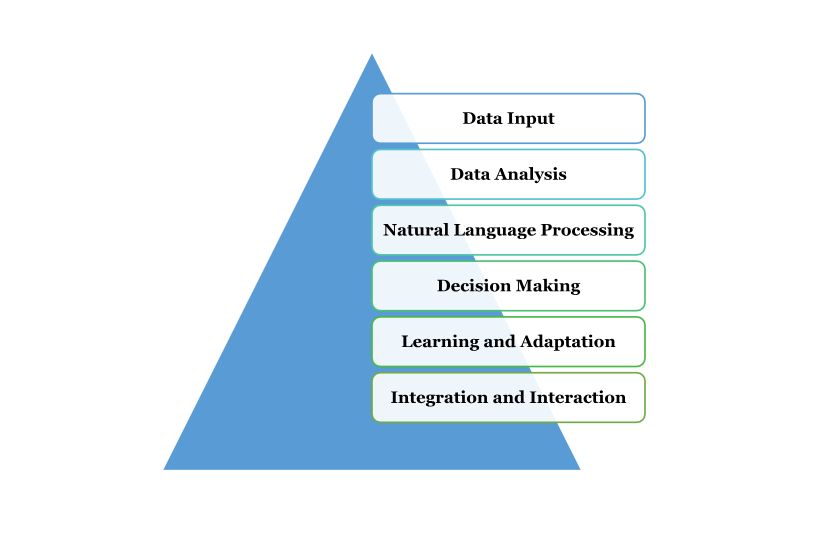
Let’s explore how it works step-by-step.
1. Data Input: It collects data from various sources within the enterprise, such as: documents, emails, databases, and conversations. This data serves as the basis for its learning and functionality.
2. Data Analysis: Employing machine learning algorithms, AI Copilots analyze the collected data to uncover patterns, trends, and insights. For instance, it can learn from past customer interactions to predict and efficiently resolve future queries.
3. Natural Language Processing: Copilot utilizes NLP to understand and generate human-like text, enabling natural and conversational user interactions. It interprets requests expressed in everyday language and delivers appropriate responses or actions accordingly.
4. Decision Making: The AI Copilot uses its analysis and predefined objectives to make decisions. For instance, it can prioritize tasks for an employee, recommend the most effective ways to complete them, or autonomously manage routine tasks, like scheduling routine tasks.
5. Learning and Adaptation: AI Copilot’s critical strength is its capability to learn and improve through interactions over time. By leveraging machine learning models, it updates its understanding as it receives new data, ensuring that the Copilot becomes more accurate and helpful the more it is used.
6. Integration and Interaction: They seamlessly integrate into the existing systems and workflows to communicate with other software tools and platforms. Their ability to connect with different data points, including software applications, ensures a seamless experience.
Backed by next-generation technologies, AI copilots assist employees with various tasks. These tasks range from administrative duties, which include analyzing financial reports, complex operations, managing calendars, and developing software.
This integration between humans and machines simplifies routine tasks, enhances productivity, and allows employees to focus on more strategic and creative tasks.
The 4 Types of Conversational AI Tools
There are four types of AI copilots, each adding sophistication and supporting a progressively complex range of use cases.
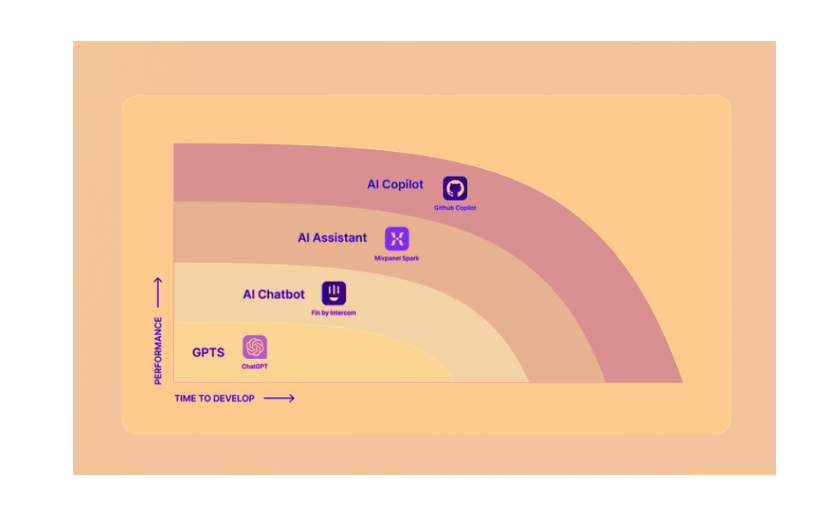
The first step is to define the scope of your AI feature. Depending on the available data, you can determine the required level.
1. OpenAI’s GPTs: The initial tier of AI assistance
Technology Base: Vectorized databases sourced from existing documentation and external APIs with function-calling capabilities.
OpenAI facilitates the creation of specialized chatbots using ChatGPT without coding.
It supports document integration and utilizes web browsing, Dall-E, and Code Interpreter functionalities, enabling code execution and file interpretation.
The Assistant API can be utilized to embed your model externally.
✅ Benefits
- Simple setup using the ChatGPT no-code platform.
- Capable of handling basic tasks with your data and files.
- Included in the ChatGPT Plus plan at no extra cost, excluding API usage.
✅ Limitations
- Performs only basic use cases.
- Restricted to GPTs within the ChatGPT interface if the OpenAI API is not utilized.
2. AI Chatbot: The second level of AI chat
- Primary Use Case: Support Questions
- Technology Base: Vectorized databases from existing documentation.
AI chat GPT is designed to answer queries using information from documented sources.
Whenever you interact with customer service, chatbots retrieve answers from manuals or FAQs you’re familiar with at this level.
✅ Benefits
- Efficient handling of high volumes of common queries.
- Reduces the need for human intervention in basic inquiries.
- Instant access to extensive documentation.
✅ Limitations
- Requires human intervention for uncommon queries.
- No access to live data; database updates require manual adjustment.
3. AI Assistant: The third level showcases AI chats
- Primary Use Case: Executing Actions
- Technology Base: Real-time communication with APIs, SQL, and vectorized databases.
Its ability to provide information and take action. These assistants can also be utilized to schedule meetings, control smart home devices, or initiate complex business processes.
It utilizes a direct interface with APIs in real-time. They act as digital aides, enhancing productivity across tasks.
✅ Benefits
- Seamless integration with diverse tools and platforms.
- Automation and simplification of complex tasks.
- Increased productivity through minimized manual input.
✅ Limitation
- Requires adaptation for APIs that may not be immediately compatible.
- Targets 95%+ use cases but within the confines of API capabilities.
4. AI Copilot: The most advanced level
- Primary Use Case: Advisory and Action Delivery
- Technology Base: Real-time communication with internal and external APIs, SQL, and vectorized databases.
AI Copilots blend reactive response with proactive intuition. Beyond answering queries and executing tasks, they understand context, predict user needs, and offer strategic insights.
✅ Benefits
- Deep integration across diverse data platforms and sources.
- Proactive recommendations and strategic advisories.
- Comprehensive capability from routine tasks to complex decision-making.
✅ Limitation
- Requires months of development, potentially involving specialized LLM creation.
Examples of AI Copilots
1. ChatGPT
OpenAI’s ChatGPT is a frequently utilized tool capable of responding to queries and questions, providing recommendations, and naturally assisting in content drafting.
Moreover, ChatGPT can streamline various tasks, making it an invaluable partner for navigating everyday challenges.
2. Jasper’s Copywriting Assistant
It is an AI Copilot tool designed to assist writers in crafting brand content, from emails to blog posts to web copy.
Interpreting user input offers relevant suggestions that enhance efficiency, boost productivity, and elevate written content quality.
3. Microsoft’s Copilot for Microsoft 365
It helps users with various tasks across the Microsoft ecosystem, including Excel, Word, and PowerPoint applications.
It provides automated text and layout suggestions, email summaries, and real-time meeting assistance.
4. Salesforce’s Einstein GPT
A versatile AI copilot generates personalized content across every Salesforce instance, enhancing employee productivity.
It is open and extensible, supporting public and private AI models and empowering Salesforce customers to boost CRM efficiency with advanced generative AI capabilities.
5. GitHub’s Copilot
AI-powered code completion tool assists in writing code more efficiently by suggesting entire lines or blocks of code.
By leveraging context and past code from a repository, Github Copilot offers tailored recommendations, reducing development time and making the coding process more intuitive. Hire AI developers in India to develop AI generative tools that help you simplify your business operation.
6. Moveworks’ Enterprise Copilot
It helps employees streamline tasks and access information across all enterprise applications using a single natural language interface.
It supports various functions, such as password resets, PTO requests, and expense submissions, ensuring seamless support for all employees, regardless of their language or preferred communication channel.
As AI continues its rapid development, copilots will increasingly play a crucial role in helping users streamline tasks and optimize their digital resources. Therefore, defining a well-structured copilot strategy is essential for businesses aiming to harness AI technology’s potential fully.
Why Do Enterprises Need AI Copilot?
Enterprises are embracing AI Copilots to streamline their operations, enhance productivity, reduce operational costs, and drive innovation.
Let’s dive into the significant benefits of adopting AI Copilots for business.
So, get set and go.
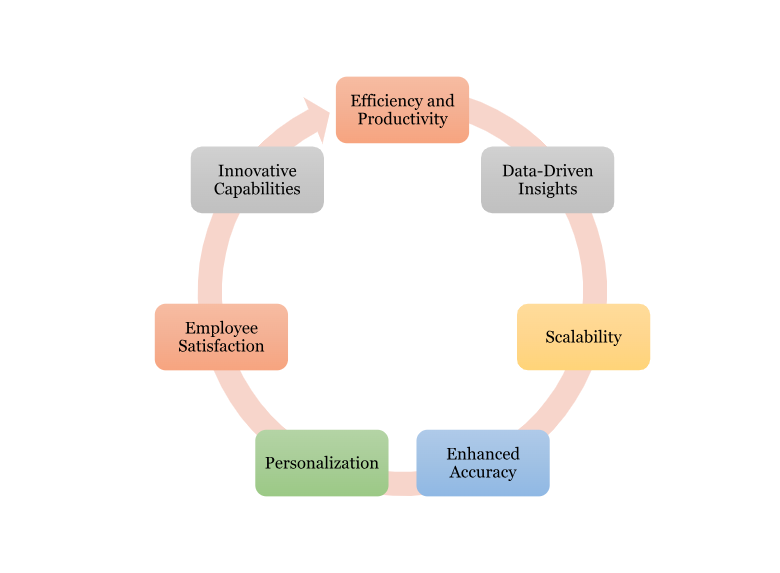
1. Efficiency and Productivity
AI Copilots significantly automate routine and time-consuming tasks, including _ data entry, scheduling, and customer inquiries.
This automation gives human resources the flexibility to focus on more complex and value-added activities, increasing overall productivity.
2. Data-Driven Insights
Through AI-Copilot, you’ll analyze a vast amount of data in real-time. It gives you actionable insights and data-driven decision support that enable businesses to make better decisions, optimize processes, and identify trends at unprecedented speed.
3. Scalability
As enterprises grow, the volume of tasks and data also increases. And that, where AI copilots play an important role to scale the operation efficiently.
Businesses who want to scale the expand without compromising performance, quality and efficiency can rely on AI Copilot to achieve these goals.
4. Enhanced Accuracy
It ensures higher accuracy in wide range of business operations, including, financial forecasting, inventory management, customer services.
Copilot can also help in minimizing human error in repetitive tasks, and maintain quality and reliability in enterprise operations.
5. Personalization
Leveraging AI Copilots can help you to provide a personalized experience by analyzing customer data.
Whether through tailored recommendations or customized support, personalization can significantly enhance customer satisfaction and loyalty.
6. Employee Satisfaction
By automating everyday tasks, AI Copilots enable employees to perform more meaningful and rewarding work. This not only increases job satisfaction but also helps retain top talent.
7. Innovative Capabilities
AI copilots can introduce new capabilities, such as predictive analytics and machine learning models, that were previously impractical or resource-intensive.
These innovations can lead to the development of new products and services, opening up additional revenue streams.
Also Check: AI Agent Development Explained: A Comprehensive Guide
How To Build an AI Copilot for Your Enterprise?
Realizing the importance of having an AI Copilot?
Do you want to develop one?
Hire AI developers to build an AI Copilot for your enterprise that can significantly enhance operational efficiency and empower employees to make better decisions.
Let’s understand how your enterprise can build an AI Copilot to drive operational excellence.
Here are some critical steps to consider:
1. Identify Use Cases
Before embarking on the development process, you need to identify the specific use cases where it can add value.
It can be integrated into customer service, sales, logistics, or any other function.
Understanding the pain points and opportunities for improvement is crucial.
2. Data Collection and Analysis
Once you identify the use case, it’s time to collect and analyze relevant data to train the AI Copilot.
This may include historical customer interactions, sales data, inventory levels, or other relevant information.
3. Selecting the Right Technology
The right technology and functionality are crucial to building an effective AI Copilot.
Whether machine learning, natural language processing, or computer vision, the technology must align with your use case and business objectives.
4. Development and Testing
Once you select the right technology for AI Copilot development, it’s time for testing, which includes building and training machine learning models, developing conversational interfaces, and integrating with existing enterprise systems. Rigorous testing is also crucial to ensure that AI Copilot performs as intended.
5. Deployment and Integration
After development and successful testing, AI Copilot must be deployed and integrated into the enterprise ecosystem, which includes _ CRM, ERP, or other relevant platforms to ensure seamless operations.
6. Continuous Improvement
Building an AI copilot is a collective effort. Enterprises must continuously monitor its performance, collect user feedback, and iterate on the design to improve its effectiveness.
Cost To Develop AI Copilot
The cost depends on the feature complexity level.
Developing an AI Copilot can cost between $25,000 and $50,000, depending on several key factors.
Firstly, the complexity of tasks the AI must handle is crucial. Advanced functions such as natural language understanding or detailed data analysis demand sophisticated programming and extensive data, thus increasing costs.
Additionally, the artificial intelligence development services and the organization of the data used also impact expenses; costs may rise if significant data cleaning or integration is necessary.
Read in detail, AI App Development Cost in 2026
Final Word
The development and integration of AI Copilots into enterprise operations signify a significant advancement. It helps you to streamline processes, enhance decision-making, and elevate overall efficiency.
As businesses navigate increasingly complex and competitive environments, the role of AI Copilots becomes pivotal.
As a leading software development company in India, ScalaCode offers expertise and technology to custom-build AI Copilots tailored to specific business needs, ensuring seamless integration and optimal performance.
Embrace the future of business with AI, and let us assist you in developing a cutting-edge AI Copilot. Whether enhancing customer interactions, streamlining operations, or unlocking new growth opportunities, an AI Copilot can revolutionize your enterprise.
FAQs
1. Is Copilot better than ChatGPT?
Despite being designed with the same purpose, Copilot is the advanced version of ChatGPT. It is intended to assist code editors with suggestions and auto-completion, making it ideal for developers.
ChatGPT is a versatile conversational AI designed to solve queries and questions- answering and generating text for various topics.
It depends on your needs, like Copilot for coding and chat GPT for generating queries.
2. What is an AI copilot and how does it work?
An AI copilot is an intelligent assistant powered by large language models (LLMs), machine learning, and automation tools that supports users in completing tasks. It works by understanding context, analyzing user inputs, retrieving relevant data, and generating helpful suggestions or actions in real time.
3. What technologies are required to develop an AI copilot?
Developing an AI copilot typically requires large language models (LLMs), natural language processing (NLP), APIs for system integration, cloud infrastructure, vector databases for contextual memory, and security frameworks for data protection and compliance.
4. How long does it take to build an AI copilot?
The AI Copilot development timeline depends on complexity and features. A basic AI copilot MVP may take 8 to 12 weeks, while a fully integrated enterprise-grade solution with advanced automation and system integrations can take several months.
5. What industries can benefit from AI copilots?
AI copilots can benefit industries such as healthcare, finance, SaaS, eCommerce, customer support, education, and enterprise IT by automating workflows, improving productivity, enhancing decision-making, and reducing operational costs.