
Tired of endless browsing on websites with product offers that have nothing to do with what you are interested in? You are not alone. Fortunately, Artificial Intelligence is changing e-commerce.
From online suggestions of your next desired product in crisp to the extra-ordinary tricks of visual search allowing the uploaded picture guide you to your favorite product, Artificial Intelligence in e-commerce is applying rapid change to online shopping. A business approach like that gives endless ways to discover products online.
One of the studies conducted was necessary to understand whether AI-based recommendations will improve sales or not. Well, here is the result:
Ninety percent of business leaders say they will use AI solutions on a regular basis over the next couple of years.

Is that not amazing? Why, you may ask, and did you know that the application of AI in visual search brings down search time? Yes, it does.
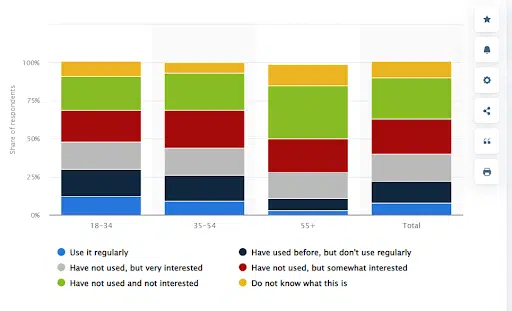
However, a survey conducted in 2022 on U.S. adults, aged 18 to 34 were more likely to use visual search regularly, taking a picture of a product and uploading it online to shop for it, 12 percent did.
That is the kind of performance that is getting business owners out of their comfort zone and into the social media arena. Whether you are a global eCommerce giant or an independent business owner interested in boosting their customers’ experience, you should find inspiration in the instances of the utilization of AI in e-commerce product recommendations and visual search.
So it is about time we explore this interesting area in more detail and find out two of the roles of Artificial Intelligence in eCommerce i.e.
- AI in product recommendations
- AI in visual search
But first, let’s understand,
Why AI in E-commerce Matters?
It gets you asking, why is AI in E-commerce Product Recommendations and Visual Search such a big deal, right?
It is, in nature, because it’s not just shopping, going there, and getting groceries or stuff you need and bringing them home. Success will mean choosing, educating, organizing, and informing; and convenience, satisfaction, and enjoyment will be the major factors in that case.
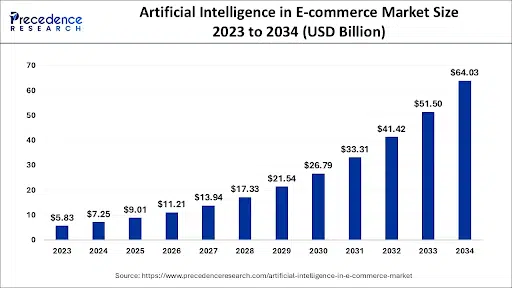
The total sales of the AI in e-commerce marketplace are forecasted to attain about 64.03 billion USD by 2034.
That’s huge! Then, what is really special about AI in e-commerce product recommendation and visual search?
Thanks to AI, it will not require so much effort and time-the amount of data one could compute within seconds means having AI observe a person’s preferences about shopping behavior or even prospect future purchases.
That is why consumers and businesses alike see great value in the recommendations of AI at this level of personalized targeting. Besides, visual search allows AI to provide the opportunity to find a product using the same picture as that of the product.
Now, let’s have an overview of these artificial intelligence applications in the eCommerce business one by one.
AI in E-commerce Product Recommendation
Recommendation of e-commerce products through AI has been revolutionary-is this fact not known to everybody? Imagine yourself entering a store and finding that all the aisles are actually made specifically to suit you.
That’s what AI is doing online: it understands what you browsed, previous orders, or just about anything other similar users purchase. The AI in recommendations and visual search of e-commerce perfectly catches this totally transformative influence as simple as deep.
With the unfolded given illustration, if one is to seek or hunt down running shoes, then the AI algorithms notice that, thus creating related products such as running socks and fitness trackers. On similar lines, if you will be seeking handbags, then some matching items may suggest themselves.

Such a recommendation is not a mere guess; it has to do with pattern recognition. Research shows that by using AI in recommendations, overall traffic sales can be increased. Isn’t that something every business owner has ever dreamt of?
Use Cases of AI in Product Recommendation
AI has an immense impact on product recommendation; there are many applications that can change the eCommerce environment. Let’s dive into a few key examples:
Getting in touch with the buyer on a personal level
First of all they enable a customized approach to shopping. Customers today want not only a unique experience while shopping via the Internet, aren’t they? AI can recommend items with more precision based on browsing history, previous purchases, as well as immediate data at the consumer’s handsets, among other elements that define customer interest. With this kind of personalization, customer satisfaction is boosted greatly. In fact, 90-91% of consumers, as Accenture reported, prefer to purchase products with the help of brands that offer personalized products and services.
Dynamic Pricing
AI, in particular, can assist with the application of dynamic pricing in product recommendations as well. This means changing the product prices depending on the volatility and what the customer gets from them. Every time there is a sale, AI algorithms can calculate and determine that the very moment is the right one for increasing the price. Isn’t that a smart move? Organizations today should hire AI developers who can leverage this technology to enable them to sustain their operations in this ever-liberalising market.
Cross-Selling and Upselling
AI is not only helpful in recommending individual products but it is also helpful in customer cross selling and product upselling. Based on the customer’s purchase history and habits AI is about suggesting complementary products or even better expensive products. For instance, when a customer is buying a laptop, AI offers to recommend the best laptop bag, or a laptop of a higher model. Apart from increasing its sales the above strategy also improves the shopping experience of the customer.
Inventory Management
Recommendation for products can also enhance stock flow in a business several ways through the use of AI. How, you ask? Having an insight on the customer buying pattern and preferences, AI helps organizations to hold the right stock. This in a way helps to ensure that those products that sell most are always in stock while at the same time avoiding a situation where a certain product is overordered, creating a stockpile. Effective inventory management makes a lot of sense and reduces costs while ensuring customer satisfaction.
Technologies Used for AI in Product Recommendation
Much about the technological approach for providing artificial intelligence in recommendation products is very interesting and intricate. However, we’ll keep it simple and focus on the key elements that drive these systems:
1. Machine Learning
Machine learning is at the core of AI any time it is being used for product recommendation. Artificial intelligence models use a lot of data from different sources to find regularities and use the results for predictions. Using customer information for example previous orders, sites they visit, or posts on social media these algorithms can anticipate what the customer wants. The key aspect of these algorithms is that they continue to learn; the higher their capabilities develop, the better their recommendations become.
2. Collaborative Filtering
Another critical technology is collaborative filtering. This feature works by making use of the behavior of like-minded users in assisting in the decision-making process. For instance if User A and User B have similar purchasing patterns, a product liked by User A will be recommended to User B. Such AI recommendation system development services is useful because never interaction solicits the power of users’ wisdom and offers relevant suggestions.
3. Content-Based Filtering
Whereas, content-based filtering centers on attributes of the product, the content of the media being filtered in this case. Though this interaction, AI can recommend similar products by knowing the characteristic features of products that the customer has used. For instance, if a customer purchases floral dresses often, the system will recommend other dresses made from floral materials or possessing a floral design. It also makes sure the recommendations given are as close as possible to the profile customer already has on a specific store or company.
4. Deep Learning
It can be defined as machine learning which is superior because it teaches like humans do. It is able to break data into layers and then send the processed information through layers, which increases the ability to recognize patterns. It is most helpful when used with unstructured data such as images, or even text. When used in the context of product recommendation, it may improve the performance of the Ai by both the velocity and the quality of the customer data inputs.
5. Natural Language Processing
Another area where understanding customer intent is quite important is when customers engage with search bar or chatbots; this is where Natural Language Processing (NLP) comes in. It is shown that using patterns and semantics, NLP can improve recommendations on relevant products. For instance, if a customer is looking for casual summer shoes, NLP makes the system to know what it’s dealing with and not just matching words only.
Benefits of Artificial Intelligence in Product Recommendation for eCommerce Companies
Applying AI in product recommendations presents significant opportunities to most eCommerce companies. Let’s take a closer look at some of the most significant advantages:
1. Increased Sales and Revenue
The most obvious advantage of using AI to recommend products is sale and revenue boost. Personalized recommendations can help businesses convince customer to buy more products. For that reason, McKinsey & Company was able to show that personalization generated five to eight times the ROI on marketing budgets and increase sales by 10% and above.
2. Improved Customer Engagement
AI in product recommendation can also be used in improving customer contribution. When clients are given recommendations relating to their past behaviors, they will spend their time possibly browsing the website. This activity can result into high conversion rates because the customers develop trust and loyalty towards the firm’s brands. However, who will not like a shopping experience that is made to feel like they care about you?
3. Better Customer Retention
They also do better at improving overall customer retention rates, thanks to the help of AI for product recommendations. The argument for positive shopping experiences with right product recommendations, consumers will be inclined to shop from the same online store again. It is as important as gaining new customers with customer loyalty in any competitive eCommerce environment. When employing AI in product recommendation, companies do have an opportunity to build good long-standing relationships with their customers. Just partner with an e-commerce software development company that can effectively integrate AI-powered recommendation engines into your online store.
4. Higher level of Customer Satisfaction
Now a day, it is very important that the customer must be satisfied with the business he is buying products from. In the case of product recommendation, the use of AI has the potential of enhancing the overall shopping experience by providing the right product recommendations. Happy customers are likely to write good things about the store, refer others to it and automatically become steady customers. This in the long run may lead to a improvement of brand image and thus customers trust on the product.
5. Effective Marketing Mechanics
It also breaks the chains of overcomplicated marketing plans in product recommendation using AI. This paper affirms that by studying on the customers’ preferences and behaviors, the marketing strategies can be developed to appeal to the customers. This also contributes a more efficient way of marketing so that when a businessman wants to promote his products, he or she knows the best product to promote. Subsequently this leads to increased conversion ratios and thus improved market effectiveness of marketing communication.
6. Reduced Cart Abandonment
Cart abandonment is a common issue in eCommerce, with studies showing that approximately 70% of online shopping carts are abandoned. AI-driven product recommendations can help reduce this figure by providing timely and relevant suggestions that encourage customers to complete their purchases. By addressing potential concerns or offering alternative products, AI can increase the likelihood of customers finalizing their transactions.
Real-World Example of AI in Product Recommendation
| Company | Product | AI Role in Recommendation |
| Amazon | Online Retail | Analyzes browsing history, purchase history, and product reviews to suggest relevant items (“Customers who bought this also bought…”, “Frequently bought together”). |
| Netflix | Streaming Service | Predicts user preferences based on viewing history, ratings, and genre to recommend movies and TV shows. |
| Spotify | Music Streaming | Creates personalized playlists and recommends new artists and songs based on listening habits. |
| Sephora | Cosmetics Retailer | Offers personalized beauty product recommendations based on skin type, past purchases, and preferences. |
| TikTok | Social Media | Curates a personalized “For You” page filled with videos tailored to individual interests. |
Now, let’s talk about AI in visual search.
AI in Visual Search
Visual search is another exciting application of AI in e-commerce that’s catching the attention of business owners. Imagine being able to find a product online just by uploading a picture. Sounds convenient, right?
That’s precisely what AI in visual search offers. By using sophisticated algorithms, AI can analyze an image and identify similar products available on an e-commerce platform.
This is where the real magic happens. Have you ever seen a product and wished you could find it online without knowing what it’s called? AI makes that possible by turning images into search queries. This innovation is making a significant impact on e-commerce, allowing shoppers to find exactly what they’re looking for in no time.
Visual search is all about convenience. Instead of typing in endless keywords, you can simply upload a picture. AI analyzes the image and brings up similar products available for purchase.
Retailers are embracing this technology because it directly improves the user experience.
Also Read: How to Develop AI Recommendation System
Use Cases of AI in Visual Product Search
In the world of ecommerce, AI in visual search is becoming a must-have feature. It offers unique ways for customers to interact with online stores, which is essential for staying competitive in the market.
1. Product Discovery
Imagine your customers capturing a photo of a product they like while walking down the street. They’ll upload that picture to your app or website, and with visual search, AI immediately surfaces items similar to your catalog. This will not only enable product discovery but turn browsers into buyers. It can be said that visual content is digested 60,000 times faster than text, hence visual search is quicker and more engaging.
2. Matching Outfit
AI in visual search can be a personal stylist at the fingertips of your customers. Customers will simply upload photos of an outfit they like, and your system will show similar available clothes and accessories in the store. The feature ranks among the greatest for personalized styling-something many fashion buyers are seeking today. This could see a serious increase in user engagement, even in sales-some studies indicate that personalization alone has a 10% or plus chance to raise sales.
3. Home Decor
AI can be of immense help in visual search for home design enthusiasts. Let them take pictures of any furniture or decoration piece they like, and the technology locates similar products in your online store. The feature will make shopping easier and reduce customer dissatisfaction because they find what they want to buy quickly. It has also been revealed that customers are 85% more likely to purchase after watching a video or image-based advertisement, let alone the power of visuals in driving buying decisions.
Benefits of AI in Visual Search for the Ecommerce Industry
So, what can AI in visual search do for your e-commerce business? Quite a lot! Here are some key benefits that can help drive success.
1. Improved User Engagement
First, visual search enhances user interaction. When users can obtain what they are looking for without having to do much apart from snapping a picture of an image, this indeed makes shopping easy and convenient for them. And as a result, such ease keeps customers longer on your site, perusing products and increasing their likelihood to buy. A study reveals that consumers would give more importance to what they see over text. That just points to the power of visual searching in commanding attention.
2. Improved Product Discoverability
Next is product discoverability. A lot of your unique products may not show up in traditional text searches, especially when customers do not know the right keywords to use. Visual search bypasses this problem by showing items based on visual similarity rather than text data, hence making product discovery easier for customers.
3. Increased Sales and Revenue
Obviously, better engagement and discovery mean improved sales and increased revenues. With AI in visual search making it easier to find what they want for consumers to purchase, that naturally reduces the buying circle. Those businesses that applied visual search reported sales jumps, even on many occasions. This amount of growth in numbers can make quite some difference in one’s balance sheets.
4. Competitive Advantage
Not to mention the competitive advantage: While more and more companies start using AI in visual search, being ahead of the competition really matters. Offering an innovative shopping experience can really make your brand stand out from the crowd and drive tech-savvy customers who value innovation. This will make early-integrated companies stand at the frontiers of e-commerce and prepare them to meet emerging demands for their target audience.
5. Customer Satisfaction and Loyalty
AI in visual search enhances customer loyalty and satisfaction. They would still be likely to return for their purchases when they feel understood and their needs met efficiently. Visual search allows the building of trust and satisfaction through correct and relevant product suggestions, thus fostering long-term customer relationships.
Technologies Behind AI in Visual Search
Now, let’s go into detail about the technologies that make AI in visual search possible. First of all, it all starts with computer vision-a subfield of AI that actually allows the computers to make sense and understand the world visually, in other words, to enable machines to process and analyze images much like a human would do.
1. Deep Learning
This form of machine learning is an important ingredient of computer vision, wherein neural network algorithms are applied for the maintenance of patterns in data. Neural networks functionally or conceptually emulate the way humans view images within the human brain and happen to be quite good in patterns related to imagery. On any visual search, deep learning algorithms evaluate the pixels within an image to establish crucial features in it, that are to be then crosschecked against a product database; with which the algorithm may return the recommendations.
2. Image Recognition
Another important technology is image recognition, which includes the identification and labeling of objects within an image. For instance, if a user uploads a photo of a handbag, image recognition technology will identify it as such and then match it with similar products. This capability is crucial for the accuracy of visual search results. For the year 2025, it reached over 99% in terms of accuracy for image recognition, which means business persons can confidently rely on the same to deliver correct results.
3. Natural Language Processing
While the focus is on images, visual search in AI does involve natural language processing. NLP will help in understanding any text accompanying the image or even user-provided descriptions. The union of image data with text data will make the results of the search more accurate and personalized. For example, if the user uploads an image of a red dress and types of evening wear, NLP will give priority to those results that fit both the visual and textual criteria.
Real-World Examples of AI in Visual Search
Obviously, AI in Visual Search is not some concept of the future; it finds its place in the strategies of leading companies across multiple industries. Let’s look into some real-world examples of showing its prospect and impact.
1. Pinterest Lens
One example of such use is Pinterest Lens, where you snap anything around you, and the system returns you with a list of pins or products associated with what you are pointing at. Such creativity with AI in Visual Search will make users want to do more with the content and stay longer on the platform. It has quickly evolved to be one of the fast-moving ways of finding inspiration, styles, and new products by showing how much visual search can enhance the user experience and drive user engagement.
2. Amazon StyleSnap
Another excellent example is Amazon StyleSnap. Using this feature, users can upload photos or screenshots of fashion items they like, and Amazon will suggest similar products available on its platform. StyleSnap makes shopping simpler, more personalized, and quicker for customers. Thus, with AI in Visual Search, Amazon can provide seamless shopping experiences tailored to individual preferences.
3. Houzz
Another company, Houzz, also employs AI in Visual Search: this home decor company provides a Visual Match tool where users can upload photos and find furniture and decor items that match their style. By making it easier for customers to find items that will go well with what they already have in their homes, Houzz’s Visual Match enhances the shopping experience and customer satisfaction.
4. Sephora Visual Artist
The Visual Artist tool by Sephora, within the beauty world, is just the perfect example of AI in Visual Search. In that, clients can upload the picture of any makeup they fancy, and a list of products to be used in that look would just appear for them to buy. Sephora’s visual artist makes the process of finding makeup products easier to amuse customers and at the same time creates brand loyalty.
5. IKEA
IKEA, a furniture seller, has also used AI in visual search through its app: IKEA Place. With this app, the customer can take pictures of any living space and then gets recommendations for products to suit their style. Therefore, IKEA develops a personalized shopping experience in which customers will be more likely to be engaged and make a purchase.
Wrap up
Therefore, changes continue to occur in the space of e-commerce product recommendation and visual search through quite a number of ways as AI burrows deep with each passing day. All these have been helping entrepreneurs create superior customer experiences that lead to increased sales, creating value from offerings on every platform.
Obviously, more than being a trend, AI is the power to reshape the future of online shopping. Ready to power up your e-commerce product recommendations and visual search to the next level with AI? It’s an investment in your business’s future that you will never regret. Hire an AI software development company for better help. With the capability to increase sales and offer a personalized shopping experience, AI is not something you would want to miss.