
The pace of speeded software development is creating greater obstacles in ensuring quality, speed, and efficiency. Traditional methods of testing may have suited their own times, but today they do not accurately match modernization demands for agility and precision.
AI shows new hope for the field, changing the entire face of software testing and quality assurance. The way how teams look into testing is transformed altogether and customizes the whole package from enhanced test coverage to reduced release cycle times. AI has benefits that cannot be matched, such as repetitive tasks, predicting defects, and enabling continuous testing.
This blog captures how AI redefines the test process in software testing and delivers reliable and quality applications for consumer markets today.
The Role of AI in Revolutionizing QA Software Testing
The worldwide AI in Software Testing Market is predicted to reach around USD 10.6B by 2033, expanding at a CAGR of 18.70% during the forecast period from 2024 to 2033.

Testing in software has come a long way from where it was. Testing in earlier days was considered a very mechanical and manual test; it consumed lots of time and energy from the QA team. Auto-testing has brought about considerable changes, and now, it can be run a little faster and even better. A continuous testing environment is created wherein automated tests would contribute to the product delivery pipeline for risk mitigation in every release.
However, the fast speed in delivering products cannot match the increase in speed by traditional means of testing. Now, future software testing uses artificial intelligence (AI), a revolutionary stride that can be the answer for these modern needs. In fact, it is emerging with the rapidity companies are trying to invest in providing efficient and accurate speed in the processes for their testing.
The global AI-enabled testing market was estimated at $414.7M in 2022 and is anticipated to grow at a CAGR of 18.4% from 2023 to 2030.

A New Age in Software Testing: AI Technologies
As software becomes increasingly agile and sophisticated, so do the mechanisms of AI and software testing. These are routine process automation, improved precision, and predictive power that enable an organization to achieve faster time-to-market and lower costs while delivering a high-quality product. And a lot of AI development company can help you with this. Some of the AI-edged technologies that influence software testing are Machine Learning (ML), Natural Language Processing (NLP), Predictive Analytics, and Robotic Process Automation (RPA).
1. Machine Learning (ML)
Machine Learning spearheads automated generation and execution of test cases. By interpreting large amounts of data, an ML algorithm identifies the pattern and provides testers with a general directive of the test cases likely to have failures based on historical failure. Hence, a more precise testing effort is spent on the most-risk area, causing less time and resource usage. Moreover, ML really improves its predictions over time, thus making the test cycles more effective and precise.
2. Natural Language Processing (NLP)
NLP thus bridges the gap for improvement in inter-stakeholder communication with the tester by bridging human language into structured test cases. Most test scripts can be automatically generated from requirements or user stories, usually written in plain, natural language, thereby reducing the need for manual intervention and better aligning business needs with test objectives. NLP extends to analyzing vast amounts of documentation for ambiguity detection and exposes comprehensive test coverage across all requirements.
3. Predictive Analytics
Predictive analytics is used by businesses to improve their methods of predicting defects and performance issues on the basis of their assessment of historical test data as well as past software behavior.
It attempts to recognize behavioral patterns or trends, thus modeling where the highest likelihood of problems lies, such that the business can, therefore, identify areas for pre-emptive action toward resolution.
Data-based decision-making is a proactive approach aimed at lowering the chances of defects after a release and enhancing the optimization of tests toward speedier, more reliable software delivery.
4. Robotic Process Automation (RPA)
For repetitive, rule-based processes such as data input, regression testing, and generation of reports, test activities are immediately automated through RPA, thus significantly saving labor while reducing the margin for human errors. Speed, precision, and scalability are gained by these automated processes in software testing.
It allows testers to focus on complex and worthy test cases, thereby increasing their productivity and enabling test teams to manage more extensive and complex software systems without over-staffing manual efforts. RPA ensures consistency across test environments and iterations.
The Transformative Role of AI in Modern QA
The complexity of modern software systems lies beyond the grasp of traditional testing techniques. Thus, AI has become vital in tackling these problems and improving quality assurance (QA) processes across the ai in software development lifecycle.
It speeds up and makes more efficient and proactive solutions to satisfy modern testing requirements. In this way, it changes how QA teams work.
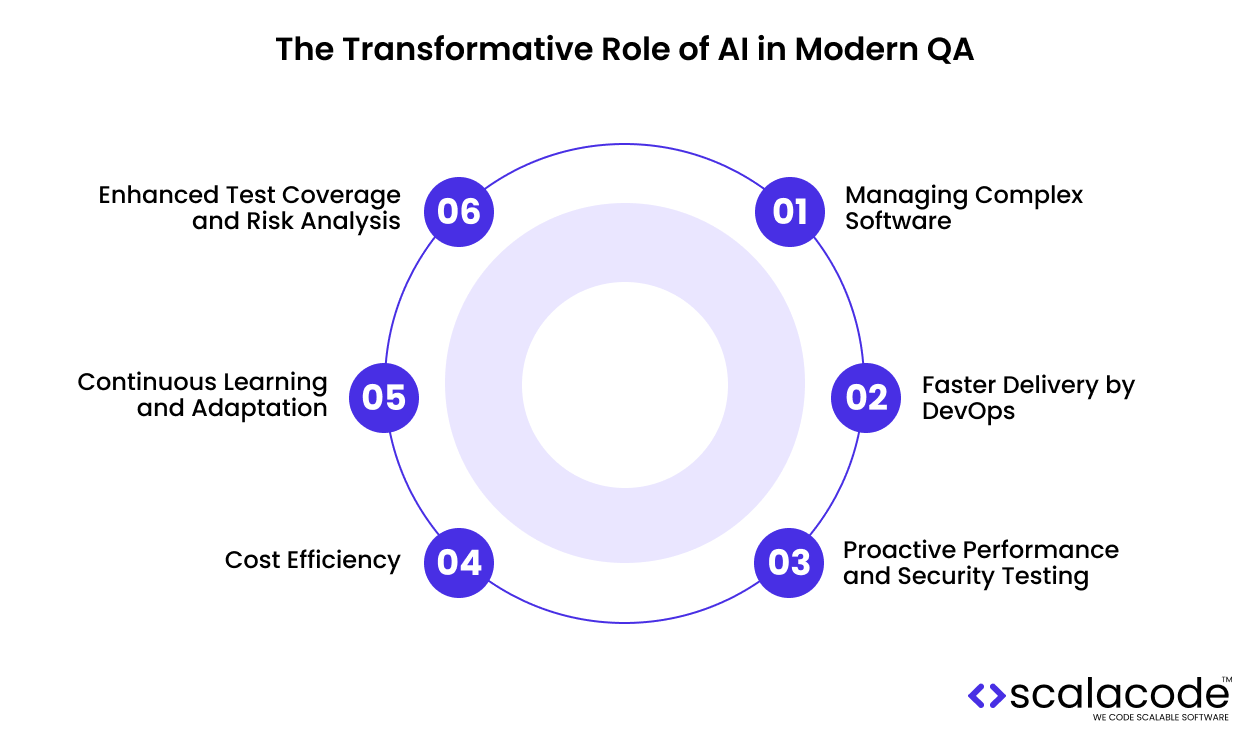
1. Managing Complex Software
The traditional testing on the complex software programs is now as insufficient as ever. Ai now employs data sets and establishes patterns that cannot be recognized by human beings.
Potential issues can be addressed at early stages by scrutinizing the areas under-tested for risks, making it easy for the teams to test and adjust as the software evolves, thus increasing testing accuracy and reducing the chances of defects.
2. Faster Delivery by DevOps
AI enables the speedy delivery of software, an aspect that is central to most DevOps environments. Case automation involves test generation, execution, and end-to-end integration into CI/CD pipelines. It is made easy by identifying HTML document proof code changes amidst real-time time, leading to instant defect detection and time-saving on debugging.
Hence waiting time is reduced with respect to this and therefore feedback is faster to allow teams to work with an agile development environment.
3. Proactive Performance and Security Testing
Hints can be given quite early by AI tools to indicate performance and security faults that will occur in time. It runs several simulation and historical data scenarios to find performance as well as security bottlenecks before they happen or even before they are imaginable.
This kind of early stage detection reduces the occurrences of performance failures and security intrusions once in production and reinforces the software reliability and security before it gets to the end users.
4. Boost Cost-Efficiency
AI offers cost-efficient automated testing solutions in all repetitive functions, such as regression testing and data validation preparatory activities. Automated testing limits manual testing, which consumes a lot of time and energy. AI puts much emphasis on high-risk areas for the work of the team to focus on standardized beyond requirements. As such, this process results in optimizing tests, thus lowering operational costs while maintaining high quality; hence, a win-win situation for the development team and the business.
5. Allow for Continuous Learning and Adaptation
Besides, AI could have the capability to learn and learn and learn, from time to time, new data or from the fact that the systems would go through a continuous change. Such capability over time allows for improving the efficiency of a testing process with such learning from formerly executed tests regarding prospective test-case generation and forecasting of errors. The requirement of adaptation will give companies the freedom to keep an eye on rapidly emerging software updates as well as new technology introductions without any changes in their testing process.
6. Amplified Testing Coverage with Risk Assessment
It could be that this will enable AI to increase the extent of test coverage that would not ordinarily be considered in traditional testing: edge cases and scenarios. By inspecting the code structure, historical defects, and user behavior, it will be possible to predict and test possible weak spots that are often overlooked. This thoroughness ensures that a whole lot more about the facet of the software has been tested, thereby improving the quality and lessening the chances of an issue slipping through the cracks in the testing process.
How AI-Powered Test Automation is Revolutionizing Quality Assurance
An organization can improve its overall QA processes significantly by incorporating AI into its testing processes. Here are some of the major advantages:
1. Increasing Test Efficiency

AI-based test automation reduces the overall testing time by automatically generating and executing test cases. This reduces the workload on manual activities, allowing those involved with quality assurance to focus on high-value work such as exploratory testing and optimizing user experience. With most mundane tasks automated, testing becomes really fast and productive, thus speeding up the entire process and allowing early release.
2. Consistency and Accuracy in Testing
AI-enabled testing tools offer continuous and steady results across test cycles. Proper defect identification with pattern recognition and anomaly detection makes sure that testing is accurate, as most of the time, such situations are very complicated. Furthermore, such features eliminate the likelihood of human error during testing, resulting in much-improved quality results, even in very complicated or extremely large-scale systems.
3. Comprehensive Multi-Layer Testing
AI swims across all layers covering the entire software testing spectrum right from user interface to backend systems. Along with this, predictive analysis by AI anticipates the possible problems and allows proactive testing for absolute application validation. Such a meticulous approach anticipates risks at a stage before they escalate, thus sparing the organization from costly issues in production.
4. Defect Detection at an Advanced Level
The most significant advantage that AI has is its wonderful capability to process gigantic amounts of data in a very quick and energy-efficient manner. It helps in digging out very particular defects and edge cases that are usually missed by the traditional and manual ways. The accomplished provision of coverage helps ensure that almost everything in the system is being tested, which makes sure that there are minimum missed issues and that the end product is polished.
The Advantages of Incorporating AI into Quality Processes
Here are some of the key benefits of integrating artificial intelligence into quality processes:
1. Enhanced Quality Indications With Better Decision Making
Artificial Intelligence is trained to analyze the data generated through various quality channels, such as complaints, customer feedback, or audit reports, and illustrates the analysis, paving the way toward first informed decisions towards the quality improvement process at later stages. Enables the team to work on high-focus areas, improving overall quality management business needs.
2. Constant Learning and Adoption
AI can learn and continue evolving through newer data and feedback now. With such consistent learning, AI-driven tools continuously adapt to quality shifts, increase their accuracy in defining the inspection process, and deliver efficiency over time. The more the numbers are, the better they are at predicting and preempting defects.
3. Proactive Alerts and Real-time Monitoring
AI-enabled tools keep real-time track of quality parameters and generate on-the-spot alerts once the limits are crossed. Such immediate reactions by the system would enable the teams working on quality improvement to identify and repair problems before they grow, as well as minimize interruptions in operations and workflow caused by inefficient operations. Efficiency is real-time monitoring regarding operations within the facility to minimize downtime and productivity issues.
Also Read: Cost to Develop an App in 2025
Practical Applications of AI in QA Software Testing
Here are ways Artificial Intelligence has influenced the testing process and promoted quality advancement in the software development life cycle.
1. Automated Test Case Creation and Maintenance
With its advanced GenAI models, AI can even analyze application requirements to automatically generate relevant and context-aware test cases. This creates a direct impact on the test case creation speed, keeping it in step with continuously evolving applications. Real-time adaptation of test cases as the software evolves reduces maintenance effort and keeping tests up-to-date with minimal manual intervention.
2. Predict and Prevent Defects
AI uses historical defect data to predict future hotspots in the application, analyze these previous patterns, and predict defect-incurring factors so that corrective action can be done before users come to terms with it. This predictive ability will help not only improve the overall quality of the product but also minimize the chances of defects post-release.
3. Test Execution and Automation
Automated test execution and the advantages of automating the different forms of testing, including functional, regression, performance, and security testing, are all possible with the aid of artificial intelligence.
Automation helps to execute tests in an efficient way that is faster than manual tests require, as well as ensures improved accuracy and the ability to cover a greater number of testing scenarios. It increases cycles and gives faster feedback by making improvements in speed and getting more reliable results.
4. Root Cause Analysis
AI has greatly enhanced speed and accuracy in root cause analysis by rapidly identifying the root causes of defects. This enabled the QA teams to minimize debugging time and fix issues, thereby shortening delays in a development cycle. Now, the ability to conduct root cause analysis enabled by AI has improved efficiency in perennial problems of the teams at large.
5. Performance Testing
AI can mimic users’ complex interactions and thus measure performance metrics to help spot potential bottlenecks within the system. Like an actual usage scenario, the applications can run heavy loads of operations and still be fit to perform while moving under different conditions, ensuring that optimum use is experienced and the software meets expectations in real-life environments.
A travel company implemented a GenAI-powered testing framework as a use case for AI-based applications. The solution empowered the ability to detect defects much more quickly, while also providing an improvement in the reliability of applications to use, resulting in more satisfied customers.
Say goodbye to manual bottlenecks and hello to faster, smarter testing powered by AI.
Challenges and Considerations in Implementing AI into QA Software Testing
1. Data Quality and Availability
The accuracy of AI-driven tests entirely depends on good quality data, without which AI cannot be made to reflect its best self. Almost all AI algorithms’ effectiveness depends on the actual and comprehensive data available for training and validation.
False and inadequate data fed into the AI used in QA will not analyze defects or suggest improvements in a reliable manner. Therefore, organizations must have strong data management in place to make the most out of AI.
2. Gaps in Skills
AI implementation in testing necessitates skills that the majority of QA teams do not now possess. To ensure maximum efficiency from AI, companies must invest in training and development programs to nurture their skills within their teams. Thus, all the members can now effectively utilize the AI tools and integrate them with the existing processes.
3. Ethical Concerns and Security Concerns
AI in testing has all of the above ethical and security-related implications of data privacy and bias as it engages in data processing. Properly ensuring responsible AI actually prohibits the occurrences of data breaches in testing results or discrimination among them.
Thus, strong ethics and security frameworks shall be well defined and initiated in such organizations to address these concerns for responsible penetration of AI technology into the testing process.
4. Integration with Existing Tools
Seamless integration of AI with existing testing tools and workflows is imperative for the complete adoption of AI. Depending on how it is planned and executed, the advent of AI might actually disrupt the process and bring in inefficiencies, if not properly done.
Therefore, organizations must very strategically plan towards AI integration to ensure it fits in the overall existing toolset, making the transition much smoother, hence maximizing the value of AI implementation.
How Can ScalaCode Help You Overcome Such Challenges and AI Development?

ScalaCode is a top-notch software testing company with vast experience in AI solutions within various industries, such as software testing. Our professional AI experts team supports organizations in battling several challenges related to data quality, skill gaps, ethical concerns, and complexity in integration.
At ScalaCode, end-to-end support is rendered, right from building strong data management frameworks to assuring quality data for training AI and custom training programs for upskilling QA teams. From AI development services to testing solutions, we do it all.
Explore More: Top Software Development Companies in India
Conclusion
AI is revolutionizing the QA software testing landscape by making all parts of the test lifecycle efficient, accurate, and flexible. From predicative defect detection to improved test coverage, AI helps QA meet the needs of modern software development.
Organizations like ScalaCode enable companies to take the complete benefits of AI, optimizing workflows while delivering quality applications. With the evolution of AI, adapting to this technology has changed from optional to mandatory in order to remain competitive. So, when you hire software developers from us you gain access to AI expertise that pushes innovation in your QA processes.
FAQs
1. What will AI bring to software testing?
AI will improve efficiency and test coverage, as well as increase accuracy. It automates repeatable processes, predicts defects, and allows continuous testing so that QA professionals can spend time innovating and enhancing user experiences.
2. How does AI even predict defects in software testing?
AI adapts historical data, using advanced algorithms to recognize the patterns, pointing to a probability of elements failing. Therefore, it enables proactive teams to act on predictions before they visit the end-user.
3. Can AI achieve a complete takeover of manual testing?
No, AI cannot do without manual testing since there are repeatable and boring tasks for which manual input is no longer sufficient. However, exploratory and some types of creative testing still need human participation.
4. Why is data quality so critical for AI testing?
AI requires proper and ample data for training and validation. Poor data will result in unreliable results and minimize defect prediction and automation efficiency.
Revolutionize your testing process with intelligent automation and precise defect detection.