
AI evaluation services that prove your AI works, before and after launch
Our AI evaluation services build test sets from the questions your users ask, score every model, prompt and data change against them before release, and add AI observability in production. You see answer quality, cost and latency for each release on one dashboard.
AI systems running in production
clients served since 2012
shipping software since 2012
on Clutch, from 33 verified reviews
countries with live clients
9001:2015 certified delivery process
Trusted by teams at








Clutch 4.8/5Verified client reviews

GoodFirmsReviewed software partner
ISO 9001:2015Certified delivery process
GDPR compliantData handled under EU rules
What AI evaluation services involve
A demo that looks right on a handful of questions says little about how the system handles live traffic. Evaluation turns that judgment into a score you can track.
- What is AI evaluation?
- AI evaluation is the process of measuring how well an AI system answers, using a fixed set of test questions with agreed correct answers. Each model, prompt or data change is scored against that set before release, and production answers are sampled and scored after launch to catch drift in quality, cost and latency.
Related: RAG development needs retrieval scored as well as answers. LLM development uses the same test sets to compare models.
AI testing at each stage of a release
Each check runs at a different point and catches a different kind of failure, so production systems need all four.
| Golden test set | Release gate in CI | Canary and shadow release | Production monitoring | |
|---|---|---|---|---|
| When it runs | Built before launch, then extended as new questions come in | On every model, prompt or data change | When a new version first meets live traffic | Continuously, on sampled live answers |
| What it catches | Wrong answers, missing sources and unsafe replies on known questions | Regressions a change would ship to users | Differences between the new and current version on live questions | Drift in quality, rising cost and slow responses |
| What your team sees | A scored baseline per question type | A pass or fail on the pull request | Side-by-side scores for both versions | Dashboards and alerts for quality, cost and latency |
| Where it falls short | Covers only the questions in the set | Only as good as the test set behind it | Needs enough traffic to compare | Spots problems after users have seen them |
Evaluation records also serve as evidence for auditors. See AI governance and compliance.
LLM evaluation we set up
LLM evaluation that runs inside your release process, owned by your team once it is in place.
Golden test sets
Before launch we collect the questions your users ask, with the answers and sources your experts would accept.
Retrieval scoring for RAG
Checks that the right passages come back for each question, so retrieval faults are found before answers go wrong.
See RAG developmentAnswer scoring
We score correctness against expected answers, faithfulness to the cited sources and the tone your brand allows.
Release gates in CI
Every model, prompt or data change is scored against the test set, and a drop in score blocks the release.
Model comparison
Candidate models from OpenAI, Anthropic, Google or open-weight families scored on your own questions, with cost per answer.
See LLM developmentTracing
We record each request with its prompt, retrieved context, response, latency and cost, so failures can be replayed.
Evaluation dashboards
One view shows quality, cost and latency per release and per question type, in a form your product owner can read.
Alerts on drift
Alerts fire when sampled answer scores fall, cost per request rises or responses slow down.
Audit of an existing system
We audit an AI system another team built, run a baseline evaluation and hand you a ranked list of fixes.
Unsure whether your AI system is getting better or worse
Tell us what it does and how you check it today. We will show you what an evaluation set and dashboard would look like for it.
AI observability in production
AI observability links every live answer to the version that produced it, so a drop in quality traces back to one change.
Release gate
A change only reaches users after it scores at least as well as the current version on the golden test set.
Canary release
A new version serves a small share of traffic first, and is rolled back if its scores, cost or latency fall behind.
Shadow deployment
The new version answers the same live questions in the background, and only the current version's answers reach users.
Production monitoring
Traces of sampled live answers are scored, and alerts go to the owner when quality, cost or latency moves.
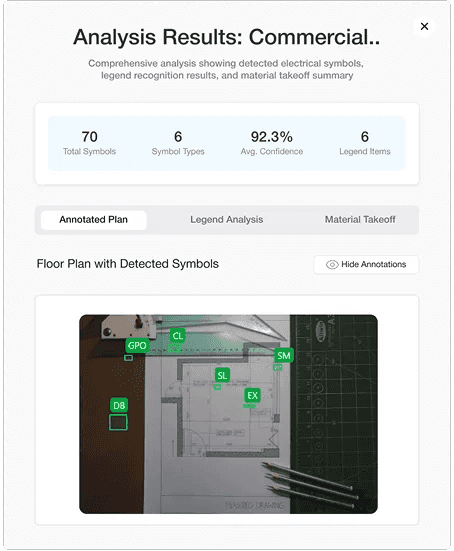
Planwise: AI electrical takeoff from residential plans
OCR and computer vision read each plan's own legend and count every lighting, power, fan and data point. Bounding boxes on every detection let electricians check and correct the counts before they quote.
Takeoff cycle time, per the client
How we set up AI evaluation
For a new system, evaluation is built during the 3 to 4 week proof of concept and carried into production. For an existing system, it starts with a technical audit.

One team, 14 years of shipping
projects shipped since 2012
AI systems running in production
clients across 45+ countries
years building software, since 2012
Your test data stays under your control
Evaluation sets are built from your own questions and records, so they get the same protection as the system they test.
Access control
Test sets and traces sit in your environment, readable only by the people you approve.
Redacted traces
Personal fields can be masked in traces and test sets before anyone outside your team sees them.
Yours from the first commit
Test sets, scoring code and dashboards are your IP, and NDAs are standard.
One accountable team
The engineers who build your evaluation suite also run it after launch.
Evaluation and observability tools we use
We use the monitoring tools you already run where they fit, and add tracing and scoring where they are missing.
Where AI evaluation matters most
Workflows where a wrong answer reaches a patient, a customer's money or a public channel.
Healthcare
- Clinical drafts checked against sources
- Refusal tests on unsafe questions
Financial services
- Policy answers scored for accuracy
- Records kept for model risk review
Retail and eCommerce
- Product answers checked against the catalogue
- Support replies scored before release
SaaS platforms
- In-app assistants scored per release
- Cost per tenant tracked
AI evaluation services cost
Evaluation is priced as part of the work it protects. A free discovery sprint is the usual starting point.

Evaluation discovery sprint
1 to 2 weeks and free, ending in a written proposal with a fixed quote. Technical audit, first evaluation set and a plan for gates and monitoring.
Best for a live system with no reliable way to measure quality.

Proof of concept with evaluation
From $4,999, 3 to 4 weeks. A working prototype on your data, scored against an evaluation set built from your questions.
Best for proving a new AI use case with numbers before the full build.

Dedicated AI engineers
Engineers who run evaluation and monitoring inside your repositories and CI, from $1,799 a month per engineer.
Best for teams running several AI systems that change often.
Rated 4.8/5 by the clients we build for
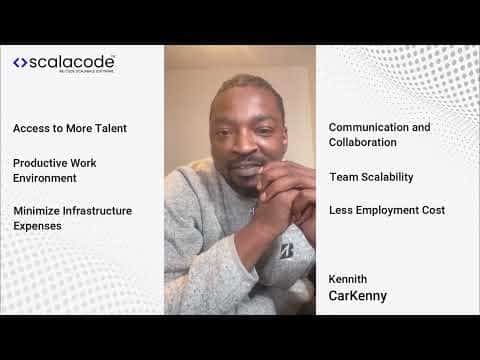
Verified reviews from Clutch and GoodFirms, and clients on camera.
33 verified reviews on Clutch
 Clutch review★★★★★
“What sets ScalaCode apart is their technical AI expertise and an understanding of a client's organizational ethos.”
 GoodFirms review★★★★★
“They built a high-performance, AI-powered platform that transformed video engagement for learning.”
Clutch review★★★★★“What stood out to us as most impressive and unique about ScalaCode was their ability to humanize complex AI.”
Clutch review★★★★★“They managed to balance technical skill with an understanding of the marketing world.”
Clutch review★★★★★“Their team often proposed innovative features we hadn't considered.”
Clutch review★★★★★“They didn't just build an algorithm; they built a tool that respects the nuances of Indigenous reconciliation.”
Clutch review★★★★★“What I found impressive about ScalaCode was their ability to listen to the soul of an educational mission.”
AI evaluation services FAQs
We will answer anything not covered here on the call.
How do you build an evaluation set?
We collect questions from your users, support logs and subject experts, then your experts approve the expected answer and sources for each one. The set includes hard cases and questions the AI should refuse. It is built before launch and grows as production failures are added.
Which metrics do you track for LLM systems?
For LLM systems we track answer correctness against expected answers, faithfulness to the cited sources and, for RAG, whether retrieval found the right passages. In production we add cost per request, latency, refusal and escalation rates, and user feedback. The business measure agreed at the start sits on the same dashboard.
Can you evaluate an AI system another team built?
Yes, after a technical audit. We review the architecture, prompts and data flow, build an evaluation set from your questions, and score the system as it runs today. You get a baseline and a ranked list of fixes, whether or not we make them. Routine traffic can then move to a small language model that passes the same tests, which lowers cost.
Which observability tools do you use?
We often use Langfuse for tracing and Ragas for scoring RAG answers, alongside dashboards and alerts in your existing monitoring stack. When your team already runs a tool that covers tracing or evaluation, we build on it. You can also hire MLOps engineers to own the monitoring day to day.
How much do AI evaluation services cost?
AI evaluation services usually start with a free 1 to 2 week discovery sprint. A proof of concept with its evaluation set starts at $4,999. Ongoing evaluation and monitoring by dedicated engineers starts at $1,799 a month.
How often should an AI system be re-evaluated?
Every model, prompt or data change should be scored against the evaluation set before release. Sampled production answers should be scored continuously and reviewed weekly. Re-run the full set whenever your model provider releases a new version, even if your own code has not changed.
Does AI evaluation slow down releases?
Scoring runs automatically in CI on each change and replaces the manual spot checks teams otherwise do before a release. Changes that pass ship as usual, and only changes that lower the score are held back.
How does evaluation support AI compliance?
Scores for each release, kept with the model version and test set used, give auditors evidence of how accuracy was checked. We store them alongside the audit logs and model documentation described on our AI governance page.
One team, matched to your working hours
We schedule 4 to 6 hours of daily overlap with US time and a full working day with the UK and Europe, so reviews, demos and fixes happen during your working hours.
They built a high-performance, AI-powered platform that transformed video engagement for learning.
Know whether your AI works, release after release
- 30 minutes with the ScalaCode team
- How to measure the AI system you run or plan
- What evaluation and monitoring would cost

“Their approach, dedication and project execution played a critical role in TipStars' success.”
James Ellis, Founder, TipStars