


While shopping online you see some products that you were thinking of buying. Even if you’re just having a conversation with a friend about any product, you suddenly see that the social media feed is offering information about it.
Have you experienced that?
Undoubtedly, yes, for most of us!
But did that make you curious to know why this is happening? If so, let us quench your curiosity. The recommendations you see are due to the presence of an AI recommendation engine.
You may agree that personalization isn’t just a luxury but an expectation.
From Netflix suggesting the next movie one should watch to the ad campaigns flashing to buy the favorite product, AI recommendation systems have acquired today’s digital landscape. They have become integral to our daily online experiences.
But how exactly do these tools work? What benefits does it have for the business leaders? And, how to develop AI recommendation systems?
Well, that is too many questions, but we have answered them all. Continue your reading, as this blog has all the essence that one should know in order to develop an AI recommendation system.
Let’s start this blog by getting on the basics i.e.
What is an Artificial Intelligence Recommendation System?
Artificial Intelligence (AI) is a branch of computer science that aims to create machines capable of intelligent behavior. Recommendation systems, on the other hand, are tools or algorithms that suggest products, services, or information to users.
So, when we combine these terms and their capability, we get AI recommendation systems. Basically, this mixture of technologies provides more personalized and accurate suggestions.

These things could be anything from movies on Netflix, products on Amazon, products on SERP, songs on Spotify, or even articles on a news website.
The whole idea behind developing an artificial intelligence recommendation system is to help users discover things they might like, based on their previous behavior, past purchases, demographic information, search history, preferences, and other factors.
However, Elaine Rich was the one who coined the first recommender system back in 1979, called Grundy.
For an AI recommendation system, we have to code an AI algorithm somewhere that also includes machine learning, so that it’s easy to use Big Data in a way to recommend stuff to consumers.
Want to know in depth, how exactly it is working? Read the section below:
How do AI Recommendation Systems Work?
As said, AI recommendation systems utilize machine learning algorithms to analyze user data and predict preferences. Besides, the working of these systems employs various techniques to make personalized suggestions. How? Let’s break it down step-by-step to see how these recommendation system AI projects operate.
1. Data Collection
First things first, hire AI developers to dig in-depth. Now, let’s get back to the first step of how the AI recommendation system works.
Data collection is crucial. AI recommendation systems gather data from users to understand their preferences. This can include:
- Browsing history: The pages you visit or the items you click on.
- Purchase history: The things you buy.
- Ratings and reviews: The ratings you give to movies, books, or products.
- Search queries: The keywords you type into the search bar.
2. Data Storing
Once data is collected, the next step is data storage. But why is this important? Simply put, data storage allows the system to keep all the gathered information in a structured manner.
This data is stored in vast databases, often cloud-based, which can handle massive volumes of information. Think of it as a huge library where all your data is cataloged and ready for analysis.
Cloud storage is particularly popular because it offers scalability and flexibility. For instance, Amazon Web Services (AWS) and Google Cloud Platform (GCP) are commonly used for storing such massive data sets.
3. Analyzing the data
In this step, the collected data has to be analyzed by the AI system to look for patterns and relationships. This analysis involves:
- Statistical Analysis: Some of the simplest qualitative analysis techniques are used to reveal patterns.
- Machine Learning Algorithms: Such algorithms can be supervised learning, unsupervised learning, and reinforcement learning.
- Natural Language Processing (NLP): If the data is textual in nature, then NLP supports in understanding the context and the sentiment of the text as well.
Analysis techniques in recommendation systems involve the use of acts as filters on the user involvement data.
For the immediate response to customers, lean real-time systems analyse data as it is compiled, with the help of event-stream tools.
Batch analysis processes data at certain intervals, for instance, daily, which is ideal for later email recommendations.
Both near-real-time and event-driven updates the data within the time frame of several minutes or even seconds, which is suitable for same-session advice.
4. Filtering the data
In recommendation systems, filtering is used to get information that a particular user needs to make recommendations.
Some of the methods include content-based, cluster-based, or even collaborative filtering.
Ratings or interaction data can also be stored in matrices and connected with the help of some relations, such as K-Nearest, Jaccard coefficients, Dijkstra’s, or cosine similarity.
Recommendations are provided either immediately or at a later time, depending on how timely they need to be, such as PDA or e-mail.
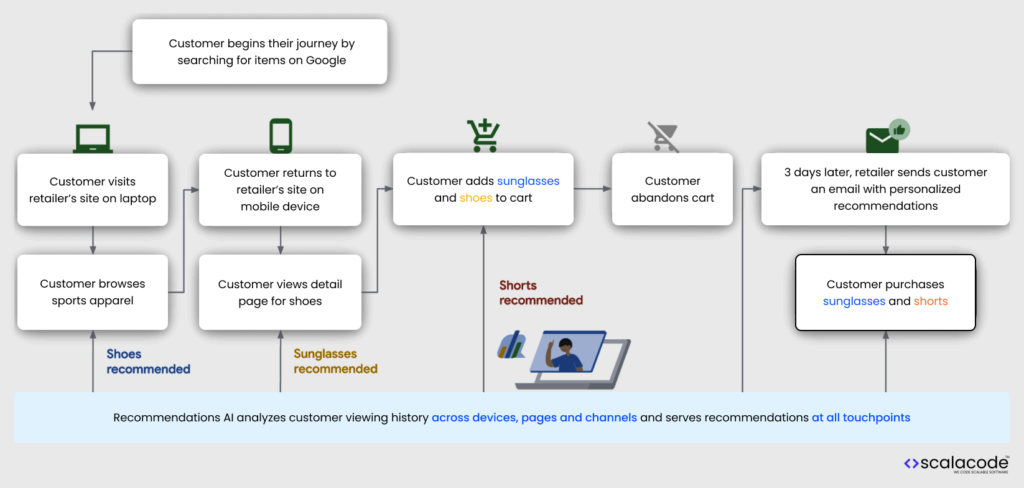
There we have it- now we know how the AI recommendation system works. But is it in demand or not? That is what we will see in the next section.
AI Recommendation System: Market Overview
In 2021, the global recommendation engine market size was USD 3 billion. Whereas, it is expected to be valued at USD 54 billion by 2030.
Therefore, it is expected to grow with a CAGR of 37% during the forecast period (2022 to 2030).

Next up, the AI-based recommendation system market size is a value of $2.01 billion in 2023 and may reach $2.21 billion in 2025.
Not just that, but expert predicts it will reach $3.28 billion in 2028.

Steps to Build an AI Recommendation System
Now, you should know that an AI-based recommendation system is an organized process that requires careful planning and, most importantl,y better execution.
But how to do that? Let’s have a look at the key steps involved in creating an AI-based recommendation system.
Step 1. Understand the Business Needs
The first step in the AI recommendation system development process is to -have a clear picture of what you want it to do.
We mean this, whether you have to use that recommendation system in an eCommerce website or have to use it in the social media domain.
Clearly define the goals of the recommendation system. Have some questions for yourself; What specific outcomes are you aiming for? Will it be:
- Gen AI recommendation system
- AI-based music recommendation system
- Movie recommendation system using AI
- Book recommendation system using AI
- Product recommendation system using AI
Similarly, identifying your target audience initially helps in creating a roadmap for the recommendation system. It is important that you are clear with the business objectives from the start.
Step 2. Data Collection & Processing
According to a 2022 report by experts, 97.0% of businesses are increasing investments in data, and among them 91.0% investing in AI activities.
This number itself highlights the importance of quality data and integration of AI in making the proper use of raw data.
One thing is important to understand-
‘Data is the backbone of any AI recommendation system.’
You’ll need data on user behavior, preferences, ratings, and interactions. This could be in the form of purchase history, search history, clicks, or even social media activity. The more data you have, the better your recommendations will be.
However, make sure the data is clean, accurate, and relevant.
Once you have your data, the next step is to preprocess it. This involves cleaning the data by removing duplicates, handling missing values, and normalizing it. You can also transform the data to make it suitable for your model.
For instance, converting categorical data into numerical values. Preprocessing is crucial because garbage in equals garbage out; if your data is flawed, your recommendations will be too.
Step 3. Choose the Right Model For the Recommender System
Next, select the model that best suits your needs. There are several AI recommendation models, among which are
- Collaborative filtering
- Content-based filtering
- Hybrid filtering

Step 4. Model Training
The next crucial step to build an AI recommendation system is the training model you pick. AI algorithms, often deep learning models, are trained using the data provided.
Machine learning techniques such as matrix factorization, neural networks, and decision trees are commonly used to develop algorithms.
These models learn to make predictions about what you might like. It’s a bit like teaching a child, the more data you provide, the better the system gets at making accurate recommendations.
Step 5. Evaluate the Model
Once your model is trained, it’s time to evaluate its performance. You can use metrics like precision, recall, F1 score, and Root Mean Squared Error (RMSE) to measure its accuracy.
These metrics will help you understand how well your model is performing and where it needs improvement. According to a study by Gartner, 85% of AI projects fail due to poor evaluation methods. So, this step is critical.
Step 6. Deploy the Model
After evaluating and fine-tuning your model, you can deploy it in your live environment. This involves integrating the model with your application so it can start making real-time recommendations.
Ensure that the deployment process of your AI-enabled recommendation system includes monitoring and maintenance to keep the system running smoothly.
Step 7. Monitor and Improve
The final step is to continuously monitor the performance of your recommendation system and make improvements as needed.
User preferences and behaviors can change over time, so your model needs to adapt accordingly. Regularly updating the model with new data and retraining it will help maintain its accuracy and relevance.
Moreover, A/B testing can be used to compare the effectiveness of different recommendation strategies.
Now, you might have a question, what amount of money you have to pay to the AI development company to build such a recommendation system. Let’s do that one too.
How Much Does it Cost to Build an AI Recommendation System?
No doubt, building an AI recommendation system is a great choice, but how much will it cost? It’s a big question, right? The cost of building AI recommendation software solutions can vary widely based on a number of factors. So, let’s break it down together.
1. Development Team and Expertise
Firstly, who’s building this thing? You’ll need a team of experts. Data scientists, AI specialists, software developers, and user interface designers, all these folks come with a price tag.
According to Glassdoor, the average salary for a data scientist in the US is around $113,000 per year. And that’s just one part of the team. If you go for a highly skilled AI specialist, the cost to hire an AI developer in India is around $25-$40 per hour.
But wait, you might not need to hire a full-time team. You could outsource, which could save you some money. Therefore, to cut AI software development cost, go for an Indian developer. Why? Read our guide, why hire software developers from India.
2. Data Collection and Storage
Next up is data. You need a lot of data to train an AI recommendation system. Where will you get this data from? You might already have a treasure trove of user data, but if not, you’ll need to collect it.
Data collection can be pricey. According to some industry estimates, data collection can cost anywhere from $10,000 to $100,000, depending on the scope and complexity.
After collecting the data, you need to store it. Cloud storage services like Amazon S3 or Google Cloud Storage are popular choices. The cost here is usually based on the amount of data you need to store. For instance, Amazon S3 pricing starts at $0.023 per GB for the first 50 TB per month. If you’re storing terabytes of data, the cost can add up quickly.
3. Software and Tools
Now, let’s talk about the software and tools you’ll need. If you decide to build your own AI models, you’ll need artificial intelligence frameworks like TensorFlow or PyTorch. These are free, but you’ll need skilled AI developers who know how to use them effectively.
On the other hand, there are pre-built AI services like Google’s Recommendations AI or Amazon Personalize. These services can be more cost-effective and quicker to deploy.
Google’s Recommendations AI, for instance, charges based on the number of predictions you make. According to their pricing, it can cost about $0.01 per 1,000 predictions. This might seem cheap, but it adds up when you have millions of users.
4. Training the Model
Training your AI model is another factor that add up cost of building AI recommendation system. This involves feeding your data into the model and letting it learn patterns. Training a model can be computationally intensive and requires powerful hardware.
If you don’t have this hardware, you’ll need to rent it from cloud providers like AWS or Google Cloud. AWS offers a machine learning service called SageMaker, which can cost some sort of money.
5. Maintenance and Updates
Don’t forget about ongoing costs. Once your AI recommendation system is up and running, it’s not a set-it-and-forget-it kind of deal.
You’ll need to maintain it, update it, and improve it over time. This means ongoing costs for cloud storage, data processing, and, of course, your team’s time.
According to industry experts, maintenance can cost about 15-20% of the initial development cost per year.
Total Estimated Cost
So, putting it all together, what’s the total cost? It’s hard to give a one-size-fits-all answer, but let’s estimate. For a small to medium complexity of the AI recommendation projects, the initial development could range from $50,000 to $80,000. If you’re project has a higher level of complexity with tons of data and complex needs, the cost could easily soar to $1 million or more.
Here’s a simple breakdown:
➱ Development Team: $50,000, $200,000 annually
➱ Data Collection: $10,000, $100,000 one-time
➱ Storage: $1,000, $10,000 monthly
➱ Software and Tools: Varies (could be free if using open-source)
➱ Training: $1,000, $10,000 one-time
➱ Maintenance: 15-20% of initial development cost annually
Now, after having all sorts of information on the cost of developing an AI-enabled recommendation system, let’s explore more about the AI recommendation engine.
Types of AI Recommendation Systems
AI recommendation systems are available in various forms. Each of them has unique methodologies and applications. For example, you have collaborative filtering, content-based filtering, and hybrid systems. Let’s have a deep discussion around some of these recommendation system types in the section below.
1. Collaborative Filtering
Collaborative filtering is counted among the most widely used approaches in recommendation systems. The main characteristic of this system is that it leverages the behavior and preferences of users to suggest items that similar users have liked.
In simple terms, collaborative filtering is a way to suggest items to users based on what similar people like. For example, if you and your friend both love watching romantic kind of movies, the probability is high that you might also enjoy the same new romantic film.

Furthermore, there are two main types of collaborative filtering:
- Memory-based: This looks at what similar users have liked or disliked.
- Model-based: This uses machine learning and AI in a recommendation system to predict what you’ll like based on your past choices.
Collaborative filtering recommendation systems in AI are a valuable tool for businesses to suggest products and content to their customers.
Furthermore, Collaborative filtering is even categorized as:
▶ User-Based Collaborative Filtering: This technique identifies users who have similar tastes and recommends items that these similar users have liked. For example, if User A and User B have similar viewing histories on a streaming platform, the system will recommend shows watched by User A to User B and vice versa.
▶ Item-Based Collaborative Filtering: Instead of focusing on users, this method looks at items and recommends those that are similar to what the user has shown interest in. For instance, if a user has enjoyed a particular movie, the system will suggest other movies that are liked by users who enjoyed that movie.
2. Content-Based Filtering
Content-based filtering recommends items similar to those a user has liked in the past based on item characteristics. They analyze the items you enjoy (movies, products, etc.) and find similar ones.
For example, in an online bookstore, if a user frequently purchases mystery novels, the system will recommend other books in the mystery genre. Unlike systems that rely on what other people like, this one focuses on your personal taste.

Therefore, consider building a Content-Based Filtering AI Recommender System for your business. This system, powered by a machine learning algorithm, can utilize metadata such as genre, keywords, and descriptions to identify item similarities and provide tailored recommendations.
3. Hybrid Systems
Hybrid recommendation systems combine the strengths of both collaborative and content-based filtering to provide more accurate and comprehensive recommendations. By integrating multiple methods, hybrid systems can mitigate the limitations of each approach and enhance overall performance.
For instance, a hybrid system might use collaborative filtering to identify similar users and then apply content-based filtering to refine the recommendations based on item attributes. This combination ensures that the system can cater to a broader range of user preferences and provide more personalized suggestions.
Using these different types of recommendation systems, businesses can tailor their approach to meet specific needs and maximize user satisfaction. Whether focusing on user behavior, item characteristics, or a blend of both, each method offers distinct advantages that can drive engagement and growth.
Also Check: Adaptive AI for Businesses
Benefits of AI-Powered Recommendation Systems
Using AI in recommendation systems brings several advantages for businesses in various domains. Ideally, it helps them change how they interact with customers, acting as a catalyst for improved user experience.
Here are some of the business benefits of an AI-based recommendation system:
1. Personalization
One of the most significant benefits of AI-powered recommendation systems is the ability to deliver highly personalized recommendations. By analyzing user data and behavior, these systems can tailor suggestions to individual preferences, ensuring that each user receives content or products that are most relevant to them. This level of personalization not only improves user satisfaction but also fosters a stronger connection between the user and the platform.
2. Increased Sales
Personalized recommendations have a direct impact on sales. By suggesting products or services that align with user preferences, businesses can enhance upselling and cross-selling opportunities. According to a report by McKinsey & Company, personalized recommendations can drive 10-30% of revenue. This boost in sales is a testament to the effectiveness of AI in understanding and catering to user needs.
3. Scalability
AI-powered recommendation systems are designed to handle large datasets and numerous users simultaneously. As businesses grow and their user base expands, these systems can scale accordingly, maintaining performance and accuracy. This scalability ensures that the recommendation system remains effective even as the volume of data and the number of users increase.
4. Real-Time Adaptation
One of the unique strengths of AI-powered recommendation systems is their ability to adapt in real time. By continuously analyzing new data and user interactions, these systems can adjust recommendations to reflect changing preferences and contextual factors. This dynamic adaptability ensures that users receive the most relevant suggestions, enhancing their overall experience.
5. Improved User Engagement
Keeping users engaged is a critical goal for any digital platform. AI-powered recommendation systems contribute to this by continuously offering relevant and interesting content. Whether it’s a new movie suggestion on a streaming platform or a product recommendation on an e-commerce site, personalized suggestions keep users coming back for more, thereby increasing retention and loyalty.
Explore More: Top AI Development Companies
Applications of AI Recommendation Systems
You might be wondering, Where are AI recommendation systems used? The short answer is: almost everywhere! Here are some common applications:
1. E-commerce
Platforms like Amazon use AI recommendation systems to suggest products you might be interested in based on your browsing history, past purchases, and even what other customers with similar tastes have bought.
According to McKinsey, up to 35% of Amazon’s revenue comes from recommendations. Their system not only suggests products you might like but also bundles and accessories that go well with your past purchases.
To get such benefits for your e-commerce business, you should build mobile apps. It becomes easy to share the push notification and recommend stuff. Go ahead and hire mobile app development company in India not just to have quality products but to even cut the development cost.
2. Streaming Services
Netflix, Spotify, and YouTube use AI recommendation systems to suggest movies, TV shows, music, and videos. According to Netflix, their recommendation system influences 80% of the content watched by users!
They use a combination of content-based and collaborative filtering to recommend shows and movies. The more you watch, the better their recommendations get.
3. Social Media
Platforms like Facebook, Instagram, and Twitter use AI recommendation systems to show you content that you’re likely to engage with. This includes posts, friends, and even ads.
4. News Websites
Websites like Google News and Flipboard use AI recommendation systems to suggest articles based on your reading habits and interests.
5. Online Learning
Platforms like Coursera use AI recommendation systems to suggest courses and learning materials based on your past activities and interests.
6. Online Dating
Apps like Tinder and Bumble use recommendation systems to suggest potential matches based on your preferences and swiping history.
Challenges and Ethical Considerations While Developing AI Recommendation System
While AI recommendation systems are incredibly useful, they are not without their challenges and ethical considerations:
1. Data Privacy
Collecting and using data to make recommendations can raise privacy concerns. Users need to trust that their data is being used responsibly. The General Data Protection Regulation (GDPR) in Europe, for example, sets strict guidelines on how personal data should be handled.
2. Bias and Fairness
AI systems can sometimes perpetuate biases present in the data they were trained on. For example, if a recommendation system primarily suggests content from one demographic, it can marginalize others.
Therefore, when availing such types AI software development services, ensuring fairness and eliminating bias is a significant challenge. In that case, you need an expert by your side to prevent this situation from taking place.
The Future of AI Recommendation Systems
The future looks bright for AI recommendation systems. They are becoming smarter, more accurate, and more integrated into our daily lives. Advances in machine learning and data analytics are paving the way for even more personalized and relevant recommendations.
✅ Voice Assistants
Voice assistants like Alexa and Google Assistant are already using AI to make recommendations. As these technologies improve, we can expect even more intuitive and accurate suggestions.
✅ Augmented Reality (AR) and Virtual Reality (VR)
Imagine shopping for clothes online and getting recommendations on what would look good on you, all in augmented reality.
✅ Generative AI
Generative AI recommendation engines are offering LLM-based personalization that means the system is constantly learning and adapting. No doubt, Generative AI for Businesses will be a topic of discussion in future.
How ScalaCode Helps in Building AI-enabled Recommendation System?
By virtue of the above-stated features and capabilities, the ScalaCode is immensely capable of contributing to the development of artificial intelligence recommendation systems.
We work on a functional programming paradigm, but are strongly typed, which emphasizes code reliability and maintainability, which are important while working on complex AI algorithms.
Also, we integrate perfectly with competent recommendation models. Thus, for any type of custom software development services, consider us. Our team will make sure your requirements are met and the solution matches today’s trends and market standards.