


Are you planning to speed up your product launch process? Well, this is not as easy as walking around the free streets, so now what? No worries… offshore software development is the solution.
Whether you are a seasonal project manager or an entrepreneur who wants to launch their application in the market, outsourcing a software development team can be the best choice.
You can hire an offshore software development company or offshore app developers that will not only help you in reducing cost, but they will also help you in managing risk, meeting deadlines, and maintaining quality standards.
In this guide, we will discuss everything about offshore software development, including why businesses should hire offshore developers, the benefits of hiring an offshore development team, and the associated costs.
What is Offshore Software Development?
In offshore software development, companies recruit third-party firms or committed distant teams where operations are cheaper to create and support software platforms.
To promote collaboration and innovative processes, companies are establishing offshore software development centers, or specific facilities in foreign countries, to support international operations 24/7.
This differs from offshore outsourcing software development, which typically involves outsourcing short-term or project-based software development, whereas offshoring involves building long-term development capabilities.
Stats and Market Size
- According to a survey, offshore software development is a growing trend, and it is expected to grow $170.9 billion by 2026, growing with an annual rate of 12.5%.
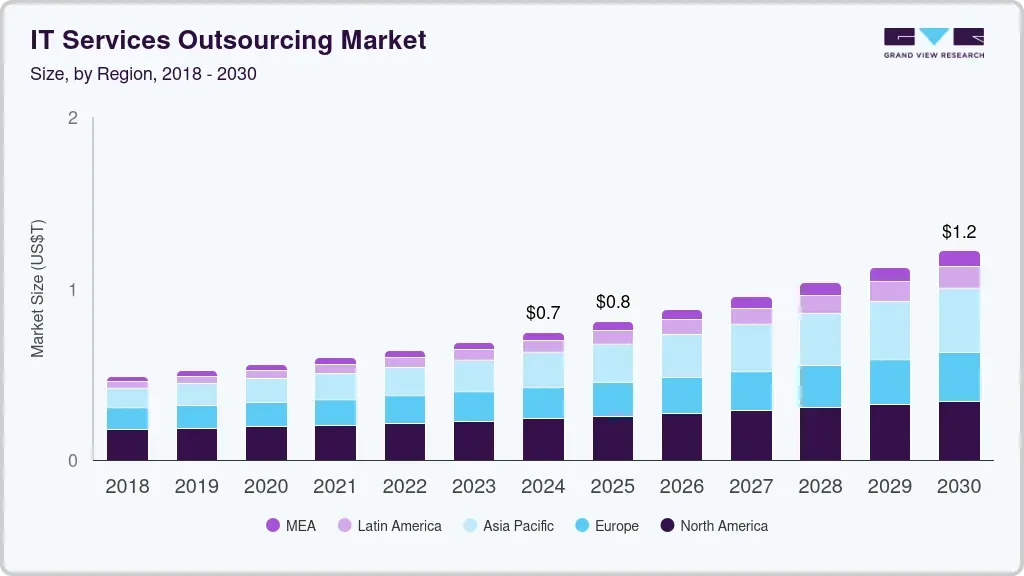
- According to a report by Grand View Research, the IT outsourcing market is continuing its upward trajectory with projections reaching $1219.31 billion from 2025 to 2030.
What is the difference between Onshore, Nearshore, and Offshore?
Let’s look at the clear comparison table for Onshore, Nearshore, and Offshore:
| Aspect | Onshore | Nearshore | Offshore |
| Definition | Outsourcing to a company within the same country. | Outsourcing to a nearby country, usually within the same or a close time zone. | Outsourcing to a distant country, often on another continent. |
| Location | Same country as the client | Nearby or neighboring countries | Distant countries, often on different continents |
| Cost | Highest (due to local labor rates) | Moderate (lower than onshore, higher than offshore) | Lowest (due to cheaper labor markets) |
| Time Zone Alignment | No time zone difference, real-time collaboration | Minor time zone difference, easier communication | Major time zone difference, slower communication |
| Cultural Alignment | High cultural and business alignment | Similar cultural values and work ethics | Significant cultural differences may affect collaboration |
| Communication | Seamless with minimal delays | Easy, but slightly more challenging than onshore | Can be slower, requires more management |
What are the benefits of offshore software development?
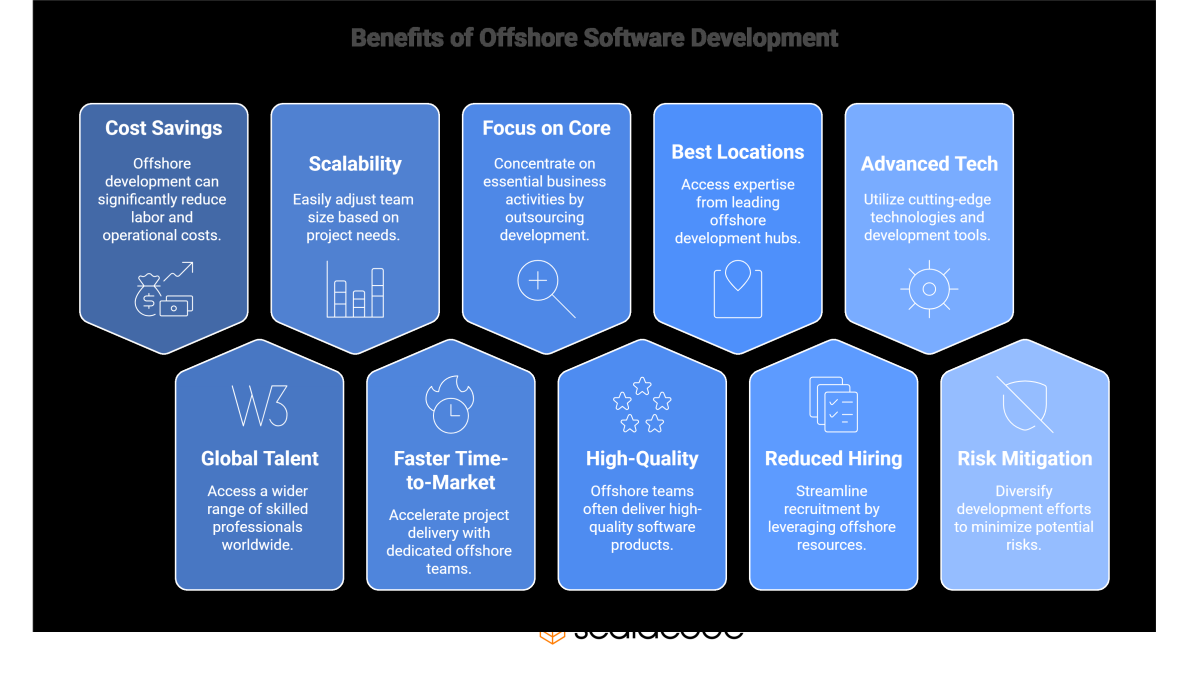
When collaborating with an offshore outsourcing software development company, you have several benefits, such as cost reduction and rapid delivery time. Companies are often willing to work with offshore software development firms due to the availability of global talent, modern technologies, and expertise. Let’s look at these benefits in detail:
1. Cost Savings
A major advantage of offshore software development is that it can save a great deal of money. Outsourcing helps the company save the costs of infrastructural expenses, employee training, and full-time wages. Rather, they only pay what they need, and this reduces overhead. Offshore software development is commonly a fraction of the cost that it would be locally, particularly in areas such as Asia or Eastern Europe, where labour is cheaper.
2. Access to Global Talent Pool
Outsourcing to a foreign software development firm creates access to a global pool of talent. No company has to be restricted to local developers, but can seek specialists in fields such as AI, blockchain, cloud, or the benefits of machine learning and IoT. This international connectivity helps companies to access niche technologies with the right skills that will result in a future-ready and innovative solution that might not have been found in their local market.
3. Scalability and Flexibility
An offshore software development team offers unmatched scalability. The companies can scale up or scale down the size of their workforce without committing to full-time contracts like the hiring of permanent employees. Offshore alliances are particularly relevant to a start-up and a company that needs flexibility without compromising cost-effectiveness to ensure that their projects are completed on time and within budget.
4. Faster Time-to-Market
Offshore software development agencies can speed up the delivery cycle time. Workers located in various time zones are able to work around the clock, which means that there are tasks that are constantly being undertaken. This 24/7 development model helps to minimize bottlenecks and enables the business to introduce products at a faster rate than its competitors. A quicker time-to-market provides businesses with a competitive advantage and enables them to gain the attention of customers at an earlier stage.
5. Focus on Core Business
Hiring an offshore software product development company will enable enterprises to focus on their core goals as they outsource technical operations. Companies can also outsource software project tasks to professionals who would effectively handle them instead of overloading their own teams. This liberates leadership and employees to work on areas like customer service, sales, and business development. When doing technical work offshore, businesses would be able to be productive without reducing quality or innovation.
6. High-Quality Deliverables
Best practices, agile, and high standards of quality in an offshore custom software development company are followed around the world. These firms usually hire qualified consultants who are skilled in providing powerful, safe, and scalable applications. They build quality assurance, automated testing, and continuous integration into their workflows, and fewer bugs and accelerated iterations. The outcome is a high-performing product that meets the needs of the business and is reliable over a long period of time, yet remains affordable.
7. Access to the Best Offshore Locations
Selecting the best offshore software development countries, i.e., India, Ukraine, or Poland, offers companies several benefits. These places provide a high number of qualified programmers, low prices, and good business environments. Several governments also promote outsourcing by providing IT-friendly policies, tax concessions, and strong digital infrastructure. Cost savings are not the only benefits of working with professionals who have a thorough understanding of global markets and innovation trends.
Good Read: Top Mobile App Development Trends
8. Reduced Hiring Hassles
Hiring an internal developer is time-consuming, costly, and, in many cases, restricted to local talent. This is eliminated through offshore outsourcing as businesses have access to pre-vetted professionals. Working with an offshore software development company means that you can recruit full teams within days rather than months. This does away with recruitment overhead, HR management hassles, and allows the liberty to work on the project execution whilst using experienced engineers.
9. Advanced Technology & Tools
Many offshore software development companies invest in modern tools, frameworks, and technologies. These businesses are up to date with the current trends in the industry, such as AI-based analytics, cloud native applications, DevOps automation, and cybersecurity. These new emerging technologies will enable companies to get future-proof solutions capable of supporting the already existing needs of customers.
Explore More: Top Game-Changing Technology Trends That Will Define 2025
10. Risk Mitigation
Understanding how to deal with an offshore software development company with experience minimises risk. These companies have strict contracts, NDAs, and policies of compliance to ensure the safety of intellectual property and information. They also establish disaster recovery and risk management that will support continuity in service delivery. Diversification of development activities helps companies eliminate the threat of over-dependence on an in-house team.
Challenges of Offshore Software Development
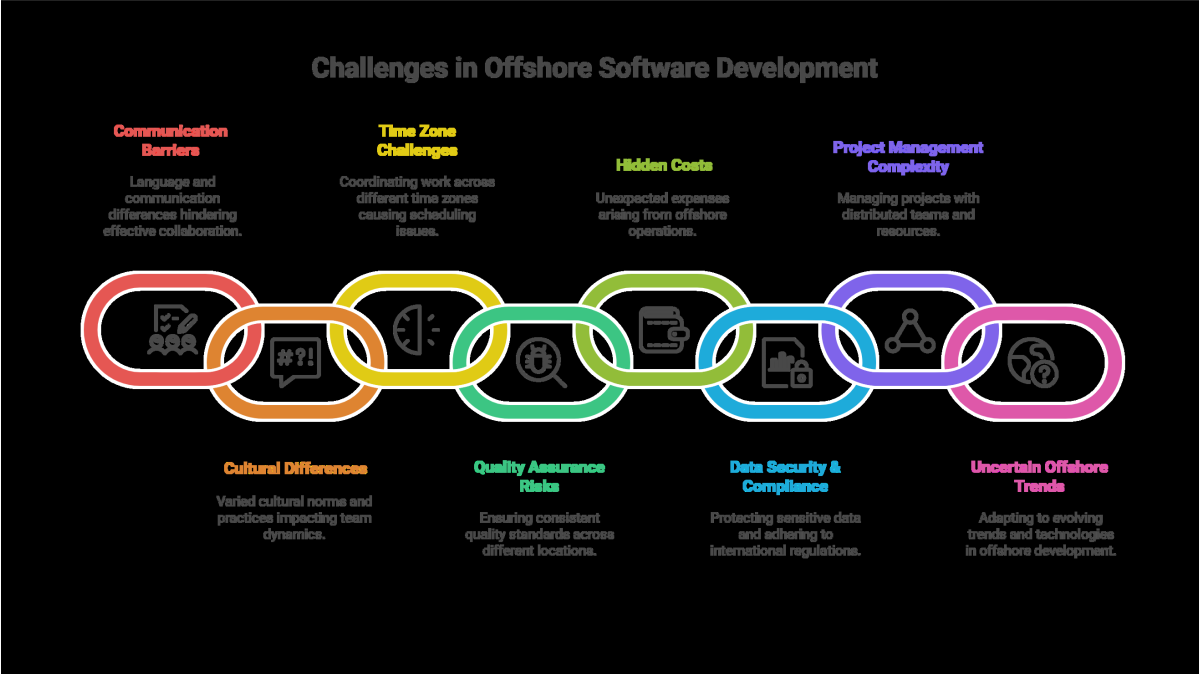
Although offshore software development can have challenges, companies are likely to experience issues that may affect the success of a project. With communication challenges to data security concerns, awareness of these challenges will contribute to making smarter outsourcing choices when engaging offshore software development firms.
1. Communication Barriers
Communication tends to be the first barrier in offshore software development. Delays or confusion may occur due to language differences, accents, and mismatched expectations. Nuances may be lost with such tools as Slack or Zoom and make project requirements unclear. These barriers can be minimized with the implementation of well-defined guidelines and formal reporting.
2. Cultural Differences
Each area possesses its own work ethic and practice. There are various strategies that offshore software development firms can use with regard to hierarchy, deadlines, or problem-solving. Cultural differences might cause friction unless either party invests in cultural training, understanding, and developing a mutual understanding.
3. Time Zone Challenges
Offshore groups usually work in various time periods, which may slow down the communication process. An agile process can be hindered by the fact that a simple feedback loop would require 24 hours. The best way to reduce these delays in offshore agile software development is to adopt some overlap in working hours or rotation in meeting times.
4. Quality Assurance Risks
On the one hand, offshore software development services are very affordable, but quality may differ greatly. Poor testing, inconsistent coding, or poor QA procedures could have an effect on product reliability. Having regular audits, code reviews, and quality benchmarks is critical in maintaining high standards.
5. Hidden Costs
As the offshore software development rate appears to be favorable, there might be some unseen expenses. These may be investments in communication tools, additional management time, or unforeseen delays. Businesses have to look at the overall ownership cost as opposed to looking at hourly charges.
6. Data Security & Compliance
Offshore teamwork usually requires the sharing of sensitive information. In the absence of compliance, this poses a threat of data leakage or breach. To prevent information leakage in offshore software development, it is important to ensure that the provider adheres to GDPR, HIPAA, or other international regulations.
7. Project Management Complexity
Communication with an offshore team needs to be organized systematically and monitored. Without good leadership, projects could have overlapping tasks, missed timelines, or duplication of efforts. Project management tools and agile frameworks allow the facilitation of collaboration.
8. Uncertain Offshore Trends
Due to the nature of the new technologies, changing markets, and political or economic uncertainty in the outsourcing destinations, the Offshore software development trends change continuously. Alterations in the rate of offshore software development across nations also have the potential to impact partnerships in the long term, so it is important to monitor trends regularly.
Must Read: Top Software Development Trends
Why must you hire offshore developers?
Offshoring software developers is among the best cost-reduction and global talent sourcing strategies. Most companies hire remote developers based in the top countries to do offshore software development, such as India, to achieve flexibility, scalability, and quicker delivery through reliable custom software development firms.
1. Cost-Effective Development
Hire software developers for cost reduction; they are skilled engineers at a significantly lower cost than the home markets. Other than salaries, infrastructure, training, and overhead costs of recruitment are also saved by businesses, thus making the projects more affordable.
2. Access to Specialized Skills
A bespoke software development firm provides knowledge in a variety of technologies. Common offshore developer specializations include AI, machine learning, cloud solutions, and cybersecurity. This keeps your project within reach of high-level skills, without the necessity of employing niche-specific talent in your local area.
3. Faster Scalability
When you get remote developers, you can easily change the size of your team, depending on project requirements. Offshore partners provide flexibility, which enables a business to grow when demand is at its peak and also to tighten down when projects become slow. This flexibility makes the operations cost-effective.
4. Round-the-Clock Productivity
Your offshore teams operate in other time zones, allowing development even after your local office closes. This 24-hour productivity accelerates project completion and enables companies to introduce products in a faster manner. Startups that are in a race with each other find this particularly useful.
5. Focus on Core Business
By outsourcing technical tasks to the best countries for offshore software development, companies free up their in-house teams to concentrate on growth, marketing, and customer relationships. Offshore developers handle execution while internal staff focus on strategy.
6. Access to Global Talent
Through offshore outsourcing software development, you are able to access a global talent pool of engineers and experts. This exposes the businesses to skills that they might not get locally, and the development is innovative and of high quality.
7. Proven Track Record of Offshore Hubs
Outsourcing destinations such as offshore software development in India are well known worldwide due to IT talent and a well-developed outsourcing infrastructure. The results of these hubs are always reliable, which is why they are a safe and reliable choice for all types of businesses.
8. Quality with Cost Advantage
Offshore developers deliver competitive quality at affordable prices. Collaborating with an advanced and seasoned custom software development firm guarantees it access to the world’s best practices, quality checks, and delivery on time- all at a controlled cost.
Explore in detail, Top Software Development Companies in India
Tips for hiring the best offshore development team
Outsourcing is a key to hiring the appropriate offshore team. Since the advantages of offshore software development include cost reduction, access to talent, and scalability, there exist challenges related to poor selection. Companies cannot simply look at the price, but also at experience, communication, and security measures. These tips will help you to be on the right team to succeed over the long term.
1. Define Clear Project Goals
It is important to determine your project goals, project scope, and targeted results before you approach an offshore partner. Having a comprehensive roadmap documented enables the offshore team to be in sync with your vision and expectations on Day 1.
Such clarity helps to prevent misunderstandings, keep everyone on the same page, and establish quantifiable standards of success. This shows that there are multiple offshore software development benefits from streamlining delivery to reducing delays.
2. Evaluate Technical Expertise
Not every team is equal, and that is why it is important to review technical expertise. Find an offshore partner that has a good track record in the technologies that your project needs. Request portfolios, client case studies, and references that show similar experience in the project.
Not only do you decrease risks by engaging a technically competent custom software development team, but you are also more likely to realize innovative, scalable solutions that fit your business model.
3. Check Offshore Rates by Country
Budgeting is important based on knowledge of offshore software development rates by country. Prices can be very different- India and Vietnam are among the cheapest options, or Eastern Europe can be a bit more expensive, but closer to culture and time zone. The destination match function allows you to locate the appropriate balance of cost, talent, and cultural fit.
4. Balance Cost and Quality
As affordability is among the key benefits of offshore software development, the lowest price does not always help. Reduced rates can occasionally affect quality and cause rereadings and higher expenses over the long term.
Rather, make value a priority and pick a partner who delivers a competitive price and quality expertise. This will not only make your investment more sustainable, but it will also mean long-term savings, reduced delays in the project, and increased scalability.
5. Assess Communication Skills
Successful onshore and offshore software development partnerships operate under good communication. Make sure that the team that is recruited understands the English language (or any other language you desire), project management software like Jira, Slack, or Trello, and frequent reporting. Good communication reduces confusion, enhances coordination, and offshore alliances are as smooth as an internal team.
6. Review Cultural Compatibility
Cultural differences can have a serious impact on collaboration unless it is handled well. Offshore partners can approach various deadlines, hierarchy, or feedback in different ways. You should determine the extent to which their work culture is in tandem with the expectations of your company. The nations that are rampant in outsourcing usually educate their professionals in ways that are familiar in the West, to facilitate less cultural friction.
7. Ensure Strong Security Practices
In the process of outsourcing, sensitive information and intellectual property are usually required to be exchanged. An effective offshore partner should consider security as a priority by adopting compliance with GDPR, HIPAA, or ISO.
Include NDAs in contracts, have secure data transmission strategies, and well-understood data protection protocols. This reduces risks as well as fosters trust that will make your offshore software development services more secure and reliable.
8. Start with a Pilot Project
Rather than negotiating a huge contract immediately, you can start with a pilot project to evaluate the skills, communication, and reliability of the team. This would allow you to consider the capability of the offshore team to perform as promised without unnecessarily risking.
Such a small experiment based on the test project also offers information about how the team works, the level of work, and the ability to meet the deadline, and based on this information, you can make a definite long-term choice.
What is the cost of hiring the best offshore software development partner?
Hiring a software development offshore partner costs more or less, depending on the location, experience, project scope, and the engagement model. Offshore outsourcing is often adopted by businesses to save on costs, yet gain access to the best talent. As opposed to onshore models, offshore partnerships could provide competitive pricing without losing quality, particularly when comparing them on a regional basis.
Hourly Rates By Region
- Asia (India, Philippines): $20-$50/hour; India is one of the most cost-effective destinations, especially for top talent.
- Eastern Europe (Poland, Ukraine): $30-$58/hour; Poland and Ukraine are known for high-quality engineering and slightly higher costs.
- Latin America (Mexico, Colombia): $25-$55/hour; competitive rates with skilled developers.
| Country | Rates (per hour) | Strengths | Language Proficiency | Time Difference with CST |
| India | $20, $60 | Largest talent pool, cost-effective, expertise in IT, AI & cloud services | Good | +10.5 hours |
| Poland | $40, $100 | Highly skilled, culturally aligned with Europe, top coding talent | High | +7 hours |
| Mexico | $35, $70 | Nearshoring for the US, expertise in embedded systems & software | Good | Same as CST |
| Belarus | $25, $50 | Strong in AI and cloud solutions, a highly educated workforce | High | +8 hours |
| Ukraine | $30, $100 | Skilled developers, strong in AI & Blockchain | Good | +8 hours |
| Philippines | $25, $55 | Strong English proficiency, BPO & software expertise | High | +13 hours |
Key Factors Affecting Offshore Software Development Costs
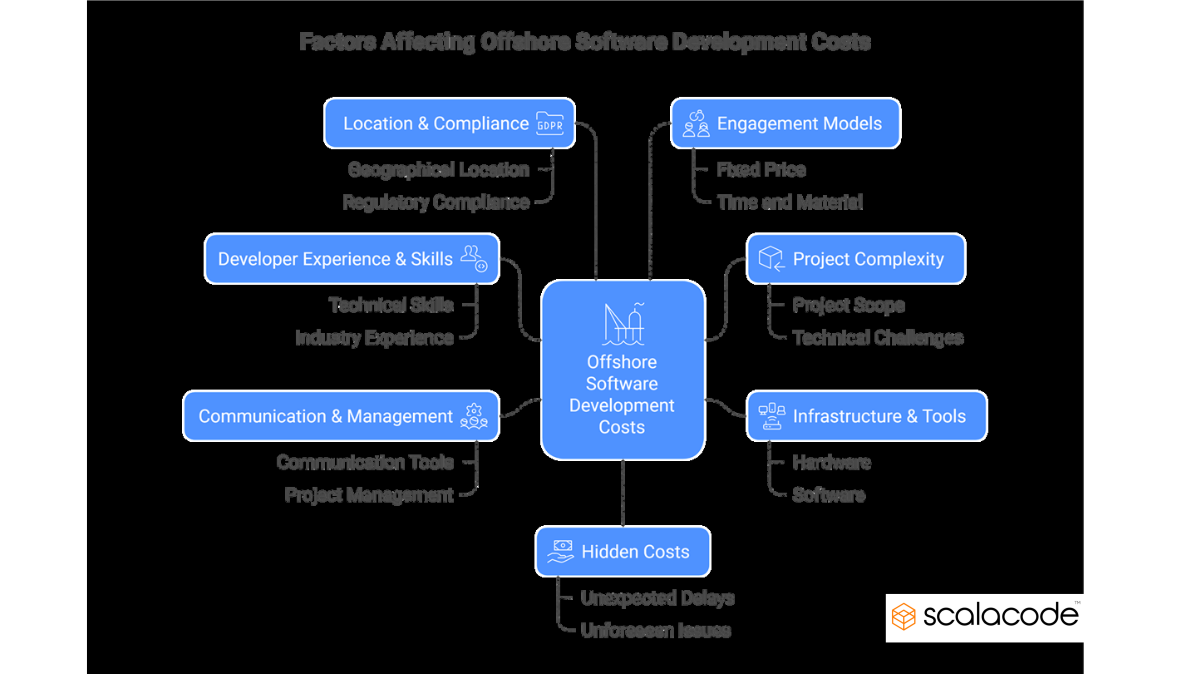
The total cost of offshore software development is a variable influenced by several factors beyond hourly rates. Proficiency of the developer, project complexity, location, compliance, and management overheads are also important factors to consider in determining the final budget.
1. Developer Experience & Skills
The rates vary depending on seniority. The junior developers are cheaper, whereas senior engineers or AI, IoT, or blockchain specialists are more expensive. More experienced developers will also be able to achieve shorter timelines and fewer errors, which can save money over time.
2. Project Complexity
Basic applications or MVPs can be developed by a small team, whereas more complex applications need a designer, testers, DevOps, and project managers. The more complex the project-integrations, scalability, or advanced security-the higher the cost.
3. Infrastructure & Tools
Servers, collaborating tools, and hosting can increase the overall budget by 3-7%. These are sometimes included with other offshore companies, and other times charged separately.
4. Communication & Management
Operating internationally is also associated with coordination costs, which are usually 5-10% of the budget. Seasoned partners reduce this through a systematized communication process and project management tools.
5. Location & Compliance
Rates differ by region. India is very cost-efficient, Eastern Europe provides good technical skills at the middle-range rates, and Latin America is conveniently close to the U.S at marginally higher prices. Expenses can also be increased by compliance requirements (HIPAA, GDPR, SOC2).
6. Engagement Models
Fixed-price models are appropriate when projects are small and clearly defined and can have buffers. Time-and-materials pricing is flexible, but dedicated offshore teams have guaranteed monthly costs on long-term projects.
7. Hidden Costs
There may be some unforeseen costs, such as delays, additional revisions, integration problems, or mid-way scaling. It is better to select an old and open partner to avoid surprises.
Also Read: How Much Does it Cost to Develop an App?
Conclusion
One of the most strategic ways a business can grow and scale rapidly, cutting costs and accessing a wide range of talent in the global market, has been offshore software development. When organizations collaborate with the appropriate offshore software development firm, they can reap the benefits of flexibility, quick time-to-market, and specialized skills that they might not have locally.
Since the beginning of start-ups in the business world, offshore development has enabled business organizations to concentrate on their main goals while their offshore software development team delivers quality products.
But this will only be successful with the selection of the right partner. The assessment of offshore software development rates across countries, matching project needs with experience, and maintaining transparent communication are the major factors in realizing the highest ROI.
Scalability, ongoing innovation, and the possibility to implement new advanced technologies like cloud, IoT, and AI-based solutions into their projects are other long-term offshore software development benefits that companies should take into account.
Today, numerous companies go as far as partnering with an AI software development company in an offshore arrangement to speed up the digital transformation process with smart and data-driven applications.
Offshore collaboration allows you to remain competitive in a quickly changing digital environment, whether you are considering offshore custom software development or creating a product entirely.
How Can ScalaCode Help You?
At ScalaCode, we are experts in providing quality offshore solutions to your business requirements. Being a reliable mobile app development company, we apply both technical skills and business knowledge in creating scalable, secure, and user-friendly applications. With the experienced offshore developers, we can deliver at a cost-effective rate without sacrificing innovation or performance.
- A global talent pool of experienced developers
- Scalable models of engagement at your budget and schedule.
- Learned experience with new technologies such as AI, IoT, and cloud.
- End-to-end support-from ideation to deployment and beyond
ScalaCode is the solution here, whether you are a startup wanting to get up and running fast or an existing business that wants to reap the real advantages of offshore software development.
Frequently Asked Questions
1. Why should businesses recruit an offshore development center?
Companies are advised to recruit offshore talent to get a global labor pool of qualified talent at affordable prices. It helps reduce the cost of development and grow teams within a limited time, and it is possible to achieve results of high quality in the shortest time possible.
2. How to choose the right offshore software development company?
To choose the right offshore software development company, you need to evaluate them by reviewing their previous clients and portfolio, as well as their technical competence and pattern of communication. You also want to consider their adaptability in engagement models and their knowledge of what you need in your industry.
3. What are the challenges that I should know before hiring an offshore development team?
The most common challenges in offshore development are time-zone differences, cultural differences, communication differences, and data security threats. Nevertheless, they can be reduced to a minimum through defining the processes, collaboration tools, and an experienced partner.
4. What are the advantages of an offshore development team?
An offshore development division provides economies of scale, resource allocation, and scalability. It enables companies to have more say over teams and projects and also access expertise specific to technologies.
5. What are some pros and cons of offshore software development?
Pros are reduced prices, global talent availability, flexibility, and scalability. The downsides might include communication difficulties, unseen expenses, and quality differences, but when the right partner is found, the benefits will far outweigh the downsides.