
Mobile applications are a big pillar of what modern businesses have to become to survive in the contemporary competitive market. They engage people, streamline operations, and make up for the factors that promote growth and survival for any business. However, just as changes occur with the passing of time, so are the never-ending trends in mobile technology that come every year.
Of course, building mobile applications and using them was never the same as before. Businesses actually have to be updated regularly on whatever goes on with app development to stay ahead of their competition and keep packed with these trends. It doesn’t matter whether you are developing your very first app or upgrading an existing one because the knowledge of this advancement counts.
This blog discusses the latest mobile app development trends that businesses should closely keep an eye on. These trends are not all technology but enrich the interaction of end users with realistic and tangible value for the business. But first, we can learn a little more about the mobile app market.
Why Do You Need a Mobile App?
Do you know the app downloads will boost steadily by 2027, with the Games segment touching 176.1 Bn downloads?
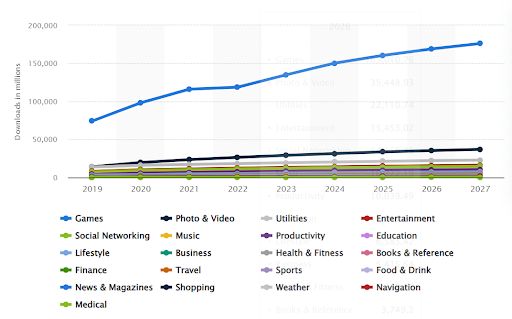
Yes, the demand for mobile apps is increasing rapidly and so do the mobile app development trends. This is because of several reasons. Here are some key benefits of mobile applications:
1. Boost Customer Engagement
You and your client will have the strongest link through customized notifications, live updates, and much more by incorporating an interactive feature in this mobile application. These things affirm and keep it closer and strengthen the brand in the mind of the consumer.
2. Raise Higher Sales and Revenues
Of course, apps come with friendly interfaces, easy-to-purchase, quick checkout, and as they say, exclusive deals. Be acquainted with how these really great things can drive sales and return profitability.
3. Enhance Visibility for Your Brand
Since your brand is only “actually” in the possession of the customer, every experience adds to and builds the foundation for a further yet even stronger trust with your audience making your brand more visible to customers.
4. Get In-depth Insights on Customers
Such apps will bring very valid information about how the users behave along with their preferences. The insight will then guide you to improve your products, services, and marketing strategies.
5. Differentiate You from the Rest of the Crowd
This mobile app is a testament to your innovation, and your cutting-edge approach to customer service. It sets your business apart from the line and guarantees that you are keeping ahead of the competition.
List of the Best Mobile App Development Trends
So, now you know why mobile apps are getting famous, here are some key emerging trends in mobile app development:
1. 5G Technology
The first trend in mobile app development reshaping the industry is 5G technology. A next-generation network will give unimaginable speed, ultra-low latency, and improved reliability in how apps interact with users.
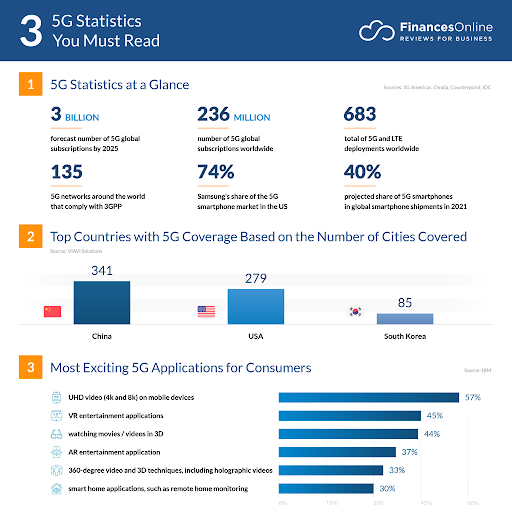
5G will open doors to businesses for developing high-performance apps involving real-time data processing, seamless streaming of content, and better connectivity. More of a fundamental factor for futuristic innovations such as smart cities and autonomous systems.
Future Trends
- Ultra-fast downloads and enhanced streaming of videos.
- More responsive AR/VR experiences because of very high bandwidth and responsiveness.
- Improved IoT with support for connectivity of many more devices.
- Expansion into cloud gaming streaming or high-definition mobile applications.
2. Apps for Foldables
Yet another one of the most spectacular mobile app development trends is to design apps for foldable devices. These devices with flexible screens will certainly affect the design strategy since usage will be affected when the device is folded and unfolded.
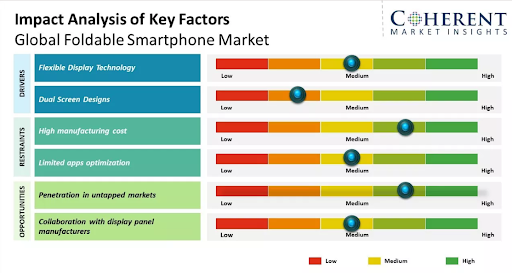
Foldable devices give people multitasking, a wider screen, and an experience beyond what they could get from an ordinary device, and the scope will be wider for businesses to come up with more attractive apps in the domain of gaming, retail, and productivity.
Future Trends
- Adaptive designs that change depending on the orientation of the user’s screen.
- Improved multitasking that can take advantage of larger displays.
- Greater adoption in entertainment and business applications.
- Facilities for easy switching from folded to unfolded modes and back.
3. Internet of Things (IoT) App Integration
Mobile apps are another revolutionizing mobile app trend with the integration of IoT. Integrated in such a manner, IoT apps connect devices such as wearables, smart home systems, and even industrial sensors for real-time monitoring, analysis, and control of various operations.
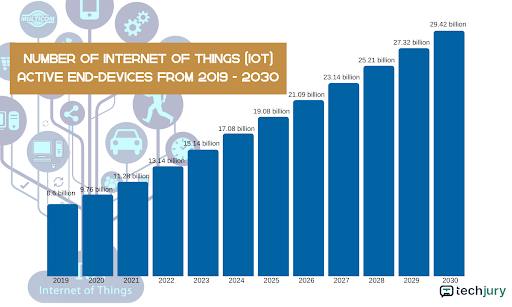
With IoT apps, it becomes possible to optimize business operations, automate business processes, and improve user experience- the tool is undoubtedly priceless to the healthcare, logistics, or smart home industries.
Future Trends
- Larger scope of IoT applications within remote patient monitoring within healthcare.
- Real-time analytics for predictive maintenance in an industrial setting.
- Developing scenery of smart home and office automation.
- Energy-efficient IoT-enabled mobile applications.
4. Augmented Reality (AR)/Virtual Reality (VR)
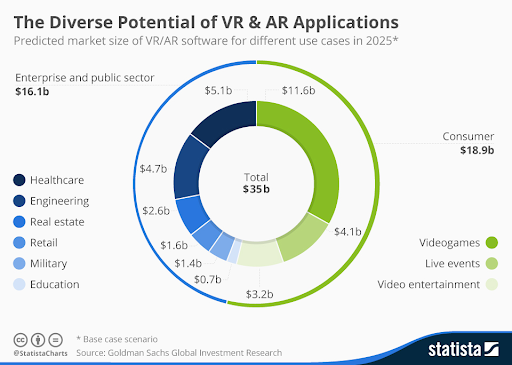
This is the next increasing trend of AR and VR being used in mobile applications. They redefine the way consumers interact with digital content, making it more immersive and engaging. AR enhances the existing view of the environment with computer-generated imagery, while VR places the user into a completely virtual setting.
From try-on scenarios in retail to land scanning of virtual properties, most companies have adopted AR and VR to make shopping experiences both entertaining and engaging.
Future Trends
- Widespread use of AR for virtual shopping experiences.
- VR-based training modules for industries like healthcare and aviation.
- Enhanced gaming and entertainment applications with AR/VR.
- Integration of AR/VR into remote collaboration tools.
5. AI and Machine Learning
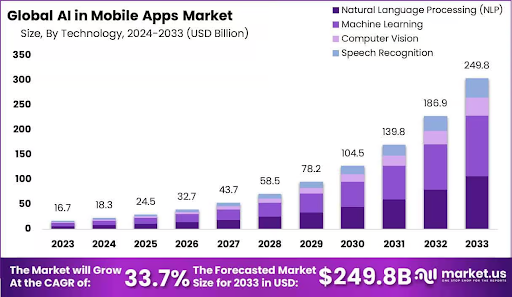
AI and ML are the two significant trends that would attract the attention of mobile application developers. These technologies allow mobile applications to learn user behavior, make intelligent predictions, and customize the user experience.
Aspects of AI Development and Machine Learning include chatbots, voice recognition, and image processing that enhance the interaction with mobile applications, and over time, the applications get better because of the machine-learning algorithms.
Companies would want to consider AI and ML for further use in strengthening customer engagement, but that is another competition that further reduces overhead costs or aspects of their business. These include:
Future trends
- Deeper integration into apps with the aid of AI-powered virtual assistants.
- More personalized user experiences through improved personalized recommendation engines.
- Real-time detection and prevention of fraud in financial applications.
- Content creation and curation for media apps by AI.
Must Read: Top AI App Ideas
6. Chatbots
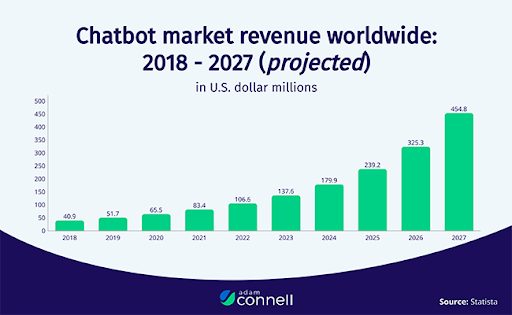
The next major trend in mobile applications is making the included experience unscripted with customer interaction as chatbots. Now, the chatbot acts instantaneously through an AI tool, giving appropriate responses to inquiries and assisting in transactions while smoothing the customer service experience.
Businesses can use AI chatbots to reduce operational costs, increase user satisfaction, and provide an all-time service. Hence, introducing it has become a must-have in mobile applications now.
Future Trends
- Integration with voice assistants for multimodal interactions.
- Improved natural language understanding for human-like conversations.
- Deployment of chatbots in industries like healthcare and finance.
- Expansion of multilingual chatbots for global user bases.
Learn More: Cost To Develop a Chatbot App Like ChatGPT
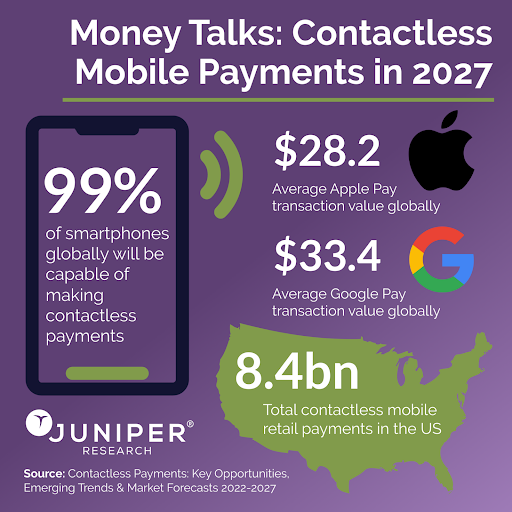
7. Mobile Wallets and Contactless Payments
Mobile wallets and systems of contactless payments have completely transformed the way a consumer accesses transactional activity-making it to required features in apps. These systems include very secure, rapid, and convenient payment options such as biometrics and tokenization. For companies, mobile wallet integration facilitates fast checkout, and conversion, and improves consumer perception of financial security.
Future Trends
- QR Code Payment Process Adoption will be done across different industries.
- Further increased growth in peer-to-peer mobile payments platforms.
- Increased adoption of cryptocurrencies that can be paid for by apps.
- Secure payments using blockchain technology.
Also Read: Future of Blockchain and AI Collaboration
8. Cloud-Based Mobile Applications
Cloud-based mobile apps are changing the way businesses store and manage data. They enable businesses to scale up and cut down infrastructure costs while ensuring completely seamless access across devices, courtesy of cloud computing. Cloud integration makes the app experience much better, for instance, by enabling the real-time syncing of data, quicker updates, and more secure data storage, among others. Businesses can use cloud technology to ensure more potent and flexible app solutions are available.
Future Trends:
- Hybrid cloud models for flexibility and security.
- Further real-time collaboration will be part of cloud applications.
- Edge computing for improved latency in cloud applications.
- More advanced cloud-based gaming and content delivery platforms.
9. Cross-Platform Mobile Development
“With cross-platform tools, developers can write once and run everywhere, achieving unparalleled efficiency without compromising on native performance.“- Nat Friedman, CEO, Xamarin (now part of Microsoft)
Another of those powerful trends is cross-platform mobile development. It allows businesses to develop applications that run on multiple operating systems using only one codebase. The interval of time wasted to complete development tasks is reduced. It saves money but still produces the same output regarding both functionality and design across multiple platforms. Businesses can access tools such as Flutter and React Native to reach a wider crowd with an effective improvement in the efficiency of their apps.
Future Trends
- More extensive Kotlin Multiplatform use in React native platform development.
- Better support for platform-specific features introduced into shared codebases.
- Broader development framework expansion to speed and scale.
- Better cross-platform UI/UX consistency.
10. Voice Recognition

With the increasing adoption of voice recognition technologies, apps will become even more hands-free and accessible for users. It also means that they will be able to communicate with their mobile applications through voice rather than manual methods. The company may offer products ranging from virtual ai assistants to voice-enabled searches, using voice recognition to simplify users’ interactions and make the applications more user-friendly, especially regarding accessibility and hands-free operations.
Future Trends
- Integration with IoT devices for voice-controlled smart environments.
- Innovation of multilingual voice assistants.
- Improvement in speech-to-text accuracy for real-time transcription.
- Utilizing voice data for personalized experiences in-app interaction.
11. Mobile Security Apps

Mobile application security now becomes one of the most important things in a digital life, due to growing cyber malicious activities along with exposure of personal data. However, businesses need to empower such applications with hardened security techniques such as encryption, multifactor authentication, and secure APIs. App security builds trust and makes it compliant with the laws of the Data Protection Act.
Future Trends
- Biometrics has been introduced for safer log-in verification.
- Artificial intelligence penetrates threat detection and loss prevention.
- Data security without transparency is based on blockchain technology.
- Better scanning tools for application vulnerabilities
Learn More: AI in Security
12. Motion Design
“Motion design adds personality to digital experiences, making interactions feel more human and intuitive.”- Val Head, Design Advocate at Adobe
What truly proves motion design in the app production process is that, indeed, it increases interactions. These subtle animations, transitions, and visual clues escort users through movements in the interface, really, making the app so friendly and fun. It is something that businesses should take advantage of: really making visually appealing experiences to glue users in while providing valuable usability improvement.
Future Trends
- Better user feedback micro-interactions.
- Animated conversations will really make it exciting.
- Use of the motion design for app tutorials and onboardings.
- Inclusion of 3D animations for a much more immersive experience
13. Extended Reality (XR)

Extended Reality (XR) is where AR multifactor with MR pushes the user experience boundaries of apps. Environments that are immersive or interactive with users are highly valued in industries like gaming, real estate, or health. Businesses benefit from offering different services within their offerings through XR and being able to engage with customers in a new way.
Future Trends
- MR for mixing the real world with a virtual one.
- XR adoption in corporate training.
- Growth of XR in e-commerce for demos of virtual products.
- Real-time XR experiences in 5G.
14. Touchless UI
Touchless UI is a rapidly growing trend, driven by the need for more hygienic and convenient app interactions. This UI possesses a seamless, accessible user experience through gestures, voice commands, and eye-tracking technologies. There is bound to make the applications inclusive, intuitive, and innovative across various industries.
Future Trends
- Gesture-based smart home interfaces.
- Voice command-enabled AR/VR environments.
- Increased penetration in the healthcare and industrial spaces.
- Greater recognition accuracy for gesture and voice input.
15. Low-Code/No-Code Development
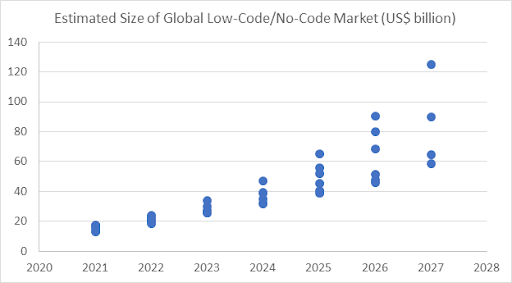
Low-code and no-code platforms are already democratizing the development of applications by enabling non-developer persons to develop functional applications with little to no programming. These platforms dramatically increase the time economy and can be optimized for prototyping and small businesses. For organizations, low-code solutions accelerate the consummation of internal applications while allowing scalability and efficiency.
Future Trends
- Rapid application development in startups.
- Cohabitation of AI-powered tools for automated coding.
- More complex applications will be increasingly supported by further enhanced features.
- Enterprise-level scalability in low-code solutions.
16. Instant Apps
Instant apps allow users to access core app functions without having to download the full version of the application. It breaks down limitations of storage space and long installation times, and the intention behind it would be to allow users to try out the app and take hold of it in a very quick manner. Instant apps can be used by businesses to improve user acquisition, especially those in e-commerce, gaming, and service delivery.
Future Trends
- More prevalent usage in e-commerce for previews of products.
- Gaming applications will broaden for try-before-you-buy.
- Features of instant apps will be further enhanced for more seamless experiences.
- Broader support among all Android and iOS devices.
17. Development for Wearable Devices
Wearable devices are among the most popular mobile app development trends in the industry right now. With the increase in the use of gadgets like smartwatches and fitness devices, the demand has risen for making more apps for small screens targeted at certain use cases.
These wearable apps are all about the convenience of real-time notifications and health monitors and therefore are ideal for consumers and businesses alike. However, developing apps for wearables does not only open the door to businesses in their fitness, healthcare, and lifestyle segments.
| Pros | Cons |
| Tracking health in real-time. | Invasion of privacy. |
| Convenience for notifications and calls. | Battery life is short. |
| Gives motivation for fitness. | Pricey. |
| Sync smart devices. | Heavily dependent on mobile phones. |
| Makes accessibility better. | Can be a distraction. |
Future Trends
- Wider fitness and health applications with intensive tracking capabilities.
- Wearable and IoT ecosystem integration.
- App development for augmented hearing and vision aids.
- Enhanced user experience in designing applications specifically for wearables.
18. Beacon Technology
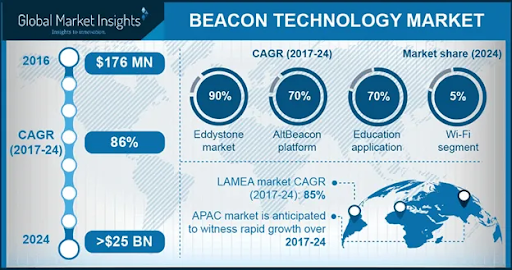
Beacon technology is taking the location-based interactions that businesses can do, such as sending highly probable notifications or customized services, to a new standard. They are informing the users about retail space locations, instant offers, and simplification of navigation in large facilities, such as airports, thus changing user engagement strategies for businesses into newer and personalized ways.
Future Trends
- More development of indoor navigation within malls and airports.
- Proximity-based notifications for individuals that would personalize marketing.
- More for healthcare: patient tracking and service given to patients.
- Improved experience with AR in use for immersive activities.
19. Mobile Commerce
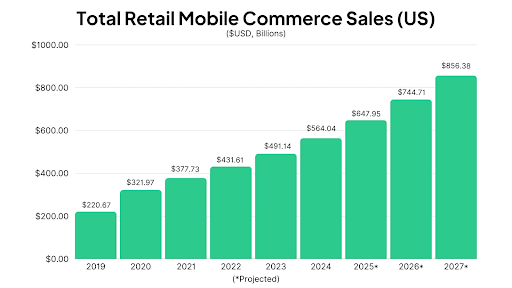
Mobile shopping, or m-commerce, has experienced rapid growth as users increasingly start to use their smartphones for shopping. Businesses now upgrade their apps with features such as personalized recommendations, secure payments, and AR-powered product previews. Hence, a trend develops where businesses are able to provide seamless and highly interactive shopping experiences.
Future Trends
- Accruing Social Commerce through app integrations.
- Enhanced checkout processes for mobile with AI assistance.
- Augmented Reality-powered product visualizations will expand.
- Voice Shopping Assistant Integration.
20. Predictive Analytics
Predictive analytics is a system that uses Artificial Intelligence and machine learning to prove the behavior beyond the analysis of users. Such applications can provide informed decisions against business developments, contribute to operational optimization, and give highly personalized user experiences. Thus, it is transforming the industries into a proactive and tailored solution.
Future Trends
- User-centered personalized marketing campaigns.
- Predictive maintenance for those IoT devices with a specific latency.
- Different wearables for advanced health monitoring.
- Predictive Models Powered by AI for business forecasting.
21. On-Demand Apps
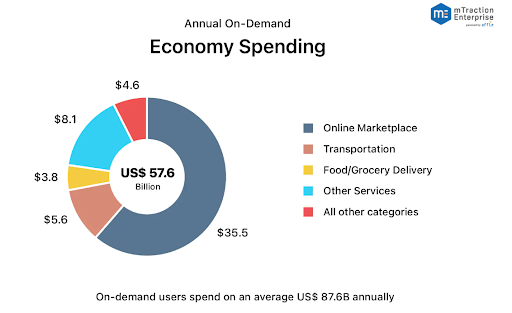
These are the apps that support the growing demand for immediate technology by providing services like food, rides, and home services. By these, modern users find everything crucial, convenience, efficiency, and customization. Here, on-demand apps serve both a purpose for businesses to invest as they can also provide on-demand apps, developing profitable markets for customer retention.
Future Trends
- Niche markets such as pet care and home services mean expansion.
- Improved real-time tracking features to make the user experience more delightful.
- AI is used for demand prediction and supply management to make on-demand apps smarter.
- Subscription-based models gain focus.
22. Integration by Cloud Computing

Another one of the leading mobile app development trends is cloud computing. Cloud computing integration enables companies to design applications that are easily scalable, cost-effective, and data-rich. Cloud-enabled applications can get updated faster while providing better real-time data synchronization and security. Cloud adoption can also help companies streamline their operations while giving a seamless and consistent app experience for users.
Future Trends
- The future of cloud development tools extends into a growing area of application.
- Real-time collaborations of the business applications.
- Improved data analytics capabilities using the cloud.
- Hybrid clouds will grow to improve scalability.
Must Read: Best Mobile App Ideas
Final Thoughts
For businesses, mobile app development is no longer something that can be added luxuriously to its list of business needs. It has been made more of a necessity, as technologies evolve, and most importantly, as the fast-paced world we live in requires competitive businesses to adopt the use of mobile technology.
New mobile app development trends, such as 5G, IoT, AI, augmented and virtual reality, and cloud computing, are emerging as technologies of the future that will put endless opportunities for innovation and links to the customer in reach. These trends would help businesses grow, improve their user engagement, and define a very unique experience for their consumers.
Whether planning a completely new app or just beginning work on upgrading an existing app, keeping up-to-date with mobile app development trends is the key to a successful digital future. Last but not least, you can hire a leading mobile app development company to get advanced apps. We hope these trends will help your business grow in the future. All the best!
FAQs
Q1. What is the future of mobile app development?
The future of mobile app development looks extremely bright with 5G, AI, IoT, and AR/VR leading the charge. Such innovations will catalyse changing user experience and facilitate businesses to innovate new processes.
Q2. Are mobile app developers still in demand among companies?
Mobile app developers are still in great demand as more and more companies are gearing towards having mobile capability in making customer engagements, internal business processes, and the market competition competitive.
Q3. Do app developers have a future?
Definitely! Technology keeps evolving and developing everyday use of mobile applications, so they are going to be a necessity in developing innovative, highly user-friendly, and high-performing apps for different industries.
Q4. What are the key challenges of mobile app development?
Challenges include the security of apps, cross-platform capabilities, diverse performance on devices, retention of users, and rapid technological development. Effective planning and testing are required to alleviate these issues.
Q5. What are the best practices for mobile app development?
Mobile app development best practices include keeping the user experience in mind, performance optimization of the apps, strong security mechanisms, agile development methodology adoption, and frequent updates to the app considering user feedback and market trends.
Explore More: Top Custom Software Development Companies