

Artificial intelligence is transforming oil and gas manufacturing in today’s highly dynamic energy sector, especially in the way core business processes and operations are executed. From seismic data analysis to refining and logistics, the application of Artificial Intelligence in the oil and gas industry is driving smarter decision-making, greater operational efficiency, and reduced environmental impact.
As the industry struggles to navigate challenges like depleting reserves, fluctuating oil prices, and mounting environmental regulations, energy companies are turning to AI and ML in the oil and gas industry to reduce costs, optimise production, improve safety, and gain a competitive edge. With the increasing availability of big data and AI automation tools, AI is rapidly becoming a strategic necessity rather than a futuristic add-on.
Here’s a quick look at how AI is shaping the oil and gas landscape:
- Massive market growth: The global market for AI in the oil and gas industry is projected to grow from USD 7.6 billion in 2025 to over USD 25.2 billion by 2034, with a CAGR of nearly 14%. North America leads this adoption wave with USD 2.6 billion in AI revenue in 2024.
- Improved productivity and cost savings: AI-powered predictive maintenance helps reduce equipment downtime by up to 70%, while automated drilling and reservoir analysis increase extraction efficiency.
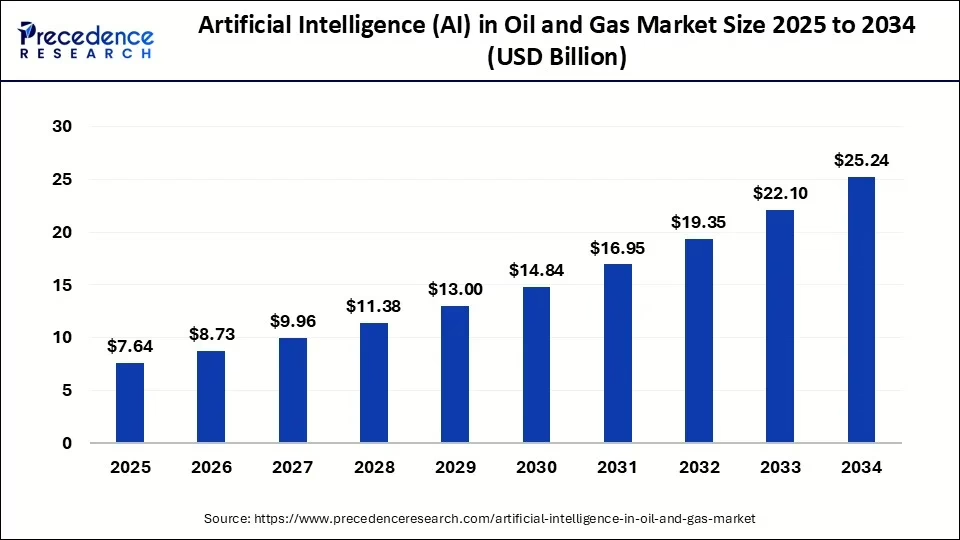
Image source: Precedenceresearch.com
In this blog, we explore the top AI applications in the oil and gas industry, key benefits, and successful examples from the field. Whether you’re an energy executive or a tech enthusiast, you’ll gain valuable insight into how AI and ML are driving innovation and transforming the industry’s future.
What is Artificial Intelligence in the Oil and Gas Industry?
Artificial intelligence in the oil and gas industry is a concept that applies smart technology like machine learning, deep learning, neural networks, and generative AI in the process of automation, optimisation, and innovation of processes in the oil and gas industry. Such intelligence includes AI and ML in oil and gas industry applications, like the interpretation of seismic data to predict the maintenance of drilling rigs.
Why Does the Oil and Gas Industry Need AI?
The increasing complexity of operations, vast volumes of data, and the need for real-time decision-making demand digital transformation. Here’s why AI is indispensable:
- Complex Data Handling: Leveraging the expert data engineering and big data capabilities, AI helps the industry generate massive amounts of data, and AI helps make sense of it.
- Operational Efficiency: AI algorithms help streamline processes, reducing downtime.
- Safety Improvements: Predictive models can foresee hazardous situations, saving lives and assets.
- Environmental Compliance: AI can help companies track emissions, leaks, and compliance risks more effectively.
Top Use Cases of Artificial Intelligence in the Oil and Gas Industry
In the oil and gas sector, artificial intelligence is revolutionizing the way things are done by automation of sophisticated tasks, better decisions, and safety. Whether it is at the exploration, refining, or any other part of the value chain, AI is reaching new heights of efficiency and innovation.
1. Exploration and Seismic Data Interpretation
Artificial intelligence in the oil and gas sector has become one of the first and most profound uses in the sector in the exploration area. Recognising hydrocarbon-rich areas in large seismic data is possible in the shortest time and with more precision as compared to the process used by human geologists, by use of AI algorithms.
- Generative AI use cases in the oil and gas industry include generating synthetic seismic models for more precise exploration.
- ML models help filter noise and highlight important geophysical features.
2. Drilling Optimization
The process of drilling is very expensive and also risky. When the AI is applied to the oil and gas sector, the incessant observation of the parameters of drilling and decision automation will help to reduce the delay and prevent breakages.
- AI-based predictive models reduce non-productive time (NPT).
- Algorithms suggest optimal drilling paths to maximise resource extraction.
3. Predictive Maintenance
It is important to maintain infrastructure. The application of AI in the oil and gas industry allows predictive maintenance of important equipment like pumps, compressors, and pipelines.
- AI analyzes historical sensor data to predict failures before they happen.
- ML models help in scheduling maintenance during non-peak times.
4. Production Forecasting
The AI applications in the oil and gas industry in 2025 will transform forecasting models. AI forecasts, on the basis of the present and the previous reservoir information, the yield of production.
- Reinforcement learning adjusts extraction rates based on reservoir behaviour.
- Better forecasting aids in budgeting and strategic planning.
5. Supply Chain and Logistics Optimization
In the oil and gas industry, AI is also being applied to supply chain management- foreseeing the demand, managing the inventories, and transport timetables better.
- AI improves fleet routes and fuel usage.
- Algorithms forecast spare parts demand and reduce inventory costs.
Partner with ScalaCode to Transform Your Oil & Gas Operations with AI
Benefits of Artificial Intelligence in the Oil and Gas Industry
The increased use of application of artificial intelligence in oil and gas industry is transforming the way firms handle their operations, assets, and resources. Whether it is increasing productivity or improving environmental compliance, artificial intelligence is proving to be a competitive advantage within an industry, in which there is always pressure to streamline operations and minimize risky behavior.
Cost Savings and Efficiency Gains
The cost reduction is one of the most prominent advantages of the AI used in oil and gas industry. Automation of manual work, predictive analytics, and intelligent resource distribution help the company reduce the expenses of operations, downtime, and output.
Improved Decision-Making with Real-Time Insights
AI and ML in the oil and gas industry offer data-based knowledge, enabling engineers and executives to make more intelligent decisions in shorter times. It can be drilling streamlining or equipment tracking, but in any case, real-time analytics allow less uncertainty and better strategizing.
Enhanced Recovery and Production Rates
Oil and gas companies can further understand how the reservoirs act with the introduction of AI-based reservoir modeling and simulation. This results in higher recovery techniques and rates, eventually better ROI of the current assets.
Environmental Monitoring and Compliance
With sustainability as a topic of central interest, AI solutions in the oil and gas industry are being used to ensure companies are keeping track of their emissions, leak detection, and the ability to maintain environmental regulations. The proactive environmental management is guaranteed with the help of artificial intelligence and anomaly detection, which are achieved through smart sensors.
Predictive Maintenance and Safety
One of the biggest uses of AI in oil and gas industry lies in predictive maintenance. Use of historical sensor data allows AI systems to predict possible failures in advance, which minimizes downtime of equipment and increases the safety of the worker.
Streamlined Supply Chain and Logistics
AI is changing the supply chain and logistics, from inventory forecasting to route optimization. It eliminates or decreases waste, results in prompt provision of materials, and increases the total effectiveness of the oil and gas logistics operations.
Workforce Augmentation and Skill Enhancement
AI-assisted tools are not taking away the workforce but rather giving them power. Utilizing automated routine processes and providing intelligent support, AI can help field engineers, analysts, and operators work better.
In adopting AI in the oil and gas sector, organisations not only reduce expenses but also enhance the safety of operations, sustainability, and long-term resilience. With the AI developments in the oil and gas industry in 2025, these points will continue to increase as we march towards 2025.
Future of AI in the Oil and Gas Industry
There is a huge potential for the expansion of AI in the oil and gas sector, mainly because the companies will need smarter and more environmentally friendly operations, which can be performed with less direct supervision.
Higher energy needs, more stringent environmental standards, and pressure to reduce carbon emissions come together, demanding a higher level of AI-related innovation than ever before. We expect that by 2025, AI applications in the oil and gas industry will become ubiquitous in the process of the oil and gas industry, whether in the upstream exploration processes, in the downstream logistical processes, or all of them in between.
With the increasing maturity of technologies and the fortification of digital infrastructure, companies will soon shift to complete AI implementations as compared to experimental pilots. The next generation of intelligent energy solutions will be amplified by the power of the cloud, better quality data, and smarter AI and ML on oil and gas industry platforms.
Also, read our latest blog to know the AI App Development Cost.
Key Trends Shaping the Future
- IoT sensors with AI: It will be essential in supporting real-time asset tracking and predictive analysis. The AI and IoT combination will provide anomaly detection in real-time, increasing safety and eliminating downtimes associated with repair.
- Self-optimizing refineries: The reinforcement learning models will enable the refineries to learn and adapt themselves, both in real-time input and output, which will maximize efficiencies with minimum waste, therefore, helping to meet the cost savings and environmental objectives.
- Autonomous drilling systems guided by AI: In the not-so-distant future, the use of AI in oil and gas industry will allow drilling rigs to be controlled with human influence to a minimum. These systems will utilize the real-time information to be adaptive continuously and make precision-based drilling choices.
- Generative AI oil and gas industry use cases: Likely, the wider use of generative AI in the creation of synthetic datasets, automation of documentation, and even the design of operational workflows is on the way in the oil and gas industry.
- Sustainability and ESG compliance: As regulating authorities pay more attention to environmental, social, and governance indicators, the oil and gas industry companies will turn to the AI solutions that will help them observe, report, and enhance their ESG indicators.
- Enhanced reservoir simulation and digital twins: Real-time digital twin of physical resources and sub-surface reservoirs will soon be generated in the oil and gas business due to the use of artificial intelligence. Such digital twins will assist in making the right decisions and long-term strategic plans.
- Unstructured data-natural language processing (NLP): Unstructured data, such as maintenance reports, drilling logs, comprises a large part of oil and gas data. The use of NLP is poised to be an AI application in oil and gas industry in 2025 since it will be used to derive meaningful insight that can be applied in operations to bring in a better understanding of operations.
Must Read: Top AI Trends to Watch in 2025
Now turning to the projects, there is no doubt that AI in oil and gas 2025 will transform the whole industry, and to do that, you will need the help of a Custom software development company. Those organizations that adopt AI early will be in a better position to tackle uncertainties in the future, outperform their competitors, and attain long-term reliability.
Partner with ScalaCode, Your Custom AI Software Development Company
Real-World Examples of AI Used in the Oil and Gas Industry
Proven Success Stories Driving the Industry Forward!
Global oil & gas leaders are embracing AI to drive smarter decisions, cut costs, and boost sustainability. With AI projected to generate over $25 billion in value by 2034, these real-life examples highlight how top companies are leading the charge.
Shell, Accelerating Exploration with AI
Shell leverages machine learning algorithms to analyze seismic data at unprecedented speed and precision.
- Result: Faster hydrocarbon discovery and reduced exploration risk.
- Benefit: Improved decision-making and minimized human error.
BP, Predictive Intelligence at Scale
British Petroleum’s AI-powered AURA system monitors over 1,000 wells in real-time, using ML to detect equipment anomalies.
- Result: Proactive maintenance, reduced downtime.
- Bonus: AI also supports emissions tracking, reinforcing BP’s ESG goals.
ExxonMobil, Smarter Refining with AI Simulations
ExxonMobil applies AI to simulate complex chemical reactions during refining operations.
- Result: Optimized output, reduced waste, and enhanced energy efficiency.
- Advantage: Engineers can tweak variables in real time for maximum yield.
Schlumberger - Digital Twins & Safer Drilling
Schlumberger uses AI-powered digital twins to simulate drilling environments and refine strategies.
- Result: Minimized Non-Productive Time (NPT) and reduced drilling costs.
- Safety Boost: AI predicts subsurface hazards, improving workforce safety.
Power Your Energy Future with ScalaCode’s AI Expertise
ScalaCode empowers enterprises to seamlessly adopt Artificial Intelligence in the Oil and Gas Industry, enabling smarter operations, reduced downtime, and enhanced ROI through custom AI solutions tailored to your value chain.
Why Choose Us?
- End-to-end AI consulting and implementation
- Predictive maintenance and drilling automation
- Generative AI and digital twin development
- Cloud-based AI platforms for scalability
- Expertise across upstream, midstream, and downstream workflows
Final Thoughts
The use of artificial intelligence in oil and gas sector is not only a technical change, but a survival and development game in a modern world of competition, limited resources, and an environmentally sensitive environment. With increasing steps towards 2025 and beyond, the AI trends in the oil and gas industry 2025 will make companies more agile, efficient, and sustainable.
In case you are willing to discover the actual potential of AI in energy, ScalaCode would be your right ally. Being a pioneer in a Custom software development company, we strive to develop powerful, scalable, and industry-specific solutions.
Ready to Revolutionize Your Oil & Gas Operations with AI?
Partner with ScalaCode, the best AI development company, to implement future-ready AI solutions in oil and gas industry. Whether you’re exploring seismic data or optimizing drilling, our experts can build intelligent systems tailored to your goals.
FAQs, Artificial Intelligence in the Oil and Gas Industry
1. What are the main applications of artificial intelligence in the oil and gas industry?
AI is used in exploration, drilling, predictive maintenance, refining, and supply chain management to enhance efficiency and reduce costs.
2. How is generative AI used in oil and gas?
Generative AI helps create synthetic seismic data, automate documentation, and develop digital twins for training and simulation purposes.
3. What benefits does AI bring to the oil and gas industry?
AI improves operational efficiency, reduces downtime, increases safety, and supports better decision-making through data analytics.
4. Is AI adoption in the oil and gas industry expensive?
Initial investments can be high, but the long-term savings and efficiency gains make AI adoption cost-effective for most companies.
5. What is the future of AI in the oil and gas industry?
The future includes autonomous operations, AI-powered robotics, and full integration with IoT and edge computing technologies.
6. How can small oil and gas companies start using AI?
They can start with small-scale projects like predictive maintenance or data analytics and scale gradually with the help of AI experts.
7. Which companies are already using AI in oil and gas?
Major players like Shell, BP, ExxonMobil, and Schlumberger have successfully implemented AI across different operations.
8. Why choose ScalaCode for AI implementation in oil and gas?
ScalaCode brings industry-specific AI expertise, custom development capabilities, and experience in generative AI development for scalable, intelligent solutions.