LangChain vs LlamaIndex: Enterprise Framework Choice
Introduction: Deciding between LangChain and LlamaIndex is not about choosing the well-known AI framework. It is about understanding where the difficulty in

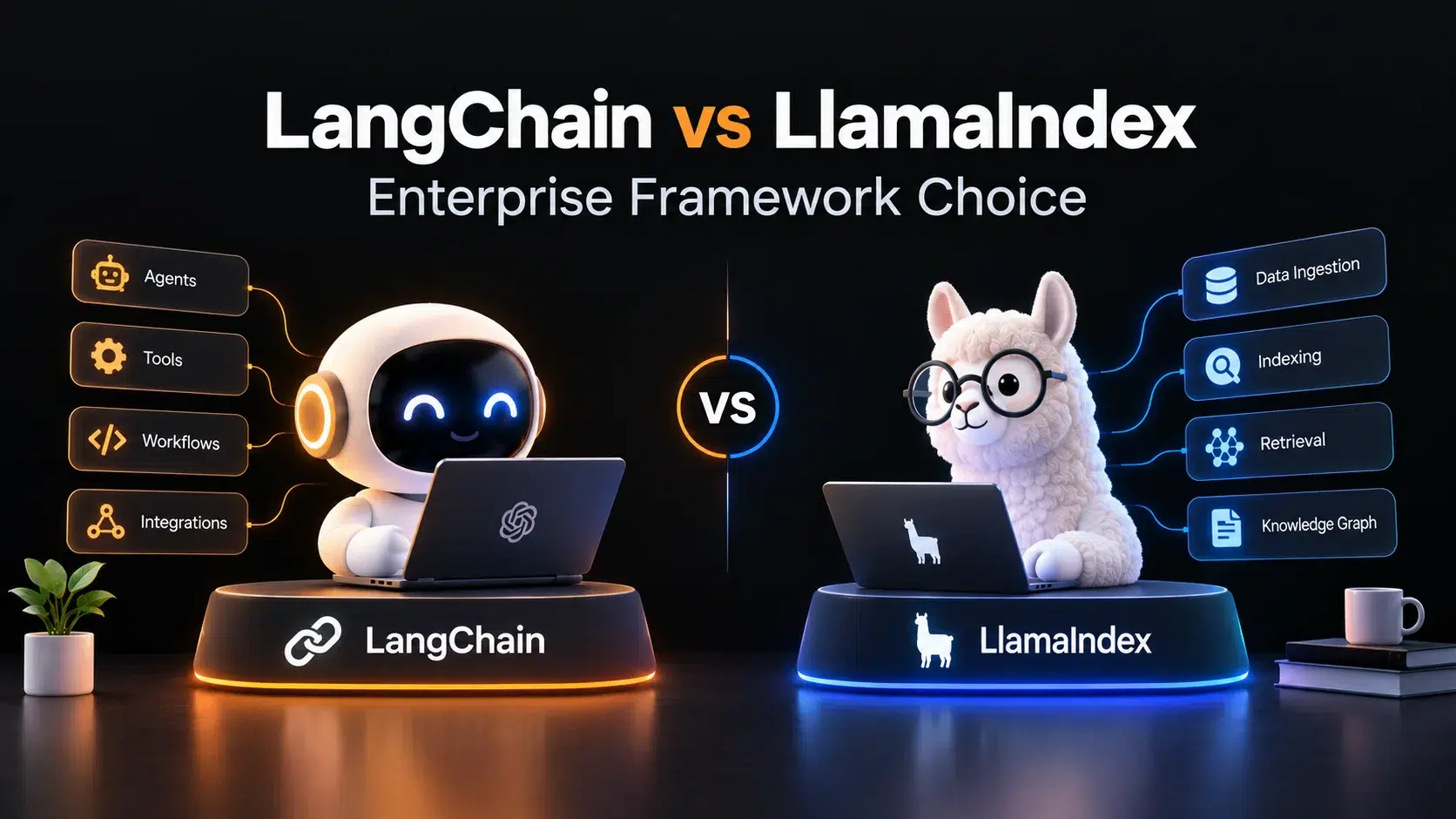
Introduction: Deciding between LangChain and LlamaIndex is not about choosing the well-known AI framework. It is about understanding where the difficulty in your application comes from. Both of them support retrieval-augmented generation (RAG) link language models to data and assist developers in creating AI applications. However they have main goals. LangChain provides a range of tools for creating LLM applications and managing agents.
LlamaIndex puts a lot of focus on connecting company data to language models using data loading, organizing and finding. For ML Leads who are getting ready to put something into use, the best option depends on how you need to find information, how complicated the steps are, what rules you have to follow and what kind of system your team already has.
Choosing Your AI Framework: LangChain vs LlamaIndex Side-by-Side
| Evaluation Factor | LangChain + LangGraph | LlamaIndex |
| Primary Strength | LLM application development and orchestration | Data ingestion, indexing, and retrieval |
| Best Fit | Agent-driven applications and multi-step workflows | Document-heavy, retrieval-first RAG systems |
| Retrieval Capabilities | Flexible retrievers and composable pipelines | Purpose-built indexing and advanced retrieval abstractions |
| Workflow Control | LangGraph supports stateful, persistent execution | Workflows support event-driven, multi-step execution |
| Data Ingestion | Broad loader and integration ecosystem | Strong focus on document processing and data connectors |
| Enterprise Considerations | Workflow control, tracing, evaluation, and deployment options | Retrieval tuning, data processing, and optional managed services |
| Main Trade-Off | Flexibility can introduce additional design and integration work | Retrieval-focused abstractions may require more orchestration work for complex applications |
Neither framework guarantees production readiness. Security, access control, evaluation, reliability and deployment still require engineering.
1. LangChain: A Flexible Foundation for AI Applications
LangChain is a general-purpose framework for connecting language models with prompts, tools, structured outputs, retrievers and external services. It is particularly useful when an application must do more than retrieve documents and generate an answer.
For Example: An internal operations assistant might retrieve company policies, query a database, call an API and route an approval request. LangChain provides building blocks for integrating these components while LangGraph adds lower-level control over stateful and long-running workflows.
Where LangChain Fits Best
- Multi-Step AI Workflows: Coordinate retrieval, tool calls, validation and follow-up actions.
- Agentic Applications: Build systems that select tools and determine steps based on results that come in during processing.
- Integration-Heavy Architectures: Connect models, databases, APIs and other services using a framework.
- Human-Supervised Automation: Use LangGraphs persistence and interruption patterns to stop workflows for review and then continue running them.
LangChain Enterprise Limitations
Flexibility comes with engineering responsibility. A team can build a pipeline quickly but it must still create error handling, define state transitions, check retrieval quality and set operational boundaries.
LangChain also has an ecosystem of packages and abstractions. Teams should look at the integrations they need, choose compatible versions, test upgrades and avoid extra layers of abstraction. For workflows LangGraph offers useful control but developers must still plan for idempotency retry policies and recovery behavior that fits their application.
Our Default Pick: Choose LangChain, with LangGraph when RAG is one part of an AI workflow that includes tools, conditional execution, approvals or persistent state.
2. LlamaIndex: A Data-Centric Approach to RAG
LlamaIndex is designed to turn private data into useful information for language models. LlamaIndex has core tools such as documents, nodes, indexes, retrievers and query engines. These tools give developers a path to build apps that answer questions about company knowledge.
Imagine a financial services company that has thousands of policy documents, scanned forms, reports and internal manuals. The challenge is not just to call a language model. The challenge is to pull out content, keep the links between documents, fetch the correct evidence and give the model the right context.
LlamaIndex offers building blocks for this data layer. Optional parsing services, like LlamaParse can help with documents.
Where LlamaIndex Fits Best
- Document-Heavy RAG: Building knowledge assistants that read PDFs, manuals, reports and internal documents is useful.
- Retrieval Optimization: Experimenting with ways to index using metadata filters, changing queries and setting up retrieval steps can help.
- Heterogeneous Data Sources: Connecting repositories and turning their content into searchable forms is key.
- Knowledge-Intensive Applications: Building systems where good answers rely on finding and arranging the evidence makes a big difference.
LlamaIndex Enterprise Limitations
LlamaIndex takes a data-focused approach. Does not eliminate the need for application-level engineering. Teams still have to handle authorization retrieval, source-level permissions, tenant isolation, monitoring during data ingestion and ensuring reliable data updates.
Advanced retrieval methods can also lead to latency and costs. Breaking down queries reordering results or performing retrieval steps might improve the quality of answers but they add more processing and model calls. These methods should be supported by testing rather than being used without thought.
Some tasks related to processing documents and managing infrastructure might require services, extra costs or different deployment choices. Teams that have rules about where data is stored or that want to host everything themselves should check the exact setup before making a decision.
Our Default Pick: Our recommended choice is to use LlamaIndex when the main engineering challenges are about document ingestion, retrieval accuracy and making knowledge easily available.
Which Framework Is Better for Production RAG?
The answer depends on what makes your RAG system hard to build and run.
If you are building a document question‑answering app LlamaIndex is a first choice for a RAG system. Its tools fit closely with the retrieval lifecycle. I have seen that it lets teams try out indexing, retrieval and building queries for a RAG system without having to build every part from the ground up.
LangChain works as well for a RAG system especially when retrieval is only one part of a bigger app. If a query needs to fire, tools follow different paths to keep the state of execution or pause, for a human sign‑off LangGraph offers handy orchestration tools. However, framework selection alone will not make a RAG application reliable. A production system should be evaluated against measurable requirements:
| Retrieval Quality
Does the correct evidence appear in the retrieved results? |
Answer Faithfulness:
Does the response stay grounded in the available evidence? |
Access Control
Can users retrieve only the data they are authorized to access? |
| Latency and Cost
Can the pipeline meet its service-level objectives at expected traffic? |
Observability
Can engineers trace a poor answer back to ingestion, retrieval, prompting, or model behavior? |
Maintainability
Can the team test, deploy, and upgrade components without destabilizing the system? |
LlamaIndex’s production guidance discusses techniques such as hierarchical retrieval and separating retrieval chunks from the context used for answer synthesis. LangGraph, meanwhile, supports persistent execution state and recovery patterns for workflows that need to resume after interruptions.
The practical lesson is to benchmark the complete application, not just the framework’s API or a tutorial example.
Can You Use LangChain and LlamaIndex Together?
Yes. Combining them can be useful when the application has two challenges: sophisticated data retrieval and complex workflow orchestration.
A hybrid architecture might use LlamaIndex to ingest documents, build indexes and retrieve passages. The retrieval operation can then be exposed as a tool that a LangGraph workflow calls when needed.
For Example: An enterprise support agent could retrieve product documentation, check an order-management API, validate the proposed response and escalate a case to a human. LlamaIndex can support the knowledge retrieval component, while LangGraph coordinates the broader process.
This approach brings work when it comes to putting things together, setting them up and fixing problems. It’s worth it only if there are benefits. Like search results or clear control over how things run. Are more important than the added effort. For a RAG chatbot sticking with just one framework usually makes more sense.
How to Choose the Right Framework
Use these decision rules as a starting point:
| Choose LlamaIndex for building something focused on documents like knowledge assistants, enterprise search or cases where getting the information is the biggest challenge. | Choose LangChain with LangGraph if you need agents that use tools to handle steps one after another, make decisions based on conditions or need to keep track of progress over time or wait for a person to approve something. |
| Choose both when you need retrieval and complex workflows at the same time and your team is ready to handle the extra work that comes with combining them. | Consider a custom pipeline when your needs are very specific; you want full control over each piece or if using a framework adds layers that don’t really help. |
Before making a decision, build a small part of the system using real data. The kinds of questions people will ask are the security rules that must be followed and the models that will be used. Check how well the system finds the right information, how accurate the answers are, how fast it responds, how each answer costs and how quickly it can fix problems when something goes wrong.
That evidence is more useful than choosing a framework based on integration counts or generalized claims about which one is best.
Conclusion
To conclude, LangChain vs LlamaIndex are both options for building AI systems in large companies but they begin in different ways. LlamaIndex works best when most of the work is about preparing and retrieving data. LangChain with LangGraph is a choice when an app needs tools that work together to keep track of state and follow controlled steps. For teams, in large companies the best RAG framework is the one that gives good answer quality and reliability while keeping operations simple.
Frequently Asked Questions
Q1. Is LangChain or LlamaIndex better for RAG?
LlamaIndex is a strong default for retrieval-first applications because its abstractions focus on ingestion, indexing, and querying. LangChain is a strong choice when RAG must operate inside a broader workflow involving agents and tools. Both can support production RAG.
Q2. Is LlamaIndex enterprise-ready?
LlamaIndex provides building blocks for production RAG and offers additional managed data-processing capabilities through its broader ecosystem. Enterprise readiness still depends on implementation choices, security controls, evaluation, deployment architecture, and operational support.
Q3. Can LangChain and LlamaIndex work together?
Yes. A common architecture uses LlamaIndex for retrieval and LangChain or LangGraph for orchestration. Use this combination when both capabilities solve substantial problems rather than adding frameworks by default.
Q4. Which framework should a team choose for production RAG in 2026?
Start with LlamaIndex for retrieval-heavy applications and LangChain with LangGraph for workflow-heavy applications. Validate the decision using a representative dataset, production constraints, and repeatable evaluation results.
Smita
Customer Delight, ScalaCode
Smita heads the Customer Delight unit at ScalaCode and looks after client relationships while projects are under way. She studied computer science and has worked in technology and customer service for more than ten years. Her articles draw on that mix of technical and client-facing work.
Talk through your project with ScalaCode
- 30 minutes with the ScalaCode team
- What is realistic, what it costs and how long it takes
- You decide afterwards whether to build with us