Why Most RAG Prototypes Never Make It to Production
Learn why RAG prototypes fail and how an agentic RAG architecture supports reliable retrieval, enterprise security, evaluation, and production deployment.

A Retrieval Augmented Generation (RAG) prototype can look impressive in a controlled demo. Just upload a few documents, connect them to a large language model (LLM), ask a question, and then receive an answer with supporting context. However, the experience often changes when real users, large knowledge bases, changing documents, and sensitive business information enter the picture.
The problem is rarely the language model alone. Production RAG requires reliable data pipelines, accurate retrieval, access controls, evaluation, and ongoing monitoring. Without these foundations, a promising prototype can become an unreliable business application.
Why Most RAG Prototypes Fail in Production
A prototype usually proves that a technical concept works. Production proves that it can work consistently, securely, and at an acceptable cost under real operating conditions. There are several gaps separating these two stages.
1. Poor Document Preparation and Chunking
The agentic RAG architecture depends on the quality of the information it retrieves. If source documents contain duplicate content, inconsistent formatting, broken tables, or missing metadata, the retrieval pipeline starts with an unreliable knowledge base. A common shortcut is to split every document into fixed-size chunks without considering its structure. This can separate a heading from its explanation, divide a table across chunks, or remove the context needed to interpret a policy clause.
The result is incomplete or misleading context reaching the LLM. Production systems need document-aware processing, appropriate chunking strategies, metadata enrichment, and validation before information enters the index.
2. Weak Retrieval and Missing Reranking
A vector database can find content that is semantically similar to a question, but similarity does not always mean relevance.
For example, an employee searching for a particular contract clause may receive a passage about a related agreement rather than the exact clause required. This becomes more problematic when users search for product codes, policy numbers, dates, names, or technical identifiers.
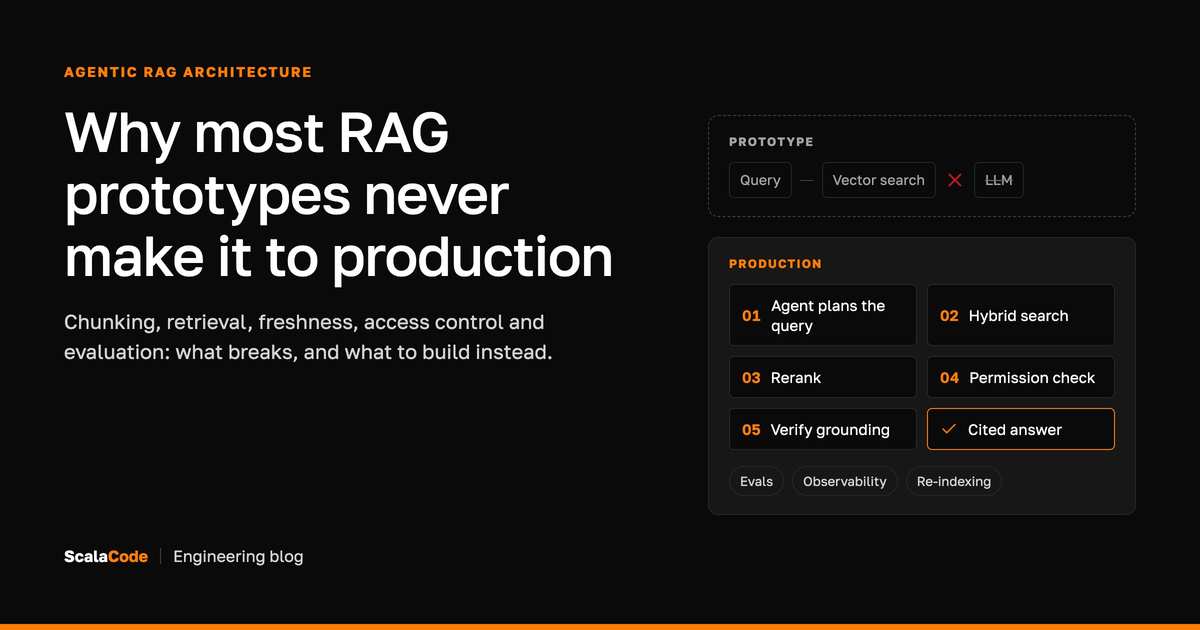
A prototype that relies only on vector similarity may struggle with these queries. Production systems often benefit from hybrid retrieval, combining semantic vector search with keyword-based search. A reranking stage can then reorder the retrieved passages according to their relevance before they reach the LLM.
3. Stale and Disconnected Knowledge
Business information changes. Policies are revised, product documentation is updated, contracts are replaced, and new records are added. If a RAG index is created once and never synchronized, the application can continue retrieving outdated information even when the source document has changed.
Production RAG needs a dependable ingestion and re-indexing pipeline. It should detect changes in connected sources, process updated documents, remove obsolete content where appropriate, and preserve version information. Without this, a system that worked during testing can gradually lose reliability.
4. Missing Access Controls and Data Security
A prototype may use a shared document collection and a small group of test users. An enterprise application has different requirements.
An employee should not be able to retrieve confidential information simply because the information exists in the connected knowledge base. Permissions must follow the user's identity and the access rules of the original source system.
Production RAG should enforce role-based or user-specific access controls during retrieval, not merely hide restricted information in the interface. Depending on the use case, it may also require PII redaction, encryption, audit logs, and clear data-retention policies.
5. No Evaluation or Observability
A prototype is often judged by whether a few sample questions receive convincing answers. That is not enough to establish production readiness.
A prompt change, new embedding model, different chunk size, or updated retrieval strategy can improve one answer while damaging several others. Without repeatable evaluation, teams may not notice the regression until users report it.
A production system needs a representative set of real questions and expected results. Teams can use this evaluation set to measure retrieval relevance, answer accuracy, citation quality, latency, and other application-specific requirements. Monitoring should continue after launch so that retrieval failures, changing data quality, and performance issues are visible.
What a Production RAG Reference Architecture Should Include
The gap between demo and deployment is architectural. A production RAG system isn't a single pipeline. It's a set of layers, each with its own engineering responsibility.
Data Ingestion and Preparation
Connect the real sources: PDFs, databases, knowledge platforms, business applications. Extract text and structure, deduplicate, identify versions, handle tables and scans. Preserve source identifiers and metadata so every answer is traceable.
Chunking, Embeddings, Indexing
Chunk according to document type, not arbitrary size. Attach metadata: category, owner, revision date, access level, source ID. Maintain a lexical index alongside the vector index for anything requiring exact matching.
Query Understanding and Retrieval
Classify the question's intent before searching. Simple questions go straight to semantic search. Queries with exact identifiers go to keyword retrieval. Complex questions may need query expansion or multi-source search. And retrieval applies the user's permissions before returning a single passage.
Reranking and Context Assembly
Merge results, remove duplicates, rerank by relevance. Respect token limits, keep related passages together, preserve source references. The LLM should receive focused evidence, not a pile of loosely related text.
Generation and Validation
The model answers only from retrieved context, cites its sources, and critically says "I don't have enough information" when the evidence doesn't support an answer. Saying nothing is cheaper than hallucinating.
Evaluation, Monitoring, Feedback
Log events across every layer. Run evaluation suites before every release. Monitor latency, retrieval relevance, errors, and usage patterns in production. Feed user corrections back into the knowledge base. This loop is what separates a system that ships from one that just demos well.
How to Evaluate a RAG System Before Production
Evaluation should test the retrieval pipeline and the generated answer separately. An agentic RAG architecture can produce a fluent response while retrieving the wrong documents. It can also retrieve the right evidence but fail to use it correctly.
A practical evaluation framework should include these dimensions:
- Retrieval Relevance: Did the search return passages that directly address the question? Review the relevance and ranking of retrieved documents, not just whether the expected document appeared somewhere in the results.
- Groundedness: Are the answer's claims supported by the retrieved context? Check whether the model introduces information that the evidence does not contain.
- Answer Relevance: Does the response address the user's actual question, rather than providing generally related information?
- Completeness: Does the answer cover all important parts of a multi-part question? A response can be factually correct but still omit a required condition, date, or comparison.
- Citation Quality: Do citations point to the correct source passages? Users should be able to verify important claims against the underlying documents.
- Latency and Cost: How long does the full request take, and what does it cost across retrieval, reranking, model calls, and supporting services? Measure performance under realistic usage rather than relying only on isolated tests.
- Security and Permission Behaviour: Can users retrieve only the information they are authorized to access? Include tests for revoked permissions, cross-tenant access, sensitive data exposure, and malicious content in retrieved documents.
Evaluate agentic workflows by tracking tool selection, retrieval calls, evidence sufficiency, latency, and cost. Build a test set covering ambiguous, exact-match, multi-part, unanswerable, and restricted queries. Rerun these tests after every change to prompts, models, embeddings, chunking, or retrieval settings, making evaluation a mandatory release requirement.
Production RAG Readiness Checklist
Before moving a prototype into production, teams should be able to answer yes to the following questions:
- Data Quality: Are source documents parsed, cleaned, deduplicated, and validated?
- Chunking: Does the chunking strategy preserve the structure and context of each document type?
- Metadata: Does every indexed chunk retain source, version, ownership, and permission information?
- Retrieval: Have vector, keyword, and hybrid retrieval approaches been tested against real questions?
- Reranking: Is reranking used where evaluation shows it improves relevance?
- Freshness: Can the pipeline detect document updates and deletions and synchronize the index?
- Security: Are identity, access permissions, tenant boundaries, and sensitive-data controls enforced before generation?
- Grounded Answers: Can the application cite evidence and decline to answer when the knowledge base does not support a response?
- Evaluation: Is there a repeatable test set covering retrieval, groundedness, relevance, completeness, and citations?
- Observability: Can the team trace retrieval, model calls, errors, latency, and cost?
- Scalability: Has the architecture been tested against expected traffic, data volume, and concurrent users?
- Operations: Are there defined owners, alerting, recovery procedures, and a process for handling incorrect answers?
A prototype does not need every enterprise feature on its first day. However, the production plan should identify which controls are essential for the intended users, data sensitivity, and business risk before launch.
Where Agentic RAG Architecture Fits
Not every RAG application needs an agent. A well-engineered retrieval pipeline handles a straightforward knowledge assistant perfectly well. But some questions aren't single searches. An enterprise question about a supplier might require checking a contract, a purchase record, and a renewal policy before a consolidated answer is even possible.
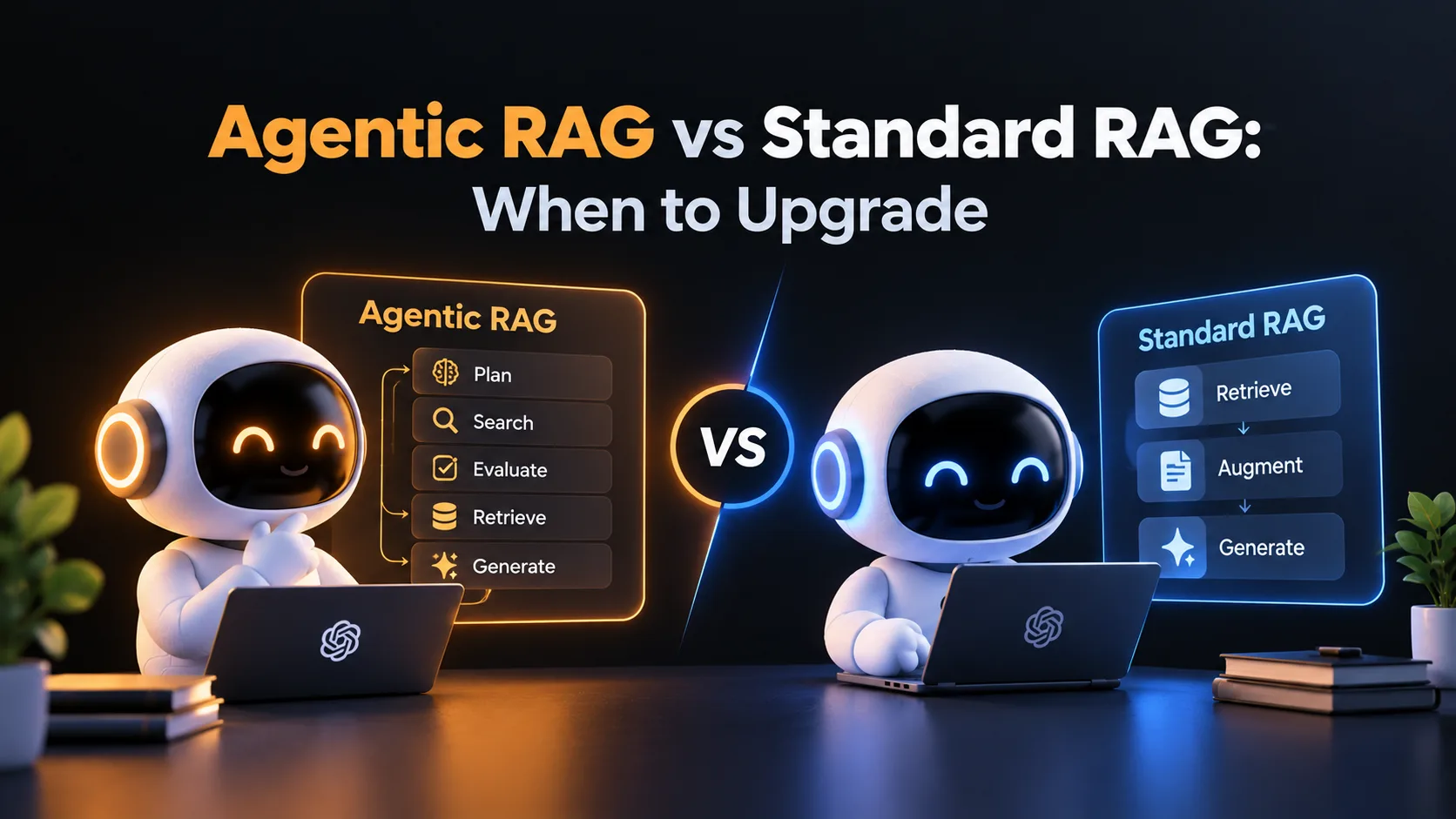
That's where an agentic RAG architecture earns its complexity. The agent layer adds a planning and verification loop: break the question into sub-tasks, select the right tools and sources, retrieve in multiple steps, and assess whether the evidence actually answers the original request before responding.
The question to ask is whether the orchestration solves a retrieval or workflow problem that a simpler pipeline can't handle efficiently. Used selectively, agentic RAG turns a retrieval tool into a reasoning system that can plan, verify, and know when to stop.
Closing Remarks
A successful RAG demo is only the starting point for production readiness. The prototypes that die share the same failure pattern: weak data pipelines, retrieval that can't handle real queries, no access controls, no evaluation, and no operations story. The systems that ship share the opposite one: structured ingestion, hybrid retrieval with reranking, security enforced at retrieval time, continuous evaluation, and, where the problem demands it, an agentic orchestration layer.
The right enterprise AI architecture depends on your data, your users, your knowledge base integration, and your risk profile. Explore ScalaCode's RAG Development services to plan a system built for production from day one. Production RAG systems at ScalaCode start from $14,999. To discuss your requirements, contact the team.
Frequently Asked Questions
Why do most RAG prototypes fail when they move to production?
A prototype answers "can this work?" while production demands "can this work consistently, securely, and affordably on real data?" The usual failure points are poor document preparation, vector-only retrieval that misses exact queries, stale indexes, missing access controls, and no evaluation framework. None of these show up in a demo built on clean sample documents.
What is an agentic RAG architecture?
An agentic RAG architecture adds a planning and verification layer on top of standard retrieval. Instead of one search-and-generate pass, the system can break a question into sub-tasks, select tools and sources, retrieve across multiple steps, and check whether the evidence answers the request before responding. It's suited to complex, multi-source questions. Not every RAG app needs it.
Is vector search enough for enterprise RAG?
Usually not on its own. Vector search finds semantically similar content, but it struggles with exact identifiers: product codes, policy numbers, contract clauses, dates. Production systems typically use hybrid retrieval (semantic + keyword) with a reranking stage to reorder results before they reach the LLM.
How do you keep a RAG system from going stale after launch?
With a living ingestion pipeline: change detection on connected sources, incremental re-indexing when documents are updated, removal of obsolete content, and preserved version metadata so answers stay traceable. Without this, the system quietly serves outdated information and users lose trust.
How do you secure RAG against unauthorized data access?
Enforce permissions at retrieval time, not in the UI. The system should filter results based on the user's identity and the source system's access rules before any content reaches the model. Depending on the use case, add PII redaction, encryption, audit logs, and data-retention policies.
How do you evaluate whether a RAG system is production-ready?
Build a repeatable evaluation set from real questions and expected answers, then measure retrieval relevance, answer accuracy, citation quality, and latency. Rerun it on every prompt, model, or chunking change. Continuous production monitoring catches drift after launch; a one-time demo is not an evaluation.
What's the difference between RAG fine-tuning and RAG evaluation?
Fine-tuning changes the model; evaluation measures the system. Most RAG failures come from retrieval and data quality, not the model, so evaluation pipelines, better chunking, and reranking usually fix accuracy issues more cheaply than fine-tuning.
How long does it take to build a production RAG system, and what does it cost?
With a defined use case and accessible data, a production-grade build typically takes weeks rather than days. Ingestion pipelines, access controls, and evaluation are what consume the time. At ScalaCode, production RAG systems start from $14,999. Contact the team to scope yours.
Asif K
Engineering Manager, ScalaCode
Asif has more than 20 years of hands-on engineering experience and has delivered over 15 projects in AI engineering, mobile apps, digital transformation and cloud-native development. He mentors engineering teams and business leaders on adopting AI, and writes about modernising the technology a business already runs on.
Talk through your project with ScalaCode
- 30 minutes with the ScalaCode team
- What is realistic, what it costs and how long it takes
- You decide afterwards whether to build with us