
Key Takeaways
- Vertical AI agents use deep domain knowledge to make operational processes smarter and more efficient.
- Vertical AI agents automate and enhance decision-making, leading to flexible, optimized operations in every growing sector, such as healthcare, manufacturing, and finance.
- Vertical AI agents bring highly personalized, fast, and reliable customer experiences, improving customer loyalty.
- Early implementation of vertical AI agents in every business domain delivers measurable benefits, reducing costs, boosting efficiency, and much more.
Most businesses today still rely on broad, general-purpose AI solutions, but are they doing what you have expected while integrating them into your system?
Maybe not… right? Well, we know this because AI is something that changes continuously, and adapting the latest technology into your business makes you different from your competitors.
Traditional Generative AI often falls short when dealing with complex tasks, especially in leading industries like healthcare, finance, and manufacturing. So, what to do? Well, here the role of vertical AI agents comes into play.
They are the AI agents that are specifically designed with deep industry expertise tailored to solve highly specialized tasks, and they also boost efficiency and accuracy.
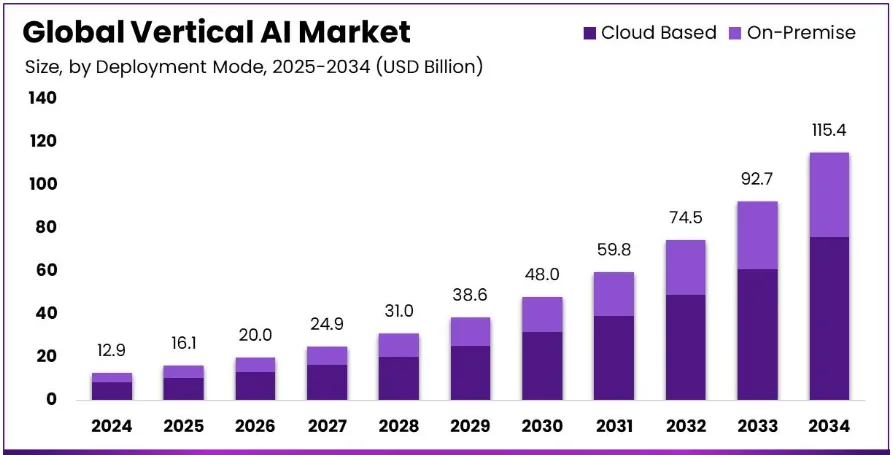
If we see the stats, then, according to a report, the Vertical AI Market size is growing from USD 12.9 billion in 2024 to USD 115.4 billion by 2034 with a CAGR of 24.5%.
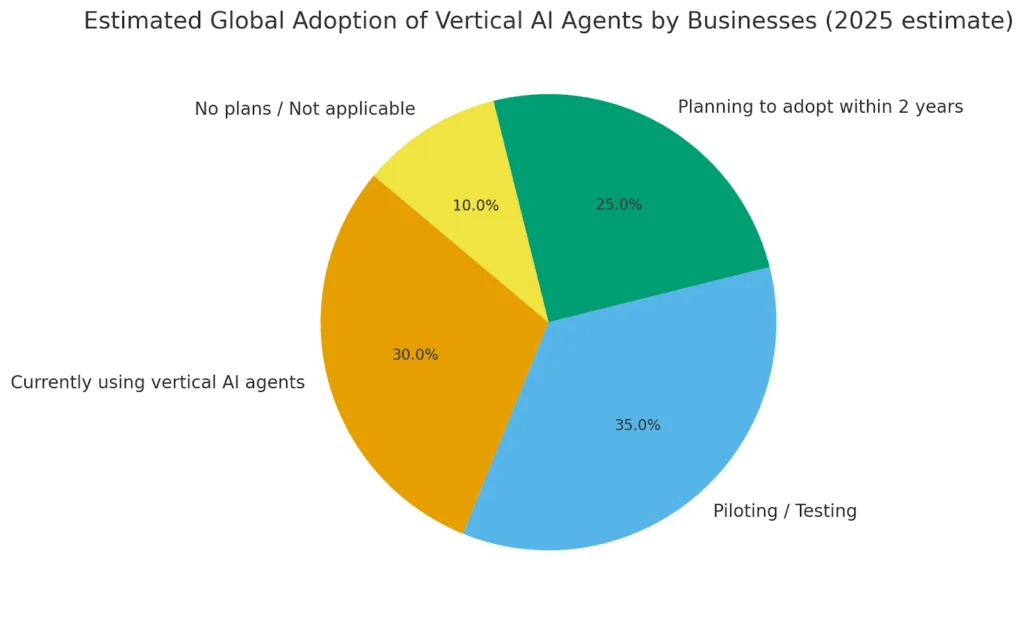
For more clarity, see the pie chart, which shows that approximately 30% of businesses are already using vertical AI agents globally, and 35% are testing them for implementation.
If you are the one who is fascinated with vertical AI agents and wants to have one for your business, then you are at the right place. In today’s guide, we are going to tell you everything about vertical AI agents, from their definitions to their real-time applications. So, pack your seats, keep your Netflix aside, and concentrate on this wonderful blog.
Let’s start with what vertical AI agents are.
What Are Vertical AI Agents?
Vertical AI agents are systems designed to easily fit into the unique needs of different sectors. And this is the best part about this latest technology, which makes it different from the traditional ones. Now, with the help of vertical AI, one can focus on single small tasks and industries without making silly small mistakes.
Along with that, vertical AI agents are making waves in various industries by incorporating deep expertise into automated processes, allowing businesses to tackle specialized challenges with precision and efficiency.
In the healthcare industry, vertical AI agents simplify clinical workflows by handling tasks like appointment scheduling, managing patient data, and offering diagnostic support. They dig into medical records and lab results, helping doctors make quicker and more accurate diagnoses, which cuts down on errors and boosts patient care.
If we take the example of the finance industry, where making mistakes is common and it is important to correct them in a minimal time. These agents outperform traditional systems by keeping an eye on transactions in real-time to spot fraud. Moreover, these agents also ensure compliance with regulations and aid in risk assessments.
Just like this, there are multiple things that vertical AI agents can do in different industries, which we will look at in this blog in our real-world use cases section. But as of now, you have understood what vertical AI agents are.
All in all, vertical AI agents deliver the intelligent insights needed to boost operational efficiency, speed up decision-making, and improve customer experiences. As we look towards 2026 and beyond, they are proving to be essential tools for businesses striving to stay ahead in the competitive landscape.
Top Business Benefits of Vertical AI Agents in 2026
Now, we have already said that there are multiple benefits of vertical AI agents for every domain. So, let’s look at them in detail:
1. Industry-Specific Knowledge
Vertical AI agents are developed with in-depth domain knowledge, and they are capable of solving unique problems in a specific industry. In addition to that, Vertical AI agents make use of industry-specific data to perform small but important tasks perfectly. Moreover, vertical AI agents in organizations can also enhance the workflows to present precise and actionable insights.
2. Enhanced Efficiency in Operations
The next business benefit of integrating vertical AI agents in firms is that they help enhance the efficiency of business operations. In addition to that, these agents facilitate workflows and minimize human error by automating difficult and repetitive workflows. Not only this, but vertical AI agents in businesses can also accelerate the pace of operations, allowing companies to perform more tasks in less time.
3. Improved Experience for Customers
Vertical AI agents provide personalized engagement and assistance by leveraging deep customer behavior and industry context. The relevance of the personalized service provides customers with a more satisfying experience, increasing both loyalty and engagement. You can hire AI Developers to improve the experience for customers.
4. Quicker Decision-Making
Making decisions based on data is important for all businesses, irrespective of the industry they belong to, and vertical agents AI allows rapid data analysis and understanding so that business leaders can make solid decisions. In addition to that, vertical AI agents have the capability of deep understanding of industry data and the latest trends. This aids businesses in making fast, data-driven judgments that increase competitiveness and agility.
5. Cutting Expenses
AI vertical agents help organizations in cutting extra expenses, as vertical AI can perform small and regular tasks that the team does on a daily basis. There is one more loop as well: when humans perform tasks, there are chances of making errors, the same with the AI as well, but the percentage of making errors is less for AI compared to humans. In addition to that, vertical AI agents can automate repetitive and labor-intensive work that lessens both team requirements and associated costs.
Learn More: Top AI App Ideas
6. Adherence to Regulations
Everybody knows that in highly regulated industries such as healthcare, finance, and legal services, compliance is non-negotiable. But no worries when you have chosen Vertical AI agents for your business that are designed with built-in AI agent frameworks that continuously monitor and can help you maintain compliance. In addition to that, they can simply adapt to changing laws, standards, and industry guidelines. For instance, in healthcare, they ensure compliance with HIPAA, while in finance, they align with KYC/AML regulations.
7. Smooth Integration of Workflow
Maintaining workflow in any organization is important, and vertical agents AI do this task pretty well, as it is compatible with your system and helps you manage all the regular tasks. This ultimately helps you in managing the workflow in the organization, and you will receive the best output for your company. In addition to that, these AI agents integrate smoothly with existing enterprise tools like CRM, ERP, and industry-specific software instead of disrupting operations.
8. Enhanced Return on Investment
Every business wants to boost the ROI of their firm by 10x every year, but this is not as easy as hanging around in the park. But no worries, with the help of a vertical AI agent, this difficult task can be easy because vertical AI agents deliver faster ROI since they come pre-trained with domain-specific knowledge. In addition to that, they can also reduce training and deployment costs while quickly optimizing workflows.
9. Enhanced Precision and Dependability
As mentioned above, vertical AI agents are specialized AI systems built for a single industry or a narrow set of tasks; therefore, they are masters in achieving precision and dependability. Unlike general AI, vertical AI agents are fine-tuned and perform industry-wise, and give you the result that a generative AI could never provide in a short period of time. Additionally, with industry-specific data for higher accuracy, this leads to fewer errors, better predictions, and improved decision-making across multiple industries.
10. Scalable Automation
Automation is something that big business players have already adopted, and other businesses are in the process of adopting this latest thing. This is because automating daily tasks not only gets you extra working time but also helps your organization focus on its productivity, innovation, and important factors. Moreover, businesses can start automating their tasks with the help of vertical AI agents across multiple units, from logistics to operations.
11. Less Work for Humans
Some regular tasks like invoicing, record-keeping, or customer queries are difficult to perform but are important, so here as well, vertical AI agents can help. With the help of these AI agents, you can free employees to focus on strategic and creative work, as these agents can do these daily tasks in minimal time if they are well-trained with the correct data. Along with that, this boosts productivity, reduces burnout, fosters better human-AI collaboration, and boosts team productivity.
12. An edge over competitors
When companies tap into vertical AI agents, they really set themselves apart. They innovate faster, draw richer insights, and enhance the experiences they offer their customers. This specialized intelligence, tailored to specific industries, allows them to swiftly adjust to market shifts and stay ahead of competitors who are still sticking with general AI.
These are the perfect business benefits that you can also achieve that you can have in your organization with the help of top AI development companies. Now, if you have decided to move forward with vertical AI agents, then you must know the work cycle of vertical AI agents.
How Vertical AI Agents Work?
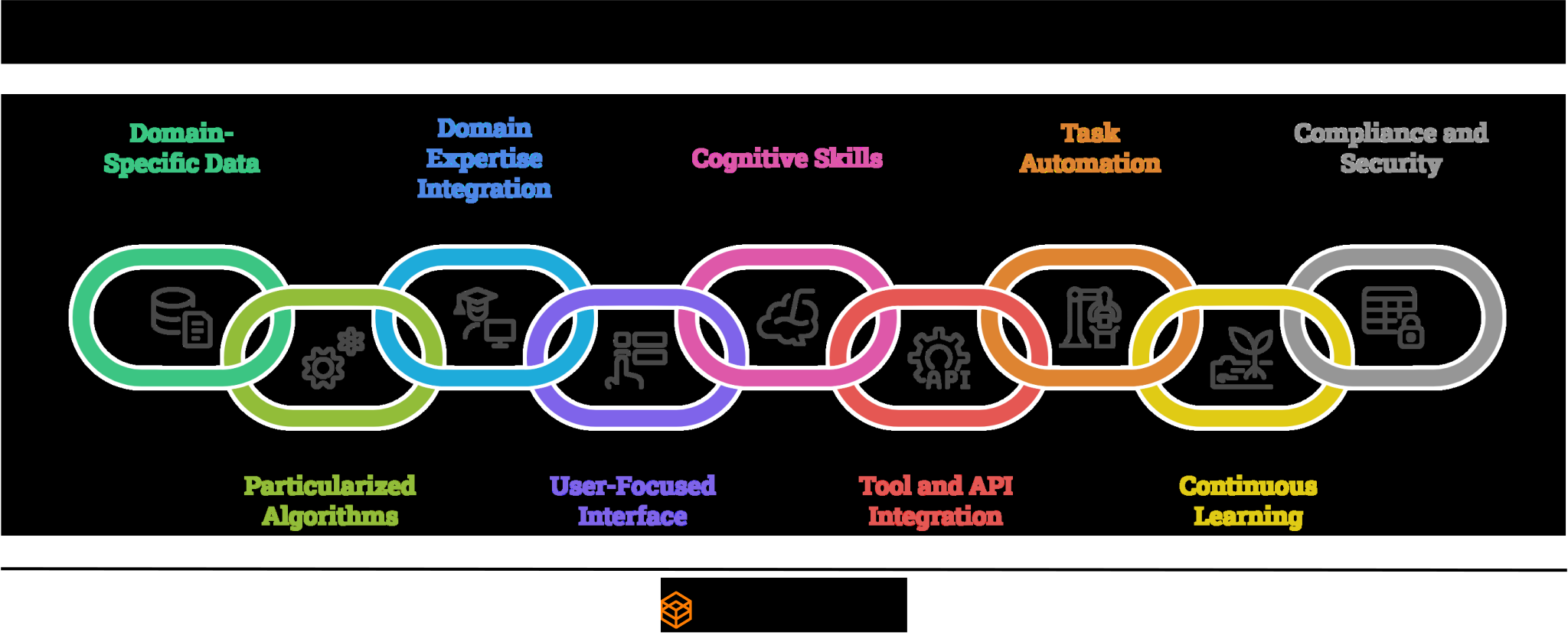
In a user-centric system architecture, vertical AI agents seamlessly integrate domain-specific data, specialized algorithms, and human expertise to directly integrate AI capabilities into industry workflows. This is a thorough description of how vertical AI agents work:
1. Domain-Specific Information Gathering
The initial step for vertically-focused AI agents is to identify and collect usable, quality data that may or may not already be specific to the vertical. This includes user activities, historical or legacy documentation, closely-coupled real-time sensor data, as well as external bounded databases. The AI can recognize the particular patterns and business rules associated with the vertical based on the high quality and specificity of the data.
2. Particularized Algorithms
Instead of general-purpose AI, vertical agents utilize algorithms suited for vertical problems. Examples can include predictive models that are tailored for AI trends in a sector, and natural language processing (NLP) models that are customized to a specialized vocabulary. Using these algorithms, vertical agents are able to address complex challenges with industry accuracy.
3. Integration of Domain Expertise
In this AI agent development guide, to instill explicit domain knowledge into the agent’s reasoning processes, developers collaborate with human experts. For domains with regulatory requirements, such as healthcare or finance, this integration can provide the vertical AI agent with confidence in making automated determinations.
4. Interface Focused on the User
The user-friendly interfaces of vertical AI agents are made to enable efficient, rapid user interactions. By abstracting away the intricacy of the underlying AI, these interfaces enable non-technical users to quickly make decisions by utilizing insights and recommendations.
5. Cognitive and Reasoning Skills
Vertical AI agents employ reasoning engines that utilize logic and domain rules to assess inputs, project outputs, and recommend actions. Cognitive skill modules such as document parsing, risk assessment, image identification, and compliance checking enhance their abilities even more.
Bonus Visit: AI in Mobile App Development
6. Combining Tools and APIs
Existing enterprise systems, APIs, and external data sources like knowledge bases or Internet of Things devices are all connected to by vertical AI agents. Dynamic, real-time data retrieval and action execution within organizational workflows are made possible by this integration.
7. Automation of Tasks and Actions
According to their analysis, vertical AI agents can generate reports, initiate workflows, carry out tasks on their own, or refer complicated problems to humans. As shrewd team players, they manage tedious or data-intensive tasks while maintaining precision and adherence to regulations.
8. Acquiring Knowledge and Adjustment
By using machine learning techniques like supervised learning, reinforcement learning, or unsupervised pattern recognition, these agents are constantly learning from fresh data and user input. As a result, vertical AI agents can develop and make better decisions over time.
9. Compliance and Security
Given that most data in verticals is considered sensitive, these AI agents operate on strict security protocols and compliance frameworks to maintain the privacy of data and follow industry regulations, which increases user and stakeholder trust.
Vertical AI agents ultimately integrate deep learning and reasoning into industry ecosystems. They process domain-specific inputs, leverage expert-augmented intelligence, and provide domain-specific automation and recommendations that change the speed and scale of business operations.
Connect with our experts today to build smarter solutions.
Agentic Architecture and Model Context Protocol (MCP), How Vertical Agents Scale in 2026
By 2026, the shift from task-specific bots to fully agentic vertical AI is what separates production-grade deployments from demos. An agentic vertical AI agent does not wait for instructions at every step. It decomposes a goal, “close this insurance claim,” “screen this job candidate,” “reconcile this trade break”, plans the sub-tasks, calls the right tools, checks its own work, and escalates to a human only when confidence is low.
The reason this matters now: Model Context Protocol (MCP). Introduced by Anthropic in late 2024 and now widely adopted across OpenAI, Google, and open-source agent frameworks, MCP gives vertical agents a standardised way to discover and call the specialised tools they need, CRM, EHR, ERP, trading systems, underwriting engines, claims systems. Before MCP, every integration was bespoke. With MCP, a vertical agent built for one healthcare system can plug into another in days.
For teams scaling vertical AI, three design patterns stand out in 2026:
- MCP-native integration layers, your vertical agent connects to enterprise tools through MCP servers, not custom connectors. Cuts integration time 60-80%. See our AI integration services for enterprise MCP implementation patterns.
- RAG-grounded reasoning, vertical agents paired with domain-specific retrieval so every decision cites your actual policies, protocols, or data rather than the model’s general training. Our RAG development services handle the retrieval layer.
- Multi-agent orchestration with GPT-5 and Claude, a lead agent delegates sub-tasks (research, drafting, compliance check, execution) to specialised sub-agents. The lead handles the user-facing conversation; the sub-agents operate in parallel. Built on GPT-5, Claude Sonnet 4.6, or open-source equivalents depending on cost and sovereignty needs.
None of this is theoretical anymore. Gartner’s 2026 CIO survey shows 41% of large enterprises have at least one autonomous agentic workflow in production, up from 4% in 2024. The vertical AI vendors that did not move to agentic + MCP architectures in 2025 are losing deals this year to those who did.
Types of Vertical AI Agents
Before you get into the vertical AI agent in your business, it’s important to know all types of vertical AI agents.
| Type of Vertical AI Agent | Description & Applications | Industry Examples & Use Cases |
| Industry-Focused AI Agents | Customized for specific industries with deep knowledge of workflows and regulations. | Manufacturing (predictive maintenance), Healthcare (diagnostics, coding), Finance (fraud detection, underwriting), Retail (inventory management) |
| Customer Interaction AI | AI is designed to improve customer engagement through personalized support, chatbots, and recommendations. | E-commerce (personalized recommendations), Retail (customer support chatbots), Telecom (service queries) |
| Operational Improvement AI | Automates routine tasks and optimizes internal processes such as supply chains and resource allocation. | Logistics (fleet management and route optimization), Manufacturing (process automation), Energy (grid management) |
| Predictive Analytics & Decision Support AI | Analyzes historical and real-time data to forecast trends, assess risks, and guide strategic decisions. | Healthcare (patient risk prediction), Financial services (investment and risk analysis), Energy (demand forecasting) |
| Mixed AI Solutions | Combines abilities such as operational improvement and customer interaction into integrated solutions. | Platforms providing both operational automation and customer support services for sectors like retail and finance. |
| Robotic Process Automation (RPA) with AI | Merges AI with RPA to handle repetitive processes intelligently, adapting to new data and scenarios. | Invoice processing, claims management in insurance, and customer onboarding in banking. |
Use Cases of Vertical AI Agents With Real-Life Examples
Here in this section, you will understand the vertical AI agent examples in real life so that you can build a blueprint for building a vertical AI agent for your business, particularly.
1. Healthcare: AI agents in healthcare streamline clinical processes by integrating with electronic health records (EHRs). This helps in managing appointment scheduling, patient data, and diagnostic support, which is difficult for one person to manage. This tool cuts costs in terms of hiring multiple people for different shifts; only one agent can manage all
2. Finance: The next is the finance industry. As discussed earlier, the finance industry is the industry where the chances of making mistakes are really high and huge. Hence, enterprises have a decisive decision to implement vertical AI agents specifically for this industry to focus on small details and make fewer mistakes. Along with this, these AI agents excel at real-time transaction monitoring, fraud detection, risk assessment, and regulatory compliance.
3. Manufacturing: Vertical AI agents dive into sensor data to anticipate equipment breakdowns before they occur, which allows for predictive maintenance. This proactive approach not only keeps downtime and maintenance expenses low but also fine-tunes production workflows. If you belong to the manufacturing industry and want to know all the real-time use cases of AI in manufacturing, then tap on the given link.
4. Retail and Supply Chain: In the world of retail, vertical AI agents play a crucial role by handling inventory, customizing customer experiences, and fine-tuning supply chains. For example, Amazon, being the world’s largest retailing platform, leverages AI-driven recommendation engines to suggest products to its customers based on their previous activities and interests.
Also Read: AI Agents in the Retail Industry
5. Customer Support: Vertical AI agents drive chatbots and virtual assistants to manage routine questions and transactions, which allows human agents to concentrate on more complicated matters. This shift leads to faster response times and boosts customer satisfaction.
Businesses looking to hire software developers skilled in AI can partner with experienced vertical AI agent companies like Scalacode to design and deploy tailored vertical AI solutions that drive measurable impact.
Explore More: Top Personal Assistant AI Apps
Future Trends of Vertical AI Agents
Vertical AI agents are on the brink of transforming enterprise technology by introducing highly specialized, intelligent automation that surpasses the capabilities of traditional SaaS and general-purpose AI. As we are moving towards 2026, a few notable trends are shaping this evolution.
- To start, domain-specific large language models, or LLMs, are becoming the backbone of vertical AI agents. They are meticulously fine-tuned using industry-specific data, which allows them to offer precise, compliant, and context-aware responses. This enables AI agents to take on more complex tasks on their own.
- The development of multi-agent systems will enable various specialized vertical AI agents to work together on complex workflows, achieving comprehensive automation that standalone tools couldn’t manage before.
- With the growing use of real-time data and edge computing, vertical AI agents will be able to provide prompt, actionable insights directly where they’re needed, like on manufacturing floors, in healthcare facilities, or on financial trading desks.
- AI and regulatory compliance remain a priority; vertical AI agents will increasingly be designed to adhere to rigorous ethical standards and industry-specific rules, such as HIPAA in healthcare and Basel III in banking.
In the tech world, big players like Google and Oracle are paving the way by offering ready-made vertical AI agent platforms, making it easier for businesses to deploy and customize these tools.
In essence, the real competitive edge comes from vertical AI agents’ capability to offer scalable automation, improve efficiency, and enhance customer experiences, making them essential for businesses striving to excel in a future dominated by AI.
The increasing demand for these advanced AI solutions is driving growth in AI Agent Development Services, with specialized companies offering custom-built vertical AI agents tailored to the unique challenges of specific industries.
Conclusion
To sum up, Vertical AI Agents represent a groundbreaking advancement in a direct way that the industry will improve operational efficiencies, cater to the selection of customers, and base decision-making on data. Because these Agents are industry specialists, as opposed to generalists, they can provide tailored, industry-specific intelligence that can convert into real business value.
It is important to partner with a Top Software development company to realize that value. This type of firm has the technical knowledge and industry experience to successfully engineer, integrate, and layer vertical AI agents into a business’s enterprise systems to drive transformative outcomes. Using a vertical AI agent fills a business’s need to remain competitive and agile in an AI-dominated world.
No business that aims to implement or expand its use of vertical AI would benefit from the tailored, scalable solutions provided by leading software development companies, which can provide meaningful improvements in business capabilities and value generation.
Start your AI-powered journey today.
How Much Does It Cost to Build a Vertical AI Agent in 2026?
Vertical AI agent costs vary by region, complexity, and how much production-grade engineering the firm puts behind the build. The numbers below reflect what buyers paid in 2026 for v1 production deployments across healthcare, fintech, legal, and enterprise SaaS, validated against benchmarks published by McKinsey on the state of AI.
Senior AI engineer hourly rates by region
| Region or tier | Senior hourly rate | Best for |
|---|---|---|
| Value offshore (India) | $13 to $25 | Tight budget, multi-month engagements, mid-market |
| Mid-tier offshore (Eastern Europe, parts of Asia) | $25 to $49 | Buyers wanting timezone overlap with EU |
| Top-tier offshore plus US nearshore | $50 to $99 | Regulated industries, high oversight |
| Premium boutiques plus US onshore | $100 plus | Strict data residency, in-person required |
Total project cost for a v1 vertical AI agent in production
| Engagement model | Project cost (v1, 7 to 11 weeks) | What you get |
|---|---|---|
| Value offshore | $20,000 to $70,000 | 2 to 4 senior engineers, 4 to 6 week build, basic compliance |
| Top-tier offshore | $40,000 to $120,000 | Full team plus PM and QA, 7 to 11 week build, regulated-industry compliance audit included |
| Premium plus US-onshore | $80,000 to $250,000 | In-person presence, deeper compliance footprint, post-launch SLA |
Three things shift a vertical AI agent project up the cost band. First, regulatory and compliance overhead. A HIPAA-compliant healthcare agent or a SOC 2-audited fintech agent adds 20 to 40 percent of build time for guardrails, audit logs, and penetration testing. Second, multi-agent orchestration. A single conversational agent costs less to build than a team of agents that hand off tasks across functions. Third, custom data integrations. Plugging into a legacy EMR, a niche ERP, or a proprietary CRM adds engineering time that out-of-the-box connectors do not. Buyers planning a production rollout should budget another 15 to 25 percent of the build cost for the first 6 months of post-launch operations: model drift checks, observability, human-in-the-loop review, and continuous fine-tuning.
Monthly retainers for ongoing engagement run from $1,200 (associate engineer, value offshore) to $4,000 (lead engineer, top-tier offshore). For a typical v1-plus-operate engagement, plan a $30,000 to $80,000 build followed by $8,000 to $20,000 monthly for a 2 to 3 engineer steady-state team.
Real Vertical AI Agent Case Studies
The following are anonymized case studies from production vertical AI agent engagements. Industry, problem, and outcome are real; specific client names are withheld for confidentiality.
Healthcare: patient triage agent for a US health system
Problem: A US regional health system was losing patients to longer-than-acceptable phone-triage wait times during peak hours. Their nurse-staffed call center was hitting 18-minute average hold times during morning shifts, and patient satisfaction scores were sliding.
Solution: A HIPAA-compliant conversational agent trained on the health system’s care pathway protocols, EHR access patterns, and clinical guidelines. The agent runs as a phone-first triage layer that routes urgent cases directly to a nurse and handles non-urgent intake autonomously. Built on a HIPAA-certified vector database with audit logging and a human-in-the-loop review queue, aligned with HHS HIPAA Security Rule guidance.
Outcome: Average phone-triage wait time dropped from 18 minutes to under 4 minutes over 90 days. Patient satisfaction scores on triage rose 28 percent. The nurse-staffed team was redeployed to higher-acuity patient outreach. Build cost: 9 weeks, 3 senior engineers, $95,000. Operating cost: $14,000 monthly for a 2-engineer steady-state team plus model retraining quarterly.
Fintech: transaction-monitoring agent for a UK challenger bank
Problem: A UK challenger bank was generating thousands of low-quality fraud alerts per day. Analysts were spending 70 percent of their day clearing false positives, and the bank was under FCA pressure to demonstrate measurable improvements in alert quality.
Solution: A vertical AI agent that ingests transaction streams, customer behavior history, and merchant risk signals to score every alert on a fraud-probability axis. The agent escalates only high-confidence alerts to human review and routes the rest into automated decisioning. Built with full FCA SYSC-aligned audit trails and an explainability layer that shows the analyst exactly why each alert was scored.
Outcome: False positive rate dropped 62 percent. Analyst case-clearing throughput rose 3.4x. The bank passed its FCA model risk audit on first submission. Build cost: 11 weeks, 4 senior engineers, $145,000. The bank now runs a 3-engineer ongoing team and adds new fraud rule sets monthly.
Legal: contract review agent for a multinational law firm
Problem: A multinational law firm’s M&A team was burning 8 to 12 hours per associate per week on initial due-diligence document review. The firm wanted to compress that without losing the rigor that partner-level review demands.
Solution: A document review agent trained on the firm’s prior deal corpus and tuned to flag the issue patterns partners cared about most: change-of-control clauses, indemnification gaps, IP assignment edge cases. The agent produces a structured first-pass review with confidence scores; associates spend their time on the flagged sections rather than reading every page.
Outcome: Initial due-diligence review time dropped from 10 hours to 3 hours per associate per deal. The firm reallocated those hours to client-facing work and senior-associate development. Build cost: 8 weeks, 3 senior engineers, $78,000.
Vertical AI Specialists vs Horizontal AI Firms vs In-House Build vs Off-the-Shelf SaaS
Buyers comparing vertical AI agent options (and looking at the broader market mapped in our 2026 ranking of top AI agent development companies, using frameworks like Anthropic’s guide to building effective agents) usually weigh four paths: a vertical-specialist development firm, a horizontal AI firm that does general agent work, an in-house build, or an off-the-shelf SaaS agent. Each has trade-offs.
| Evaluation criteria | Vertical specialist | Horizontal AI firm | In-house build | Off-the-shelf SaaS |
|---|---|---|---|---|
| Speed to v1 production | 7 to 11 weeks | 10 to 16 weeks | 16 to 24 weeks | 2 to 4 weeks (limited customization) |
| Industry vocabulary fit | Strong (trained on vertical corpora) | Weak (generic prompts) | Strong (your team knows the vocab) | Generic |
| Regulatory readiness | Strong (HIPAA, SOC 2, GDPR, FINRA) | Weak to medium | Strong if your team has compliance expertise | Varies by vendor |
| Cost to ship v1 | $40,000 to $120,000 | $60,000 to $200,000 | $200,000 plus (loaded engineering cost) | $0 plus per-seat licensing |
| Integration depth | High (custom EMR, ERP, CRM) | Medium | High | Low |
| Model and data ownership | You own it | You own it | You own it | Vendor owns |
The right path depends on three questions. Are you in a regulated industry? Off-the-shelf SaaS often fails the compliance bar, which leaves vertical specialist or in-house. Do you have an in-house ML team with shipped production agents on their resume? If yes, in-house build can work; if no, the vertical specialist path is faster and cheaper. How critical is industry vocabulary? For nuanced verticals like legal, healthcare, and fintech, horizontal firms typically need 3 to 6 months of prompt iteration to reach the quality a vertical specialist hits in week 1.
12-Question Checklist for Choosing a Vertical AI Development Partner
Buyers often overpay for vertical AI projects because they pick the firm with the best slide deck rather than the firm with the best engineering bench. Use these 12 questions on every vendor call to filter for actual production capability.
- Production references in your vertical. Ask for two production references in your specific industry with measurable outcomes (precision, recall, deflection rate, time savings). If they cannot produce two, they have not shipped enough vertical work to lead yours.
- Regulatory and compliance audit framework. Will they run a regulatory and compliance audit before quoting the build? Firms that quote without a compliance audit are usually hiding gaps.
- Senior engineer on the discovery call. Insist on a senior engineer joining the discovery call, not just a sales engineer. The senior engineer is who will architect your build; if they cannot show up, the firm is selling capacity it does not have.
- Model and framework stack in 2026. Confirm they are building on 2026-current models: GPT-5, Claude Sonnet 4.6 or Opus 4.6, Llama 3.3, Gemini 2 family. Inference on vLLM or NVIDIA NIM. Vector DBs Pinecone, Weaviate, or pgvector. Orchestration on LangChain or LlamaIndex. Protocols including Model Context Protocol (MCP). Firms still building primarily on GPT-3.5 or 2023-era stacks are behind.
- Multi-agent track record. If your use case requires multi-agent orchestration (the patterns documented in OpenAI’s agents guide), ask for evidence of shipped multi-agent systems. Firms that have not shipped multi-agent often underestimate the design and observability complexity.
- Production support and observability. What is their post-launch support stack? What does observability look like? Who responds to a model failure at 2 AM?
- Data and model ownership. Do you own the trained models and the training data after the engagement ends? If not, walk.
- Integration with your stack. Can they integrate with your existing EMR, ERP, CRM, or data warehouse without forcing you to rip and replace?
- Trial-to-hire framework. Will they offer a 2-week paid trial-to-hire framework so you can walk if the engineers are not what was sold?
- Senior engineering ratio. What percent of the engagement team is senior engineers (5 plus years AI experience)? Below 60 percent and you are paying senior rates for junior work.
- Compliance certifications. ISO 9001, SOC 2, HIPAA business associate agreement (BAA), GDPR processor agreement, alignment with NIST AI Risk Management Framework. Match certifications to your regulatory environment.
- Total production AI project count. How many production AI projects have they shipped? 50 plus is the minimum bar. Firms with fewer projects are still learning on your engineering budget.
Use this checklist on every vendor call. Walk if any single answer raises a flag. The cost of a bad vendor pick on a vertical AI project is rarely the project fee itself; it is the 6 to 12 months of lost opportunity and competitive ground while a flawed agent fails to deliver outcomes.
How ScalaCode Builds Vertical AI Agents
ScalaCode has shipped 800 plus production AI projects across 45 plus countries since 2012, with a 95 percent client retention rate and ISO 9001 certification since 2011. The AI practice operates as a senior-heavy team, with two senior engineers on every discovery call (not sales engineers) and a delivery model built around 2-week paid trial-to-hire frameworks for buyers who want to validate engineering quality before signing a longer engagement.
For vertical AI agent buyers, ScalaCode brings three things that horizontal firms typically lack. First, vertical-specific compliance frameworks built into the engagement: HIPAA business associate agreements for healthcare, SOC 2 readiness for fintech, GDPR processor agreements for EU buyers, FINRA-aligned audit logging for capital markets work. Second, model and data ownership transfers to the client at engagement end, with full source-code handoff and post-launch support contracts available. Third, transparent pricing tied to the canonical rate card: senior AI engineers from $13 to $25 hourly at the value tier, $1,200 to $4,000 monthly retainers for ongoing engagement, and a typical vertical AI v1 project priced at $20,000 to $120,000 depending on regulatory and integration complexity.
Whether you need a HIPAA-compliant patient-triage agent for a US health system, a transaction-monitoring agent for a UK challenger bank, a contract review agent for a multinational law firm, or a yield optimization agent for a German factory, the engagement starts the same way: a 30-minute architecture call with a senior engineer, a 1-week discovery and compliance audit, and a fixed-scope quote within 7 days.
Talk to a senior AI engineer about your vertical AI agent build, or request a vertical-by-vertical roadmap if you are still scoping the business case.
FAQs
-
What is a vertical AI agent?
In simple words, a vertical AI agent is an AI system that can be used to carry out a task that is very specific to a certain industry or domain, like healthcare, finance, retail, or logistics. Additionally, it tackles niche problems, and it has high-level domain knowledge.
-
How does vertical AI change industry operations?
Vertical AI agents boost every industry operation by enhancing workflow, making data-based decisions, increasing efficiency, cutting down errors, and much more.
-
Which industries use vertical AI agents?
There are multiple industries that use vertical AI agents to boost their business operations, but specifically, healthcare, finance, retail, logistics, etc., use the technology most nowadays.
-
What is the difference between SaaS and an AI agent?
SaaS (Software-as-a-Service) provides access to software applications on the cloud and typically has pre-configured functionality. On the other hand, an AI agent is not a small piece of software, as it actively learns, changes, and makes decisions based on data.
-
How do vertical AI agents differ from horizontal or general-purpose AI?
Vertical AI agents are designed to fit a particular industry or application and provide specialized knowledge and great precision. Horizontal or general-purpose AI is more basic and can work on a variety of tasks in industries, but sometimes they are not specialized enough to work on tasks specific to a domain.
-
What are some real-world examples of vertical AI agents?
There are multiple real-world examples of vertical AI agents given below for different industries:
- AI in Healthcare: AI agents that assist doctors with diagnostics.
- AI in Finance: Fraud detection or algorithmic trading systems.
- AI in Retail: Personalized shopping assistants.
- AI in Legal: AI tools that review contracts and legal documents. -
What is the future of vertical AI agents?
Vertical AI agents will be more autonomous, industry-specific, and able to make intricate decisions with limited human supervision. As generative AI and machine learning improve, they will transform industry-related processes, decrease expenses, and increase personalization on a large scale.
-
How does vertical AI improve business efficiency?
By automating repetitive tasks, reducing errors, speeding up decision-making, and providing industry-specific insights, vertical AI agents help improve the business’s efficiency.
-
How do vertical AI agents ensure accuracy and reliability?
Vertical AI agents ensure accuracy and reliability with the help of training, as they are trained enough on domain-specific data. Additionally, they are integrated with real-time feedback loops, and they are also in compliance with regulatory aspects.
-
How much does it cost to build a vertical AI agent in 2026?
Senior AI engineer hourly rates range from $13 to $25 at the value offshore tier, $25 to $49 at mid-tier offshore, $50 to $99 at top-tier offshore plus US nearshore, and $100 plus at premium boutiques and US onshore. A v1 vertical AI agent in production typically costs $20,000 to $70,000 at value pricing, $40,000 to $120,000 at top-tier offshore, and $80,000 to $250,000 at premium plus US-onshore. Three things shift cost up the band: regulatory and compliance overhead (HIPAA, SOC 2), multi-agent orchestration complexity, and custom data integrations into legacy EMR, ERP, or CRM systems.
-
How long does it take to build a production vertical AI agent?
Discovery and architecture takes 1 week, build takes 3 to 5 weeks, internal QA and staging takes 1 week, and production rollout plus iteration takes 2 to 4 weeks. Total: 7 to 11 weeks for v1 in production. Faster firms ship in 4 to 6 weeks. Larger enterprises with deeper compliance requirements take 4 to 6 months.
-
How do I choose a vertical AI development partner?
Use the 12-question vendor evaluation checklist on every vendor call. Filter for production references in your specific vertical, regulatory and compliance audit framework, senior engineer presence on discovery calls, 2026-current model and framework stack, multi-agent track record, production support and observability, data and model ownership, integration depth, trial-to-hire framework, senior engineering ratio, compliance certifications, and total production AI project count. Walk if any single answer raises a flag.
-
What models and frameworks should a vertical AI agent firm be using in 2026?
Models: GPT-5 (OpenAI), Claude Sonnet 4.6 and Claude Opus 4.6 (Anthropic), Llama 3.3 (open source), Gemini 2 family. Inference: vLLM or NVIDIA NIM. Vector DBs: Pinecone, Weaviate, or pgvector. Orchestration: LangChain or LlamaIndex. Protocols: Model Context Protocol (MCP) for tool integration. Firms still building primarily on GPT-3.5 or 2023-era stacks in 2026 are behind the curve.
How do Model Context Protocol (MCP) and agentic patterns change vertical AI deployments in 2026?
MCP gives vertical AI agents a standard way to discover and call enterprise tools, CRMs, ERPs, clinical systems, claims platforms, without custom integration code for each one. Agentic patterns let those agents plan multi-step workflows autonomously rather than waiting for prompts at every turn. Together they cut vertical AI deployment time 60-80% and enable workflows that were impractical in 2024, like fully autonomous claims triage, multi-document loan underwriting, and cross-system order reconciliation. In our 2026 client deployments, the vertical AI projects using MCP-native architectures are shipping in 6-10 weeks vs 4-6 months for custom-connector builds.
Should we build our vertical AI on GPT-5, Claude, or an open-source model like Llama 3.3?
Depends on the decision rules that matter for your vertical. GPT-5 and Claude Sonnet 4.6 offer the strongest reasoning, best tool-use reliability, and lowest ops overhead, use them when decisions have real consequence and you can tolerate cloud processing of your data. Llama 3.3, Qwen 3, or Mistral make sense when you need on-premises deployment for regulatory reasons (healthcare PHI, defence, regulated financial data), or when your query volume is high enough that a smaller fine-tuned model pays off economically. Many 2026 vertical AI deployments use a hybrid, frontier models for nuanced reasoning, fine-tuned open-source for deterministic sub-tasks. Our LLM development services cover fine-tuning when it’s the right call.
For organisations rolling vertical AI agents across multiple business units, an aligned program design matters more than any single technical choice. See our AI consulting and strategy services for vertical-by-vertical roadmaps that pair this technical work with the right operating-model and governance fit.