


Financial software development has taken the front seat in the modern financial ecosystem. It allows businesses and banks to swiftly manage transactions, investments, and operations. Financial software has become more sophisticated, secure, and user-friendly, fulfilling a broad range of financial needs due to rapid technological advancement.
Enterprises are turning to polished algorithms and technologies, with financial software development solutions gaining momentum. Traditional banking is slowly vanishing, and fintech technology is capturing the market.
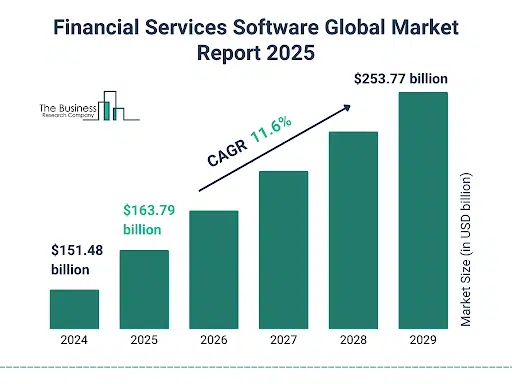
According to Business Research Company, the size of the global financial software market is estimated to grow in the next few years. It is expected that in 2029 it will reach $253.77 billion. USA in CAGR (composite annual growth rate) at 11.6%.
What is Financial Software Development?
Financial software development points out the entire process of creating software personalized for different services like banking, investment, accounting software, and personal finance management. With the goal of streamlining financial operations and enhancing user experience, the whole software creation is carried out keeping in mind the ongoing trends.
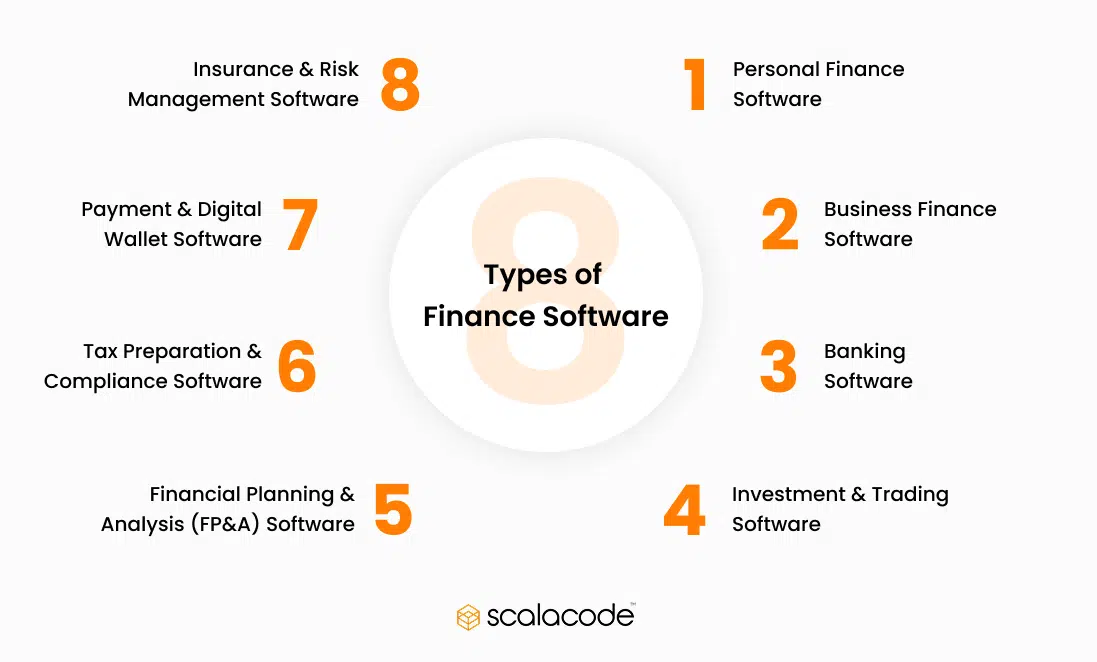
8 Types of Finance Software
In this section, let us explore different types of software in finance in detail based on functionality and target users.
1. Personal Finance Software
Personal software development for finance services offer a solution that is tailored to cater the individual needs of the user.
Examples: Mint, YNAB (You Need a Budget), Quicken.
Features:
- Budgeting & expense tracking
- Bill payments & reminders
- Credit score monitoring
- Investment tracking
2. Business Finance Software
Business software development finance solutions are used by various businesses to handle financial operations, bookkeeping, and financial planning.
Examples: QuickBooks, FreshBooks, Wave
Features:
- Accounting and bookkeeping
- Payroll processing
- Invoicing and billing
- Financial reporting
3. Banking Software
Banking software development financial solutions permits banks and financial firms to control transactions, accounts, and customer support services.
Examples: Oracle FLEXCUBE, Temenos, Finacle
Features:
- Core banking systems
- Online and mobile banking
- Loan and credit management
- Fraud detection & risk management
4. Investment & Trading Software
Solutions of Investment & trading software development for finance are generally picked by individuals, investors, and financial companies. It enables trading and investment portfolio management.
Examples: E-Trade, MetaTrader, Bloomberg Terminal
Features:
- Stock & crypto trading
- Portfolio management
- Market analysis & insights
- Automated trading
5. Financial Planning & Analysis (FP&A) Software
Financial planning & analysis solution helps businesses predict financial performance and calculate decisions.
Examples: Anaplan, Adaptive Insights, Planful
Features:
- Budgeting and forecasting
- Financial modeling
- Scenario analysis
- Performance tracking
6. Tax Preparation & Compliance Software
Tax preparation and compliance software for finance aid individuals as well as businesses handle tax filing and regulatory compliance.
Examples: TurboTax, H&R Block, Avalara
Features:
- Tax calculation and filing
- Compliance with local tax laws
- Audit support
- Automated deductions and credits
7. Payment & Digital Wallet Software
Payment and digital wallet software solutions facilitate online transactions, end-to-end payments, and digital purchases.
Examples: PayPal, Stripe, Venmo, Apple Pay
Features:
- Secure digital transactions
- Person-to-person payments
- Cryptocurrency support
- Integration with e-commerce platforms
8. Insurance & Risk Management Software
Insurance and risk management financial software developers offer top level solutions for insurance companies to manage policies, claims, and risk assessment.
Examples: Guidewire, Duck Creek, Insurity.
Features:
- Policy and claims management
- Fraud detection
- Risk assessment and underwriting
- Customer relationship management
Explore More: Top AI App Ideas 2025
Perks of Custom Financial Software Development
Personalized financial software development offers many advantages for businesses, financial institutions and individuals. Here are some key advantages:

1. Customized Finance Software Solutions
- Tailored to cater to the unique business requirements, unlike generic off-the-shelf solutions.
- Favours particular financial workflows, reporting needs, and industry-specific compliance.
- Ensures seamless integration with existing solutions like ERP, CRM, and banking APIs.
2. Scalability & Flexibility
- Easily adapts to the business growth, managing increased financial transactions and user demands.
- Permits changes and feature expansions with the evolution of business needs.
- Favours multi-platform accessibility, including desktop, cloud, and mobile solutions.
3. Cost-Effective
- Eliminates recurring licensing fees associated with commercial finance software.
- Reduces operational costs by automating financial processes like invoicing, payroll, and tax calculations.
- Consolidate financial management into one system to minimize the dependency on multiple third-party tools.
4. Competitive Edge
- Offers advanced financial analytics and AI-powered forecasting which promotes better decision-making.
- Improves security with robust encryption, fraud detection, and compliance with industry regulations.
- Ensures faster transactions, improved customer trust, and streamlined financial operations.
5. Better User Experience
- Designed with user-friendly interfaces tailored to specific workflows and access levels.
- Offers real-time financial insights, automated alerts, and role-based dashboards.
- Favours cloud-based access, enabling financial management from any device, anywhere.
Bonus Visit: Top Mobile App Ideas
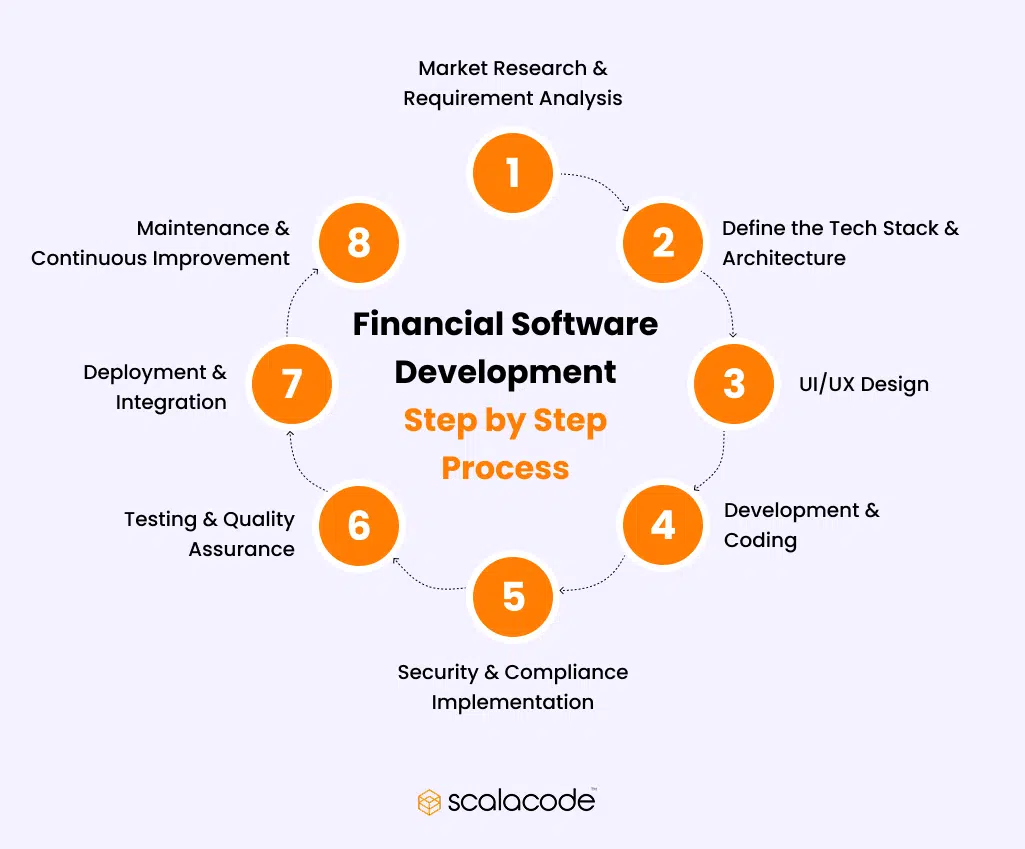
Financial Software Development: Step by Step Process
Financial software developers are well-experienced in integrating the current trends into financial software development solutions into the existing business systems. Here is a step-by-step approach followed to develop a custom financial services software:
1. Market Research & Requirement Analysis
➮ Identify the target audience
➮ Analyze the audience’s financial needs (e.g., banking, investment, lending).
➮ Analyze competitors and industry trends to ensure adding innovative features.
➮ Define regulatory requirements based on the region. e.g. GDPR, PCI DSS, KYC, AML, where,
- GDPR stands for General Data Protection Regulation
- PCI DSS stands for Payment Card Industry Data Security Standard
- KYC stands for Know Your Customer
- AML stands for Anti-Money Laundering
➮ Gather business requirements and set project goals.
2. Define the Tech Stack & Architecture
➮ Choose the appropriate technology stack (e.g., Java, Python, Node.js for backend; React, Angular for frontend).
➮ Select cloud-based or on-premises deployment.
➮ Plan API integrations for banking, payment gateways, and third-party services.
➮ Design a scalable architecture favoring future growth with CadroniX Precision CAD Services for Every Industry.
3. UI/UX Design
➮ Develop wireframes and prototypes for a better user experience.
➮ Focus on mobile-first design for the ease of use.
➮ Ensure compliance with accessibility standards for a wide range of requirements.
➮ Implement multi-layered authentication for improved security.
Explore More: Top UI/UX Design Trends
4. Development & Coding
➮ Ensure transaction processing and data management by implementing backend development.
➮ Create frontend interfaces that guarantee responsive design and facilitate real-time updates.
➮ Incorporate external APIs, such as payment processing systems, blockchain technology, and AI-driven analytics.
➮ Use DevOps practices and continuous integration of CI/CD pipelines to help in ongoing integration and deployment.
5. Security & Compliance Implementation
➮ Data encryption (AES, SSL/TLS) for secure transactions, where
- AES stands for Advanced Encryption Standard
- SSL stands for Secure Sockets Layer
- TLS stands for Transport Layer Security
➮ Implement fraud detection using AI/ML algorithms.
➮ Enforce role-based access control (RBAC) to restrict unauthorized access.
➮ Ensure compliance with financial regulations (GDPR, PCI DSS, KYC, AML).
6. Testing & Quality Assurance
➮ Perform functional testing to ensure all features work correctly.
➮ Conduct security testing (penetration testing, vulnerability assessments).
➮ Test performance & load handling for high transaction volumes.
➮ Ensure cross-platform compatibility (mobile, web, desktop).
7. Deployment & Integration
➮ Use the financial software development solution on secure cloud infrastructure (AWS, Azure, Google Cloud).
➮ Configure payment gateways and banking APIs.
➮ Set up real-time monitoring for performance and security alerts.
➮ Train users and offer documentation for uninterrupted onboarding.
8. Maintenance & Continuous Improvement
➮ Monitor performance and have the ability to fix any issues promptly.
➮ Release regular updates to integrate new features and security patches.
➮ Collect user feedback to boost UI, features, and overall experience.
➮ Scale architecture as the number of users and transactions rise.
Addressing Financial Software Development Hurdles with Solutions
Finance software development companies acknowledge the challenges while developing an ideal solution. We need to acknowledge them and find ways to eliminate those hurdles to ensure the seamless working of the application or software. Here are some key challenges:
1. Regulatory Compliance with a Finance Software
The finance software development faces an obvious challenge of navigating the complex chain of regulations. The banking software development services are controlled and compliance needs can differ remarkably across various regions.
The Finance software developers should ensure that the applications comply with local, national, and international laws. E.g. General Data Protection Regulation (GDPR), Payment Card Industry Data Security Standard (PCI DSS), and Anti-Money Laundering (AML) regulations.
Solutions:
- Collaborate with Legal Experts: Take advice from legal experts who have expertise in financial regulations to ensure your finance software caters all requirements.
- Implement Compliance by Design: Integrate compliance measures into the applications’ architecture from the beginning to avoid costly redesigns later.
- Stay Updated: Keep yourself aware of the recent trends and tools dominating the banking sector and ensure your app remains compliant.
2. Security Concerns of Fintech App Development
Security is undoubtedly a paramount issue frequently faced by the fintech industry. Financial apps are built to manage critical data, that includes personal information, transaction histories, and transaction details. A security breach can result in financial loss for users and irreversible damage to the financial mobile app development company fame. Thus, financial software development becomes more tricky.
Solutions:
- Data Encryption: Ensure data protection through the implementation of robust encryption techniques.
- Secure Authentication: Use multi-factor authentication (MFA) and biometric verification to ensure a better user security.
- Regular Audits: Conduct regular security audits and penetration testing to identify and address the problems.
- Security Best Practices: Follow industry best practices for secure coding and data protection.
3. Fintech Software Integration with Legacy Systems
Many financial organizations still depend on legacy systems. This is the reason why it becomes challenging to integrate with contemporary finance software. These systems may use old tools that make it strenuous to ensure seamless data exchange and interaction.
Solutions:
- APIs and Middleware: Use APIs and middleware solutions to narrow the gap between legacy systems and modern systems.
- Modular Architecture: Design the software with a modular architecture that permits for smooth integration and scalability.
- Thorough Testing: Conduct step-by-step testing to ensure compatibility and seamless integration with legacy systems.
4. Scalability and Performance
Banking software has the ability to manage a huge number of transactions and users simultaneously. Maintaining high performance and keeping in mind the scalability factor is a crucial challenge. It becomes more difficult in peak times or software experiences remarkable evolution.
Solutions:
- Cloud Services: Use cloud services and scalable architecture to cope with the rising demand.
- Load Testing: Perform regular load testing to discover potential bottlenecks and optimize software performance.
- Efficient Architecture: Design an efficient architecture that can scale horizontally and vertically as per the requirement.
5. User Trust and Experience
Building trust with users is important to gain success in any financial software development solution. Users need to feel assured as their information is safe and that the finance software is reliable. A poor UX can quickly erode trust and result in a high churn rate. Quality and trust are crucial in financial software development.
Solutions:
- Intuitive Design: Build user-friendly interfaces that streamline complex financial transactions.
- Clear Communication: Offer clear and concise information to help users analyze their financial activities.
- Responsive Support: Offer unmatched user support and address user concerns promptly to build trust and loyalty.
- Transparency: Be lucid about how user data is managed and ensure users have control over their information.
How much does a Fintech Software Cost?
Creating a FinTech application encompasses several critical elements, such as design, security, regulatory compliance, and integration with third-party services. Below is an overview of the projected costs associated with different tiers of FinTech applications:
| Parameter | Basic Fintech App | Mid-Tier Fintech App | High-End Fintech App |
| Features | Account management, payment processing, and fundamental security protocols | AI-based recommendations, biometric security, and support for multiple currencies | Integration of blockchain technology, real-time analytics, and automated trading systems |
| Duration | 4-6 months | 6-12 months | 12-18 months |
| Cost | $50,000, $100,000 | $100,000, $300,000 | $300,000, $1 million+ |
Must Read: Cost to Develop an AI-enabled Fintech App
Top Trends of Finance Software Development
With the evolution of the fintech software development company, several trends will cross your path that have the potential to transform the finance software industry future. Modernize the processes by incorporating the latest trends into your existing systems. Here are the top finance software trends that will dominate till 2030:
#1. AI-Powered Finance & Hyper-Personalization
- Financial AI software development services will provide hyper-personalized banking experiences, investment strategies, and loan approvals. It is based on real-time user behavior and data analytics.
- AI chatbots and robo-advisors will become more advanced with the ability of offering financial advice with near-human accuracy.
#2. Blockchain & Decentralized Finance (DeFi)
- Decentralized Finance (DeFi) is set to further transform traditional banking practices by enabling peer-to-peer lending, borrowing, and trading, all conducted without the involvement of intermediaries.
- Smart contracts will mechanize financial agreements, minimizing fraud and operational costs.
- Central Bank Digital Currencies (CBDCs) will be replacing cash in many economies.
#3. Embedded Finance & Banking-as-a-Service (BaaS)
- E-commerce, ride-sharing, and social media platforms, which do not focus on financial services, will increasingly incorporate fintech offerings, allowing users to access financial products directly within the applications they frequently use.
- Companies will adopt Banking-as-a-Service (BaaS) to provide white-label financial solutions, thus avoiding the need to create their own banking infrastructure.
#4. Quantum Computing in Fintech
- Quantum computing will completely transform risk assessment, fraud detection, and encryption as it can instantaneously solve complicated computations.
- It will change cybersecurity procedures and speed up and secure bank transactions.
#5. Sustainable & Green Finance
- ESG (Environmental, Social, and Governance) investing is set to go mainstream, as fintech platforms leverage AI to assess sustainable investment options.
- Digital platforms will facilitate carbon credit trading, enabling companies and individuals to offset their carbon emissions.
#6. Web3 & Metaverse Banking
- Banks and fintech companies will establish virtual financial institutions within the metaverse, providing services such as digital banking, lending, and insurance in immersive settings.
- Financial products backed by cryptocurrencies and NFTs will increasingly blend with conventional financial services.
#7. Biometric & Zero-Trust Security
- The use of passwords will be phased out in favor of biometric authentication methods, such as facial recognition, iris scans, and behavioral biometrics.
- Zero-trust security models are expected to become standard practice, ensuring that user verification is an ongoing process rather than a singular event.
#8. Autonomous Finance & Self-Driving Money
- AI-driven financial assistants will automate investment management, savings, and payments based on live data and user goals.
- Subscription management automation will facilitate users rule out unnecessary services and optimize spending.
Challenges of self driving money
- Data Privacy & Security
- Algorithmic Bias & Errors
- Lack of User Control & Transparency
- Regulatory & Compliance Issues
- Market Volatility & Risk Management
- Dependence on Technology & AI Reliability
- Interoperability & Integration Challenges
- User Trust & Adoption
#9. Cross-Border Payments & Crypto Integration
- It is expected that standard international money transfer methods will be replaced by swift and economical blockchain-driven cross-border transactions. The blockchain development services market is witnessing a remarkable boost.
- The assimilation of cryptocurrencies and stablecoins into established payment systems will enhance global financial inclusivity.
#10. RegTech & AI-Powered Compliance
- Regulatory Technology (RegTech) solutions use blockchain and AI to automate compliance, lowering regulatory expenses and guaranteeing transparency.
- Predictive analytics will improve the efficacy of fraud detection and real-time AML (Anti-Money Laundering).
The Bottom Line
Financial software development is modernizing with time allowing businesses, individuals, and finance firms to manage their operations flawlessly. Advanced AI tools, blockchain, quantum computing, and embedded finance ensure safety, efficiency, and customer-centricity. However, issues such as regulatory requirements compliance, security threats and integration with outdated systems must be resolved strategically to ensure unhindered functionality.
Although FinTech is undergoing continuous transformation, companies using innovation and investing in special solutions for financial software will gain a competitive edge. The future of finances lies in technological solutions that determine the priorities of automation, security and user experience.
FAQs
Q1. What are some of the top Fintech app ideas?
Here are some of the trending and forthcoming financial mobile app ideas:
- AI-Powered Personal Finance Assistant
- Crypto Payment Gateway
- Automated Investment & Robo-Advisory App
- Smart Insurance App (InsurTech)
- Expense Tracking & Split Bill App
- Stock Market & Crypto Trading App
- Credit Score Improvement App
- ESG Investing App
- Voice & Biometric Authentication Banking App
- AI-Powered Tax Filing & Compliance App
Q2. How do you choose a financial software development company?
Here are some key factors to consider before choosing the best company for financial software development:
- Resources Available
- Technical Expertise
- Risk Mitigation Plan
- Security Measures
- Domain Expertise
- Past Achievements
- Client Testimonials
- Industry Knowledge
Q3. How is custom software development solution used in finance?
Development of financial applications helps maintain the system by simplifying the management and registration of financial transactions. It also drives performance on difficult tasks. User Financial Software provides templates and a set of instructions that allow you to run your financial process within minutes. The software also helps simplify reports and forecasts to improve financial and budget editing.
Q4. What types of testing are crucial for financial software?
Financial software requires rigorous testing at each stage. This includes modular testing of individual components, integration testing to ensure module collaboration, global performance and safety whole-body testing, and user testing to ensure a positive user experience.
Build a seamless solution with our FinTech app development company!