

Measuring AI Agent ROI is one of the biggest challenges for enterprises investing in AI. While many organizations have deployed AI agents, far fewer can prove whether those investments are generating measurable business value. Without a clear way to track financial impact, productivity gains, or operational improvements, it becomes difficult to justify expanding AI initiatives.
Gartner predicts that more than 40% of agentic AI projects will be abandoned by 2027, not because the technology fails, but because organizations struggle to demonstrate ROI and establish effective governance.
The issue is rarely the AI agent itself. More often, businesses lack the right framework to measure success. Whether you are evaluating an existing deployment or planning an AI agent development service engagement, understanding how to measure returns is essential before scaling your investment.
This guide explains how to measure AI agent ROI with a practical, step-by-step approach. You’ll learn which KPIs matter most, how to calculate the total cost of ownership, the ROI formula enterprises use, and how to run a 90-day pilot that delivers meaningful data before expanding AI across your organization.
Why Measuring AI Agent ROI Is Different From Traditional Software ROI
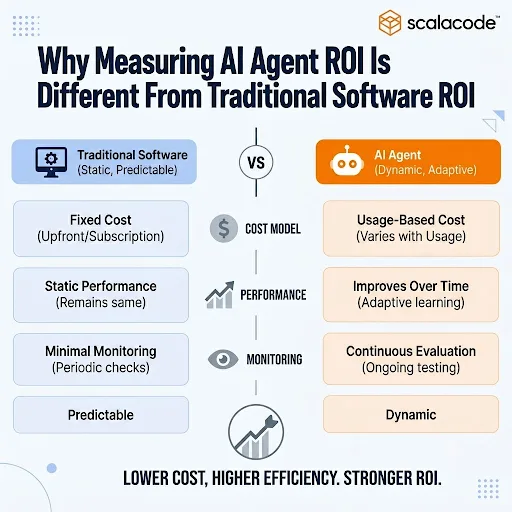
Measuring AI Agent ROI is different from traditional software ROI, as it helps you differentiate it from calculating the return on a traditional software investment.
If you have well understood how to measure AI agent ROI, then you will be able to have AI agents have usage-based pricing, improve over time, and require continuous evaluation, unlike conventional business applications with fixed costs and predictable performance.
Here are the three factors every business should consider while measuring AI agent ROI:
1. Costs Increase With Usage
The cost of traditional software is typically a fixed fee or subscription, which can be predicted. An AI agent, however, does tend to cost by the token, API call, or task completed. The more it is used, the higher the operating costs. Forecasting becomes more dynamic, and companies only pay for the work done by the AI agent.
2. Performance Improves Over Time
New features added to the software after deployment are hardly ever added to the most common type of software. The most common type of software is not usually the type that is delivered with new features. AI agents are not the same. As prompts, workflows, retrieval systems, and guardrails are enhanced, their performance gets better. But as time passes, they become more effective in satisfying requests and, with the right training, more effective at doing it accurately, which makes early AI agent ROI predictions more conservative.
3. Ongoing Evaluation Is Part of the Cost
In traditional software, the software program will either carry out a job accurately or deliver an error. There may be some inaccuracies in the answers provided by AI agents since they are probabilistic. To keep their systems performing as intended, the organizations must constantly monitor them, review them by humans, optimize them if they want, and test their products for quality. When measuring AI agent ROI, these recurring activities should always be considered.
To measure AI agent ROI accurately, your framework must account for usage-based operating costs, performance improvements over time, and the ongoing effort required to maintain output quality. Ignoring any of these factors can lead to misleading ROI estimates and poor investment decisions.
The AI Agent ROI Formula

The core AI agent ROI formula used for measuring AI agent ROI is simple:
| AI Agent ROI (%) = [(Total Benefits − Total Costs) / Total Costs] × 100 |
A result of 100% means the agent returned twice what it cost. A result of 200% means it returned three times its cost. The AI agent ROI formula itself is not the hard part. Defining what honestly belongs in “benefits” and “costs” is where most ROI cases fall apart, which is exactly what the next two sections cover.
Key KPIs for Measuring AI Agent ROI
Choosing the right AI agent ROI KPIs are the single biggest factor in whether your AI agent ROI numbers hold up under scrutiny. Track these six.
1. Cost Per Task or Resolution
This is the clearest efficiency signal for any AI agent deployment.
| Cost Per Resolution = Total Channel Cost / Number of Successfully Resolved Tasks |
Use resolutions, not conversations or interactions. A task the agent “completes” but a human still has to fix afterward is not a resolution, and counting it as one inflates your numbers artificially.
2. Deflection or Automation Rate
This tells you what share of total volume the agent is handling without human intervention.
| Deflection Rate = (Tasks Fully Resolved by AI / Total Tasks) × 100 |
A rate between 40% and 60% is typical for a well-tuned agent in its first year. Rates above 70% are strong but should always be checked against satisfaction scores, since very high deflection with falling satisfaction usually means the agent is avoiding escalation rather than genuinely resolving issues.
3. Outcome Rate vs. Completion Rate
This is the AI agent ROI KPI where most models get it wrong, and it is worth measuring carefully.
| Factor | Completion Rate | Outcome Rate |
| Definition | Measures whether the AI agent completed the assigned task. | Measures whether the completed task achieved the intended business result. |
| Primary Focus | Task execution | Business impact |
| Example | AI agent answered 95 out of 100 customer chats. | 65 of those chats actually resolved the customer’s issue. |
| What It Indicates | Operational efficiency | Business effectiveness |
| Can It Overstate Success? | Yes. A completed task may still produce the wrong or unhelpful result. | No. It reflects whether the AI agent created measurable value. |
| Best Used For | Monitoring workflow performance and system reliability. | Measuring customer satisfaction, revenue impact, cost savings, and overall AI agent ROI. |
| Importance for ROI | Low to Moderate | High |
4. CSAT Delta
For any customer-facing AI agent, track satisfaction before and after deployment.
| CSAT Delta = Post-Deployment CSAT Score − Pre-Deployment CSAT Score |
A drop of more than five points is a warning sign worth investigating immediately, even when cost metrics look strong, because a worse experience typically shows up later as churn.
5. Payback Period
| Payback Period = Total Investment / Average Monthly Net Benefit |
This is usually the first number a finance stakeholder asks for, since it directly answers how soon the investment pays for itself.
6. Net Present Value (for longer deployments)
For agents evaluated over 12 months or more, Net Present Value accounts for the time value of money and is worth including alongside the simple ROI percentage.
| NPV = Σ [Net Cash Flow in Year t ÷ (1 + Discount Rate)^t] − Initial Investment |
A positive NPV at your company’s standard discount rate is a strong signal to scale. A negative NPV is worth a second look, even if the simple ROI percentage looks attractive on its own.
Building a Realistic AI Agent Cost Model
A realistic AI agent cost model is essential for measuring AI Agent ROI accurately. Many organizations calculate infrastructure and development expenses but overlook ongoing operational and human costs. As a result, the projected ROI looks much higher than the actual business return.
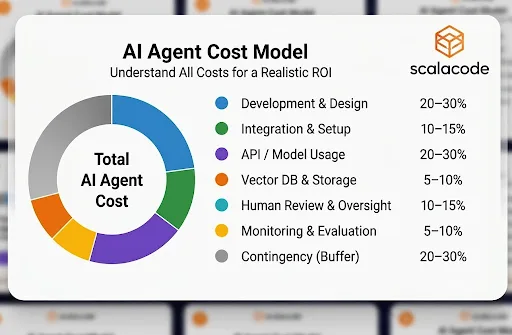
If you’re learning how to measure AI agent ROI, include every cost involved throughout the agent’s lifecycle, not just the initial implementation.
1. Implementation Costs
Implementation costs include everything required to launch the AI agent. This typically covers development, system integration, prompt engineering, testing, and deployment. Projects that connect AI agents with enterprise systems such as CRM development, ERP, or internal databases usually require additional integration work, making implementation one of the largest upfront investments.
2. Operational Costs
Once deployed, AI agents incur ongoing costs. These features span everything from LLM API usage to compute resources, cloud hosting, and vector databases to monitoring tools and prompt updates. However, in many AI platforms, costs are based on usage, meaning that the more users interact with the AI agent, the higher the operational cost will be.
3. Human-in-the-Loop Costs
While AI agents can tackle many situations on their own, they simply cannot address all of them. There is still work to be done for teams in terms of reviewing escalations, reviewing sensitive responses, correcting inaccurate outputs, or handling exceptions. One of the biggest pitfalls in creating an AI agent cost model is excluding these costs for human watchfulness, which can result in optimistic ROI projections.
4. Evaluation and Monitoring Cost
Production AI agents need to be continually assessed. Organizations should plan for response quality testing, regression testing following model or prompt changes, safety checks, performance monitoring, and analytics. These activities ensure reliability and make it so that the risk of inaccurate or inconsistent outputs over time.
Build a Cost Model That Reflects Reality
When measuring AI Agent ROI, assume your first cost estimate is incomplete. New integrations, higher usage, additional monitoring, or evolving business requirements often increase expenses after deployment. Adding a contingency of 25% to 30% to your initial budget provides a more realistic financial model and helps set expectations before scaling AI across the organization.
The 90-Day Pilot Plan for Measuring AI Agent ROI
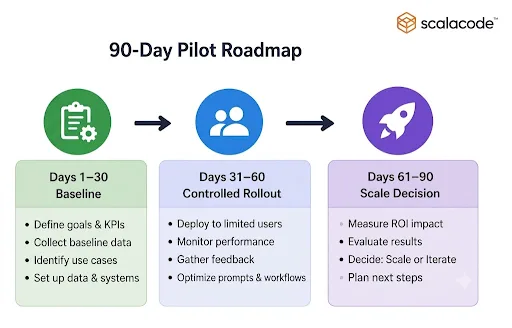
A 90-day AI agent pilot plan for measuring AI agent ROI is helpful for businesses as it helps them make decisions before investing in a full-scale deployment. Not only this, but this 90-day pilot plan can also help you avoid making a large upfront commitment to test the AI agent in a controlled environment.
A pilot does not provide the final ROI figure, but it provides the data required to understand whether the AI agent is delivering enough business value to justify scaling.
Days 1 to 30: Baseline and Instrumentation
The first 30 days in the 90-day pilot plan in the process of how to measure AI agent ROI are baseline and instrumentation, which includes defining what success looks like before deployment.
During this phase, teams should:
- Document the existing workflow before automation.
- Measure current cost per task and manual effort involved.
- Track processing time, error rates, escalation volume, and customer satisfaction.
- Define the KPIs that will determine success, such as outcome rate, resolution rate, accuracy, and cost savings.
- Set up dashboards and reporting systems before the AI agent goes live.
Days 31 to 60: Controlled Rollout and Iteration
The second phase is 31 to 60 days in the process of measuring AI agent ROI that focuses on testing the AI agent with real users while keeping the deployment scope limited.
During this phase, teams should:
- Deploy the AI agent for a clearly defined use case.
- Monitor task completion rate, outcome rate, response accuracy, and user satisfaction.
- Compare AI-assisted performance against the original baseline.
- Identify integration issues, knowledge gaps, and edge cases.
- Improve prompts, workflows, retrieval processes, and escalation rules based on real usage data.
Days 61 to 90: Early Signal and Scale Decision
The final phase focuses on analyzing pilot results and determining whether the AI agent is ready for broader adoption. At this stage, businesses can compare actual performance against their initial goals and relevant AI agent ROI benchmarks.
During this phase, teams should:
- Calculate changes in cost per task and operational efficiency.
- Measure productivity improvements and automation levels.
- Evaluate customer or employee satisfaction changes.
- Estimate the expected payback period for a larger rollout.
- Identify additional investments required for scaling.
The goal of a 90-day pilot is not to generate a perfect ROI calculation. It is to provide enough evidence to make a confident scale-or-no-scale decision and establish a measurement framework for long-term AI success.
| A note on what 90 days can and cannot tell you: A pilot this short is excellent for validating feasibility, catching integration issues, and building an early cost baseline. It is too short to capture the full financial picture, since agent performance and cost efficiency typically keep improving for months after launch. Treat the 90-day pilot as your go or no-go checkpoint, not your final ROI report. |
From Pilot to Full ROI: Why 6 to 12 Months Matters
A 90 day pilot is a test to see if you should continue. The 6-12 month time frame will give you the real value of the investment.
The longer time frame is due to three practical reasons. First, the accuracy and efficiency of agents generally continues to improve as prompts are refined, and edge-cases are addressed, with often significant improvements within the first 3-6 months.
Secondly, the seasonal fluctuation of volume can skew a short period of time in either direction. Third, some benefits, such as quicker deployments of agents to the future when your team has the base workflow, only become apparent when you have more than one project to compare to.
It is best to run both of the above practically. Scale using the 90-day pilot then measure again (month 6 and month 12) using the same KPIs to determine your final defensible ROI number. This two-stage process provides stakeholders with a timely answer without a rush for a verdict on the investment.
Common Mistakes That Skew AI Agent ROI Calculations
A few recurring mistakes distort AI agent ROI numbers more than any other factor.
- Counting saved hours without proving redeployment: Time not spent redeploying doesn’t really count if it isn’t spent on something that can be measured and is revenue-generating. Saving time becomes time you’re leaving out of meetings and admin.
- Measuring completion rate instead of outcome rate: A high completion rate may hide a much lower actual success rate, as discussed above in the KPI section.
- Ignoring the evaluation and monitoring cost: One of the most common ways ROI projections get to be too rosy is to skip this line item and to disregard the evaluation and monitoring cost.
- Using too short a measurement window for the final number: A 90-day pilot is worth a go or no-go decision, but trying to provide a full ROI verdict based on a 90-day time frame will overestimate or underestimate the actual situation.
- Skipping the pre-deployment baseline: A baseline would provide a way to differentiate the effects of the agent from other changes in the same time frame.
Real-World Example: Measuring ROI in an AI Agent Deployment
Here is a simplified worked example to illustrate the formula in practice.
A mid-size company handles 2,000 support tickets per month at an average human cost of $5 per resolution, for a baseline cost of $10,000 per month. After deploying an AI agent, it resolves 55% of tickets at $0.30 each, while humans continue handling the remaining 45% at $5 each.
Post-deployment monthly cost: (1,100 × $0.30) + (900 × $5) = $330 + $4,500 = $4,830. Monthly savings: $10,000 − $4,830 = $5,170.
Over 12 months, that is $62,040 in direct savings. Against an implementation cost of $35,000 and annual operational costs of $18,000 ($53,000 total first-year cost), that works out to:
| ROI = [(62,040 − 53,000) / 53,000] × 100 ≈ 17% in year one, with a payback period of roughly 10 months. |
The number looks modest in year one largely because implementation costs are absorbed upfront. Once that cost is sunk, year-two ROI on the same deployment typically climbs well above 100%, which is exactly why the 6- to 12-month measurement window matters more than the 90-day snapshot.
FAQs on Measuring AI Agent ROI
Q1. What is a good ROI for an AI agent?
A first-year ROI between 50% and 150% is generally considered solid for an AI agent deployment, with returns often accelerating significantly in year two once implementation costs are already absorbed.
Q2. How long does it take to see ROI from AI agents?
Most well-implemented AI agents reach payback within 4 to 12 months. A 90-day pilot is not long enough to show final ROI, but it is enough to confirm whether the agent is worth scaling further.
Q3. What KPIs matter most for measuring AI agent ROI?
Cost per resolution, deflection rate, outcome rate, CSAT delta, and payback period are the five KPIs that give the clearest, most defensible picture of AI agent ROI.
Q4. How do you calculate AI agent cost savings?
Compare your pre-deployment cost per task against your blended post-deployment cost, which combines AI-handled volume, remaining human-handled volume, and ongoing AI operating costs, across the same time period.
Q5. What happens after the 90-day pilot ends?
If the pilot KPIs meet your go criteria, continue tracking the same metrics through month six and month twelve to calculate a final, defensible ROI figure before scaling company-wide.
Conclusion
At the end of this how to measure AI agent ROI blog, we have concluded that measuring AI agent ROI accurately comes down to discipline more than complexity. Our experts have done deep research and used our real-time experiences to provide you with the best impactful formula to measure AI agent ROI.
Additionally, businesses need to understand what separates a defensible ROI case from an overly optimistic one. An honest baseline, complete cost accounting, and KPIs that track real business outcomes can help you in this case rather than surface-level activity.
We have informed you that the 90-day pilot is the right place to start, and you can also take the help of experienced AI developers. They will give you a low-risk way to validate feasibility, build your baseline, and make an informed scale decision.
Why ScalaCode for Your AI Agent Pilot
ScalaCode builds and deploys AI agents for enterprise teams that need a measurable pilot, not just a proof of concept. Our AI agent development services cover the full path from use case scoping and KPI design through integration, evaluation, and post-launch monitoring, so the ROI framework in this guide is built into the delivery process from day one, not bolted on afterward.
Our team works across LangGraph, CrewAI, and the Model Context Protocol to build agents for Tier-1 support, sales operations, document-heavy back-office work, and industry-specific workflows in logistics, retail, healthcare, and financial services. Every engagement includes an ROI-focused roadmap before development starts, so the 90-day pilot structure in this guide reflects how we actually scope projects.
If your team is evaluating an AI agent deployment and wants help structuring the pilot, KPIs, or cost model, book a call with ScalaCode’s AI development team to get a delivery plan, cost range, and measurement framework suited to your specific use case.