


We all know that the healthcare industry is experiencing a massive transformation, from telemedicine platforms to AI-powered diagnostic tools. However, this shift comes with a critical challenge of protecting patient data.
To secure the critical patient data, there are multiple compliance standards available that vary from nation to nation. However, HIPAA (Health Insurance Portability and Accountability Act) sets the benchmark for safeguarding healthcare information.
So, if you also want to keep your patients’ digital data safe, then you should invest in HIPAA-compliant app development. Beyond regulatory protection, this compliance will also help in enhancing data security, patient trust, seamless integration with healthcare systems, and scalability.
In this guide on “HIPAA compliant app development in 2026,” we will discuss some notable points, like understanding HIPAA rules, essential features, technical requirements, development costs, upcoming trends, and the complete step-by-step process.
A Glimpse of HIPAA Compliant App Development
In simple words, HIPAA-compliant mobile app development is the process of building an application that adheres to the security, privacy, and data protection standards. Any application that stores, processes, or transmits Protected Health Information (PHI) must meet these regulatory requirements. These requirements not only help protect complete data confidentiality but also build trust among patients about the brand.
Along with that, a HIPAA-compliant app not only prevents data breaches but also helps you in avoiding heavy penalties, lawsuits, and operational disruptions. Overall, in a digital healthcare system where security and privacy may define success, HIPAA compliance is the essential foundation for building reliable medical applications.
Other than that, there are multiple advantages of HIPAA-compliant application development that we will discuss in the next section.
Who Is Legally Responsible Under HIPAA?
Not every healthcare business needs to build a HIPAA-compliant app, as HIPAA clearly defines which organizations are legally accountable for safeguarding Protected Health Information (PHI), a nuance that’s often misunderstood until a team like Citrusbug walks a client through it during the discovery phase. The liability of a HIPAA-compliant app primarily depends on its relationship with a HIPAA-covered entity and how it handles Protected Health Information (PHI).
Under HIPAA, compliance obligations apply to Covered Entities, Business Associates, and, in some cases, software vendors, SaaS platforms, and healthcare app owners. Let’s discuss them one by one.

1. Covered Entities
“Covered Entities” is an umbrella term that includes healthcare providers, health plans, and healthcare clearinghouses. These entities directly provide healthcare services or manage healthcare payments and operations. These covered entities are primarily responsible for complying with HIPAA Privacy, Security, and Breach Notification Rules.
2. Business Associates
Next are business associates; they are the third-party organizations that create, receive, store, or process PHI on behalf of a Covered Entity. Business associates include cloud providers, software development companies, analytics vendors, billing services, and IT support providers. They are directly liable under HIPAA and must follow the security and privacy requirements.
3. Software Vendors and App Owners
Software vendors, SaaS platforms, and app owners become legally responsible under HIPAA only when their applications handle PHI for Covered Entities. In such cases, they may be considered as business associates even if they do not directly interact with patients.
4. Who Is Not Covered Under HIPAA
Other than covered entities, business associates, and software vendors/app owners, all healthcare organizations that do not handle PHI are not legally responsible for HIPAA. For example, General wellness and fitness apps, wearable or IoT device companies, life insurance and disability insurance companies, etc.
Benefits of HIPAA Compliant App Development
There are multiple benefits of HIPAA-compliant app development other than just meeting legal requirements. For example, it boosts patient trust, it’s a future-ready solution, and it provides a competitive advantage. Here in this section, we will discuss all the possible advantages in detail.

1. Legal and Regulatory Protection
Not securing crucial patient data may lead your organization to costly penalties, lawsuits, and regulatory setbacks. However, a HIPAA-compliant app can help you in that by minimizing the risk of civil lawsuits that may result in data breaches or mishandling of PHI.
2. Enhanced Data Security
HIPAA-compliant app development requires the implementation of enhanced security controls like AES-standard encryption, role-based access control, and multi-factor authentication.
3. Increased Patient Trust
Maintaining patient trust is one of the most important factors for an organization to grow in the market. With the help of a mobile app development company, you can build a HIPAA-based healthcare application. This helps you in securing medical records, chat histories, consultations, and personal details.
4. Seamless Integration with Healthcare Systems
Modern healthcare environments are built on interconnected systems such as EHRs, EMRs, RIS, and PACS. Here, securing data exchange across these platforms is crucial. However, HIPAA-based healthcare applications can do this with the help of interoperability standards like HL7 and FHIR.
5. Future-Ready and Scalable Architecture
HIPAA-compliant apps are designed on modern architecture to support future scale requirements. Additionally, these apps can evolve without disrupting compliance. So, organizations can integrate modern technologies like AI-driven diagnostics and connect with IoT-enabled wearable devices in the future.
Read in details, AI in Healthcare: A Complete Guide
Key HIPAA Rules to Follow in 2026
Before you hire mobile app developers to build your HIPAA-based mobile app, you should know the 4 core rules that form the foundation of HIPAA compliance. In this section, we have curated a table that includes the rules, what that particular rule covers, and why it matters for app development, all in one place.
| HIPAA Rule | What It Covers | Why It Matters for App Development |
| HIPAA Privacy Rule | Governs how protected health information (PHI) is used, accessed, and shared. | Ensures your app handles patient data ethically and legally, allowing access only when necessary. |
| HIPAA Security Rule | Sets standards for safeguarding electronic PHI (ePHI) through administrative, physical, and technical protections. | Helps developers implement encryption, access control, secure servers, and strong authentication. |
| HIPAA Breach Notification Rule | Requires organizations to notify affected individuals, HHS, and sometimes the media about data breaches. | Ensures your app includes monitoring, auditing, and clear protocols for breach detection and reporting. |
| HIPAA Omnibus Rule | Expands liability to business associates, third-party vendors, and partners who handle PHI. | Requires signing BAAs, securing third-party APIs, and ensuring every integration complies with HIPAA. |
Common HIPAA Misconceptions in App Development
Sometimes, even experienced teams misunderstand how HIPAA applies to digital health solutions. Here in this section, we jot down the most common misconceptions and the real facts you should know.

1. HIPAA Automatically Applies to All Fitness Apps
There is a common misconception that any app collecting health-related data, such as fitness trackers, must comply with HIPAA. This is not true; HIPAA only applies to an app that handles PHI on behalf of a covered entity or business associate.
2. HIPAA Covers All Types of Health Data
Not all health data, like general wellness data or anonymized metrics collected by consumer apps, is protected under HIPAA. Only Protected Health Information (PHI) associated with covered entities and business associates falls under HIPAA’s rules.
3. HIPAA Replaces the Need for Cybersecurity
Some organizations believe that HIPAA replaces the need for cybersecurity; however, reality is different. HIPAA does not guarantee complete protection against modern cyber threats.
4. HIPAA Only Applies to Digital Systems
Another misconception is that HIPAA only applies to digital systems, which is not true. HIPAA rules also apply to paper records, verbal communications, and any form of PHI.
5. Popular Tools Don’t Ensure HIPAA Compliance
Some teams mistakenly believe that using a popular third-party tool makes you HIPAA compliant, which is a myth. Before using any tool, you must verify Business Associate Agreements (BAAs) and ensure secure settings that align with HIPAA rules.
6. HIPAA Provides Official Certifications
HIPAA provides official certifications, the most common misconception. Whereas the reality is, HIPAA does not provide any kind of certifications. It is a US federal law that defines privacy, security, and breach notification requirements for protecting PHI.
Examples of HIPAA-Compliant Apps
Let’s look at how integrating a HIPAA-compliant app in the healthcare system can help in protecting patient data. Here in this section, we have listed some apps that should be built on HIPAA-compliant rules.

1. Telemedicine platforms
HIPAA compliance in telemedicine apps is important because it helps in protecting patient data while the patient connects with a doctor via video consultations. Moreover, it ensures that medical histories and chat messages are transmitted and stored safely.
2. EHR/EMR apps
Through HIPAA compliance, Electronic Health Record (EHR) and Electronic Medical Record (EMR) apps manage patient health data. Not only this, but it will also help in securing records and preventing unauthorized access.
3. Prescription management apps
HIPAA compliance is helpful in managing prescriptions digitally; it ensures that all the details, like medication history, dosage instructions, and refill data, are secured. This also reduces the need for patients to visit doctors repeatedly for routine prescription updates.
4. Remote patient monitoring apps
Remote patient monitoring apps are applications that help doctors track patients’ chronic conditions and post-treatment recovery remotely. At the same time, HIPAA compliance in this kind of app ensures that sensitive health data collected from devices is securely transmitted.
5. Mental health apps
Since this kind of app handles highly sensitive information, integrating HIPAA compliance is important. It ensures secure communication between doctors and patients. Other than that, it also takes care of protecting personal assessments, session histories, and emotional health data.
6. Fitness apps that collect PHI
Today, almost every fitness freak has a fitness app to track health metrics like heart rate, blood pressure, or sleep patterns. Hence, it is important to add the Health Insurance Portability and Accountability Act to this kind of application. This ensures that data is collected, stored, and shared securely.
Risk Assessment & Threat Modeling in HIPAA Compliant App Development
Before development begins, HIPAA compliance starts with a thorough risk assessment. First, organizations need to identify where PHI is created, stored, transmitted, and accessed across the application.
This will help them in uncovering the potential vulnerabilities in protecting electronic PHI (ePHI). Additionally, it also ensures that confidentiality, integrity, and availability are maintained through administrative, physical, and technical safeguards.
After completing the risk assessment, threat modeling comes into play. This step helps in analyzing potential attack vectors, such as unauthorized access, insider threats, insecure APIs, or cloud misconfigurations.
Developers can prioritize threats, implement mitigation strategies, and design robust security controls by understanding how risks could be exploited. Together, risk assessment and threat modeling lay the foundation for a secure, compliant, and reliable healthcare application.
Let’s understand risk assessment & threat modeling in HIPAA-compliant app development with the help of a flowchart.

Key Features of a HIPAA-Compliant Application
Beyond basic compliance, some advanced features help the organization minimize security risks, improve trust, and maintain regulatory alignment. Here in this section, we will look at those features in detail:

1. Multi-factor authentication
MFA (Multi-factor authentication) provides an additional level of security, as it verifies users with multiple methods like passwords, OTPs, or a scan of the body. This helps in reducing unauthorized access, particularly in the case of sensitive PHI.
2. Role-based access control
Role-based access control (RBAC) restricts unauthorized staff from accessing crucial data by assigning permissions based on the user’s job function. As a result, it helps in reducing the risk of accidental or intentional data exposure.
3. End-to-end encryption
The end-to-end encryption feature provides a high level of security to PHI by converting it into unreadable code that only authorized parties can decrypt. In addition to that, it ensures safe communication between apps, servers, and cloud environments.
4. Secure cloud storage
Secure cloud configurations ensure PHI is protected against breaches by controlled access, real-time monitoring, and isolated storage environments. Additionally, the properly secured cloud storage helps in improving scalability and system reliability.
Also Read: Cloud Computing in Healthcare: Explore Benefits, Types, and Risks
5. Data backup + disaster recovery
All HIPAA-compliant healthcare apps must include automated backups to restore PHI during outages, system failures, or cyberattacks. Regular data backup helps in reducing downtime and protecting business continuity.
6. Patient identity verification
Patient identity verification ensures that only permitted administrators, patients, and doctors can access the sensitive data. This verification includes security measures like biometric authentication, ID scanning, photo matching, or secure document validation.
7. Audit trails & activity logs
Audit trails & activity logs include capturing access attempts, data edits, downloads, or sharing activities. All these details are available to the administrator, and they help in detecting any suspicious activity at an early stage.
8. Automatic logout & session timeout
Automatic logout & session timeout help in closing inactive user sessions to prevent access. It is important in the healthcare industry, as it has multiple crucial pieces of information about patients. If you are going to initiate HIPAA software development, then you should ensure integrate these kinds of features.
9. Consent management
Consent management is especially for patients, as it allows them to take control of their critical data. In this case, patients have access to control over how their data is collected, used, and shared across providers or third-party tools. As a result, this whole process ensures legal compliance and builds trust in digital health applications.
10. Offline data handling rules
The protection of PHI shouldn’t be limited to online environments; however, a HIPAA compliance app should protect the data offline as well. To do that, the app must ensure PHI remains encrypted and restrict access through authentication controls.
Technical Requirements for HIPAA Compliant App Development
For HIPAA app development, developers should implement robust security and compliance measures across the entire technology stack. Here in this section, we have discussed the key technical requirements to make sure your applications meet all the regulatory standards.

1. Frontend Security Requirements
- Implement strong authentication and authorization mechanisms
- Use secure coding practices to prevent XSS and CSRF
- Encrypt data in transit using SSL/TLS for communications
2. Backend & Server Security Requirements
- Enforce access controls and user permissions at the server level
- Apply patch management and continuous monitoring to protect against vulnerabilities
- Enable logging, audit trails, and intrusion detection to monitor and respond to threats
3. API-level Protection
- Use token-based authentication and secure API gateways
- Implement rate limiting and input validation to prevent misuse
- Encrypt API traffic and enforce strict access rules for external integrations
4. Database Best Practices
- Encrypt data at rest using industry-standard algorithms
- Separate sensitive PHI from less critical data and enforce strict access controls
- Regularly back up data and implement secure disaster recovery mechanisms
5. Cloud Infrastructure (AWS, GCP, Azure)
- Use HIPAA-compliant cloud services and sign Business Associate Agreements (BAAs)
- Enable network isolation, encryption, logging, and monitoring features
- Implement redundancy, disaster recovery, and compliance-focused configurations
6. DevOps & CI/CD Security
- Integrate security checks and compliance validation into CI/CD pipelines
- Automate vulnerability scanning and code analysis before deployment
- Maintain version control, secure containerization, and environment separation for production
Best Practices of HIPAA Compliant App Development in 2026
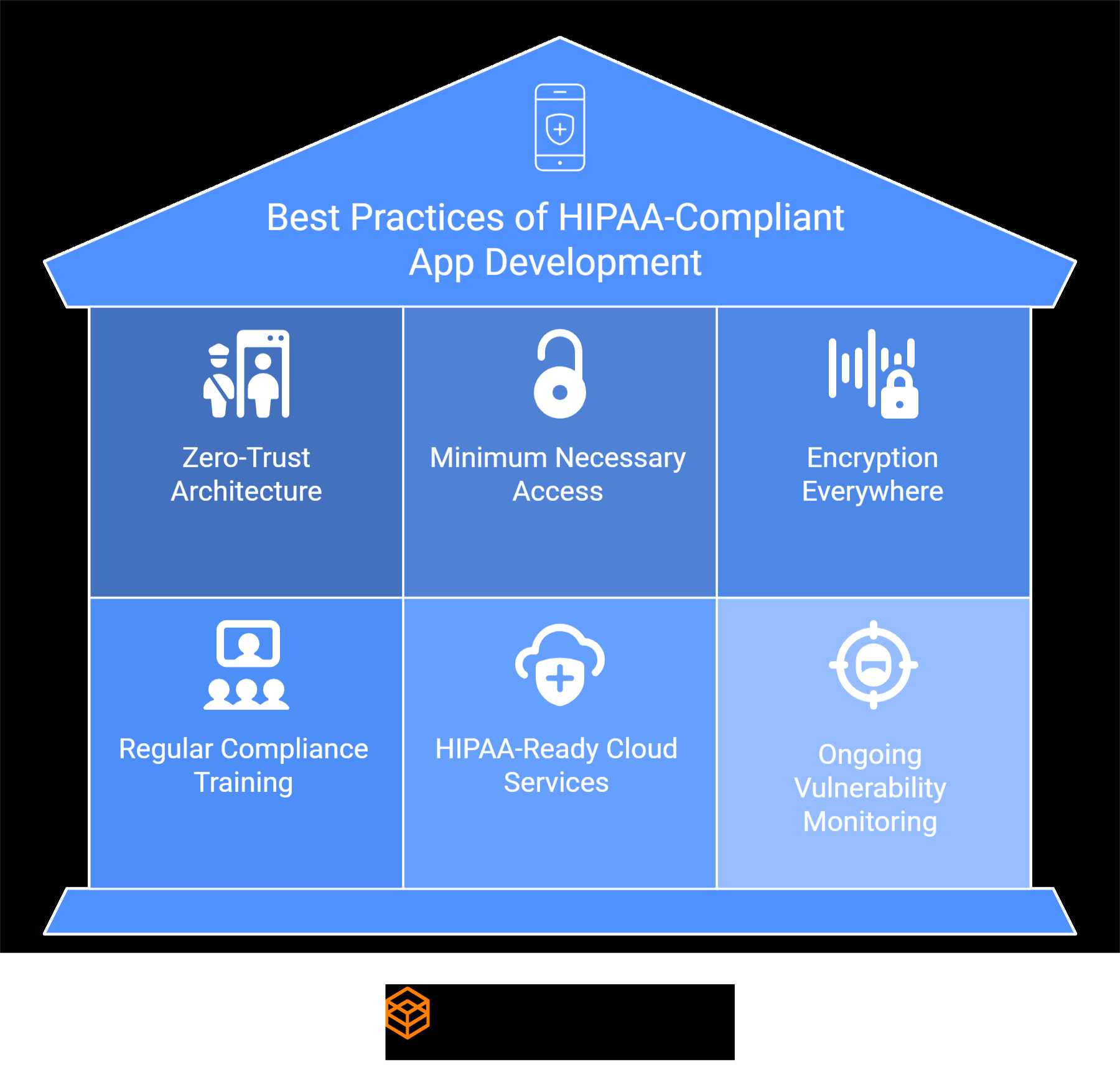
To build HIPAA encryption software, just understanding the regulation is not enough; following a meticulous approach to protect all patient data is also important. Let’s understand this by taking some real-world practices that big business players are already doing.
1. Zero-trust architecture
The first is a zero-trust architecture that runs on the rule of “never trust, always verify.” Here, whenever someone wants to access the data, they have to request access every time, and the access is continuously authenticated, authorized, and monitored. In 2026, the zero-trust architecture can be the baseline security expectation for all healthcare applications.
2. Minimum necessary access principle
A HIPAA-compliant healthcare application always grants minimum-level access to data; this helps in reducing unnecessary data exposure and restricting insider threats. Not only this, but it also ensures PHI is accessible only to authorized persons with proper role mapping and permission management.
3. Encryption everywhere
Encryption should be applied to all data, whether it is at rest, in transit, or even in temporary storage or cache. This helps information to remain protected from interception. Moreover, if you are integrating HIPAA-grade protection into your data, you must incorporate modern standards like AES-256 and TLS 1.3.
4. Regular compliance training
Regular compliance training is important to minimize human error that leads to HIPAA violations in multiple cases. This training will ensure that the team is updated on regulatory changes, evolving cyber threats, and new compliance tools.
5. Using HIPAA-ready cloud services
Using HIPAA-ready cloud services like AWS, Azure, or Google Cloud is important, as it helps in taking control over encryption, access logs, network isolation, and automated monitoring. In addition to that, these cloud services also offer Business Associate Agreements (BAAs) to handle PHI securely.
6. Ongoing vulnerability monitoring
With the help of real-time monitoring tools, healthcare businesses can do continuous scanning, penetration testing, and security audits before any vulnerability turns into breaches. Moreover, the ongoing vulnerability monitoring will also ensure that the app remains compliant despite updates, integrations, or increased user load.
Step-by-Step Process to Build a HIPAA-Compliant App
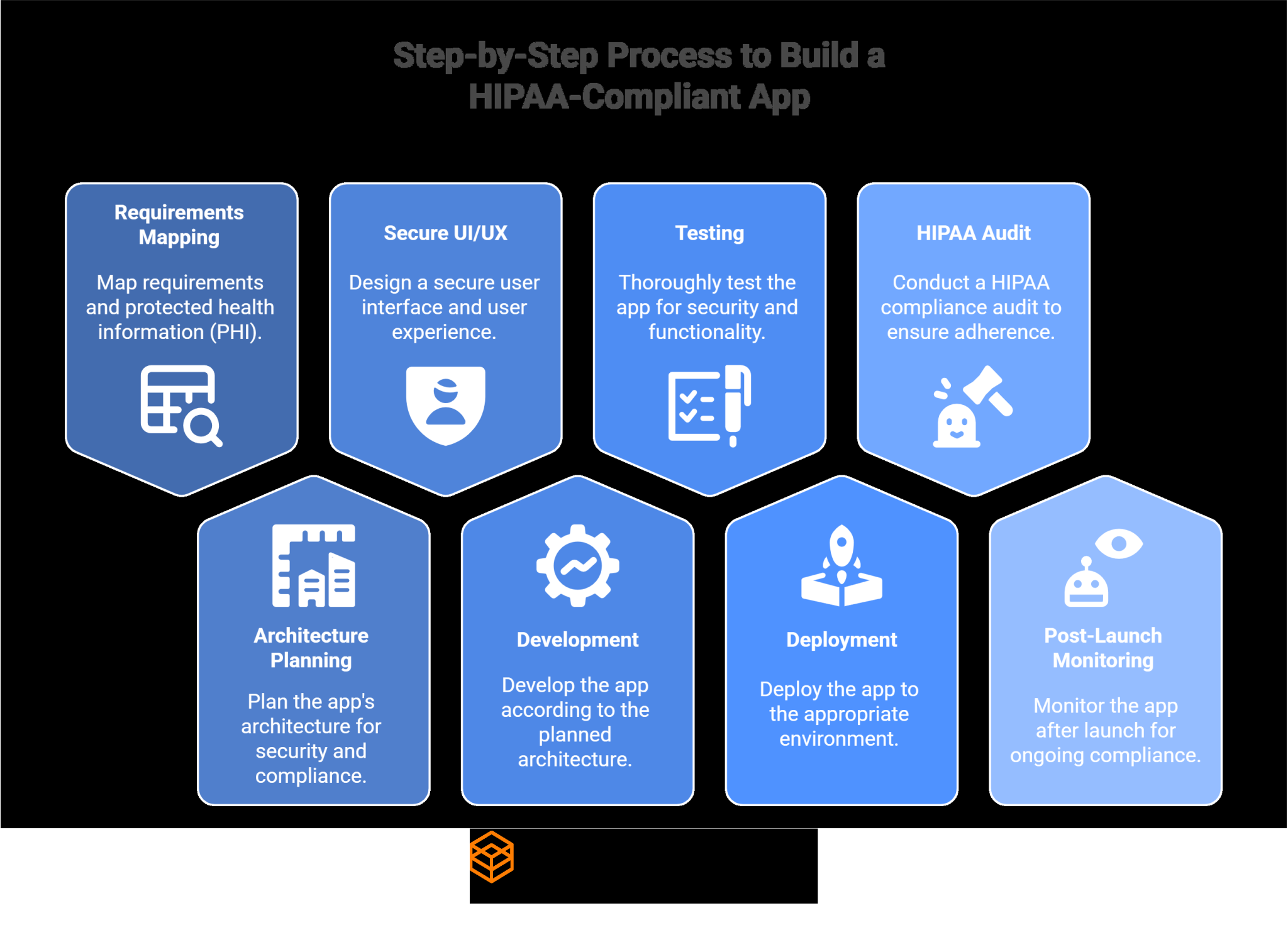
HIPAA-compliant app development demands a comprehensive and security-first approach. From planning to post-launch operations, below is your step-by-step guide on developing a HIPAA-compliant healthcare application.
1. Requirements & PHI mapping
In the first step, you should define the requirements and identify all data flows; this will help you map where PHI is created and stored. Additionally, this mapping helps you in understanding which part of the app must follow HIPAA rules.
2. Architecture planning
Here in this step, you can decide the backend design of the application, like servers, HIPAA-compliant database design, APIs, and integrations. In addition to that, one can also plan for encryption, access control, logging, and cloud infrastructure.
3. Secure UI/UX planning
This step includes creating user-friendly screens and workflows while keeping security in mind. Additionally, in this step, you can also plan for securing login flows, permission screens, and clear consent options for data use.
4. Development
The development stage is one of the crucial aspects of the process, and this includes turning your idea into a real-time application. Here in this step, the implementations of features like encryption, user roles, authentication, secure APIs, and PHI protection take place.
5. Testing
In HIPAA-compliant app development, testing is a must, as in this step, you can test if the application is working as expected or not. If not, then you can fix the bugs early before the app goes live. As a result, this step ensures the solution is safe, stable, and compliant.
6. Deployment
Once everything is tested and on point, then you can make the application live with the help of a HIPAA-ready environment. Such as AWS, GCP, or Azure with a Business Associate Agreement (BAA).
7. HIPAA compliance audit
In a HIPAA-based healthcare application, it is important to do a HIPAA compliance audit. As it helps in reviewing documentation, security controls, risk assessments, PHI handling processes, and system logs.
8. Post-launch monitoring
Once the application goes live, you should continuously monitor it for better implementations and growth. In addition to that, you should also regularly update patches, audits, and performance checks to keep the system secure.
Challenges in HIPAA Compliant App Development
As said, integrating HIPAA-compliant rules into existing applications or even building a HIPAA-compliant app from scratch is not that easy. It will require the experience and expertise of developers. However, in some cases, developers get stuck with some challenges; here in this section, we have listed some major challenges with solutions.

1. Complex regulations
HIPAA interpretations and enforcement guidance evolve, which makes it hard to ensure full compliance in the application. To not be left behind the updates, one can stay updated with the latest HIPAA guidelines and also work closely with legal experts.
2. High security demands
HIPAA requires high security demands like encryption, secure authentication, and audit trails, but implementing all of these can be challenging for developers. To streamline the incorporation process, developers should adopt a “security-first” development approach.
3. Cloud configuration mistakes
Sometimes, misconfigured cloud servers or storage buckets may lead to revealing PHI even if your healthcare app is secure. In that case, you should use HIPAA-compliant cloud services like AWS, Azure, or GCP to ensure Business Associate Agreements (BAAs) are in place.
4. Integration with EHRs (Epic, Cerner)
Integrating third-party systems like electronic health records may lead to API differences, security requirements, and data format inconsistencies. To solve this problem, developers can use standardized APIs (like FHIR), implement strong authentication, and test data flows for compliance.
5. Managing AI compliance in healthcare apps
To make the app modern, businesses integrate AI models into the healthcare app. However, integrating artificial intelligence models needs data access for training and prediction purposes. This may lead to a risk of data leakage or noncompliance. To deal with this, AI developers can regularly monitor AI outputs to prevent unauthorized data exposure.
6. Balancing usability with security
Highly secured apps can be difficult to operate sometimes due to strict authentication steps, encryption workflows, and access restrictions. This process may lead to user frustration; to solve this, developers can design intuitive user interfaces. They can also use built-in security features like single sign-on (SSO), multi-factor authentication, and clear consent prompts.
HIPAA Compliant App Development Cost
As we have discussed multiple benefits, best practices, and multiple things till now in this guide. It should have impressed you if you also want to build a healthcare application based on HIPAA compliance to boost patient trust. Then you should know the cost of a HIPAA-compliant app development. We have done deep research to curate this section on costs to give you the right idea.
On average, HIPAA-compliant app development can cost you around $45,000 to $300,000. However, the cost is affected by multiple factors, which we will break down in this section.
While deciding the budget of your HIPAA compliance app, businesses must acknowledge a few points, like
- Number of user roles for the application (user, admin, staff, etc.)
- Complexity of the application
- Location of app developers
- Size of the development team
- Third-party integrations (EHR/EMR, pharmacy, IoT, insurance)
- Advanced AI features
- Compliance audits and security testing
- Type of infrastructure (on-premise vs. cloud)
Here are some cost tables we have created based on the cost breakdown, a cost breakdown for the development stage, and hidden costs.
1. Cost Breakdown, By App Complexity
| App Type | Features Included | Estimated Cost Range |
| Basic HIPAA App | User login, PHI encryption, basic dashboard, limited roles, essential compliance features | $45,000-$80,000 |
| Mid-Level HIPAA App | RBAC, EHR/EMR integrations, advanced security, telehealth modules, audit logs | $80,000-$180,000 |
| Enterprise-Grade HIPAA App | Multi-role system, AI features, IoT integrations, complex workflows, scalable cloud infrastructure, advanced analytics | $180,000-$300,000+ |
2. Cost Breakdown by Development Stage
| Development Stage | Description | Estimated Cost Share |
| Planning & Compliance Setup | Requirement gathering, HIPAA documentation, risk analysis | 10 to 15% |
| UI/UX Design | Wireframes, prototypes, accessibility compliance (WCAG) | 10 to 12% |
| Frontend Development | User-facing components, screens, interactions | 15 to 20% |
| Backend Development | APIs, server logic, authentication, RBAC | 20 to 25% |
| Security Implementation | Encryption, audit logs, MFA, secure cloud setup | 10 to 18% |
| Integrations | EHR/EMR, IoT devices, billing, pharmacy | 10 to 15% |
| Testing & QA | Functional, security, and penetration testing | 8 to 10% |
| Deployment & DevOps | CI/CD pipelines, cloud configuration | 5 to 8% |
| Post-Launch Maintenance | Monitoring, updates, bug fixes | 10 to 20% annually |
3. Hidden Costs Healthcare Companies Often Forget
| Hidden Cost | Why It Matters | Typical Cost Impact |
| Annual HIPAA Compliance Audits | To proactively find and fix security/privacy gaps | $5,000, $25,000 |
| Advanced Security Tools (SIEM, IAM) | Real-time threat detection & identity management | $3,000-$20,000/year |
| Penetration Testing | Required before launch & annually | $5,000, $30,000 |
| Business Associate Agreements (BAAs) | Required for cloud vendors & partners | Included for $0-$5,000 |
| Ongoing HIPAA Training for Staff | Reduces human errors (the top cause of breaches) | $2,000-$10,000/year |
| Cloud Scaling Costs | More users = higher infrastructure cost | Varies by usage |
| Incident Response & Forensics | For breach investigation (if needed) | $10,000+ |
Detailed Breakdown, How Much Does it Cost to Develop an App
Why Partner with ScalaCode for HIPAA Compliant App Development?
Partnering with ScalaCode, the result-driven healthcare software development company, is beneficial because they ensure that the solution is built with the highest standards of security, compliance, and scalability. Moreover, we have 15+ years of experience in combining deep industry expertise with a security-first engineering approach to deliver HIPAA-compliant applications.
Key Reasons to Choose ScalaCode:
- Expertise in HIPAA, HITECH, HL7, and FHIR standards
- Security-by-design development approach
- Certified developers with healthcare domain experience
- Seamless integration with EHR/EMR and third-party systems
- Ongoing compliance support, audits, and maintenance
Don’t just take our word for it, see what our clients say about ScalaCode, testimonials.
Conclusion
HIPAA-compliant app development in 2026 is no longer a luxury but a requirement. All businesses dealing in the healthcare industry must choose a HIPAA-compliant application to secure their patient data.
With the continued growth of digital health solutions across telemedicine, AI-driven diagnostics, remote monitoring, and patient engagement platforms. It is essential to prioritize HIPAA compliance and robust data security to protect sensitive patient information.
Organizations that invest in strong security practices, scalable infrastructure, and ongoing audits not only reduce legal risks but also gain long-term trust from patients, providers, and enterprise partners. Hence, it is important to partner with an app development company that provides result-driven, HIPAA-compliant healthcare applications.
FAQs
1. Do all healthcare apps need to be HIPAA compliant?
Not all apps need to be HIPAA compliant; however, it depends on whether the app handles PHI (Protected Health Information) or not. If yes, then they must hire developers who are well-versed in HIPAA compliance.
2. Can I publish a HIPAA-compliant app on the App Store or Google Play without restrictions?
Without significant responsibility and restrictions, one cannot launch the app on the Google Play Store and App Store. You must ensure that your app meets strict HIPAA rules (like BAAs, encryption, and security safeguards) and platform policies for handling sensitive data (PHI).
3. Does HIPAA compliance apply to apps used outside the United States?
Yes, HIPAA compliance applies only within the United States, as it is a U.S. federal law. However, if an app outside the U.S. handles PHI for U.S.-based patients or partners with U.S. healthcare providers, it must still comply with HIPAA regulations.
4. How often should a HIPAA-compliant app be audited?
According to the HIPAA regulations, organizations have to perform a regular technical and non-technical assessment of their security measures. An annual HIPAA audit or a substantial change in the app is the industry standard and best practice to ensure the app meets the industry requirements.
5. Can AI and machine learning models be HIPAA compliant?
Yes, it is quite possible to make AI and machine learning models HIPAA compliant, provided they are also designed to safely process, store, and transfer PHI. It involves the analysis of anonymized or de-identified data, a high level of encryption, and a high level of assurance that all processes in the model are conducted according to the privacy and security protocols of HIPAA.