
We all know that AI is reshaping all industries, and the stock market is no exception. Without any doubt, the stock market has the potential to make massive wealth in a small period of time. Hence, every smart business wants to have a smart, fast, and more efficient trading application.
Thanks to AI in stock trading apps, AI makes the application so efficient that it enables merchants to manage multiple markets simultaneously. Not only this, but an AI stock app can also help traders to optimize their strategies and make their decisions even better with predictive analytics.
According to a global market report, the AI in Trading Market size is expected to be worth around USD 50.4 billion by 2033, from USD 18.2 billion in 2023, growing at a CAGR of 10.7% during the forecast period from 2024 to 2033.

Whether you are a beginner or an entrepreneur, if you also want to grow fast with an AI stock trading app, then you are reading the most appropriate blog.
In this blog, we are going to discuss how AI in a stock trading app makes it smarter, and whether it is worth investing in it or not.
What is AI in Trading?
AI trading which also known as algorithmic or automated trading, is a branch of trading that helps in applying artificial intelligence to analyse market data, identify trends, and provide automated trades with precision.
Instead of relying on human judgment for investments and decisions, smart traders use predictive algorithms and machine-learning models to make even brighter choices.
With the best AI stock trading app, it is possible to have advanced systems that can process real-time financial information, trends on stocks, and even collect news around the world at a much faster rate than human traders.
In addition to that, it also allows traders to spot opportunities and allows automated buy or sell behavior depending on predefined strategies. As digital investing gains momentum, a variety of platforms are now marketing themselves as the best AI stock trading software, with such capabilities as predictive analytics, portfolio optimization, and risk management.
These tools are intended not only for professional traders but also for beginners who are interested in simplified access to smart trading strategies. Basically, AI stock trading software is an algorithm capable of converting huge financial data into actionable information.
As we are comparing human trading strategies and AI stock trading then you must have a look at the next comparison section.
What Are The Key Differences Between Human Stock Trading & AI Stock Trading?
Here, we are going to discuss the key differences between human stock trading and AI stock trading to know which is better.
| Factor | AI Stock Trading | Human Stock Trading |
| Speed | Executes trades in milliseconds | Takes seconds to minutes |
| Emotion | No emotions; purely data-driven decisions | Emotional bias can influence trades |
| Data Processing | Analyzes millions of data points instantly | Limited to manual analysis; slower processing |
| Adaptability | Learns and updates strategies in real-time | Adapts based on experience; slower to adjust |
| Cost Efficiency | Lower long-term operational costs | Higher ongoing costs (commissions, errors) |
| Consistency | Consistent performance; no fatigue | Performance varies with mood & health |
| Strategy Complexity | Handles complex, multi-variable strategies | Limited by tools and cognitive load |
| Market Intuition | Lacks intuition, relies on data & algorithms | Uses intuition & experience in decisions |
By analyzing the table, you must know which technique is better for you. Now, let’s move forward with learning how the AI stock trading app works. In addition to that, you can also take the help of an AI consulting service to know more deeply.
How AI Stock Trading App Work?
Here in this section, we have divided the working model into 10 steps to help you understand easily.
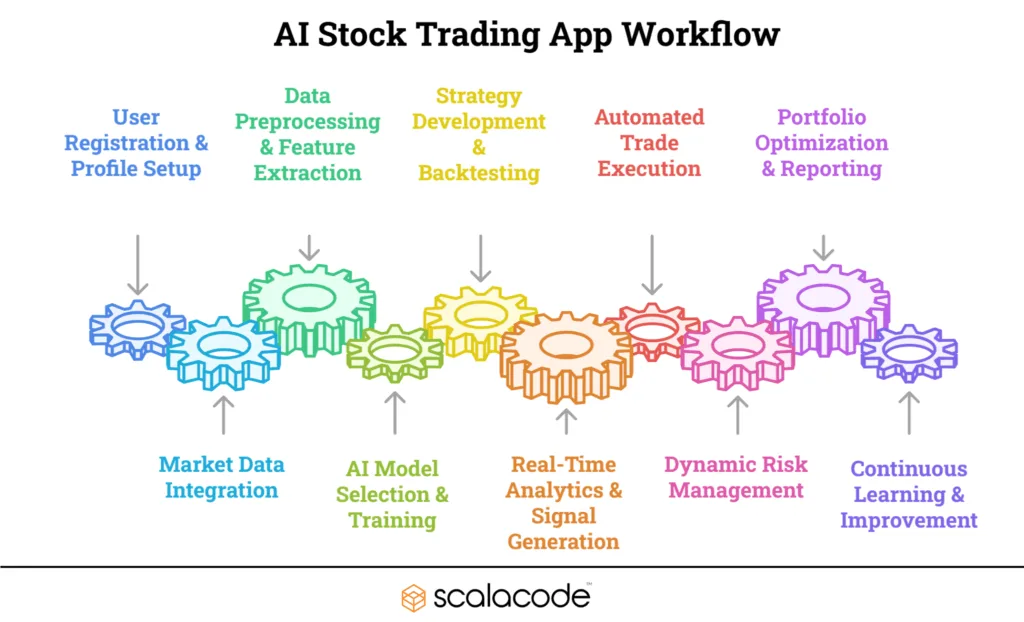
1. User Registration & Profile Setup
User registration and profile creation are the preliminary processes in the working model of an AI-based stock trading app. The users must initially create a profile in the application and choose investment preferences, goals, and risk tolerance. Such personalized information will allow the AI stock trading software to personalize advice.
2. Market Data Integration
The next step is to integrate the current or latest market data into the application. This helps in compiling the various real-time financial data sources, such as stock markets, news feeds, and social media, to gather complete market data. This stream of data drives the artificial intelligence-based stock trading software backbone to provide real-time analysis.
3. Data Preprocessing & Feature Extraction
After integrating the data, it’s time to process the data and perform feature extraction. Raw data is cleaned and normalised to eliminate noise and redundant data. The feature extraction algorithms help in identifying multiple important variables, such as price trend, volume, sentiment signals, and much more, that are needed to make correct prediction models.
4. AI Model Selection & Training
Now AI has multiple devising and one of them is machine learning models (e.g., neural networks, reinforcement learning) that help in training the software according to customer needs. This training makes the algorithms of the AI software used in stock trading to pick out intricate market trends and provide sound projections.
5. Strategy Development & Backtesting
People love the feature of AI recommendations that can be created by an AI recommendation engine development. This feature helps in providing real-time recommendations to customers based on their previous activities. In addition to that, this also helps in the process of designing data-driven trading plans in accordance with user goals. All these strategies are strictly backtested against historical market data to prove performance and strength.
6. Real-Time Analytics & Signal Generation
The AI engine constantly evaluates the real-time market environment, which helps in evaluating what trend is trending and how people can take advantage of it. In addition to that, it also activates buy or sell signals with forecasts. The step allows the app to offer timely trading recommendations using the strength of artificial intelligence stock trading software.
7. Automated Trade Execution
AI in stock trading apps makes it possible to automate via secure API connections with any of the brokerages or stock markets can also be automatically carried out by the app and is much faster than a manual trade. Delay and emotional bias are the advantages of AI-driven stock trading that are reduced by automation, so that you can simply take data-based decisions that work in the future.
8. Dynamic Risk Management
The app has risk management modules that track portfolio exposure, or any other risks, with the use of stop-loss orders, position size, and volatility changes. This makes sure that users do not incur unnecessary losses, and they do not fail to get lucrative opportunities. In addition to that, this also alarms the user for any foul opportunities at the right time.
9. Portfolio Optimization & Reporting
The AI continuously reinvests the portfolio according to the conditions of the markets and the objectives of the user. Detailed performance reports assist the users in monitoring returns, risk measures, and changing preferences accordingly.
10. Continuous Learning & Improvement
The AI recommendation engine consists of continuous learning, with each new piece of information or trading results, the algorithms update themselves, refining their forecasting accuracy, adjusting to new market conditions, and optimizing user returns over time. Moreover, this will help the trader to know the latest AI trends and capitalize on the new market data.
Let’s move forward with learning the top 15 benefits of investing in AI stock trading apps.
Also Read: Role of AI in Mobile App Development
What are the Top Benefits of AI in a Stock Trading App?
This section is crucial for every newbie and existing entrepreneur, as before choosing the new technology or technique for the business, one must know its benefits.
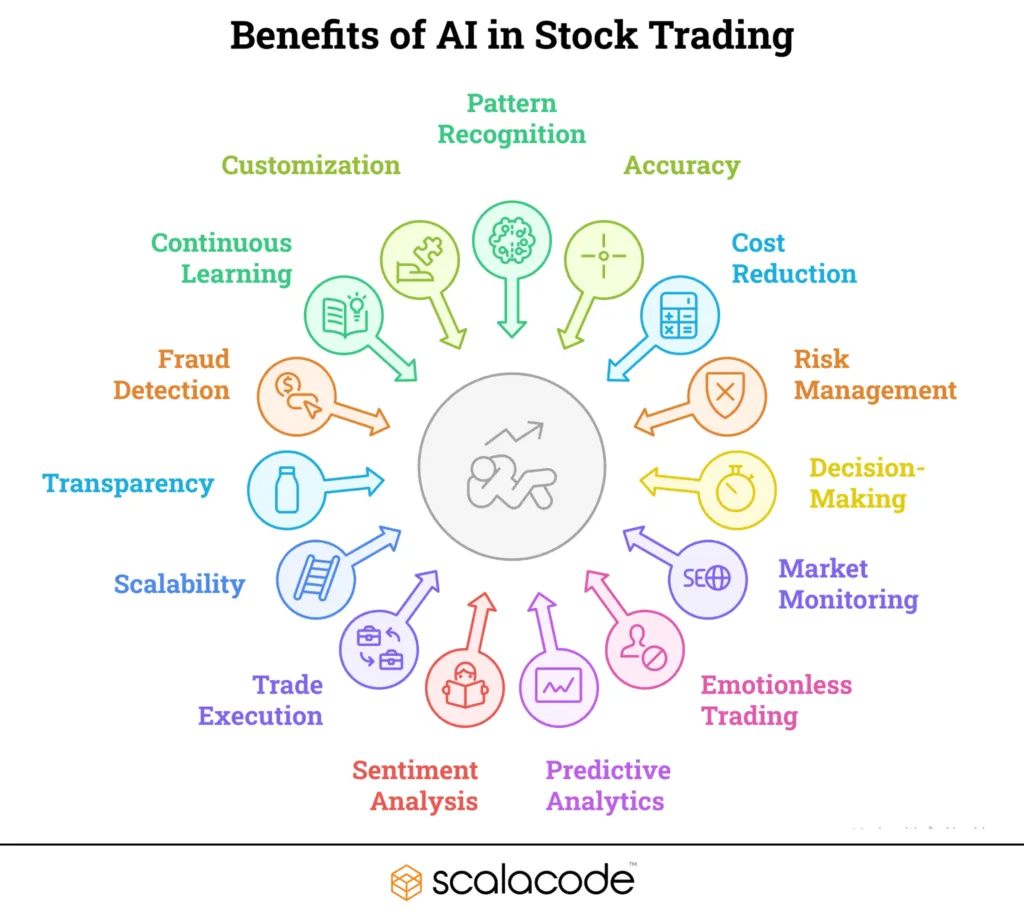
1. Advanced Pattern Recognition
An AI-based stock trading application applies deep learning and sophisticated algorithms to recognize intricate and hidden market trends. This feature enables the software to identify trading prospects and trends that cannot be easily predicted using manual analysis, and therefore, stock trading with AI is very effective in forecasting price changes.
2. Enhanced Accuracy and Precision
The best AI trading software provides highly accurate trade signals by running large volumes of historical and real-time data with a lower margin of error than humans. This will minimize the expensive errors and improve the chances of successful trades that are advantageous to both novice and seasoned investors.
3. Reduced Costs and Enhanced Efficiency
The significance of AI trading apps in cost-saving relates to the automation of operational costs by eliminating the need to carry out research manually.. This enhances overall efficiency and allows traders to focus on strategy and not routine.
4. Dynamic Risk Management
AI is continually reviewing market conditions and portfolio exposure and dynamically re-estimating stop-loss limits, position sizes, and diversification strategies. It is an active risk management strategy, which decreases losses in real time in line with risk preferences chosen by the user.
5. Faster Decision-Making
Carrying out statistical analysis on millions of data points in real time, AI systems allow making decisions at lightning speed, which humans cannot. This is because the fast processing improves the timing of trade in volatile markets, which are important in maximizing returns within periods of opportunity.
6. 24/7 Market Monitoring and Trading
The AI trading applications work 24-hour, unlike human traders who need to take breaks and check the global markets, news, and social sentiment across different time zones. This round-the-clock monitoring will make sure that no market opportunity is lost, particularly during off-conventional trading hours.
7. Emotionless Trading
Human traders can easily be emotionally biased, like being afraid or greedy, and end up making impulsive decisions. AI trading will remove emotional bias and will allow more consistent and rational investment behavior by adhering to data-driven algorithms.
8. Predictive Analytics for Market Forecasting
Using past data trends and real-time data, AI-driven applications predict future stock price changes and market trends. Proactive insights allow traders to make smarter, proactive decisions and not reactive ones.
Learn More: AI in Forecasting
9. Sentiment and News Analysis
Natural language processing is an AI-based solution that analyzes news headlines, social media, and analysts’ reports to understand the market sentiment. This integrative analysis aids in predicting market response to external occurrences that would otherwise have been overlooked by the use of traditional chart analysis.
10. Automated Trade Execution
When trade signals are produced, AI in stock trading applications is utilized to automatically communicate with brokerage connections to buy or sell stocks in real-time. This automation removes human delays, improves execution precision, and maximizes the most out of rapid changes in the markets.
11. Scalability and Flexibility
The artificial intelligence trading software of the stock market is easily scalable to process growing amounts of data and users, in that it can be used by individual traders and also by large institutions. The technology responds to the changes in the market and various trading needs.
12. Transparency via Explainable AI
Contemporary AI uses have the ability to give insights into the way they make their decisions. This openness creates confidence in the users by making it clear how they arrive at trade recommendations and complying with regulatory requirements.
13. Fraud Detection and Regulatory Compliance
AI always keeps an eye on transactions with odd or unusual transactions to protect users against fraud and insider trading. It also ensures that trades are always aligned with the evolving regulatory demands, reducing the legal risks to a minimum.
14. Continuous Learning and Optimization
The primary instrument of an AI recommendation engine is continuous model refinement. Market data and past trade performance can educate AI to optimize predictions and strategies over time to enhance profitability and resiliency.
15. Customized Trading Experience
A more sophisticated AI stock trading software enables users to customize recommendations and automated trading strategies according to their risk aversion, investment objectives, and trading preferences. This tailoring increases customer satisfaction and effective results.
So, these were the supreme advantages of integrating AI in stock trading applications, and now let’s look at how the real world is using these amazing techniques with the given use cases.
Let’s create your future-ready trading platform today!
Top 10 Use Cases of AI in Stock Trading
Here we will see the real-time use cases of people using AI in a stock trading app:

1. Data Exploration
The process of data exploration or data mining examines a large amount of historical and real-time financial data to find latent patterns and trends. This allows the traders to gain knowledge and make valuable investment choices by unearthing prospects that cannot be found by using traditional approaches.
2. Market Prediction
AI predicts future stock prices and market dynamics so that you can make an investment decision easily. In addition to that, this process is done on the basis of historical data and prevailing trends with the help of machine learning models. These forecasts assist traders in foreseeing market changes and developing proactive trading plans to work out optimal returns.
3. Automated Trading
The algorithms run on AI are used to perform trades automatically in accordance with pre-programmed strategies and respond to live market environments. This automation is faster in order placement, reduces human error, and takes advantage of the fleeting market opportunities effectively.
4. Sentiment Evaluation
AI uses natural language processing to extract sentiment in news articles, social media, and financial reports. Through public sentiment and market mood, the traders will know the direction of the stock price based on external occurrences and investor perception.
Explore More: Best Free Offline Music Apps for Android & iOS
5. Risk Assessment
AI considers the possible risks of various trading plans through simulation and evaluation of market volatility. This enables traders to have a balance of risk and reward so that portfolio choices can be made in order to minimize the possible losses.
6. Stress Scenario Testing
AI uses the hypothetical extreme conditions of the market to determine the robustness of the trading strategies. Stress testing is a practice that can pinpoint weaknesses, allowing traders to improve their strategies in times of market decline and unexpected market shocks.
7. Live Market Monitoring
AI keeps real-time monitoring on the market data, the market news, and the volume of trade to identify new tendencies and abnormalities. This continuous observation aids in dynamism in adjustments in trading strategies, which ultimately increases receptiveness and competitiveness.
8. Strategy Backtesting
Before being operationalized, AI validates the trading strategies with the historical market data to ascertain the execution performance and accuracy. The empirically valid backtesting is helpful in the optimization of strategies in real-life conditions.
9. Performance Benchmarking
In order to quantify the relative success, AI will contrast the effectiveness of the trading strategies and the benchmarks or indices in the market. Benchmarking assists the traders in refining their strategies and aligning them to the general market trend and market goals.
10. Trading Algorithm Design
AI assists in information-based trading algorithms to suit different market conditions and investments. These algorithms improve the precision of the decisions made, as well as fast and automated trading.
Explore More: Top AI Development Companies in India
Real-Time Examples of Companies Using AI For Stock Trading
1. JPMorgan Chase (LOXM Trading Platform)
The JPMorgan Chase (LOXM Trading Platform) applies machine learning and reinforcement learning to achieve the best trade execution, specifically for predicting price trends and reducing market impact.
2. Renaissance Technologies (Medallion Fund)
Renaissance Technologies (Medallion Fund) uses highly advanced AI and quantitative models to generate consistently high returns using large data sets to find non-random market patterns.
3. Numerai (Crowdsourced AI Hedge Fund)
Numerai (Crowdsourced AI Hedge Fund) has an AI model that generates diverse trading strategies across all global markets based on the data that scientists across the world feed.
4. Wincent (Crypto Hedge Fund)
Wincent (Crypto Hedge Fund), following the high volatility and market swings, uses AI algorithms adapted to cryptocurrency trading to take advantage.
5. CoreWeave (AI Infrastructure for Trading Platforms)
CoreWeave (AI Infrastructure for Trading Platforms) offers scalable AI infrastructure and cloud computing services tailored to the workflows of AI trading.
6. Nvidia Corp. (AI chip manufacturer and platform provider)
Nvidia Corp. (AI chip manufacturer and platform provider) produces AI-oriented GPUs and other hardware to run deep learning and AI models applied in stock trading extensively to provide analytics and predictions.
7. Alphabet Inc. (Google’s AI applications and trading tools)
Alphabet Inc. (Google’s AI applications and trading tools) uses AI and machine learning in financial instruments and trading software, and takes advantage of massive data sets and advanced algorithms.
8. Palantir Technologies (Data analytics and AI solutions)
Palantir Technologies (Data analytics and AI solutions) provides AI-based data analytics and decision-making solutions that are adopted by financial institutions to gain market insight, risk, and automated trading strategies.
9. Advanced Micro Devices (High-performance AI computing chips)
Advanced Micro Devices (High-performance AI computing chips) manufactures AI hardware and high-performance processors that are used to build and execute the intricate AI models of a trading platform.
10. Broadcom Inc. (AI-driven semiconductor solutions)
Broadcom Inc. (AI-driven semiconductor solutions) provides AI-enabled semiconductor and networking solutions that can serve AI stock trading systems that demand high-performance and real-time data processing.
So, these are the big enterprises using AI in stock trading apps and taking advantage of it to its fullest. If you also want to achieve these kinds of benefits for your organization, then you must know how to create an AI-powered stock trading app.
Bonus Visit: Top AI App Ideas
Top Easy Steps To Develop An AI-Powered Stock Trading App
Now let’s look at the 10 easy steps of building an AI-powered stock trading app for your business:
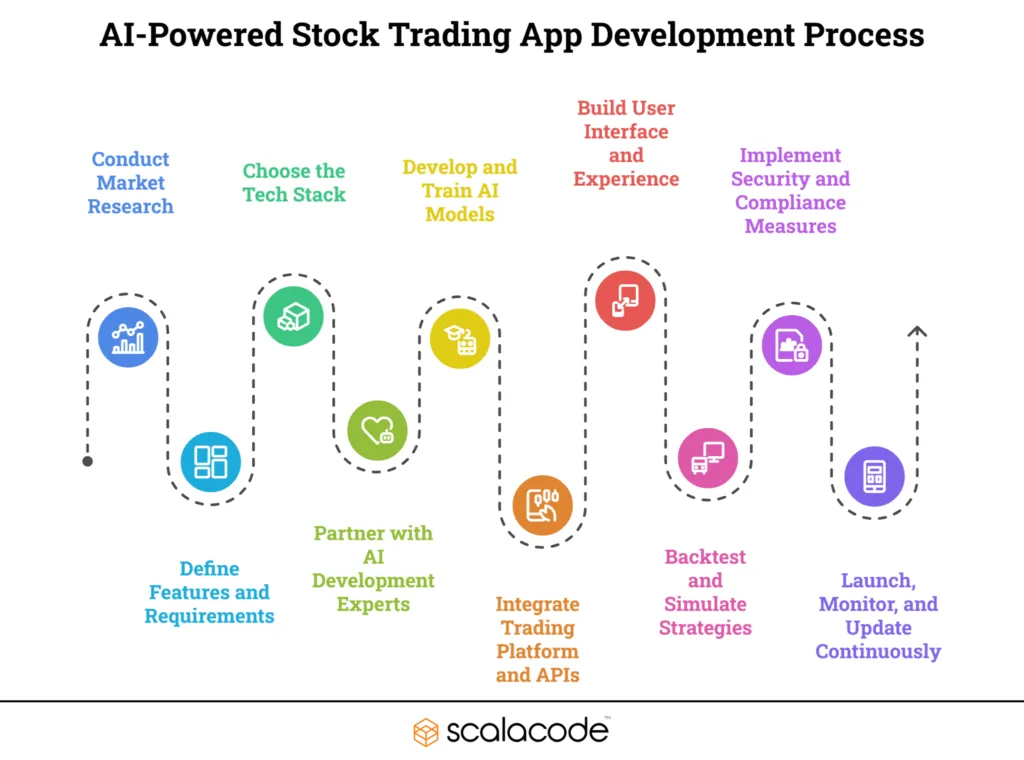
1. Conduct Market Research
First, you must understand your market and the target audience; to do that, you must go deeper into the research part. Here you will find what you need to serve to the market and what the market is demanding.
2. Define Features and Requirements
Depending on your application’s requirements, it’s now time to design or decide the needed features. These features involve AI-driven trading algorithms, portfolio management, and user account features.
3. Choose the Tech Stack
Choosing the correct and trending tech stack is the most important factors that people generally ignores. If you want your application to work smoothly, then you must pay attention here. You can go for programming languages (e.g., Python), AI or AI Agent frameworks, and development tools.
4. Partner with AI Development Experts
Doing individual research and then planning the features, choosing the tech stack, implementing, and whatnot, all take time. Especially, if you are not familiar with this, then this will take longer than usual, so it is better to partner with a Fintech app Development company so that they can do everything with perfection for you.
5. Develop and Train AI Models
To work according to your customers’ then, you must train the AI model with data and market trends so that it can suggest the best to your clients. You need to train the AI model in a way that it can analyze trends, predict stock movements, and generate trade signals.
6. Integrate Trading Platform and APIs
To build the best AI trading app, integrate your app with brokerage APIs, as this will give you the live market data updates and help you make the best decision for investing. In addition to that, this automated trade execution ensures compliance with regulatory standards.
7. Build User Interface and Experience
For a top mobile app development company, building the best user interface is the most crucial factor, as this becomes the face of your application and attracts people to use it if it is visually appealing. Additionally, you must design an intuitive, secure, and responsive UI that also provides personalized AI insights.
8. Backtest and Simulate Strategies
Testing the application before launching to the market is crucial and advantageous at the same time. This will let you know all the glitches or bugs before you launch the application in the real world. Moreover, you can simply test AI algorithms using historical data to evaluate performance and minimize risk.
9. Implement Security and Compliance Measures
Security is something that cannot be compromised at any cost. Protecting user information, using encryption, observing financial guidelines, and employing transactional monitoring steps to foster trust and legal compliance is a must.
10. Launch, Monitor, and Update Continuously
Test the application with real users, test AI model quality and performance, receive feedback, and constantly enhance functions and algorithms.
As suggested in the above section, you may need the help of experts. And in case you have followed the steps and have not been successful, then you must hire AI developers or consult with a company that provides such services.
Future of AI in Stock Trading
- The global AI trading platform is estimated to increase to USD 11.23 billion in 2024, then USD 33.45 billion in 2030 with a CAGR of 20.0.
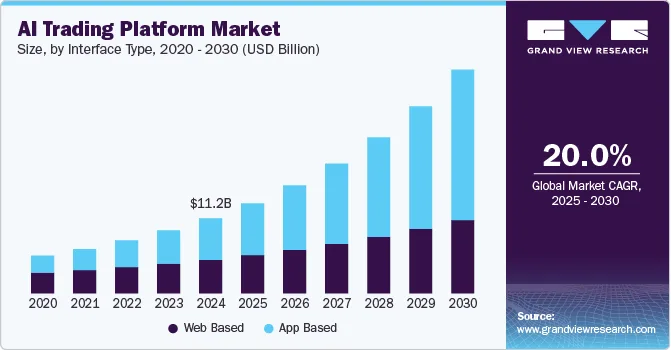
- The rise in usage of AI and machine learning in financial markets leads to automation, efficiency, and risk reduction in the trading processes.
- The regulatory contexts are changing to hold AI tools applied in trading accountable, protect data privacy and security, to ensure better governance and transparency.
- The use of machine learning and computing power technological progress also allows the use of more complex, adaptive, and efficient AI trading systems in a variety of asset classes.
- The increasing demand for mobile and web-based AI trading platforms with real-time analytics and customized AI-driven services helps the market to develop.
- Cloud-based trading solutions have momentum towards scalability, cost-effectiveness, and the quick implementation of AI models and analytics.
- North America dominates the market due to its developed fintech infrastructure; Asia Pacific has the highest growth rate because of the increased number of retail investors and the government policy.
- All aspects of AI trading are evolving according to investment in AI research, fintech innovation, and infrastructure, which are accelerating in the U.S. in particular.
- Retail and institutional investing will be transformed with increased integration of AI with regulatory compliance, risk management, and customized user experiences in the future.
Final Words: Should You Invest in AI Stock Trading Apps or Not?
At the end, the last verdict is…
Possible benefits of investing in an AI in Stock Trading App are that it can provide better decision-making, 24/7 monitoring of the market, expedited trade execution, and enhanced risk management.
Such applications use advanced AI algorithms to process large volumes of data and produce insights that are based on data, where investors may have a competitive advantage in unstable markets.
After looking at the supreme benefits of AI in stock trading applications, it is mandatory for you to know the AI app development cost. However, it may be high, particularly when it comes to sophisticated platforms that need sophisticated machine learning models, real-time data integration, and high-security standards.
When investors think about using AI stock trading apps, they should consider the features of the app, its transparency, compliance with regulations, and consistency with their investment goals. By integrating AI with human judgment, one can have the best results.
To conclude, AI-charged trading applications are potentially valuable instruments, but they need to be dealt with and due diligence to be informed before investing. As AI technologies keep evolving and becoming more accessible, they are becoming inseparable auxiliaries of retail and institutional investors who seek to trade smarter.
Partner with us to develop your custom AI Stock Trading App.
How ScalaCode Can Help You Make Your Dream AI Trading Stock Application
- ScalaCode is the top AI development company that has been known to possess approximately 15+ years of experience and over 150+ highly trained developers specializing in AI-driven solutions.
- Offers full-service AI app development, starting with the analysis of requirements, to AI model training and API integration secured.
- Skills in the creation of scalable, robust, and efficient AI stock trading applications, etc., with real-time data processing and automation capabilities.
- The agile model of development is one that ensures prompt delivery, budgeting, and flexibility based on client requirements.
- Applies the latest AI capabilities and strong domain expertise to develop transparent, compliant, and high-performance platforms.
- Provides scalable engagement options to startups, small to mid-sized enterprises, and larger organizations with customized AI solutions.
- Dedicated to fluid UI/UX, developing the intuitive user experience and personalized AI trading insights.
- Dedicated technology partner assisting with ongoing monitoring, model upkeep, and future-proof AI adoption to maximize ROI.
FAQs
-
What is AI stock trading, and how does it work?
AI in a stock trading app means the application of artificial intelligence algorithms to process market data, recognize trading patterns, and automatically make trades. These applications run real-time financial data, historical trends, and news sentiment to forecast market trends and make informed investment choices quicker than humans can.
-
How accurate is AI in predicting stock market movements?
Though no system can be 100% accurate, the use of AI in a stock trading app can provide much higher rates of prediction since large amounts of data are analyzed in real time. The precision is dependent on the quality of the algorithm, the source of data, and market volatility. Overall, AI models tend to be more successful than manual analysis, which can detect latent patterns and signals.
-
What are the benefits of using AI in stock trading apps?
The key benefits of AI in a stock trading app include:
● Faster decision-making
● Reduced emotional bias
● Automated portfolio management
● Ability to analyze massive datasets
● Improved efficiency
● 24/7 monitoring of markets -
Can AI trading systems replace human traders completely?
An AI stock trading application is able to automate routine and repetitive tasks, carry out trades in real time, and analyze extensive datasets more efficiently than humans. Nevertheless, they cannot substitute human traders completely as market dynamics tend to have geopolitical, psychological, and unpredictable elements in which human judgment is still a critical consideration.
-
What are the risks and limitations of AI in stock trading?
Despite its advantages, AI in a stock trading app comes with risks like:
● Over-reliance on algorithms
● Vulnerability to data errors
● Poor performance
● High maintenance costs -
How do AI stock trading apps manage risk and volatility?
Advanced risk management strategies, including stop-loss orders, predictive volatility models, and portfolio diversification strategies, are applied in the AI of a stock trading app. Such systems observe a change in the market continuously and automatically change the trading strategy in order to reduce possible losses.
-
Are AI stock trading apps suitable for beginner investors?
Yes, most AI in stock trading applications are developed with intuitive dashboards and auto-trading algorithms, thus being user-friendly. Nonetheless, even novice investors need to be familiar with the fundamentals of trading to put their full trust in AI systems.
-
How is regulatory compliance ensured in AI-powered trading platforms?
Stock trading application AI platforms are compliance-driven and implemented by adherence to financial regulation, including SEC, FINRA, or MiFID II requirements. Accountability and prevention of legal problems are ensured by the use of audit trails, clear reporting, and safe data management.