

Introduction
AI demand forecasting has moved from an emerging capability to a business-critical function. Organizations across retail, manufacturing, finance, and healthcare now rely on artificial intelligence to predict consumer demand with a precision that traditional statistical models simply cannot match. In 2026, as global supply chains grow more volatile and consumer behavior shifts faster than ever, AI in demand forecasting is no longer optional , it is the foundation of competitive supply chain strategy.
This guide covers everything you need to know about demand forecasting using AI: what it is, why it matters, how it works, the tools leading the space, and how autonomous AI agents are reshaping the entire discipline. Whether you are evaluating your first AI-powered forecasting pilot or scaling an existing deployment, this resource delivers the clarity you need to act.
AI in Demand Forecasting: The 2026 Market Snapshot
The numbers confirm what enterprise leaders already sense , AI-driven forecasting is accelerating at scale:
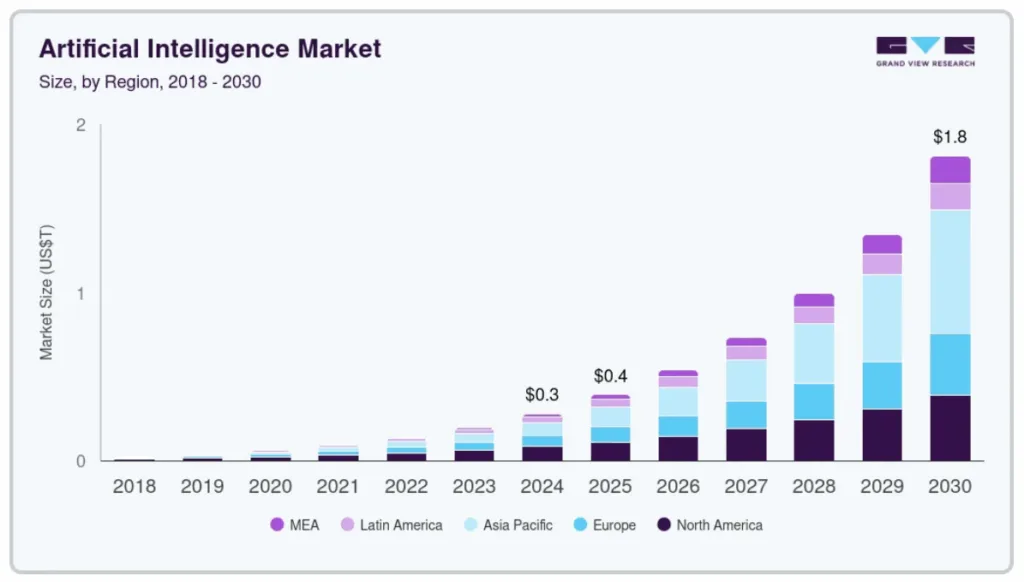
- Global AI market value crossed $500 billion in 2026 and is projected to surpass $1.8 trillion by 2030 (Statista, Grand View Research).
- India’s AI market is on track to reach $10 billion by the end of 2026, with demand forecasting ranking among the top five enterprise AI use cases (NASSCOM).
- AI-powered demand forecasting reduces forecast errors by 30-50% compared to traditional methods (McKinsey, 2025).
- 73% of supply chain leaders have either deployed or are actively piloting AI-based demand planning solutions (Gartner, 2026).
- Inventory carrying costs drop by 20-35% when companies implement AI ml demand forecasting at scale (Deloitte).
- The AI in supply chain management market alone is expected to exceed $24 billion by 2028, with demand forecasting as its fastest-growing segment.
These figures make one thing clear: organizations that delay AI adoption in demand planning are losing ground every quarter.
What Is AI-Enabled Demand Forecasting?
AI-enabled demand forecasting uses machine learning algorithms, deep learning models, and natural language processing to analyze historical sales data, market signals, weather patterns, social media sentiment, economic indicators, and hundreds of other variables , simultaneously , to predict future product or service demand.
Unlike traditional forecasting methods that rely on moving averages, exponential smoothing, or basic regression, AI based demand forecasting:
- Processes unstructured data (news feeds, social posts, satellite imagery) alongside structured datasets
- Detects nonlinear patterns that human analysts and spreadsheet models miss entirely
- Learns continuously from new data, improving accuracy with every cycle
- Operates at SKU-level granularity across thousands of products and locations simultaneously
- Adapts in real time to demand shocks, promotions, competitor moves, and external disruptions
In practical terms, AI demand planning transforms forecasting from a periodic, backward-looking exercise into a continuous, forward-looking intelligence system.
For organizations exploring broader AI capabilities, AI and ML development services provide the foundation for building custom forecasting models tailored to specific business contexts.
Why Is AI Important in Demand Forecasting?
1. Volatility Has Outpaced Traditional Models
Post-pandemic supply chains, geopolitical disruptions, and rapid consumer preference shifts have made legacy forecasting methods unreliable. AI handles volatility by ingesting real-time signals and adjusting predictions dynamically.
2. Data Volume Has Exploded
The average enterprise now generates terabytes of demand-relevant data daily , from POS systems, IoT sensors, web traffic, and third-party feeds. Only AI can process this volume at the speed required for actionable forecasting.
3. Customer Expectations Demand Precision
Same-day delivery, personalized promotions, and zero-stockout guarantees require forecast accuracy measured in hours, not weeks. AI in demand forecasting delivers this granularity.
4. Cost of Forecast Errors Is Rising
Overforecasting leads to excess inventory, markdowns, and waste. Underforecasting causes stockouts, lost revenue, and customer churn. AI-powered demand forecasting reduces both error types by 30-50%, directly protecting margins.
5. Competitive Pressure Leaves No Room for Guesswork
Competitors already using AI demand forecasting gain measurable advantages in fill rates, working capital efficiency, and customer satisfaction. Falling behind is not a strategy.
Companies looking to evaluate readiness for AI-driven transformation can benefit from expert AI consulting services that map business needs to the right forecasting architecture.
Benefits of AI in Demand Forecasting
Dramatic Improvement in Forecast Accuracy
AI ml demand forecasting models consistently deliver 20-50% accuracy improvements over traditional statistical methods. Deep learning architectures like LSTMs and Transformer-based models excel at capturing seasonal patterns, trend shifts, and demand intermittency.
Reduced Inventory Costs and Waste
Accurate demand signals translate directly into leaner inventory. Retailers using AI-powered forecasting report 20-35% reductions in safety stock while maintaining or improving service levels. For perishable goods, waste reduction reaches 30% or more.
Faster Response to Market Changes
AI models detect demand shifts within hours of emerging signals , a viral social media post, a competitor price drop, a weather event. This speed converts disruption into opportunity.
Scalability Across Products and Markets
A single AI forecasting engine can generate predictions for hundreds of thousands of SKUs across multiple geographies, channels, and time horizons , a task that would require armies of analysts using traditional approaches.
Better Cross-Functional Alignment
When sales, marketing, operations, and finance operate from a single AI-generated demand signal, the entire S&OP (Sales and Operations Planning) process improves. Forecast bias drops, consensus cycles shorten, and execution improves across the board.
Ready to Build AI-Powered Demand Forecasting for Your Business?
ScalaCode’s AI engineers build custom forecasting solutions that integrate with your existing ERP, supply chain, and analytics infrastructure. From model development to deployment and monitoring , we handle it end to end.
How AI Agents Are Reshaping Demand Forecasting
The most significant evolution in AI demand forecasting in 2026 is the emergence of agentic AI , autonomous AI agents that go beyond prediction to take action.
What Are AI Agents in Demand Forecasting?
AI agents are autonomous software systems that perceive their environment, make decisions, and execute actions without waiting for human instructions at every step. In the context of demand forecasting and supply chain management, these agents operate continuously, monitoring data streams, generating forecasts, and triggering downstream actions.
How Agentic AI Transforms the Forecasting Workflow
Traditional AI forecasting generates a prediction and hands it to a human for action. AI agents close the loop:
- Autonomous monitoring: Agents continuously scan POS data, supplier feeds, weather APIs, social sentiment, and logistics networks for demand-relevant signals , 24/7, without human prompting.
- Dynamic reorder triggers: When an agent detects that demand for a specific SKU will exceed available inventory within a defined threshold, it automatically generates and routes a purchase order to the appropriate supplier.
- Real-time pricing adjustments: Demand-sensing agents feed signals directly into pricing engines, enabling dynamic price optimization that maximizes revenue during demand spikes and minimizes markdowns during slowdowns.
- Multi-agent collaboration: In sophisticated deployments, specialized agents handle different functions , one monitors demand signals, another manages supplier communication, a third optimizes warehouse allocation , and they coordinate autonomously.
- Exception-based human intervention: Instead of humans reviewing every forecast, agents handle routine decisions independently and escalate only genuine anomalies or high-risk scenarios for human review.
Why This Matters for Enterprise Teams
Agentic AI in demand forecasting delivers three measurable outcomes:
- Speed: Decisions that previously took days (forecast review, order placement, price changes) happen in minutes.
- Consistency: Agents apply the same logic across thousands of SKUs without fatigue, bias, or oversight gaps.
- Scalability: A team of AI agents can manage forecasting and replenishment for an entire product catalog , a task that previously required large planning teams.
Organizations building AI agent development capabilities are gaining a structural advantage in supply chain responsiveness. For deeper insight into how vertical AI agents operate across industries, see our analysis of vertical AI agents and their business applications.
How Does AI in Demand Forecasting Work?
The AI demand forecasting pipeline follows five core stages:
Step 1: Data Collection and Integration
AI systems ingest data from multiple sources: historical sales records, CRM systems, ERP databases, weather feeds, economic indicators, social media APIs, web analytics, IoT sensor data, and third-party market intelligence. Data integration is often the most time-intensive phase , and the most critical.
AI integration services help enterprises connect disparate data sources into a unified forecasting pipeline without disrupting existing operations.
Step 2: Data Preprocessing and Feature Engineering
Raw data is cleaned, normalized, and transformed into features that ML models can consume. This includes handling missing values, encoding categorical variables, creating lag features, and engineering domain-specific indicators (e.g., promotional flags, holiday calendars, competitive pricing indices).
Step 3: Model Selection and Training
Multiple model architectures are trained and evaluated:
- Gradient Boosted Trees (XGBoost, LightGBM): Strong for structured, tabular demand data with clear feature importance.
- LSTM / GRU Networks: Excel at sequential time-series patterns with long-range dependencies.
- Transformer Models (Temporal Fusion Transformer, TimeGPT): State-of-the-art for multi-horizon forecasting with attention-based feature selection.
- Prophet / NeuralProphet: Effective for data with strong seasonal and holiday effects.
- Ensemble Methods: Combine multiple model outputs for robust, bias-reduced predictions.
Step 4: Forecast Generation and Validation
Trained models generate demand predictions across defined time horizons (daily, weekly, monthly) and granularity levels (SKU, category, location, channel). Forecasts are validated using backtesting, holdout sets, and business KPIs (MAPE, bias, fill rate impact).
Step 5: Deployment, Monitoring, and Continuous Learning
Production models are deployed via APIs or integrated directly into ERP/SCM platforms. Monitoring systems track forecast accuracy, model drift, and data quality. Models retrain automatically on new data , closing the feedback loop and improving accuracy over time.
Top AI-Powered Demand Forecasting Tools
The market for AI powered demand forecasting tools has matured rapidly. Here are the leading platforms that enterprises are deploying in 2026:
Amazon Forecast
Amazon’s fully managed service uses deep learning to generate highly accurate forecasts without requiring ML expertise. It automatically selects the best algorithm for your data, handles missing values, and scales elastically. Best suited for organizations already operating within the AWS ecosystem.
Google Vertex AI , Forecasting
Google’s Vertex AI platform offers AutoML-based time series forecasting with built-in feature engineering, model selection, and explainability. It integrates natively with BigQuery and Google Cloud’s data stack. Strong for enterprises with large, complex datasets requiring scalable training infrastructure.
IBM Planning Analytics with Watson
IBM’s offering combines traditional planning capabilities with Watson AI for demand sensing and forecasting. It provides robust what-if scenario modeling and integrates well with legacy ERP environments. Preferred by enterprises in regulated industries that require auditability.
SAP Integrated Business Planning (IBP)
SAP IBP embeds machine learning directly into the demand planning workflow, making it accessible to planners without data science backgrounds. It offers tight integration with SAP S/4HANA and the broader SAP supply chain suite. Dominant in manufacturing and CPG sectors.
Blue Yonder (formerly JDA)
Blue Yonder’s Luminate Demand Edge uses AI and external data signals (weather, events, social) to generate granular demand forecasts. Its strength lies in retail and grocery, where it powers some of the world’s largest replenishment systems.
o9 Solutions
o9’s AI-powered platform combines demand sensing, supply planning, and revenue management in an integrated decision-making environment. Known for rapid deployment timelines and a modern user experience.
Anaplan
Anaplan provides connected planning with embedded AI/ML for demand forecasting. Its strength is cross-functional alignment , connecting demand forecasts directly to financial plans, workforce plans, and supply plans in a single platform.
How to Choose the Right Tool
The right AI powered demand forecasting tool depends on:
- Existing tech stack (cloud provider, ERP system)
- Data maturity (clean, integrated data vs. siloed, messy data)
- Team capability (data science team vs. business planners)
- Forecast granularity (category-level vs. SKU-location-day)
- Budget (managed services vs. custom-built solutions)
For organizations that need a custom solution built on top of or alongside these platforms, hiring experienced AI developers accelerates time to production.
AI for Scenario-Based Demand Forecasting
What Is Scenario Forecasting AI?
Scenario-based demand forecasting uses AI to generate multiple demand projections based on different assumptions about future conditions. Instead of producing a single-point forecast, scenario forecasting AI creates a range of outcomes , best case, worst case, and multiple variations in between , each tied to specific variables.
Why Scenario Forecasting Matters in 2026
Supply chain volatility has made single-point forecasts insufficient. Decision-makers need to understand how demand shifts under different conditions:
- What if a key supplier faces a 3-week delay?
- What if a competitor launches a 20% price cut in Q3?
- What if raw material costs increase by 15%?
- What if a new tariff regime takes effect mid-quarter?
AI enables scenario modeling at a speed and scale impossible with manual approaches. Where a planning team might evaluate 3-5 scenarios over several days, AI systems generate hundreds of scenarios in minutes, each with probabilistic confidence intervals.
How AI Powers Scenario Forecasting
- Monte Carlo simulations enhanced by ML models explore thousands of possible demand paths.
- Generative AI creates synthetic demand scenarios based on historical disruption patterns.
- Reinforcement learning optimizes decisions across scenarios, identifying strategies that perform well under multiple conditions.
- NLP-driven signal detection scans news, regulatory filings, and analyst reports to automatically identify emerging scenarios worth modeling.
Business Impact
Companies using scenario forecasting AI report:
- 40% faster response to supply chain disruptions
- 25% improvement in inventory positioning for uncertain demand periods
- Stronger board-level confidence in demand plans backed by probabilistic ranges rather than point estimates
This capability connects directly to broader AI and ML development strategies that build resilience into enterprise planning systems.
Real-Time Use Cases: AI Demand Forecasting by Industry
Retail and E-Commerce
AI demand forecasting powers inventory optimization across thousands of stores and fulfillment centers. Retailers use it for markdown optimization, promotional demand lifts, new product launch forecasting, and hyper-local demand predictions based on neighborhood-level buying patterns.
Manufacturing
In manufacturing, demand forecasting using AI drives production scheduling, raw material procurement, and capacity planning. Predictive models factor in lead times, supplier reliability scores, and order pipeline data to generate actionable production forecasts weeks or months in advance. For a deeper look, read our guide on AI in manufacturing and its transformative impact.
Automotive
Automotive OEMs and suppliers use AI based demand forecasting to manage complex, multi-tier supply chains. Models predict demand for thousands of parts across hundreds of vehicle configurations, factoring in dealer orders, fleet contracts, and aftermarket demand.
Supply Chain and Logistics
AI powers demand sensing across the entire supply chain , from raw materials to last-mile delivery. Logistics providers use it to forecast shipment volumes, optimize route planning, and pre-position inventory at distribution nodes closest to anticipated demand. AI in procurement plays a critical role in connecting demand signals to sourcing decisions.
Financial Services
Banks and fintech companies apply AI demand forecasting to predict loan demand, transaction volumes, customer service call patterns, and ATM cash requirements. These models help optimize staffing, liquidity management, and branch operations.
Healthcare and Pharmaceuticals
Hospitals forecast patient admissions, surgical supply needs, and pharmaceutical demand using AI. During disease outbreaks or seasonal surges, AI models adjust predictions in real time based on epidemiological data, appointment trends, and prescription patterns.
Need AI Demand Forecasting Tailored to Your Industry?
ScalaCode builds industry-specific forecasting models that integrate with your data infrastructure and deliver measurable accuracy gains from day one.
How to Implement AI in Demand Forecasting: 8 Steps
Step 1: Define Business Objectives and KPIs
Start with clarity on what you are solving: reducing stockouts, cutting excess inventory, improving promotional forecasting, or all three. Define measurable KPIs , MAPE, forecast bias, fill rate, inventory turns , before touching any data.
Step 2: Audit and Consolidate Data Sources
Map every data source relevant to demand: POS, ERP, CRM, web analytics, weather, economic indicators, and competitor data. Identify gaps, quality issues, and integration challenges. Data readiness determines 60-70% of project success.
Step 3: Build a Unified Data Pipeline
Create an automated, reliable data pipeline that ingests, cleans, transforms, and stores demand-relevant data. Cloud-based data warehouses (Snowflake, BigQuery, Redshift) and orchestration tools (Airflow, dbt) are standard choices.
Step 4: Select and Train Forecasting Models
Start with proven architectures (gradient boosted trees, LSTMs) before exploring cutting-edge models. Train on historical data, validate with holdout periods, and evaluate against business KPIs , not just statistical accuracy metrics.
Step 5: Integrate with Planning and Execution Systems
Connect forecast outputs to your ERP, inventory management, and procurement systems. Forecasts that live in dashboards but do not flow into execution workflows deliver limited value.
Step 6: Establish Human-AI Collaboration Protocols
Define where AI makes autonomous decisions and where humans review, override, or approve. Build override tracking to measure when human adjustments improve or degrade forecast accuracy.
Step 7: Deploy Monitoring and Retraining Systems
Production forecasting models require continuous monitoring for accuracy drift, data quality issues, and concept drift (shifts in underlying demand patterns). Automated retraining pipelines keep models current.
Step 8: Scale and Optimize
Expand from pilot (single category or region) to enterprise-wide deployment. Add new data sources, refine features, test advanced model architectures, and build AI agent capabilities for autonomous action.
Organizations that need expert guidance through this process often engage AI integration specialists to accelerate deployment and avoid common pitfalls.
Challenges in AI-Based Demand Forecasting
Data Quality and Availability
AI models are only as good as the data they consume. Incomplete records, inconsistent formats, and siloed systems remain the top barrier to successful AI demand forecasting deployments.
Integration with Legacy Systems
Many enterprises run ERP and planning systems that predate the AI era. Connecting modern ML models to legacy databases requires middleware, APIs, and sometimes significant re-architecture.
Talent and Skill Gaps
Building and maintaining AI forecasting systems requires data engineers, ML engineers, and domain experts who understand both the technology and the business. This talent is scarce and expensive.
Model Explainability
Black-box models struggle to gain trust from planners and executives. Investing in explainable AI (SHAP values, feature importance dashboards, prediction intervals) is essential for organizational adoption.
Change Management
Shifting from spreadsheet-based planning to AI-driven forecasting requires cultural change. Planners must learn to work with AI, not against it , and leadership must champion the transition.
Cold Start for New Products
AI models need historical data to learn. For new product launches, limited data availability forces reliance on proxy models, analogous product mapping, or generative approaches.
Overfitting and Model Fragility
Models trained too closely on historical patterns may fail when market conditions shift. Regularization, cross-validation, and ensemble methods mitigate this risk but require expert oversight.
Cost of Implementation
Enterprise-grade AI forecasting systems require investment in infrastructure, talent, and organizational change. ROI is typically strong (3-10x within 18 months) but requires executive commitment through the initial ramp period.
The Future of AI in Demand Forecasting (2026 and Beyond)
Autonomous Demand Management
AI agents will evolve from assistants to autonomous demand managers , handling not just forecasting but also the downstream decisions that forecasts inform: ordering, pricing, allocation, and markdown execution.
Foundation Models for Time Series
Large pre-trained models for time series data (TimeGPT, Chronos, Lag-Llama) are making it possible to generate accurate forecasts with minimal historical data and zero feature engineering. These foundation models will democratize AI forecasting for mid-market companies.
Generative AI for Demand Narratives
Generative AI will transform how forecasts are communicated. Instead of dashboards and spreadsheets, planners will receive natural-language demand narratives explaining what is happening, why, and what they should do about it. Generative AI development services are accelerating this capability for enterprise teams.
Digital Twin Integration
AI demand forecasting will merge with digital twin technology to simulate entire supply chains , testing the impact of demand changes on production, logistics, and financial performance before any real-world action is taken.
Edge-Based Forecasting
AI models deployed at the edge (in stores, warehouses, and distribution centers) will generate hyper-local demand predictions with sub-minute latency, enabling real-time shelf replenishment and dynamic merchandising.
Sustainability-Driven Forecasting
As ESG mandates tighten, AI forecasting will incorporate sustainability constraints , optimizing demand plans not just for profit and service levels but also for carbon footprint, waste reduction, and circular economy goals.
To stay ahead of these trends, explore our roundup of the top AI trends shaping enterprise strategy in 2026.
Build Your AI Forecasting Capability with ScalaCode
From strategy to deployment, ScalaCode’s AI engineering team delivers production-ready demand forecasting systems. Custom-built. Fully integrated. Continuously improving.
Conclusion
AI demand forecasting has reached a maturity inflection point. The technology works. The tools are available. The business case is proven. The question for enterprise leaders in 2026 is not whether to adopt AI-powered demand forecasting but how fast they can deploy it , and how effectively they can extend it with autonomous AI agents that close the gap between prediction and action.
Organizations that invest in robust data foundations, select the right tools, and build human-AI collaboration workflows will capture measurable advantages in forecast accuracy, inventory efficiency, and customer satisfaction. Those that delay will face compounding disadvantages as competitors scale their AI capabilities.
How ScalaCode Can Help
ScalaCode is a technology partner specializing in AI solutions for enterprises across industries. Our capabilities include:
- Custom AI/ML demand forecasting models built on your data, integrated with your ERP and supply chain systems , AI/ML development services
- AI agent development for autonomous demand management, reorder automation, and dynamic pricing , AI agent development services
- AI integration that connects forecasting models to SAP, Oracle, Salesforce, and custom platforms , AI integration services
- AI consulting to evaluate your forecasting maturity, define your roadmap, and select the right architecture , AI consulting services
- Dedicated AI developer teams that embed with your organization for rapid, high-quality delivery , Hire AI developers
Whether you are launching your first AI forecasting pilot or scaling an existing system across global operations, ScalaCode delivers the engineering talent and domain expertise to make it happen.
FAQs
What is AI demand forecasting?
AI demand forecasting is the application of machine learning, deep learning, and natural language processing to predict future product or service demand. Unlike traditional statistical methods, AI models analyze hundreds of variables simultaneously , including unstructured data like social media sentiment and news feeds , to generate highly accurate, granular predictions that improve continuously over time.
How is AI transforming demand forecasting?
AI transforms demand forecasting by replacing periodic, spreadsheet-driven processes with continuous, automated intelligence. AI models process real-time data, detect nonlinear patterns, and adapt to market shifts within hours. In 2026, autonomous AI agents are extending this transformation by not just predicting demand but automatically executing downstream actions like reordering and pricing.
What are the best AI-powered demand forecasting tools?
Leading AI powered demand forecasting tools in 2026 include Amazon Forecast (AWS-native deep learning), Google Vertex AI (AutoML time series), SAP Integrated Business Planning (ERP-embedded ML), Blue Yonder Luminate Demand Edge (retail-focused AI), IBM Planning Analytics with Watson, o9 Solutions, and Anaplan. The best choice depends on your existing tech stack, data maturity, and team capabilities.
How do AI agents improve demand forecasting?
AI agents improve demand forecasting by operating autonomously , monitoring supply chain data streams 24/7, generating demand predictions, and executing actions like purchase order creation, inventory reallocation, and dynamic price adjustments without waiting for human review. This reduces decision latency from days to minutes and ensures consistent, scalable execution across thousands of SKUs.
What is the role of NLP in demand forecasting?
Natural language processing (NLP) enables AI demand forecasting systems to extract demand signals from unstructured text sources: news articles, social media posts, customer reviews, analyst reports, and regulatory filings. NLP identifies emerging trends, sentiment shifts, and event-driven demand changes that structured data alone would miss, adding a critical intelligence layer to forecasting models.
How much does it cost to implement AI demand forecasting?
Implementation costs vary based on scope and approach. A focused pilot using managed cloud services (Amazon Forecast, Vertex AI) can start at $50,000-$150,000. Enterprise-wide custom deployments typically range from $250,000 to $1 million+, including data engineering, model development, integration, and change management. ROI of 3-10x within 12-18 months is common for well-executed implementations.
What is scenario-based AI demand forecasting?
Scenario-based AI demand forecasting uses machine learning and simulation techniques to generate multiple demand projections under different assumptions , such as supplier delays, price changes, or economic shifts. Instead of a single-point forecast, it produces probabilistic ranges that help decision-makers prepare for multiple outcomes and build resilient supply chain strategies.
How does AI improve inventory forecasting?
AI improves inventory forecasting by generating more accurate demand predictions at the SKU-location level, enabling precise safety stock calculations and reorder point optimization. Companies using AI for inventory forecasting report 20-35% reductions in carrying costs, 15-25% improvements in fill rates, and significant decreases in both overstock and stockout events.
Can small and mid-sized businesses use AI demand forecasting?
Yes. The emergence of managed AI services (Amazon Forecast, Google Vertex AI) and foundation models for time series has dramatically lowered the barrier to entry. SMBs can now access enterprise-grade forecasting capabilities through cloud-based platforms without building in-house data science teams. Starting with a focused pilot on high-impact product categories is the recommended approach.
What industries benefit most from AI demand forecasting?
While AI demand forecasting delivers value across all sectors, the industries seeing the largest impact include retail and e-commerce (inventory optimization, promotional forecasting), manufacturing (production planning, raw material procurement), healthcare (patient volume prediction, pharmaceutical demand), automotive (multi-tier supply chain management), financial services (transaction volume prediction), and logistics (shipment volume forecasting, route optimization).