


Companies are outsourcing or hiring remote developers instead of keeping everything in-house.
Get Statista, which discussed the big picture of the technology industry employees who worked mainly remotely and found that 67% of employees claimed that type of work arrangement.

In fact, in a survey by McKinsey & Company, it has been observed that out of 80 million American office workers, 87% of those have been given the opportunity to work from home. Besides, left does for an average of 3 days a week.
It also discovers that although employees are offered limited remote possibilities 12% of workers arrive to work five days a week remotely indicating a greater potential for remote work than many employers offer at present.

Pretty compelling, right?
However, the question remains- is it possible to hire dedicated remote developers?
But let’s be honest, sourcing the right remote developers may not be very easy, this is particularly so for first timers. You may be thinking, is it the same as having an internal staff? Well, they are the same to some extent, but they are not. The major distinctions are in the ways you deal with subordinates and in the ways you interact with your subordinates. Remote developers may work from any corner of the world, from their comfort of their homes or any office space.
Here’s a quick table to help you compare remote developers with in-house ones:
Remote Developers vs. In-house Developers
| Feature | In-House Developers | Remote Developers |
| Location | Work from the company’s office | Work from a remote location (home, co-working space) |
| Management | Direct, in-person supervision | Requires strong communication and trust |
| Collaboration | Easier face-to-face interaction | Relies heavily on digital tools and communication |
| Supervision | More direct observation of work | Requires clear expectations, regular check-ins, and performance tracking |
That means, if you ever plan on outsourcing and trying to get the top remote developers, you will have to always ensure that you get a proper plan that deals with:
- the handling of the worker
- communication with the worker
- and most importantly means of working together.
After reading this guide you will be prepared and informed enough to properly hire or find remote developers. We should begin with the steps usually involved in hiring a remote software developer.
How to Hire Remote Developers: Step-by-Step Guide
Remote developers are among the best talents you may hire for the development of your project, and therefore, hiring should follow a proper plan. Nonetheless, setting up remote work can be a breeze once you know these seven tips for hiring dedicated remote software engineers. Let’s start:
Step 1: Pre-preparation (Defining what you need)
The only way you can be sure to get your hands on the right resource is if you have done all that is needed prior. This phase of the process to hire remote developers sets the tone for working on future projects together. This is because every business is different, and knowing how a remote developer can help you accomplish your goals is going to make a world of difference in the hiring process.
In fact, it is the measure of the overall productivity of the remote team. For that, a thorough understanding of your requirements is needed.
By that we mean, to clarify cut-
- the particular specialization (for example are you looking for Android developers for hire or iOS developers)
- quantified (junior, mid-level, or senior, will they be).
- tasks that can be a prerequisite for the remote developer position
Start by identifying the type of project they will work on. Is it a full-scale application, integration with other applications, creating an MVP, or support for existing systems? Each project type requires different skills and experience.
For example, if you’re working on an iOS app development, you might want to hire a remote iOS developer who is aware of Swift, Objective-C, and the iOS ecosystem and can operate with minimal supervision.
Conversely, for AI product development, you may need to hire remote AI developers. Similarly, for ongoing IT support & maintenance services, there is a need to hire dedicated remote developers who can integrate with your existing team long-term.
Besides, how complex the project is, is it developing simple websites or complex B2B marketplace apps?
Additionally, establish a budget framework early on. This is because, with financial constraints, you can make informed decisions about hiring models (part-time, full-time, freelance, or agency).
Key Points:
- What technologies do you need them to be proficient in (e.g., programming languages, frameworks, databases)?
- What level of experience is necessary (e.g., junior, mid-level, senior)?
- What are the key responsibilities and daily tasks?
- How much are you ready to spend to hire remote devs?
- Where do you want to hire the resource? Are you hiring software developers from India or the USA?
Step 2: Create a Job Description or Project Outline
Next up, you have to create a comprehensive job description or project outline. Clearly outline responsibilities and expectations to help candidates understand their daily tasks and minimize mismatches.
Highlight the project’s specifics, so potential hires know what they’ll be working on. Specify the required skills and preferred frameworks or languages, ensuring the technical criteria are clear for a more efficient hiring process.
You can even include the perks and benefits of working remotely with your company (e.g., flexible work hours, competitive compensation, professional development opportunities, paid time off).
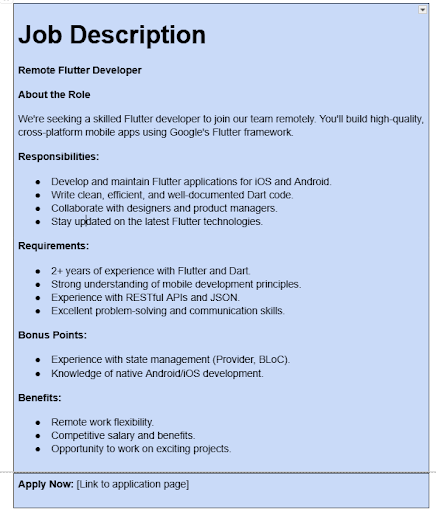
By providing a detailed and transparent job description, you not only attract qualified candidates but also set clear expectations for both parties, leading to a smoother onboarding process and a more successful working relationship. Here is a job description sample to hire remote Flutter developers.
Step 3: Choose Your Hiring Channels
Now that you have your job description ready and have set your sights on a particular country, it’s time to choose your hiring channels. It’s always beneficial to use multiple talent pools to increase your chances of finding the right candidate. Your choice of hiring channels will largely depend on the collaboration model you’ve decided upon.
However, some of the options are:
Remote-Focused Job Boards
Platforms like RemoteOK, We Work Remotely, and Stack Overflow Jobs specialize in remote positions and attract a pool of experienced remote workers. These platforms can be highly effective for finding skilled developers with a proven track record of remote success.
Freelancing Platforms
While primarily for short-term projects, platforms like Upwork and Fiverr can be a starting point to assess developer skills and potentially identify long-term remote candidates.
Leverage LinkedIn’s advanced search filters to target remote developers with specific skills and experience. LinkedIn Groups related to software development and remote work can also be valuable for networking and identifying potential candidates.
Referrals
Encourage existing remote employees to refer qualified candidates within their networks. Remote work often fosters strong professional relationships, making employee referrals a valuable source for high-quality hires.
| Hiring Channel | Examples | Pros | Cons |
| Job Boards (General) | Indeed, LinkedIn, Glassdoor, RemoteOK, AngelList, Hired | Wide reach, large applicant pools | High competition, potential for unqualified applicants |
| Job Boards (Niche) | Stack Overflow Jobs, GitHub Jobs, We Work Remotely, HackerNews | Targeted audience, higher quality applicants | Smaller applicant pools |
| Company Website | Careers page, dedicated remote page | Direct applications, employer branding | Limited reach compared to other channels |
| Social Media | LinkedIn, Twitter | Organic reach, cost-effective | Can be time-consuming to build a strong presence |
| Referrals | Employee referrals | High-quality candidates, strong cultural fit | Limited reach, potential for bias |
| Recruitment Agencies | Specialized remote agencies | Fast and efficient hiring, access to top talent | High costs, potential for misalignment |
| Freelancing Platforms | Upwork, Fiverr, Toptal | Quick access to freelancers, flexible engagement | Project-based, may not be suitable for long-term roles |
| Developer Communities | Reddit, Discord, forums | Direct access to target audience, community engagement | Can be time-consuming to build relationships |
Step 4. Screen Candidates Application Carefully
It’s therefore important in hiring remote developers that you get hold of a good selection criterion. Carefully read resumes, portfolios, and code samples of all the applications received.
Resume Screening
Technical Skills: Concentrate on areas like programming languages, frameworks, and technologies. This characteristic will help in sort listing the position. By that, we mean, you can easily know; are you hiring:
- Rremote AI Developers
- Remote Mobile App Developers
- Remote Node.js developers
- Remote Java developers
- Remote React Native Developers
- Remote DevOps Engineers, or else.
Experience
Examine the experiences of your candidates, not only the depth of their experiences, but the variety as well, in terms of project type, size of team, and roles.
Also, cross-check remote work experience: The hiring targets should have previous experience undertaking the job through working from home so as to showcase self-driven and discipline when working in a decentralized setting.
Portfolio/Code Samples
- Quality of Work: Check on aspects that include code quality aspects including ease of readability of code, efficiency, and how easy it is to maintain the code. Besides, makes sure that the code is optimized in conformance to internationally accepted standards.
- Project Complexity: They should evaluate the level of difficulty that has been achieved on previous work done by them with a view of illustrating the extent of difficult tasks they have solved and the extent of optimum solutions they have provided.
- Personal Projects: Treat the personal projects as they may be important, as they can reveal the candidate’s motivation, predisposition to initiate a new project, and his/her aptitude to work in m civil engineering project.
Technical Assessments
The two common technical assessments you can carry out during the process of hiring dedicated remote developers are:
- Coding Challenges: Use practical coding questions, quizzes, or home assignments to check candidates’ problem-solving skills, coding background, and self-organizing skills.
- Technical Interviews: Ask them referential technical questions to test their technical knowledge base, evaluate their interpersonal as well as problem-solving skills, and learn about their work style and approach in spite of coding challenges.
Step 5: Cross-Check Soft Skills
Moving on from such technical competencies what is next, which is very vital in the remote hiring of software developers:
Communication and Collaboration: As collaboration forms a critical part of remote work, determine their communication capability using written correspondence or relay their technical ideas without distortion. Remote software engineers must know how to work with some of the common tools and technologies.
Essential Tools & Technologies for Remote Software Engineering Teams
| Category | Tools & Technologies | Description |
| Project Management | Jira, Asana, Trello, Monday.com | Track tasks, manage sprints, and collaborate on project timelines. |
| Communication & Collaboration | Slack, Microsoft Teams, Google Workspace | Facilitate real-time messaging, video conferencing, and file sharing. |
| Version Control | Git, GitHub, GitLab | Track code changes, collaborate on code, and manage code repositories. |
| Code Collaboration & Review | GitHub, GitLab, Bitbucket | Host code repositories, review code changes, and manage pull requests. |
| Video Conferencing | Zoom, Google Meet, Microsoft Teams | Conduct online meetings, webinars, and screen sharing sessions. |
Time Management and Self-Discipline: Assess their organizational, time and planning skills, inclination towards meeting time bound targets and self-organising capabilities respectively.
Cultural Fit: Interestingly, this is something that is still relevant when working from home, namely cultural fit.
Step 6: Make an Offer
If you’re happy with the candidates, it’s time to make them an offer to a remote developer you choose. Besides, you can either do this by email or phone.
Here are some things to keep in mind when making an offer:
- Salary: Make sure you’re paying a reasonable wage. You may get a feel of what people earn in similar roles by using websites like Glassdoor.
- Benefits: If you’re not offering a benefits package, you may be losing out on some great candidates. Be sure to offer things like healthcare insurance.
- Timing: Try to be as flexible as possible when it comes to timing. Many people are interested in working remotely, but they may not be available to start right away. Moreover, 99 percent of individuals would opt to work remotely for the remainder of their lives.
Step 7: Employee Onboarding
You can begin the employee onboarding process after you’ve made an offer and the candidate has accepted. This involves setting up their computer, introducing them to the team, and providing them with any tools or software they may require.
Once you’ve selected the ideal remote developers, an effective onboarding process is crucial for seamless integration into your team.
#1. Provide Comprehensive Documentation
Ensure remote developers have access to comprehensive documentation detailing project expectations, workflows, and company culture. This documentation acts as a reference point, helping them understand your business’s unique dynamics. Clear guidelines reduce ambiguity, enabling developers to hit the ground running.
#2. Facilitate Virtual Introductions
Introduce new hires to the team through virtual meetings. Encourage team members to share insights about their roles, fostering a sense of community. These introductions help remote developers feel connected and valued, setting the tone for a collaborative work environment.
#3. Assign a Mentor or Buddy
Pair remote developers with mentors or buddies who can guide them through the initial stages. Having a point of contact for questions and support accelerates their adjustment process. Mentors can provide valuable insights into company practices and help navigate any challenges.
Legal Implications of Outsourcing Remote Developers
Outsourcing remote developers is gaining popularity as more companies accept the use of a global staff. However, managing the legal issues about this process tends to appear challenging. Some legal issues to discuss in this guide include hiring remote developers from different legal systems.
The employment status of a developer
Before anything, let’s know the difference between an employee and an independent contractor for you to have a clear understanding of what your remote developer is. This means the difference is important because taxes, benefits, and many legal responsibilities depend on it.
In the U.S., the body responsible for offering guidelines to enable such a distinction is the Internal Revenue Service, IRS, and the two major criteria include control and independence.
If for instance the developer is considered an employee then you will be subject to employment laws including offering employee benefits and must pay the minimum wage.
However, independent contractors meet different tests. For the most part, they are personally liable for their taxes and benefits to eliminate expenses for your company.
Contracts are Key
Again, depending on the status of the project, though should always be a definite agreement. A clear and detailed contract will outline roles, responsibilities, payment terms, and timeframes of the contract. It’s your backup that gives both parties an equal understanding of what is expected and/or allowed.
All contracts should be accompanied by a non-disclosure clause so as to protect proprietary information from your firm. This is because when developers have access to confidential data or innovative programs then this is a great loss to the firm. Another form of protection is also the use Non_disclosure agreements that are very useful in protecting the secrets of your company.
Consider International Laws
Remote developers’ hiring involves crossing international borders and that’s where international law comes to act. Should your developer be located out of your country then you would have to factor the employment laws of the said country, taxes as well as the laws regarding data protection.
For instance, the European Union General Data Protection Regulation affects how you process personal data. If your remote developer processes personal information of the EU citizens, you are subjected to GDPR laws that entails strict measures of data protection.
Moreover, understanding tax treaties between the U.S. and the developer’s country can help avoid double taxation. Consulting with a legal expert familiar with international employment law is advisable here, don’t you think?
Paying Your Remote Developer
Another legal consideration is how to pay your remote developer. Are you paying them in U.S. dollars or their local currency? Exchange rates and transaction fees can add complexity to this process.
Platforms like PayPal, TransferWise, and Payoneer can facilitate international payments, but each has its pros and cons. Ensure that your chosen method is both convenient and compliant with any applicable financial regulations.
Protecting Intellectual Property
When hiring remote developers, safeguarding your intellectual property (IP) is a must. This involves ensuring that all work created by the developer for your company is owned by your company.
Include IP clauses in your contract, clearly stating that any software, code, or other creations are company property. This not only secures your IP but also prevents potential disputes.
Work Hours and Communication
Another point to consider is setting expectations for work hours and communication. Time zone differences can be a hurdle, but they can be managed with clear communication strategies.
Make sure your remote developer knows your preferred communication channels and expected response times. While flexibility is a perk of remote work, maintaining some structure can enhance productivity.
Tax Obligations
Taxes are another area where businesses often trip up. When you hire remote developers, you need to understand the tax implications for both parties. Depending on the arrangement, you might need to withhold taxes, report payments, or even register in the developer’s country. Consulting with a tax professional can save you from potential penalties down the line.
Benefits of Hiring Remote Developers
The most common benefit of hiring remote software developers for which CEOs or any business leader would opt is access to a wider talent pool. Not just that, they can also significantly reduce overhead costs associated with maintaining a physical office. There are many more advantages that remote hiring of software developers brings to the table. Here, we have tried to break those one by one:
Access to the large pool of talented
When you hire remote developers, that means you can look anywhere in the world. This means that you can access professionals in your business from all over the world which creates a larger pool of talent. This means that while searching for people you can be specific about the employees’ skills that you want without limiting your search to employees located nearby. For instance, let’s say you have to look for remote Python developers to join your development team, you don’t have to do this locally as there are talented developers from all over the world.
Cost-Effective Solutions
It is sometimes more economical to outsource your development than to have a remote development team. Since there is no requirement for making use of ample office space, electricity, water and other overhead costs, it will be a big cost saver. Further, since there are highly skilled developers all over the world, you can hire your developers at a lower cost than in your own locality, yet offer them a good salary that will make sense to them.
Increased Productivity
Research has also indicated that employees working from home are usually more efficient than those in the office. Formerly flexibility that allows employees to work in the environment they like, and the lack of interruptions in the offices, can result in higher productivity. As a result, when you are employing remote developers, you may in fact be improving the productivity of your team.
Flexibility and Scalability
Sometimes hiring remote developers can be very strategic, and can offer practical benefits for example in matters concerning flexibility and scalability. It allows you to hire or let people go without stress about the space in which they will conduct their work depending on the projects they have at hand. It is especially advantageous to new firms or quick-growing corporations because they can hire and fire as necessary.
Greater Employee Productivity
Remote working enhances the organization’s productivity by providing employees with a chance to balance their work and family responsibilities thus reducing rates of turnover among employees. There are more advantages to hiring distant developers inasmuch as creating productivity improves workers’ satisfaction levels. Furthermore, smart shoppers do an excellent job, are devoted to your company, and are loyal.
Round-the-Clock Development
Another benefit of outsourcing work to riveting remote developers is that you might hire talented workers from other time zones to stay productive during your night shifts, for instance. Such a round-the-clock development cycle can help to build greater time efficacy and gain a market advantage in terms of project completion. It also means that you can offer more relevant help to clients in different areas.
Better for Decision Making
One advantage of hiring remote developers is that business organizations are able to devote more attention to other aspects of the business. It frees up your internal team so that they can focus on core business functions reducing inefficiencies significantly. This division of labor gives ample consideration to every aspect of your business organization.
Reduced Environmental Impact
Working from home is highly eco-friendly since it also minimizes the carbon emissions that is associated with transportation and electricity use in office buildings. When selecting remote developers as employees, companies will also be making a responsible decision for the future. That kind of environmentally sustainable development can also reinforce your brand image.
Fast Hiring Process
It was okay because the possibility of finding remote developers on the internet means you don’t need to spend a lot of time on the choosing process. Being an international supplier, you have an opportunity to turn to various job websites and freelance portals and find suitable candidates within a short time. It helps you reduce hiring time so that you can keep pace with your rivals and initiate your projects in the least possible amount of time.
Now, that you know how to hire remote developers, you might also have a question- how much does it cost to hire remote software developers? Well, your answer is just below:
Cost To Hire Remote Developers
If there is one thing that candidates need to know about remote developers, affordability also depends on one thing or the other. In this guide let’s look at the various factors that make up the cost of hiring remote developers. You will understand better how much each of you will be required to spend financially at the end of it, right?
Moreover, based on some reports, the cost to hire a remote developer in India is between $10- $50 per hour. Quite a range. Now, factors that impact the cost:
1. Location Matters
This means that, depending on your need and distance, the price will differ dramatically depending on where your remote developer is situated.
In more specifics, the cost of most developers in North America is relatively higher than that established by developers in Eastern Europe or the Asian continent.
The survey presented the Figure indicating that the developer’s hourly rate is roughly $50 in the United States for seniors and $11 in India for the same level of experience. You see that is quite a difference, do you not?

2. Experience Level
Another crucial aspect includes experience again. A junior developer earning their paycheck for the first couple of years in the field will cost less than a developer who has been practicing for over a decade. Thus, juniors, $15 to $50 per hour, seniors, $80 to $150 per hour, on average. As aforementioned, experience is expensive.
3. Project Complexity
Another factor that is charged proportionately to the project cost is the project’s difficulty level. While a basic website may suffice to serve the purpose, it might not need a high-level developer, but a sophisticated software solution might require one. Of course, it means that one should try to match the requirements with the skills of the developer, does it not?
4. Hidden Costs
In most cases, working with remote developers is accompanied by various concealed costs. For example, hardware cost, collaboration tool cost, etc.
Now that you know the cost of hiring remote developers, it’s also good that we discuss how to manage the remote developers for the best outcomes.
How To Manage Remote Developers
In general, the relations between managers and remote developers are much different from those that exist between managers and teams of in-house employees. Here are some best practices to ensure a successful collaboration:
1. Prioritize Communication
This simply means that communication is the single most important factor in any form of work, most especially when it is done remotely. Cultivate a professional relationship with your remote developers and stay as open and communicative as possible. Schedule a meeting (video call) to talk about progress and problems that happen at work, it will help to feel people and keep them united. Staff should use chat applications for the fast exchange of information in case of is required.
2. Set Clear Goals and Deadlines
In an organization where remote developers are employed, ensure that they understand what is expected of them, and what timespan they are expected to accomplish it in. In order to ensure all employees are well informed, give comprehensive briefs and time frames for the project. People need to be able to take stock of the process and make certain that they are still on course in regard to current and intended projects. Many developers requiring telecommuting or remote employment embrace clear expectations as it assists in keeping them on course.
3. Use Collaboration Tools
Use of collaboration tools to help the decentralized developers to easily work together. Some of the tools include Asana, Jira, GitHub for managing tasks and tracking progress and for coding respectively. These tools offer techniques for its accessibility and create project awareness and collaboration especially when you outsource your app development teams.
4. Promote Enhancing Positive Corporate Culture
Regardless of whether some or all of your team members work remotely, it is critical to maintain a good company culture. Clients should be encouraged to organize how they meet or communicate to foster team spirit, informal gatherings, and also to check on their group members. Always commend to encourage and foster a pleasant environment for the members of the team.
5. Provide Regular Feedback
This was important because feedback is indispensable in the process of individuals’ professional development and enhancement. Give positive critiques to your remote developers as often as possible. Congratulations on their achievements and advice for improvement. It is also less personal as developers receive feedback on what they should improve and what they have done well.
6. Trust and Empower Your Team
One must remember that trust is always important when working with remote developers. You must allow them to make choices and be personally and professionally responsible for the work that is assigned to them. Micromanagement is one of the biggest threats to performance and motivation.
Wrap Up
Hiring a remote developer can be a great option if you’re looking for a talented developer who’s not available in your area. By following these steps, you’ll be able to find the perfect candidate for your role. So, try these tips to hire dedicated remote developers for your project.
Furthermore, you consider ScalaCode for the remote developers. We have certified and trained developers who keep themselves with the latest trends and technologies.