

Artificial Intelligence (AI) is full of stories of pathbreaking solutions that are changing industries. Be it advanced AI products for automation or everyday AI tools that enhance how we live and work, AI product development is today’s need.
Organizations often invest years in researching AI technologies before they go live in the market. Although it would sound complex, it follows a structured path, grounded in research, data, and insights.
But don’t think instincts play a role- because they absolutely do.
In this guide, we’re going to discuss the development process of AI products step by step so you understand how it works. Besides, this will even help you understand how you can leverage it effectively.
Let’s get started.
AI Products Market Statistics
Whether small or a large enterprise, all of them are involved in AI product development. They are fascinated by the tons of opportunities that artificial intelligence brings to the table.

According to Grand View Research, the global artificial intelligence market size was estimated at USD 390.91 billion in 2025 and is projected to reach approximately USD 3,497.26 billion (USD 3.50 trillion) by 2033, growing at a CAGR of 30.6% from 2026 to 2033.
Businesses were big spenders on artificial intelligence in 2025, but spending was highly variable across industries. Banks and retailers were the biggest investors in AI.
According to estimates, businesses globally spent around $208 billion on AI products in 2025.
By region, North America was the largest revenue-generating market in 2025.
Country-wise, South Korea is expected to register the highest CAGR from 2026 to 2033.
Experts believe that, in the coming years, spending on AI in the financial world will increase significantly.
Further, a significant portion of business owners (approximately 40%) express concerns about the potential risks of becoming overly reliant on AI technology.
Let’s come directly to the main point, i.e. AI product development process.
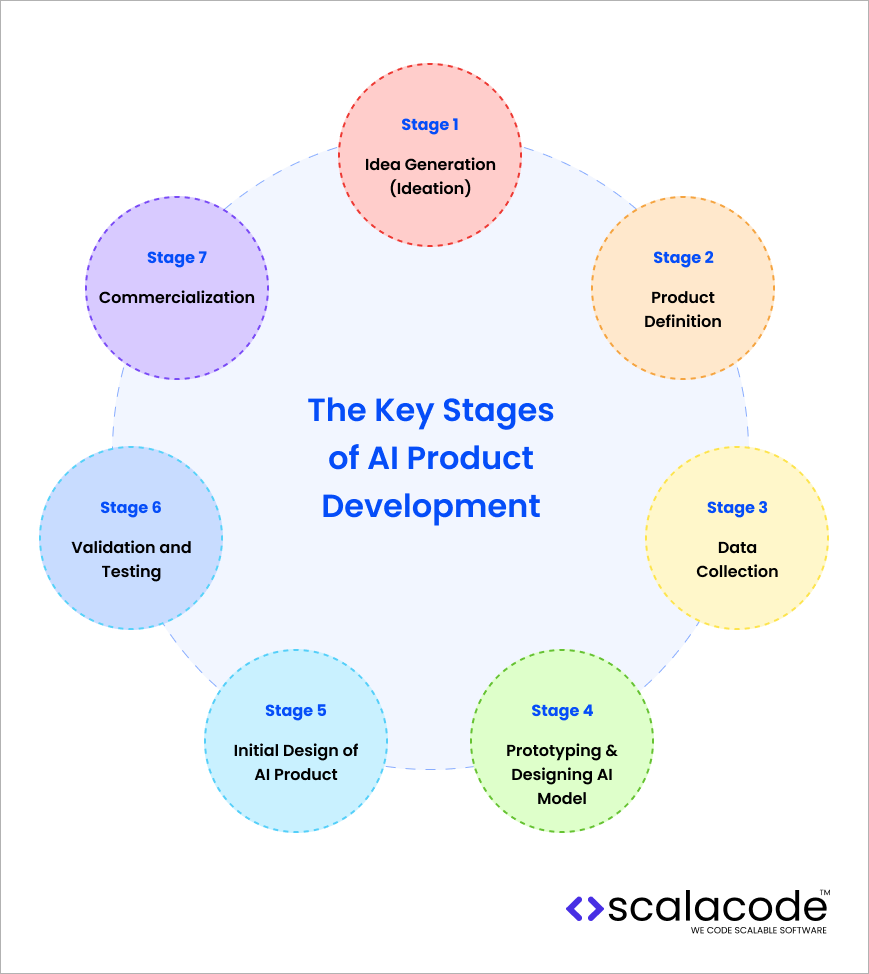
The Key Stages of AI Product Development
Here is a quick overview of the AI product development process- from ideation to completion:
1. Idea Generation (Ideation)
The first stage of AI product development begins with generating new ideas. This is where AI innovation takes shape, driven by brainstorming based on user needs, market trends, and data insights.
Key considerations while at the very beginning of any new AI concept:
➦ Target Market: Identify your target users upfront. For whom will your AI product create the most value? It’s really crucial for stakeholders to know your audience. Why? Knowing about the potential audience will help mold the AI product to solve their specific problems from the very beginning.
➦ Functionality: While you are not required to map out every feature, you should have an outstanding idea of your AI product’s core functionality: What problem does it solve? How does it improve user experience? Keep the focus on practicality and usefulness.
➦ Existing Solutions: Take another look at the existing AI products that have been loved by the audience. In short, take a glance at your competition. Can you find an existing AI tool that solves the problem you’re trying to solve? If so, what’s going to be different about your AI-driven product? With this step, you will get to know more about the market landscape. It will definitely help in ensuring that your AI product offers something unique and useful.
➦ SWOT Analysis: Perform a SWOT analysis of your product, considering strengths, weaknesses, opportunities, and threats that your AI product will face, and accordingly fine-tune your idea.
➦ SCAMPER Method: Refine the Artificial Intelligence concept by applying the SCAMPER method. Starting to think about how to substitute, combine, adapt, modify, or even repurpose AI technologies for improving the concept and filling market gaps.
Now, you have a solid foundation for the next stage of AI product development.
2. Product Definition
Once you have identified your AI product idea and target market, now is the time when you actually define the product. Scoping or concept development is all about refining the AI strategy. In the below section, what you need to define in this stage is given; have look into that:
➦ Business Analysis: Begin with a deep business analysis to have custom software development services. Outline your strategies for the distribution and deployment of your AI product. Go in deep about competitor AI products, detailing gaps and opportunities. This will, therefore, help outline a clear, actionable roadmap for any type of AI/ML product.
➦ Value Proposition: Your value proposition defines what unique problem your AI product solves. How is your solution unique as compared to others? This clarity is important for positioning your product at the marketplace level and framing a marketing message that connects.
➦ Success Metrics: Success measures should be defined from the start. What does success look like? Will you be monitoring users’ interactions, performance rates, or cost savings? It will introduce an opportunity whereby you will have a means of evaluating the success of your AI product after launch.
➦ Marketing Strategy: To kick-start your marketing strategy, get your USP and success factors in the right order. Avoid reliance on individual channels, in fact, it would be valuable to look out for as many arenas as possible in which you could market your product that is embedded with artificial intelligence.
Whether it be social networking sites, webinars, or a content marketing platform such as Reddit, look into every aspect so that your AI-based software or product reaches more of the audience. This may change as the product grows, however, anticipating can help give the project direction.
Once those aspects are defined, your next phase of AI product development becomes less difficult.
3. Data Collection
Data collection is very important as data is the raw material for any AI product at the disposal of the business.
It simplifies in the sense that without data, an AI model cannot learn or even make decisions if it is made to. Collect data prior to designing AI models that can be used to solve your problem first. These can be inside the company or obtained from public resources.
This step is crucial when using AI in product development, or in other applications, because it determines the quality of your data, and therefore the quality of your AI model.
In short, if the data is gathered properly, this will ensure that your AI product returns more relevant and less biased information.
Also Read: How to Develop AI Recommendation System
4. Prototyping & Designing an AI Model
After gathering data, it’s time to design the AI model and the prototype.
Shift your focus in designing AI product prototypes, design wireframes, and most importantly AI models by writing AI algorithms that apply well to your vision.
This step entails choosing appropriate algorithms and methods that are right for training your AI model. Depending on your problem, you might use-
- Machine learning
- Deep learning
- Natural language processing
- Generative Adversarial Networks
Choose the approach that best fits your data and objectives. For example, if you’re dealing with image recognition, deep learning might be your best bet. If you want an application that creates content like humans, then Generative AI development services are needed.
Prototyping aims to develop a minimum-viable product (MVP) that has all the core models and basic functionality. With your MVP ready, designing the product for market launch would be the next step in AI product development.
5. Initial Design of AI Product
In the initial design phase, the entire team collaborates to create a mock-up for the MVP prototype. The design must be focused on the target audience and help the AI perform its core functions.
The design team must create a clean, intuitive, and user-friendly interface for the artificial intelligence product. Consider factors such as layout, typography, color scheme, and navigation to ensure a seamless user experience.
As the initial design is considered a starting point to engage your audience, make sure each section of it is carefully done.
Once the design has been finalized, the validation phase will follow, where extensive testing will be done before the AI product is released.
6. Validation and Testing
Validate and test your AI product before its release to ensure that everything works as it should, from the smooth functionality of the AI model to the user experience.
Here is how to proceed with product engineering services:
➦ Concept Development and Testing: Even after the prototype is developed, there can be bugs at the development stage. Test the AI model for its accuracy, performance, and scalability. Also, involve team members and beta testers in order to assess functionality and find bugs or inefficiencies. This will provide an assurance that your AI product works for its intended goals.
➦ Front-End Testing: Front-end interface testing pertains to the errors that may be experienced by users. Also, validate how the AI system interfaces with the end-users and check if the user experience is intuitive. The stability of the interface for public usage should also be ensured.
When complete, you know you’ve arrived at all green lights and can prepare the final AI product for launch.
7. Commercialization
Now it is time to commercialize your AI product. This is the phase where your AI solution is launched and made live for your users.
So far, you would have finalized the design, tested the product for quality, and refined the marketing strategy. You should be fairly confident that your AI product is ready for the market.
Now, this is the finished product having integration of AI; this means it’s over-the-counter ready. Your team will take the last prototype and MVP to build the complete product. Ensure that everything is by the book and working properly and, that the AI performing its functions.
Move your AI solution into a live environment once the product is fully developed. This will ensure that your development team integrates it seamlessly and works as it did during the testing process. Run final checks to confirm everything works as intended in the live setting.
Your AI product is finally commercialized and ready for launch into the public domain!
Now, let’s have a look at several AI tools that are commonly being used for AI product development.
Top AI Product Development Tools in 2026
AI software development tools form the core basis of artificial intelligence model development, training, testing, and deployment.
The AI code tools form a basis on which the developers can automate many complex tasks and optimize workflows while speeding up innovation in machine learning and artificial intelligence. Here is a list of some of the most in-demand AI programming tools:
1. TensorFlow

TensorFlow is an open-source tool that is useful in creating AI and machine learning-based products. It offers solutions for model design, model training, and deployment solutions across different operating systems including mobile devices and big systems.
2. PyTorch
PyTorch is another open-source ML library developed by Facebook’s artificial intelligence research department. That is really flexible and easy to use and is fabulous for the deep learning application. Due to the way it can accommodate the attachment of any input and output module in a very short amount of time, it is mostly used by researchers in developing prototypes.
3. Keras

Keras can be described as a high-level neural network API for Python with multi-platform support, which operates above TensorFlow. This is one of the new-age AI product development tools. It has been developed so as to facilitate the usage of deep learning models for experimentation, and it is relatively easier to develop state-of-the-art neural networks in a few lines of code.
4. Scikit-learn
Scikit-learn is a library in Python for traditional machine learning. It targets regression, classification, and clustering other words, the algorithms at the heart of generalized machine learning. AI developers highly rely on this to use AI in product development. It is usable; it works out of the box with other tools of the Python triad, that is, NumPy and SciPy.
5. Azure AI
Azure AI is an offering that obtains a complete pallet of services that offer customers the ability to design, train, and deploy machine learning models. A number of built-in models and, a GUI interface for AI model development. This AI tool leads in entering the market with multimodal and generative AI
6. IBM Watson
IBM Watson is an AI development platform featuring NLP, machine learning, and deep learning tools. It is also a mighty tool for enterprise-level solutions to AI problems. The tool is enriched strong features related to language understanding and computer vision.
7. Hugging Face Transformers

Hugging Face became one tool that became a go-to for natural language processing. Their library, ‘Transformers’, provides state-of-the-art models such as BERT and GPT, which are widely used in generating text, translation, and sentiment analysis.
8. RapidMiner
RapidMiner is a data science platform that provides functionality for data preparation, machine learning, and predictive analytics. It features a user-friendly visual workflow interface with no-code or low-code options and is also usable by non-developers.
9. Apache MXNet

MXNet is an open-source framework for training and deploying deep learning models with top efficiency and scalability. Backed by Amazon Web Services, it has extensive language support and allows flexible coding for both research and production-grade model deployment.
Explore More: Top AI Frameworks in 2026
How Much Does it Cost to Develop an AI Product?
The AI product development cost can have a massive range depending on many variables: the complexity of the AI model, AI tools being used, and infrastructure among other factors.
Here, the main components of the costs are described:
1. Data Gathering
The main driver for the cost of AI-based product development includes a lot of data volume. Gathering and processing huge volumes of data still remains one of the most time-consuming and expensive parts of development.
Also, this depends on the kind of data: structured or unstructured, labeled or unlabeled, and whether you will buy third-party datasets or will make your own from scratch.
2. AI Model Development
Another factor affecting the cost of AI product development is the development of an appropriate AI model, including the selection of appropriate algorithms, creation of architecture, training of the model, and its optimization with the purpose of better performance.
The more complicated AI models-like deep learning with neural networks-demand a lot from computational resources and require highly professional development; hence, their cost fluctuates and is much higher.
3. Product customization
AI integration in product development includes custom development in front-end interfaces, back-end systems, and APIs.
Steps you take for customization of your AI-based product, be it integration with other systems or scalability needs of the platform. In short, the more customization, the more the cost to build AI products.
4. Infrastructure: Cloud and Hardware
Execution of AI models requires enormous computational resources that range from cloud services by AWS, Google Cloud, or Azure to investing in high-performance hardware such as GPUs and TPUs, depending on the size and scope of the AI product.
Cloud solutions are highly flexible and have low initial costs, while large-scale AI applications may also require high-performance hardware.
5. Compliance and Legal Costs
Most of the AI products for various industries need to comply with severe regulations, such as GDPR or data privacy laws. In this respect, you are going to have to hire legal consultancies and perform compliance testing. All of these could be costly, depending on your industry and geographic location.
6. Team Costs
It normally includes the following competence sets in AI product development: data scientists, machine learning engineers, software developers, and project managers.
Average Salaries:
- Data Scientist / ML Engineer: $100,000 to $200,000+ per year
- Software Developer: $80,000 to $150,000+ per year
- Project Manager: $90,000 to $150,000+ per year
The overall cost will be greatly affected by outsourcing compared to hiring in-house and AI development platforms.
Roughly Estimated AI Product Development Cost
That can be from $50,000 for a simple AI product to $500,000+. In the case of more sophisticated solutions requiring advanced AI models, high scalability, and numerous integrations, the cost can well exceed $1 million.
Explore in detail, AI App Development Cost Estimation in 2026
Benefits of Developing AI Products for Businesses
Many of you may have a query, why invest in AI product development, or how it will benefit my business?
Well, the answer is herein. Have a look into the several benefits of AI product development for businesses.
1. Smarter Efficiency in Developing AI Products
AI products greatly help in simplifying processes by automating mundane and repetitive tasks. Examples include the entry of data, setting appointments, and customer queries through their AI chatbots.
This not only increases productivity but also enhances morale among employees since the team members will work on more meaningful work related to AI advancements.
2. AI Products with Data-Driven Insights
The development of AI products utilizes data analytics for processing and analyzing large volumes of information in less time. Advanced machine learning algorithms trace hidden patterns and trends in data sets that will enable businesses to make better decisions about their AI products.
For example, AI analyzes customer behavior and preferences to personalize the features of an organization’s product accordingly, and then market those products.
Data-driven insights create opportunities for businesses to be more proactive than reactive, and thus always assured of staying ahead of changing markets and evolving customer needs through the help of AI.
3. Enhanced Customer Experience through AI Products
AI products lead to enhancing the customer experience by providing them with personalized interactions. Advanced algorithms analyze user data, the basis for recommendations and responses fitted to individual preferences.
For example,
- AI-powered e-commerce platforms can recommend certain products to customers in order to have a seamless shopping experience based on previous purchases or browsing history.
- AI-powered chatbots and virtual assistants extend instant support through quick replies to queries or issues that arise.
This level of personalization can lead to customer loyalty and satisfaction, making clients feel important and taken care of through innovative AI solutions.
4. Cost Savings Due to the Development of AI Products
There is a great potential for cost savings following the implementation of AI products across various business operations.
Automation, because of the development of AI-driven products, decreases the requirement of resources to perform any task and also reduces human errors, which are usually associated with very expensive mistakes.
For example, AI-powered predictive maintenance during manufacturing prevents equipment failure before it occurs, saving money related to repairs and shutdowns.
Smoothening processes by deploying AI solutions may further help reduce operational costs and better manage resources, adding to overall profitability.
5. AI Product Development for Competitive Advantage
The integration of AI products within business strategies yields a big competitive advantage. Organizations that can leverage AI differentiate their offerings, bring new customers, and retain old ones since they are offering superior AI solutions.
Companies that build AI products are usually perceived as innovators in their respective industries, hence adding prestige to their brand. Doing so, enables them to adapt faster toward trends in the market and customer preferences, hence placing AI-driven companies at the forefront of any given field.
Learn More: Top AI Trends to Look in 2026
How ScalaCode Can Help You With AI Product Development?
ScalaCode provides a wide variety of AI product development services that help businesses develop innovative and effective AI products. We are enriched with certified AI engineers who have taken part in numerous successful AI projects across different industries.
Thus, in case of a need for experts to define your AI strategy, identify potential use cases, and assess the feasibility of your AI projects, the ScalaCode team is always ready to help.
Our AI developers are able to build and train custom AI models by leveraging machine learning, NPL, deep learning, etc. In other words, we are the ultimate technical partner for developing AI-powered products and also for AI integration with your existing systems.
Closing Words
Here it is, all major steps for developing AI products are covered. From problem understanding to monitoring and improvement of your product, all these steps are the links that complete the chain to bring a successful AI product to the market.
Follow the steps discussed above. Convert innovative app ideas into reality with this well-defined structure and unleash the power of AI in transforming industries.
Overall, reach out to a professional AI development company if you get stuck at any point or find any need for guidance on AI-driven product development.