

Empowering seamless payments, driving business growth, and enabling progress through innovative gateway solutions worldwide!
The digital payment system is growing at a fast pace and disrupting the relationship among businesses, customers, and financial organizations in every industry. As e-commerce, mobile wallets, and contactless payments continue to gain popularity, they have never been in higher demand, and their rise in popularity means that skyrocketing interest in effortless and hassle-free online payment options.
This boom is generating substantial potential for businesses -i.e., startups, already established businesses, and fintech innovators interested in creating a payment gateway or trying to find out how to create a payment gateway that would support the changing requirements of the online economy.
Since the current digital commerce marketplace is emerging into the core of retail and services all around the world, robust, secure, and scalable forms of payment processing in this environment have very rapidly transformed into a condition of business, rather than its competitive advantage.
Market Growth & Scale:
- The global digital payment market is estimated at $26.86 trillion in 2026 and projected to surpass $36.09 trillion by 2030, growing at a CAGR of 7.63%.

Source: Grandview Research
These numbers explain why businesses are excited about setting up a payment gateway or creating a payment gateway, and even inquiring about how to build a payment processor to win new customers and offer them smooth and secure payments.
In this guide, we will cover multiple things that will help you know the cost of creating a payment gateway, the benefits of having a payment gateway for your business, the difference between a payment gateway and a payment processor, and much more.
What is a Payment Gateway? A Brief Overview
A payment gateway is a technology platform that accepts and processes a variety of electronic payments, including credit card, debit card, bank transfer, and digital wallet payments, through the use of an online tool and/or an in-store device.
It acts as a safe interface between those involved in the receipt of goods, like customers, merchants, and financial institutions, transferring confidential payment data, protecting their privacy and security during exchange.
The main elements of a payment gateway are a payment interface that users see, powerful encryption and security of payments, the ability to handle a number of possible payment methods, integration with payment processors, components to prevent fraud, and APIs that can be easily implemented in the website or app.
The payment gateways are a critical component of the contemporary commerce world as they allow merchants to deliver a seamless experience during checkouts and ensure compliance with regulatory requirements, and minimize the chances of financial fraud.
How to Build a Payment Gateway: Essential Steps
A payment gateway is a complex process that enables the portal to set control and provide secure, smooth digital experiences to businesses. Be it seeking to establish a payment gateway, finding the way to produce payment gateway solutions, and the approaches to developing a payment gateway, or to understand how to create a payment gateway in your organization, all these require proper planning as well as technical knowledge for end-to-end payment gateway development.

1. Define Requirements & Compliance
- Define business requirements, payment channels, and support (PayPal, Android, iPhone, or other app), web cascades, or integration channels.
- Make sure it flows with international compliance requirements such as PCI DSS and country-specific requirements.
2. Plan & Design Architecture
- Architect safe, containerized systems, transaction routing and scaling, encryption.
- Design APIs and front-ends for the merchants, as well as (as may be necessary) the direct users.
3. Develop Core Components
- Install payment processing modules such as transaction authorization, settlement, and processing refunds.
- Include fraud detection solutions, risk management solutions, and real-time monitoring of transactions.
4. Integration with Third Parties
- Build relationships with acquiring banks, card networks, and value-added services.
- Legalize international payments, international currencies, and instruments of payment to cover a wide market.
5. Develop for Multi-Platform Use (Web & Mobile)
- Ensure your payment gateway works across various platforms, especially if you’re building a payment gateway for mobile app use cases.
- Optimize UX for all devices.
6. Testing & Certification
- Rigorously test for security, speed, error handling, and compliance.
- Undergo formal audits and receive required certifications.
7. Deployment & Ongoing Support
- Launch with robust monitoring, support, and regular security updates as a fundamental part of continuous payment gateway development.
Tech Stack to Create a Payment Gateway
A secure and efficient payment gateway must be built using the proper tech stack, i.e., frontend stack, backend stack, databases, and cryptography measures. The right stack guarantees smooth transactions, expansion, and strong data protection.
Frontend:
JavaScript (React, Vue.js, or Angular)
HTML5/CSS3
Backend:
Node.js / Python / Java / PHP / Ruby
RESTful or GraphQL APIs
Database:
PostgreSQL / MySQL / MongoDB
Security:
SSL/TLS encryption
Tokenization
OAuth2 / JWT for authentication
PCI DSS compliance tools
DevOps & Cloud:
AWS / Azure / Google Cloud
Docker, Kubernetes, CI/CD pipelines
Additional Tools:
- Payment card tokenization tools
- Fraud detection APIs (Sift, Riskified)
- Logging & monitoring (ELK, Datadog)
Good Read: 7 Game-Changing Technology Trends That Will Define
Components of a Payment Gateway Architecture
A typical payment gateway architecture consists of the following components:
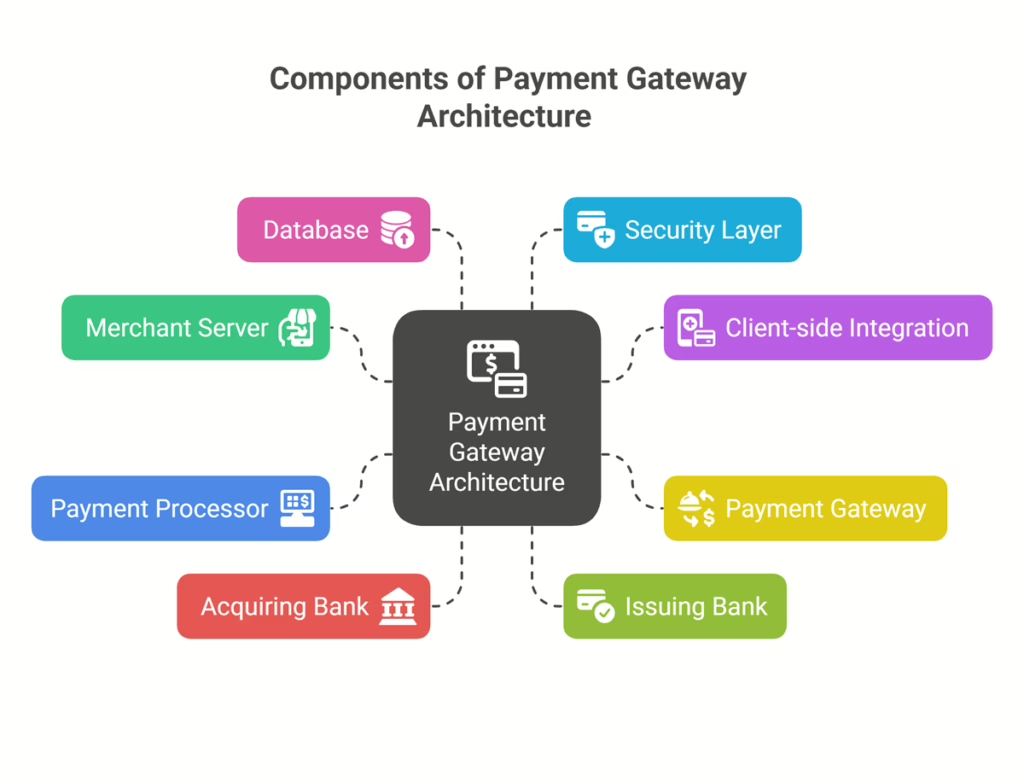
- Merchant Server, Hosts the eCommerce site or POS system.
- Client-side Integration (API or SDK), Collects payment information securely.
- Payment Gateway - Routes payment data to the acquiring bank or processor.
- Payment Processor, Connects to card networks (Visa, Mastercard, etc.).
- Acquiring Bank, Sends transaction requests to the issuing bank.
- Issuing Bank, Verifies and approves or declines the transaction.
- Database - Stores transaction logs, user data (with encryption), and error logs.
- Security Layer, Includes encryption, tokenization, 3D Secure, PCI-DSS compliance, etc.
Must Read: Progressive Web Apps: Core Features, Architecture
Cost to Develop a Payment Gateway for Your Business
The cost of creating a branded payment gateway is considerable, and it can vastly differ by the complexity of the platform and the functionality you would demand, regulatory needs, security, as well as integrations.
Key Estimates for Payment Gateway Development Cost:
- Minimal Viable Product (MVP):
The general payment gateway development cost provided by most reliable sources is that it takes around $150,000 and $250,000, whichever currency, to make an MVP that will be able to take care of a payment gateway. It involves these key transaction functionalities, fundamental security, and integration features.
- Advanced/All-in-one Solutions:
The cost of a payment gateway may exceed $300,000 to $500,000+, depending on the number of advanced features, multi-currency capabilities, broad integrations, and greater scale, as well as regulatory compliance that is more rigid in gateways with advanced functionality.
- Making Simple Solutions or Templates:
White-label or simpler solutions may be less than half of that, with some packages starting at just $50,000 to $100,000 or less; however, these solutions may not grant as much customization and scalability as purely bespoke options.
Breakdown of Major Expenses:
| Expense Item | Estimated Cost |
| Research & Feasibility | $5,000, $7,500 |
| Design | $10,000, $15,000 |
| Core Development | $70,000, $200,000+ |
| Deployment | $10,000, $20,000 |
| Integration | $20,000, $50,000+ |
| Support & Maintenance | Ongoing and variable |
| Security & Compliance | 15 to 20% of operational budgets |
With the help of this table, you get a transparent view of the primary payment gateway software development and highlights the key areas you’ll need to budget for.
Payment Gateway Integration Cost:
For businesses integrating existing payment gateway software rather than building from scratch, expenses are generally lower and may include:
- Setup fees and customization ($10,000, $50,000)
- Monthly or transaction-based charges
- Ongoing integration and support costs
Key Influencing Factors:
- Complexity & Custom Features: Multiple genes adorn the framework with higher intricacy, advanced security, analytics, fraud detection, and dummy-friendly multiple currencies.
- Team Expertise & Development Location: It is highly expensive between regions due to the competency of your development team.
- Regulatory Compliance: Standards like PCI DSS force additional investment in auditing and security tools.
Development of a secure, scalable, and flexible payment gateway is an immense financial and strategic investment, which, however, helps businesses to control the flow of their payment and earn a continuous stream of income, in the form of transaction fees and value-added services they offer via their payment gateway. Let’s look at the benefits of having a payment gateway in any business in 2026 and onwards in the next section.
Also Read: How Much Does it Cost to Develop an App?
Benefits of a Payment Gateway for Businesses
The adoption of a payment gateway bears immense benefits to businesses that target enterprise growth and to compete with other businesses in the modern online dynamics of commerce. You can use such solutions to create a payment gateway in your business to ensure that you get measurable benefits or to exploit a flexible payment gateway business model:
1. Improvement of customer experience
A payment gateway enables a relaxed, adaptable, and safe payment procedure, which leads to satisfaction and repeat orders, which are crucial objectives of any company willing to create a payment gateway or to optimize its checkout.
2. Increased Security
Modern tools offer strong encryption and audit prevention tools, which are the cornerstone of the payment gateway business model, such as applications and service providers, which can increase the level of trust between them and the customers by securing confidential financial information.
3. Automation & Operational Efficiency
The payment gateway makes workflows of transactions, manual processing errors, time, and resources. This is an efficiency able to assist companies that want to create a payment gateway around which there is minimal friction in the operations.
4. Worldwide Presence & Scalability
The use of a modern payment gateway allows taking payments in a wide variety of currencies and supports a sizable range of payment methods, facilitating the process of attracting international clients and reaching scale, which is of paramount importance for a business that makes a choice in favor of a payment gateway business model.
5. Sales Growth & Customer Acquisition
Conversion rates grow, and there will be less cart abandonment due to easy and reliable transactions. With the combination of the functionality popular in the most cost-effective payment gateway business models, the businesses can increase revenue and gain new customers.
Now, let’s move forward on how to create a Payment Gateway in 2026:
Challenges in Creating a Payment Gateway with Solutions
The desire to build a payment gateway, particularly a modern one such as a mobile app payment gateway, is accompanied by challenges of its own. Becoming familiar with these challenges and the ways to overcome them will help make a pleasant passage in the world of digital payments.
Common Challenges and Solutions:
| Challenge | Solution |
| Stringent Compliance (PCI DSS, local regs) | Establish pre-emptive audits of compliance, use end-to-end encryption, and ensure documentation/processes are up-to-date. |
| Security & Fraud Prevention | Use tokenization, real-time fraud monitoring, and strong encryption at every layer of your payment gateway development. |
| Scalability & High Availability | Scaling (cloud-native, load balancing) Architecture to manage top loads and transaction bursts through system reliability, which is a crucial feature of a mobile app payment gateway. |
| Integration Complexity | Offer clear, well-documented APIs/SDKs; support major platforms (especially for payment gateway for mobile app usage). |
| User Experience (Especially on Mobile) | Focus on speedy, seamless mobile UX; make certain the mobile app payment gateway has Apple Pay, Google Pay, etc. |
| Managing Multiple Currencies & Regions | Make use of modular, scalable platforms, real-time currency, and local payment options. |
What is a Payment Processor?
A payment processor is a service or technologically based company that processes and facilitates the technical flow of money between the customer bank (issuing bank) and the merchant bank (acquiring bank) when a payment is being made, either online-based, in-store, or by using a mobile point-of-sale.
Key responsibilities of a payment processor include:
- Authorization of transactions: Authorizing payment of details with the issuing bank to ascertain that there is enough credit or money.
- Transmission of transaction data: Frederik once described transactions as follows (to paraphrase): the process of securely conveying the data between the merchant, acquiring bank, the card networks (typically Visa or Mastercard), and the bank of the customer.
- Settlement and funding: Transfer of money from the customer account to that of the merchant upon authorization of the transaction.
- Fraud detection and risk management: Detecting suspicious transactions and preventing possible fraud with the help of monitoring and security efforts.
- Refunds and chargebacks: Supporting refunds, reversals, and, if necessary, returns.
First Data (later absorbed by Fiserv), Worldpay, and TSYS are the leading exponents of such payment processors. Their infrastructure can be running in the background, whereas people in trade and consumers only have contact with the front store and cash out.
Payment Gateway vs. Payment Processor
Although the terms are often used interchangeably, a payment gateway and a payment processor occupy different positions in the sphere of electronic payment. It is essential that any business that wants to create a payment gateway or wants to streamline its payment activities should understand the difference.
| Payment Gateway | Payment Processor | |
| Definition | A technology platform that collects and encrypts customer payment data at checkout. | A service/provider that routes transactions and moves funds between banks. |
| Function | Connects merchant site/app to payment networks; handles data security and PCI compliance. | Communicates with card networks and acquiring/issuing banks to approve and settle. |
| User Interaction | Customer-facing (checkout pages, payment forms) | No direct interaction with end users |
| Security Role | Manages tokenization, encryption, and fraud filters. | Transaction compliance, fraud checks, and funding settlement. |
| Example Providers | Stripe, Razorpay, PayPal, Authorize.Net | Worldpay, Fiserv, TSYS, Chase Paymentech |
| Integration | Merchant integrates gateway via website/app APIs | Gateway often communicates with the processor via back-end connections. |
In Essence
- Payment Gateway: Acts as the digital terminal, collecting, encrypting, and securely transmitting payment information from the customer to the processor.
- Payment Processor: Takes that encrypted information, communicates with financial networks, and ensures funds are transferred from the customer to the merchant.
Conclusion
The rapid evolution of the digital payment industry underscores its significance in the modern economy, characterized by secure, scalable, and customer-centric solutions. In 2026, the total global e-payment transaction value is expected to surpass the mark of $20 trillion, with the overall digital payment market experiencing unprecedented growth over a decade, with a decade-long CAGR.
As adoptions are at a peak, with more than 90% of the U.S. consumers having made at least a digital payment, and mobile wallets leading more than half of the digital transactions across the world, there has never been a better moment to invest in a solid payment infrastructure.
In the case of businesses, a collaboration with a top-level payment gateway development company opens up an array of possibilities for high-grade transaction management, excellent security, multi-platform support, and usable analytics.
The current fintech industry celebrates being fast, new, and in compliance, of which an expert fintech software development company can provide a competitive advantage by using AI in fraud detection, smooth integrations, and compliance knowledge.
Whenever you are at any stage, you decide which software development company to choose, and then you can decide whether your payment ecosystem will be able to evolve according to the changing consumer expectations and regulatory requirements.
As the future of digital comes true, your investment in state-of-the-art payment technology will not create a revenue-generating stream only; it will enable you to assist the customers with speed, confidence, and security.
Why Choose ScalaCode to Create Your Payment Gateway in 2026?
Partner with our experts to turn your vision into a robust fintech solution.
- ScalaCode is an experienced payment gateway software development company based in India.
- Offers secure, scalable solutions for fintech, e-commerce, and mobile platforms.
- Delivers end-to-end services: payment gateway development, API integrations, and software modernisation.
- Known for timely project delivery and strong client support.
- Adopts the latest technologies, ensuring compliance and future-readiness.
Frequently Asked Questions
1. How much does it cost to create a payment gateway?
i) Development costs usually range from $150,000 to $500,000+ for robust, compliant, and scalable custom solutions.
ii) An MVP (minimum viable product): $150,000-$250,000
iii) Full-featured solutions: $300,000+ (multi-currency, advanced security, global support)
iv) Maintenance, audits, and upgrades add to long-term costs
v) Expenses cover research, architecture, core development, certifications (PCI DSS), integrations, security, and ongoing support.
2. Pros and Cons of Creating and Owning a Custom Payment Gateway
Pros:
Complete control of functions, information, and user experience.
Field- or industry-specific requirements are customisable.
Reduced third-party costs in the long term.
Cons:
The large costs of development and compliance.
Needs a constant upgrade, security correction, and checks.
Complicated integration with banks and regulatory systems.
3. Who Needs a Custom Payment System and Why?
Custom payment systems are ideal for large-scale businesses, fintechs, subscriptions, and businesses in high-risk sectors that require additional control, flexibility, and security. They enable businesses to customize the payment flow, minimize third-party stampede, facilitate worldwide transactions, and fulfill any particular compliance or industry requirements.
4. Can I create my payment gateway for free?
Not realistically, developing a payment gateway is a costly endeavor involving development, compliance, certification of security requirements, and infrastructure. Free tools can save money; they cannot be used completely when it comes to PCI compliance.
5. How do payment gateways work?
- The customer provides payment details on the site of merchant.
- The gateway encrypts and sends data to the payment processor.
- The processor is in communication with both the card network and the issuing bank.
- The transaction is approved/Denied by the issuing bank.
- The reversed response is sent by the processor through the gateway.
- The merchant confirms the payment and the order.
6. How do payment processors work?
- Send the transaction information to the merchant, card networks, and the banks.
- Authorize transactions and verify fraud.
- Make sure the payment was deducted from the account of the customer and received in the account of the merchant.
- Process settlements, chargebacks, and reports.
7. How can I test the security and functionality of my payment gateway?
-Use sandbox environments provided by processors (like Stripe, PayPal, etc.)
-Conduct penetration testing and vulnerability scans.
-Implement unit, integration, and load testing for payment flows.
-Ensure PCI-DSS compliance via audit tools.
-Use test cards for simulating errors and successful payments.
-Use 3D Secure and CVV validation testing protocols.