

These days, bank branches are becoming as rare as relics in old movies. But, take a glance at your phone screen, you will likely have at least two or more payment applications.
So, what does it indicate?
What are the significant developments behind this shift?
The small word with a big impact is FINTECH.
With the advancement of financial technology, or fintech, the financial sector has undergone a profound transformation.
Fintech refers to leveraging technology to deliver quality services more conveniently, securely, and efficiently by improving traditional financial systems.
Today, fintech disruption has penetrated every corner of financial services, even areas considered safe from digital threats.
From digital payment and peer-to-peer lending solutions to robo-advisors, AI-enabled fintech app development solutions have revolutionized how users store, invest, borrow, pay, and protect their finances.
These factors foster innovation, leading to greater demand for financial inclusion, regulator support, and technological advancements, including AI and blockchain.
According to Statista, the global fintech industry’s revenue is increasing quickly and is projected to surpass 141.18 billion U.S. dollars in 2028.
Where do all these point to?
They indicate the rapid growth of FinTech apps.
With the increasing popularity of FinTech apps, have you considered developing one for your business?
If yes, then now is the right time to build it. Perhaps you’re concerned about the cost.
Don’t worry!
This blog covers everything you need to know about the costs of building a FinTech app.
So, let’s get started.
What are the factors on which the cost of FinTech app development depends?
When estimating the cost to build a FinTech app, it’s essential to understand that apps have no standard cost.
The types of FinTech mobile applications, their functionality, the choice of operating system, the location of a development company, and the expertise of the Fintech app developers are the significant factors influencing the cost of mobile applications.
Each business has its own set of unique needs and preferences, which significantly influence the actual cost of FinTech mobile apps. The more intricate your features, the higher the cost of developing a FinTech application.
Regardless of the platform you choose for FinTech mobile application development, such as iOS or Android, it will impact the cost. It’s crucial to be informed that the development cost of native applications tends to be higher, influencing your decision-making process.
However, banking software with basic functionality, minimal user interface, and a secure online transaction method might cost $30,000 to $50,000. It can be developed in three to four months.
Depending on the complexity of the application, integrating disruptive technology like AI, Blockchain, and machine learning into a FinTech application can cost $45,000 to $15,00,00.
However, some significant factors influence the cost of developing FinTech applications, including:
1. Feature Complexity
The features incorporated into your application will create a distinctive user experience and notably affect FinTech mobile application development costs.
The details of designs, functionalities, and user interfaces are closely tied to the complexity of the features, ranging from basic to advanced.
Developing a basic digital payment application with features like transaction capabilities and account balance checking costs significantly less than developing a banking application that is integrated with advanced features, such as AI-driven data analytics and real-time tracking.
2. UI/UX Design
Investing in a user-friendly interface for your custom FinTech mobile apps ensures a personalized and streamlined user experience.
It maximizes the user experience through effective construction and seamless designs, such as appropriate UI and UX, simple language use, animations, transitions, app layout, and more. These contribute to the overall development costs of your FinTech application.
3. Advanced Technologies Used
Integrating current technologies like Digital Analytics, Artificial Intelligence, Big Data, and Blockchain can significantly influence the cost of developing an AI-enabled FinTech application by improving its overall performance.
Not only this, it can also make the application more secure and personalized for users. However, the complexity of incorporating advanced technologies into application development requires skilled FinTech application developers.
Digital analytics, Blockchain, and Artificial Intelligence are the most important elements of FinTech applications, enabling users to access and monitor their financial activities effortlessly.
Digital Analytics
Users can gain insights into their purchases, savings, and investments through digital analytics. They can also generate translation reports, track progress towards saving goals, and more, enabling them to make informed decisions.
Artificial Intelligence
Leveraging Artificial Intelligence for capabilities such as chatbots, advanced financial planning tools, efficient transaction processing, and fraud detection systems can result in higher costs.
These features, like a chatbot, monitor user expenses and alert them when their budget is exceeded. They also make budget management interactive and enjoyable.
Blockchain
How can we forget the most essential component: blockchain? Integrating blockchain into the developing application can also cost more.
It facilitates various unique features, such as peer-to-peer payments, ensuring transparency, accelerating transaction speeds to minutes, and enabling seamless data sharing across multiple platforms.
4. Testing and Maintenance Cost
Custom Fintech application development is an ongoing process. Hence, it’s important to account for test and maintenance costs early.
Post-development, maintenance, and regular feature updates contribute to the overall application development costs.
5. Development Team Type
Various options are available when developing your digital finance application, such as in-house, freelancers, and outsourced software development agencies. All these factors contribute to costs differently.
Hiring the best development team can directly influence the cost of Fintech application development.
- Freelancers- Freelancing services can be cost-effective but may lack consistency, quality, security and long-term commitment to your project.
- In-house Team - On the other hand, utilizing the assistance of an in-house team for application development can have various benefits.
They have great expertise, deep familiarity with the ecosystem, and more significant project control. However, salaries, taxes, recruitment, and workspace steps, among other things, can cost you more than you expected.
- Outsourcing, Outsourcing to a FinTech mobile application development company in India is often considered the best alternative, balancing cost-effectiveness with quality. These companies are equipped with highly skilled developers dedicated to delivering top-notch services.
With extensive expertise in app development, they mitigate risks associated with freelancers while avoiding the overhead of maintaining an in-house team. The outsourcing mobile application development company ensures high-quality solutions tailored to your needs, regardless of project size or complexity.
6. Location of the Development Partner
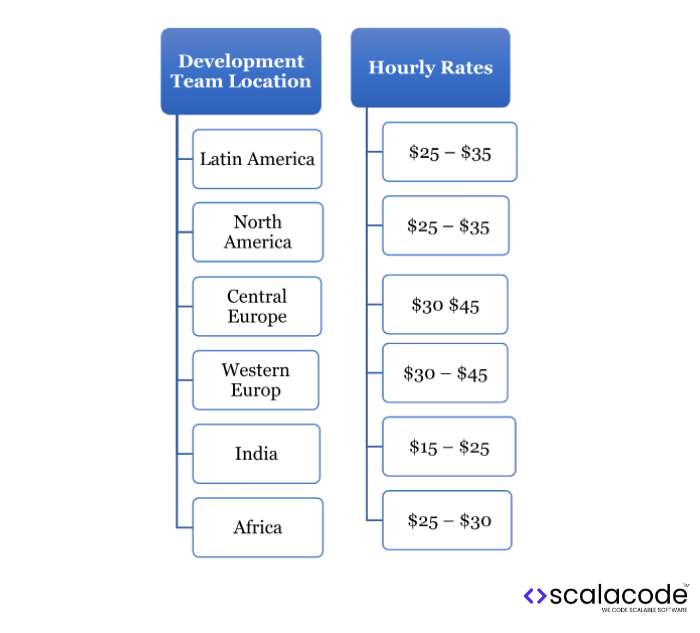
The geographical location of the company you partner with to develop the Fintech mobile application will significantly impact the prices. The cost of creating digital finance applications is higher in certain areas than in others.
This depends on the team’s hourly rates and the time it takes to build an application in a specific country and zone. However, FinTech application development companies in India charge less than specialists in the US.
7. Estimate Time Period To Develop FinTech Mobile Application
Before embarking on FinTech mobile application development, remember that time plays a crucial role, and the delivery time will significantly influence the application development cost.
If the team works on a project with a shorter delivery window, it will experience increased costs. However, the time required to build financial applications also depends on the types of FinTech applications you develop.
Let’s delve into the cost breakdown of building FinTech apps across different categories.
Types of FinTech Applications

1. Digital Wallet Application
Digital Wallet is known for eWallets and mWallets. It is an ideal payment method, enabling users to make financial transactions securely without needing hard cash.
The digital wallet application helps users store funds, make financial transactions, and track payment histories on devices such as phones and tablets.
Some of the most common features of an eWallet application are rewards and discounts, bill management, secure authentication, a chatbot, self-registration, and more.
The average cost of developing a digital wallet application can range between $15,000 to $40,000, depending on the features and complexity level.
2. Banking Application
The banking application is designed to offer convenient and secure financial solutions from the comfort of your home.
No matter what your requirement, from creating a new bank account to applying for a loan, everything can be done online. You don’t need to visit the branch to obtain financial services.
For instance, we have provided FinTech solutions to our Italy-based client by integrating cryptocurrency and NET transactions into their e-commerce platform. By integrating cutting-edge technology, our client reduced manual processes by 40% and retained potential customers by 30%.
The cost of a fintech banking application may vary depending on the complexity level and integration of cutting-edge technology. The estimated costs are between $50,000 and $300,000.
3. Lending Application
Peer-to-peer lending applications are being used to apply for loans. The loan application is designed to document information regarding the loan applicant, repayment method, loan amount, and rate of interest.
The P2P lending sector leverages artificial technology and machine learning to provide more convenient, accessible, and secure transactions. However, the cost of developing finance software ranges between $40,000 and $200,000, depending on the features you choose, complexity level, and cutting-edge technology.
4. Insurance Application
Insurtech offers various benefits to both insurers and policyholders. A mobile application lets customers easily manage their insurance policies, submit claims, and make payments anytime. This process fosters customer satisfaction and loyalty.
On the other hand, insurance companies can automate their entire business process by utilizing a mobile insurance application.
This accessibility improves data analytics for better risk assessment and empowers insurers to deliver personalized services based on customer preferences. Developing an insurance mobile application can range between $45,000 to $200,000.
5. Personal Finance Application
The personal finance application is used to manage money, which includes saving and investing. It also covers banking, insurance, budgeting, mortgages, investments, retirement, taxes, and estate planning. People can track their earnings and outlays and create budgets. A personal finance application’s development costs range between $30,000 and $150,000.
6. Investment Application
With an investment application, users don’t need to reply to other people to buy investment plans. It allows you to invest in various financial plans, such as a mutual fund.
Examples of investment applications are trading applications, cryptocurrency exchanges, and more.
No matter what type of application you want to develop, whether it is Amazon Pay, e-portals, or digital wallets, FinTech application developers can help you. The development cost may vary depending on features like real-time credit score tracking, data analytics, and EMI calculators. The estimated cost of developing an investment application is $20,000 to $40,000.
7. Crowdfunding Application
As the name suggests, crowdfunding is designed to generate funds. The application is designed to raise a small amount of funds from a larger number of individuals for charity purposes, finance a new business venture, and more.
Depending on the crowdfunding type, investors donate capital or get a reward as equity in the company that raises the money.
So, if you’re looking for a crowdfunding application, it may cost you around $50,000 to $300,000, depending on your preference, features, complexity level, and integration of advanced technology.
8. Billing Payment Application
The billing payment application is designed to pay bills. You can also make payments, automate your payment schedule, change account details, and more. Now, users don’t need to visit the website to pay all their bills.
The cost of developing a billing payment application can range between $30,000 and $150,000, depending on features such as accurate billing, automated invoices, invoice management, notification, etc.
| Application | Cost | Time |
| Digital Wallet App | $15,000 to $40,000 | Approximately 4 to 6 months |
| Banking Apps | $50,000 to $300,000 | It takes about 6 to 9 months, depending on complexity and integrations. |
| Lending Apps | $40,000 to $200,000 | Around 5 to 7 months, considering regulatory compliance. |
| Personal Finance Apps | $30,000 to $150,00 | Roughly 4 to 6 months, depending on features like budgeting tools and analytics. |
| Insurance Apps | $45,000 to $200,000 | Approximately 6 to 8 months, considering complex workflows and regulatory requirements. |
| Investment Apps | $20,000 to $40,000 | It takes about 5 to 7 months, depending on features like real-time market data and trading functionalities. |
| Crowdfunding Apps | $50,000 to $300,000 | Approximately 6 to 9 months, considering user profiles, project management, and payment integrations. |
| Billing and Payment Apps | $30,000 to $150,000 | It takes around 4 to 6 months, depending on payment gateway integrations and security measures. |
How to Develop a FinTech Application?
Developing FinTech software involves various processes. Each step is crucial to ensuring the application meets industry standards, user expectations, and regulatory requirements.
The FinTech application development process requires market research, development & testing, security measures, maintenance, and updates to keep pace with technology advancements and user needs.
#1. Requirement Gathering
The process involves documenting all your project requirements with the FinTech software development company you hired.
#2. Conducting a Focus Group Study
At this stage, experts brainstorm and create a detailed design and application blueprint for a Fintech application. This includes integrating desired features and the types of applications needed, defining the UI and UX, and ensuring that every step aligns with our client’s business objectives.
#3. Solidifying It Through User Experience Design
By understanding the needs and refining every touchpoint, from FinTech mobile applications to UI and UX, the company creates seamless experiences.
#4. Building the Bespoke Solution in Agile-based Sprint Models
FinTech application developers will create agile-based sprint models and integrate technology and security methods tailored to your needs.
#5. Testing the application
In this stage, developers conduct validation testing, which is crucial in the MVP process to ensure the elimination of all bugs.
#6. Deployment on Production Environment
At this stage, the FinTech application is deployed on operating systems like iOS and Android- after undergoing essential optimizations and configurations to guarantee smooth functionality.
#7. Continuous Support and Maintenance
FinTech applications undergo updates with new features and functionalities based on user feedback, ensuring their ongoing scalability.
FinTech Application Development Cost: Tips and plan for successful budgeting
The cost of developing FinTech applications depends on various factors and processes. Aligning, implementing, and managing this process effectively can minimize development challenges and lower the overall cost of FinTech app development.
0.1 Focus on Essential Features
When embarking on the FinTech application development process, prioritize the essential features, omitting the rest. Simplifying feature complexity can significantly reduce the development costs and time required to develop those features.
Furthermore, you can integrate advanced features to scale your business. Thereby managing the cost of developing banking applications more efficiently.
0.2 Select the Right Platform
The platform you select, such as iOS or Android, to deploy your application significantly impacts FinTech application development. Selecting the appropriate platform and development methodology will help you budget for the cost.
For example, developing a banking application separately for iOS and Android using native technologies can be expensive compared to utilizing a cross-platform framework such as Flutter or React Native.
0.3 Explore MVP Development
Crafting a Minimum Viable Product (MVP) is an effective strategy for testing and validating your banking application’s idea in the market and gathering valuable user feedback. It can also reduce overall development costs.
Launching your banking application using an MVP approach allows you to evaluate its performance, market feasibility, and functionality based on real-world data and user insight.
0.4 Connect with the Right FinTech Application Development Partner
As mentioned above, opting for an outsourcing company for your project is a smart and cost-effective decision compared to hiring freelancers and an in-house team. An outsourcing partner allows you to collaborate with skilled professionals in the field.
Connect with ScalaCode for Your Next Project
Scalacode is a renowned FinTech app development company with extensive expertise in creating full-stack FinTech software that meets regulatory standards.
Our developers excel at overcoming security challenges, with a dedicated focus on security-first practices. This enables smart business decisions to enhance banking and finance solutions.
We are committed to transforming the future of the banking, insurance, and finance sectors with cutting-edge technology and innovation-intensive FinTech application development.
Contact our experts today if you’re developing a FinTech application and have cost-related queries.
FAQ
Q1 How much does it cost to build a payment app?
The cost to develop a banking application varies based on its feature complexity level and advanced technologies, such as AI, Blockchain, and Machine learning.
A simple application with minimal complexity may cost $20,000 to $50,000. However, depending on additional features, costs can increase significantly with higher complexity, reaching up to $250,000 or more.
Q2 How long does it take to develop a FinTech app?
Developing simple banking software may take 2-6 months. The complexity of the project, your requirements, and the type of application development you choose all influence the timeline for creating a FinTech app, which can extend up to 12-18 months.
Q3 How do FinTech apps generate revenue?
FinTech apps monetize their services primarily by displaying advertisements within the app. App owners generate revenue from third-party ad networks when users interact with these ads. Additional sources of income may include subscription fees and in-app purchases.