


Is your health practice still operating on paper records or with outdated systems? It is probably high time to upgrade to electronic health records. Yes, EHR integration in the healthcare system has become a crucial step today.
Accuracy of patient data and accessibility within today’s fast-changing medical world become of the essence. But transitioning into a digital system can be utterly overwhelming, right?
EHRs were designed to simplify the storing, accessing, and sharing of information about your patients. They help minimize the chances of mistakes, help improve patient care, and save time. The transition to EHRs may never be complete.
Costs, training, and how these will fit into your current healthcare processes are one’s concerns. The good news is that this transition can be smooth if it’s properly implemented.
In this post, we will look at the importance of EHR integration in the healthcare system. You will get to know the cost and some tips on how to do so. However, let’s first understand the current market scenario.
Statistics Revealing the Expanding EHR Market
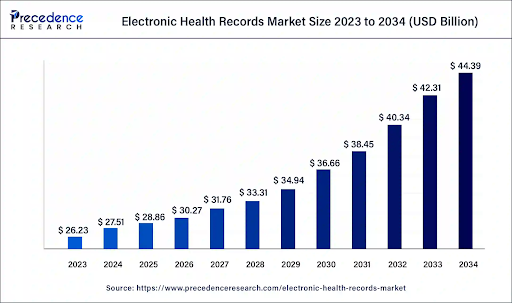
EHR integration in the healthcare system is going on all around the world. Do you know the Electronic health records market size is going to reach $44.39 by 2034.
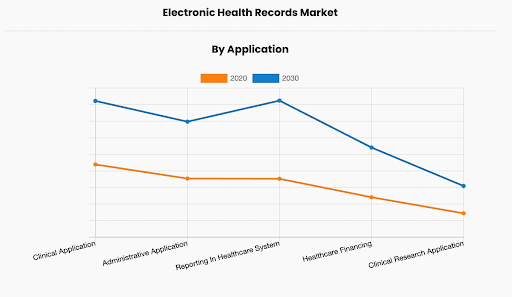
- Application areas for EHR are typically segregated into a few important categories, including:
- According to a recent survey by Industry Research Biz, the EHR market was valued at $25,896.72 million in 2023 and is expected to reach $34,782.62 million by 2032, growing at a CAGR of 5.04% during the forecast period of 2024-2032.
- The global market value for electronic health record applications in 2023 was around USD 783.22 million. Analysts expect the market to grow at a CAGR of 8.87% from 2024 to 2030.
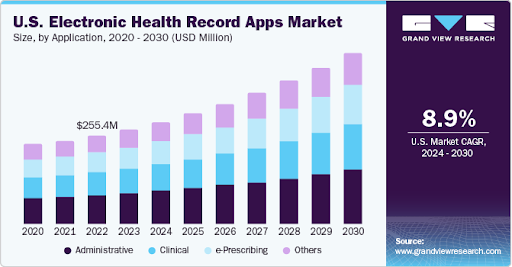
The EHR market is growing without showing signs of slowing down. Let’s move ahead and see some key benefits of EHR integration in your healthcare business.
Why is EHR Integration Crucial for a Healthcare System
The rapid evolution of healthcare in these modern times signifies that EHR integration into the practice management infrastructure is not just an upgrade in technology but more so a ‘business transformation.’ Here’s why seamless EHR integration is crucial to your healthcare enterprise:
1. Fortifying Data Integrity and Compliance
With data breaches potentially devastating both patients and providers, EHR integration makes for a strong fortress for sensitive medical information. Centrally anchoring all patient data in one secure digital ecosystem-from medical history to treatment protocols-you don’t just protect privacy; you build trust and make sure the boxes are ticked in regulatory terms.
2. Empowering Precision in Patient Care
EHR Integration serves as an amplifier of knowledge for the healthcare provider. It aids in immediate access to complete and updated patient records on which clinicians can act upon without wasting any time and also very decisively.
This kind of insight in real-time can make all the difference between a good and great outcome and raise the quality bar of your practice altogether.
3. Patient Engagement and Empowerment
It is the modern patient who requires engagement in the health journey. In this modern world of EHR implementation, there is an avenue that has created implementation through patient portals and mobile applications.
Thus facilitating opportunities to review health information, schedule appointments, and communicate with providers. Such engagement not only ensures an uptick in patient satisfaction but also creates better health outcomes due to increased treatment adherence.
4. Operational Efficiency
EHR integration acts as a catalyst for operation excellence by automating routine tasks and thus eliminating redundant data entry. This seamless flow of information throughout your practice, from scheduling an appointment to the billing process, lightens the administrative load, minimizes errors, and frees your staff up to focus on what matters most: patient care.
5. Unlocking Data-Driven Insights
Big data in EHRs empowers your practice with rich analytical tools so that you have more insight into the treatment by mining the goldmine of data at your fingertips to unearth trends, optimize resource allocation, and create informed strategic decisions that drive your practice forward. This may mean improved outcomes for patients, enhanced efficiency in operations, and a better bottom line.
6. Bridging Healthcare Ecosystems
EHR integration delivers the backbone needed by the different segments that compose the connected care ecosystem. By enabling seamless information sharing between disparate teams of care specialists, laboratories, or hospitals, you are taking care coordination to the next level and contributing to a bigger picture of a standard, effective health system that benefits all patients and providers alike.
Adopting an EHR is not just about keeping pace with the rate of technological change but also about putting your practice at the forefront of innovation in healthcare. However, an important point to note here is that you need to hire a software development team with an expert team.
EHR Integrations for Smarter Healthcare Businesses
Here are some crucial integrations you should consider for your healthcare business:
1. E-Prescribing Tools
Such digital tools revolutionize doctors’ drug prescriptions. Doctors do not need to write prescriptions on paper pads as was the case earlier. With a click of a button, their prescriptions automatically reach pharmacies. This tends to minimize errors due to bad handwriting and further avoid lost prescriptions.
More time is saved for all parties involved, including doctors, pharmacists, and patients. In addition, most of these E-Prescribing solutions provide functionality like medication interaction alerts and insurance coverage checking, hence making the prescription even more secure and efficient.
2. Lab Results Systems
The incorporation of lab systems with EHRs creates a fluid process through which much-needed patient information can flow. When a physician requests any type of test, the laboratory automatically gets the request in real time. Once the tests are carried out, the results of the tests are auto-populated in the patient’s electronic record.
This short turnaround ensures doctors give quick diagnosis and treatment choices. It also eliminates the manual processes of data entry, thereby reducing errors and freeing up the time of staff members. Patients are also informed sooner and have more access to their test results through patient portals.
3. Medical Billing Software
Integrating billing software with EHRs is a major boon to healthcare finance. This linkup ensures that every service rendered is accurately billed. It can automatically generate claims based on documented treatments, thus minimizing coding errors and the billing process.
For practices, this means payments are received faster, and fewer claims are rejected. It makes it simpler to keep tabs on which of their bills are unpaid and follow up accordingly. Additionally, changes to insurance details entered on one system will update both, so everything is current.
4. Patient Portals
Patient portals are basically personal health dashboards for patients. They let the patient have access to the EHR from any place at any time while keeping it secure. Patients can check their test results, see when they will be seen next, request refills for prescriptions, and even send messages to their healthcare providers.
This keeps the patients engaged in their care and may also lead to better health outcomes. It reduces the number of calls and paperwork burden on health care professionals and also saves time for direct care with patients.
5. Telehealth Solutions
Implement telehealth in an EHR, bringing the doctor’s office to the patient’s home. Using video, doctors can access and update the same day, just as they would in a face-to-face encounter. This is especially beneficial in follow-up, managing chronic conditions, and access to patients in remote locations.
It saves time and travel for patients but allows doctors to attend to more patients at the same rate. The system ensures that all telehealth consultations are documented as carefully as a face-to-face consultation, thereby ensuring continuity.
6. Analytics Tools
Analytics tools become mountains of patient data actionable with the integration of EHRs. They can point to trends like which treatments work best with certain conditions or where areas can be improved on. These tools could be very effective for healthcare managers in optimizing staffing, reducing waiting times, and controlling costs.
On a much broader scale, they could help with population health management by pointing out at-risk populations, guiding preventive care strategies, and paving the way toward better decisions at all levels of healthcare.
7. Medical Device Integration
This integration brings the Internet of Things to healthcare. Devices like heart monitors, glucose meters, or even smart scales can feed data directly into a patient’s electronic record. This kind of real-time data flux provides doctors with a much more wholesome and current view of what is happening in a patient’s life.
It is especially useful for chronic conditions like diabetes or heart disease. It means less counting and more accuracy for patients. This offers healthcare providers available data to make treatment decisions without requiring them to go through the extra work of collecting it.
Challenges Associated with EHR Integration
Here are some key challenges associated with EHR integration:
| Challenge | Description |
| Data Migration | Moving data from the legacy systems to the new EHRs may lead to data loss or corruption. |
| Interoperability | Seamless integration of the EHR system with other platforms, such as labs, pharmacies, or billing, is often an issue. |
| Compliance and Security | Ensuring that the regulatory requirements meet HIPAA and GDPR. |
| User Resistance to Change | Resistance to change by personnel in healthcare to the new system, who might prefer working on legacy systems or paper records. |
| Training and Skill Gaps | Inadequate or poorly provided training in handling EHRs leads to either its underutilization or incorrect entry in the system. |
| Tailoring of EHRs to Suit Workflows | Great time and expense are required to customize the EHR system for use in any specific organizational workflow. |
| Cost of Implementation | Inhibitive costs with regard to software, hardware, and training remain obstacles for smaller healthcare practices. |
| Downtime During Transition | Workflow disruptions and system downtime during integration can impact patient care. |
Also Read: Managing Remote Software Development Team
10 Steps to Integrate EHRs in Your Healthcare System
Electronic Health Records (EHR) can be implemented into your healthcare system through an appropriate step-by-step process with minimal disruption of the workflows. Here is a 10-step guide that will help you integrate EHRs smoothly into your healthcare system:
1. Plan the EHR Implementation
A well-defined plan ensures the successful implementation of EHR. All tasks be listed, objectives defined, and an estimated set of required resources. Some aspects are the establishment of a specifically dedicated team for EHR, budgeting for the anticipated costs, choice of suitable EHR software, and planning for a migration of medical and patient data.
2.Time to Structure Team
A successful implementation relies on having an experienced team. Designate appropriate roles such as project manager, EHR superuser (IT expert), lead clinician, lead nurse, and billing advocate. Ensure that specific tasks are accomplished by the team members, such as training physicians and nurses, integration with billing, and data migration. For large practices, involve an EHR Implementation Specialist.
3. Define Requirements for EHR Software
Choose an EHR solution suited to your practice by determining its unique needs. Numerous modules, from automated scheduling and telemedicine to clinical document generation and reporting, come with an EHR system. You will hence be able to find features which will give the most operational efficiency in your practice.
4. Look for a Reliable EHR Integration Team
After stating the requirements, narrow down the shortlisted potentials. Both RFI and RFPs should be sent to the vendors shortlisted. Attend an invitation to demonstrations to understand how each system works and, in return, make informed decisions. Shortlist a vendor whom you feel matches your budget and your practice needs.
5. Assess Hardware and Infrastructure Needs
Determine your hardware requirements in terms of the size and scope of the practice. Computers, servers, tablets, and printers by office or staff members will all require consideration. Assess your network infrastructure to ensure that your practice has the technical ability to support this new EHR system.
6. Data Migration and Setup
Data migration is another significant stage. Start with the conversion of paper-based records into electronic format. Clean and validate data that you can upload to your EHR system. Configure your EHR database and test it to ensure that the legacy inputs as well as new data entries are accurate and operational.
7. Train Your Medical Staff
Provide EHR training for staff based on role; start with system basics training that all staff members must receive, then role-specific to orient each member of your team on how to use the EHR appropriately to do his or her job, and also continue with training on new features and best practices.
8. Test the System
Conduct thorough testing before the go-live date. Test data migration, system performance and access by the users and workflows that need to work as anticipated. Any errors that are highlighted from the testing phase should be resolved before going live.
9. It’s Time to Launch
Decide whether you will launch all features at once or in phases of your implementation. A full launch deploys all EHR features at the same time. For a phased-in approach, deploy features gradually. Educate patients and minimize the number of patients on the go-live date for a more seamless adoption.
10. Monitor and Optimize Post-Implementation
Conducting a surveillance on the EHR system once implemented. Collect both positive and negative feeds from the staff and the patients and make improvements in the necessary areas so that the system adapts to changing needs.
Bringing alterations and developments in the system continuously will ensure the smooth run of your practice, making it efficient while timely changes will keep it up and running for a long period of time.
By following this process above, you can include EHR in the healthcare system in a structured way while being cost-effective and efficiently handling the system.
Real-Life Examples of EHR integration in the healthcare system
Here are a few case-studies of EHR integration you can take inspiration from:
▶ Vim

This focuses on accelerating value-based care by linking data to EHR workflows and digitizing tasks previously performed manually. Vim improves the provider experience by letting providers integrate data without any sweat and also improves healthcare interoperability.
▶ Arcadia

It specializes in EHR-integrated analytics for care management, health equity, and risk adjustment. The Arcadia platform aggregates patient data, makes actionable insights available in your EHR, and installs quickly and easily.
▶ PatientIQ

It streamlines clinical workflows through fast EHR integration, patient data syncing, and task management. PatientIQ reduces administrative burdens while assuring a connected approach across diverse EHR systems. Must-Have EHR Integrations for Smarter Healthcare Companies.
Explore More: EHR Software Development Guide
What is the Estimated Cost of EHR integration in the healthcare system?
The cost of EHR integration in the healthcare system is pretty varied. It depends on so many factors. Here are some typical costs and what influences them:
- Organizational Size: The size of your company and the project scope also decides the cost of EHR integration. It may vary from $15,000 and $70,000.
- Type of Integration: Simple ones can be anywhere from $5,000 to $20,000, but if the complexity goes up, so does the hundreds of thousands in cost.
- Existing Systems: If your systems are older, then you will need to update them first, which adds extra cost on top.
- Customization Needs: The more customization you will do, the more time it takes. And it ultimately leads to higher cost. All customized work can almost double or triple the base cost.
- Training and Support: You’ll also need to train your personnel, and depending on their number, another $2,000 to $5,000 will be added to the price of a user.
- Maintenance in the Long Run: You are going to pay 20% of the base price for updates and support every year.
- Transferring Your Data: It is going to cost you $10,000 to $30,000 more or more to transfer your old records to the new system, depending on how much data you have.
- Hardware Upgrades: You are going to need new computers or servers. This can be anywhere from 5000 to 20,000 dollars more.
On average, a mid-sized practice will spend between $50,000 to 250,000 dollars for a full EHR integration. Once more, these are ball-park figures and in the real world, the costs are going to be a little higher or lower depending on one’s needs.
It also should be worth noting that while the cost upfront is high, often, healthcare businesses will find EHRs pay for themselves in the long run through their improvements in efficiency, amongst others.
How ScalaCode Can Help You with EHR Integration Solutions?
ScalaCode is a leading name in delivering custom software development services. From seamless system integration to ensuring data compliance and security, ScalaCode brings unparalleled expertise and support.
Our commitment to tailored solutions, comprehensive training, and scalability of systems ensures that your practice will not only adapt to the current demands but also be well-equipped for future advancements in healthcare technology.
Parting Thoughts
EHR integration in the healthcare system is indeed not easy. However, it’s a necessary step toward betterment in patient care, operational efficiency, and data security. So, it’s always suggested to hire the best software development company to get an efficient EHR integration. ScalaCode is one such partner. If you still have some doubts, feel free to mention them in the comment section below.
FAQs
Q. What are EHR integrations?
EHR Integration is the process of attaching Electronic Health Record systems to other healthcare technologies and software. It allows information to flow effortlessly from one part of the healthcare ecosystem to another, as an example between e-prescribing tools, lab systems, medical devices, patient portals, and more.
Q. What is the EHR system in the health sector?
An EHR system in healthcare is a digital version of a patient’s paper chart. It includes all of the information related to a patient’s medical history, diagnoses, medications, treatment plans, immunization dates, allergies, radiology images, and laboratory test results.
Also Check: Top Software Development Companies in India