


Will you take the first step in changing healthcare with advanced technology? Throughout the rapidly changing medical environment, EHR software has been an indispensable assistant in any kind of medical organization.
While complex, EHR software development plays a leading role in improving patient care, smoothing workflows, and managing data for organizations operating in the healthcare industry.
The following comprehensive guide has some important lessons for the world of EHR software development, from understanding its importance to finding out how to create a successful solution. So, without any further information, let’s get started.
What is an EHR?
An EHR system is an electronic record that carries a patient’s medical history and treatment plan. It replaced traditional paper-based records and provided a sound basis upon which healthcare providers could store, manage, and even share information related to the patients.
This EHR system provides doctors and other healthcare professionals with real-time access to patient health data. Communication runs smoothly to improve the quality of care.
Besides, EHR systems include but are not limited to, automated reminders and electronic prescriptions in order to make healthcare more patient-centered, smooth, and effective.
The Growing Market of EHR Software
The market for Electronic Health Records (EHR) is experiencing significant expansion. Here are some key statistics showing how big the market of EHR is:
- According to research, the global size of the EHR market in 2025 was $35.9 billion. The market is expected to keep growing in the forecast period 2025-2032 by $78.4 billion. Such an expanding market fuelled increased demand for EHR software development.
- In 2025, it global EHR market attained a value of ~USD 35.89 million and is projected to record a CAGR of 5.10% during the forecast period 2026-2033.
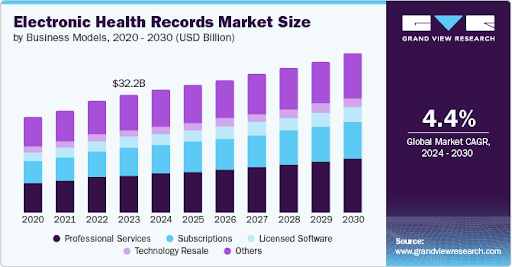
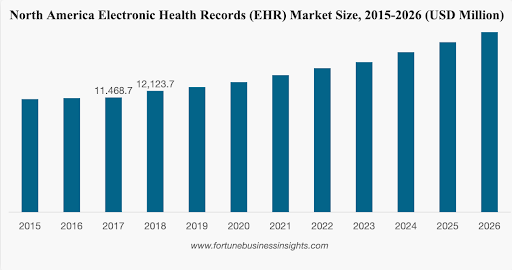
- The global electronic health record market was valued at US$32.44 Bn in 2025 and is expected to reach US$52.60 Bn by 2034, expanding at a CAGR of 5.61% during the forecast period. North America accounted for a 47.33% share of the global EHR market in 2025.
Key Benefits of EHR Software Development
The adoption of EHR systems within healthcare can be attributed mostly to the enormous benefits they offer to individual healthcare providers, patients, and the healthcare ecosystem as a whole. Let’s look at a few of the major advantages of using an EHR system.
1. Enhanced Patient Care
This is one of the major benefits, i.e., improved patient care. Compiling patient data into a centralized, digitized format makes patients’ vital information available to healthcare providers. This fosters better decision-making, quicker diagnosis, and further treatment.
EHRs minimize the risk of medical errors and can be lifesavers during emergency situations when even a single minute counts in having access to a patient’s history.
2. Greater Efficiency
EHR systems greatly increase efficiency in health services. Digitization and automation of their workflow eliminate paper-based patient records, thus making patient information entry, retrieval, and updating faster and more accurate.
Automation of routine tasks saves time and decreases errors common to manually kept records, thus enabling caregivers to invest more time in the care of their patients.
3. Smooth Communication
An EHR system promotes perfect communication among practitioners for better coordination. With secure, remote access to patient information, consultations, and collaborations can be made from other locations.
This will keep all healthcare team members informed of the latest patient information, their treatments, and any changes in real-time.
4. Data Accessibility and Interoperability
EHR systems make data highly accessible to authorized persons from any location using the Internet. This allows healthcare providers to quickly access updated critical information at their fingertips, thereby enhancing their capabilities to make informed decisions.
Another key advantage is interoperability, wherein EHR systems can seamlessly share data among different healthcare providers. This results in more appropriate medical data available across a wide array of settings, thus ensuring better care coordination.
5. Compliance with Regulations
Healthcare providers must strictly adhere to numerous regulations that protect patient information. EHR systems ensure compliance with strong security features that protect sensitive data.
The systems are designed to meet various privacy regulations, such as HIPAA, and ensure that patient data remains confidential. They also facilitate accurate reporting and documentation, which are essential in observing various health regulations.
Also Read: Telemedicine App Development: Cost, Features, and Benefits
Types of EHR Systems
There are many different types of EHR systems, all of which serve a different purpose but help practitioners manage the information of their patients more effectively. The following are some of the common types:
1. Cloud-Based EHR
In cloud-based EHR systems, all data is stored securely on the cloud. This allows practitioners to view information from any location. These are very famous for scalability, flexibility, and affordability. Moreover, the use of these systems doesn’t involve the use of on-site servers and their maintenance.
2. On-Premise EHR
On-premise EHR systems require hardware and software installation at the healthcare provider’s location. These provide complete control over the data and allow customization to the specific needs of an organization.
3. Hybrid EHR
Hybrid EHR systems combine features from cloud-based and on-premise systems. The providers using hybrid systems can store sensitive data on-site for heightened security, while less critical information can be retained on the cloud.
4. Specialty-Specific EHR
Specialty-specific EHR systems are designed to meet the particular needs of a wide variety of medical specialties. They include features oriented toward specific areas of healthcare that may not be supported by general EHR systems.
EHR systems form the backbone of modern healthcare, enhancing how patient information is organized to ensure more efficient, safer, and centered care.
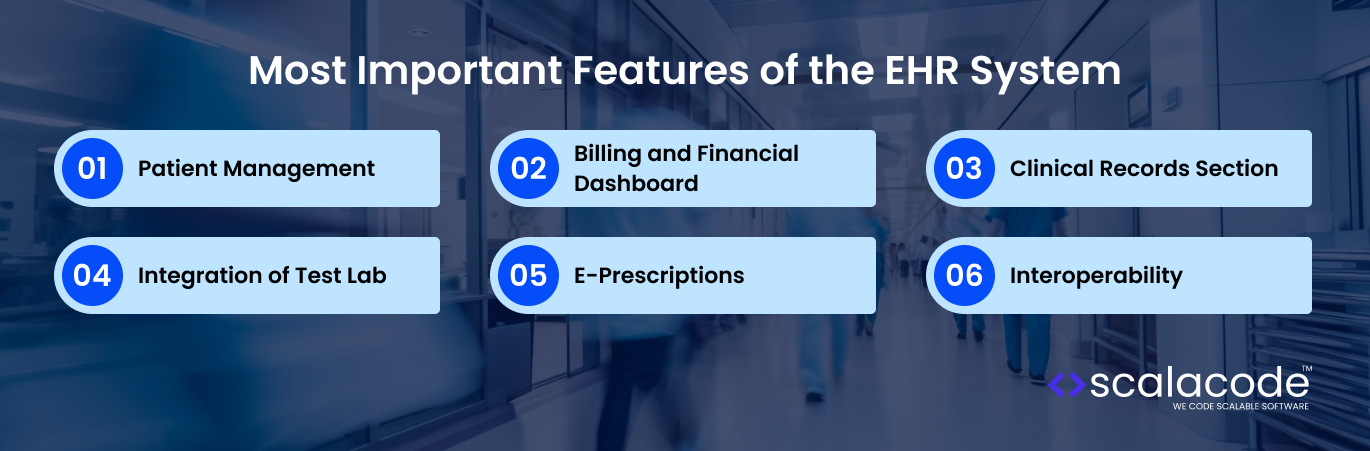
Most Important Features of the EHR System
While developing the EHR system that should be able to provide comprehensive information to both your team and your patients, the following are the key features that must be included.
1. Patient Management
This system also manages administrative tasks like patient registration, admission, discharge, and facility transfer. It opens the reception desk, where all the patients’ details may be captured or registered, including insurance, contact details, and demographics. Every patient is given an identification number called the MRN (medical record number, which tracks future interactions with the patient, such as diagnoses, visits, and prescriptions.
2. Billing and Financial Dashboard
A strong billing feature is required to assist in improving hospital productivity and profitability. It keeps track of patient charges while gathering insight through a dashboard that monitors Key Performance Indicators (KPIs) and detailed analysis reports. The financial team can use this to review revenues developed in the past and billing for each department, and make recommendations for areas of improvement.
3. Clinical Records Section
This section improves patient care by allowing a healthcare team to share and manage patient information. The doctor can record and analyze interactions with patients, such as patient diagnoses and surgical notes. Integrating this section with pharmacy and nursing records allows for better patient care and consolidates all the health information a patient needs.
4. Integration of Test Lab
This integration of the test laboratory speeds up the process of obtaining and reviewing test results. This allows doctors to make informed decisions quickly and for the laboratories to manage what tests are necessary. The integrated patient record enables healthcare providers to understand a patient’s condition much better, hence making an accurate diagnosis.
5. E-Prescriptions
E-prescription: It is one of the most important features that modern EHR systems are meant to exhibit. This feature tracks the patient’s treatment history, recent condition, and medicinal course. Thus, it gives the physician a better view of the health status of a patient, and he thereby decides about the treatment course with due consideration.
6. Interoperability
Interoperability ensures that there will be effective communication between various healthcare systems. In case this feature is present, then such patient information may be easily shared and safely transferred to any other setting where health care is provided, which will definitely enhance coordination and quality of care.
How to Develop an EHR Software System
It is necessary to develop a fully functional EHR system with a well-planned approach and expert guidance. If you want to develop such a system that will help meet your needs, you definitely have to cooperate with a trusted partner healthcare software development company. Here is how it has been going on:
1. Idea Validation
So, confirm your idea first, asking yourself such questions as: “Will this EHR software be reliable?” or “How will users benefit from it?” You have to be certain that this idea is commercially viable and also fits into the market. Of course, studying your competitors may also help you refine your business plan before going forward to develop it. Reviewing business plan examples can also give you clearer insights into structure, strategy, and industry standards. They help you understand what investors expect and how to present your idea effectively.
2. EHR Model and Prototype
Once your idea is concrete, list down the features that you would want the software to have, assemble a team, and then choose the best technology to develop. Asking for an early prototype will help you visualize how the software looks and functions; thus, you will be better prepared to see what it will look like.
3. Design and Development
Work with a development team to design an EHR system that is user-friendly, feature-rich, and targeted at meeting your organization’s goals. The developers will then bring these designs into reality. Once developed, the system will be ready for testing and launch.
4. Testing
The quality assurance team will test the software to make sure everything is working as it should. If the software passes all the tests and meets the development objectives, then it is ready to proceed to the final phase.
5. Product Launch and Maintenance
After the launch, monitoring will be done on the EHR software for its performance and any adjustments that might be needed. Moreover, interoperability with other healthcare systems should be included in ensuring seamless communication.
Read more: Why Hire Software Developers from India
EHR Software Development Tech Stack
There is no definite tech stack to build an EHR system. However, some of the most widely used technologies include the following:
- Languages: Python, Java, Kotlin, Swift, and JavaScript
- Databases: PostgreSQL, MySQL
- Frameworks and libraries: Vue.js, Angular.js, Django, Node.js
- Utilities: Amazon S3, Microsoft Azure, Cloudflare
- Payment gateways: Braintree, PayPal, Stripe
- Analytics: Amazon EMR, Google Analytics
- Web servers: Apache, Nginx
Cost of EHR Software Development
Most EHRs have a development cost that ranges from 60,000 dollars upwards, with some having costs of over 100,000 dollars, depending on many variables like development, integration, maintenance, and support.
Training and ensuring regulatory compliance will add to these figures, with such important regulations as HIPAA and its 75 security protocols. These are important standards to follow in making sure a safe and reliable system is in place.
| Factor | Estimated Cost Range | Description |
| Basic Development | $30,000, $50,000 | Core functionality development, including patient records, scheduling, and basic reporting |
| Advanced Features | $20,000, $40,000 | Additional features like e-prescribing, lab integrations, and advanced analytics |
| UI/UX Design | $10,000, $20,000 | User interface design and user experience optimization |
| Database Development | $5,000, $15,000 | Setting up and optimizing the database for efficient data storage and retrieval |
| Integration | $15,000, $30,000 | Integration with other healthcare systems, payment gateways, and third-party services |
| Security Implementation | $20,000, $40,000 | HIPAA-compliant security measures are implemented, and encryption is taken care of. |
| Testing and Quality Assurance | $10,000, $20,000 | Test all the features and ensure that the system is reliable. |
| Deployment | $5,000, $10,000 | Set up servers, deploy the application, and do some basic troubleshooting. |
| Training and Documentation | $10,000, $20,000 | The development of user manuals, training manuals, and first-time end-user training |
| Regulatory Compliance, Ongoing Maintenance and Support | $15,000, $30,000$20,000, $40,000 annually | Compliance with HIPAA and any other relevant healthcare regulations |
How ScalaCode Can Help You in Developing an EHR Software?
ScalaCode is the best software development company in India. It is known for delivering quality and customized solutions. It has an expert team of developers and designers with profound experience developing user-friendly, scalable, and highly secure EHR systems.
ScalaCode ensures that any EHR system is HIPAA-compliant and adheres to the highest level of security and privacy. This allows you to meet legal requirements and keep sensitive patient data well-guarded.
Final Thoughts
The key to modern healthcare development is developing a user-friendly EHR software system. It enhances patient care, streamlines workflows, and ensures better data management for healthcare providers.
However, you must receive an EHR solution that is secure, scalable, and fully compliant, close to your organizational needs.
So, that’s all for this blog. If you have any questions, please let us know in the comments section below.
Explore More: Top Software Development Companies in India
FAQs
-
Q. Is EMR the same as EHR?
No, they are not. The EMR, or Electronic Medical Record, is an electronic version of a patient’s paper chart from a single health care provider. In contrast, EHR, or Electronic Health Record, contains data from multiple providers, offering a more comprehensive view of a patient’s health history.
-
Q. What is the most sought-after EHR?
Some of the most popular EHR systems are EPIC, Oracle Cerner, Capterra, NextGen, and Valant. Each mentioned platform has certain strengths and weaknesses that make it more or less acceptable for the different needs of healthcare providers and patients alike.
-
Q. Why should I implement an EHR system?
Implementation of EHR software improves patient care and simplifies operations, with records being more accessible. Thus, this enhances communications among health care providers and, for this very reason, it is an indispensable tool for every modern medical organization.
-
Q. How much time does it take to develop an EHR?
Development time for an EHR system depends on its complexity, customizations, and compliance. The general timeline for EHR development is from six months to two or more years.