


Managing a remote development team is important without any doubt. If there is a mismanaged remote team, it may lead to catastrophic results.
Yes, it’s true.
Time loss, repetition of work, and frustration within the development team are some of the drawbacks that startups are likely to face if they fail to manage their remote software development teams. Of course, you do not wish to see this happen to you.
You cannot stop business growth for such reasons. Thus, you may have several questions-
- What measures should be taken to prevent oneself from getting into the situation?
- How does one ensure that a remote software development team works efficiently?
It is normal to be preoccupied with such thoughts. But, don’t worry! You are on the right page. This guide aims to assist CEOs and CTOs in addressing the problem of effective leadership in remote software development teams.
By the end, you will have a clear understanding of how to effectively manage a remote software development team. You will familiarize- with what you need, approaches, resources, and recommendations.
All of which are aimed at achieving the proper lasting management of your outsourced software development team.
Why do startup CEOs or CTOs need to invest in the effective management of remote software teams?
According to a recent study, about 70% of professionals globally work remotely at least once a week. This showcases the growing trend towards remote work, highlighting the need for effective remote team management, especially in software development.
CEOs and CTOs of companies are primarily responsible for ensuring that this trend is efficiently adopted in their organizations. Remote software teams play a pivotal role in business growth. Hence, It is an indispensable investment for business leaders.
Even if you have a question- Why is it crucial? Well, there are various benefits to hiring remote developers. Some of them that you encounter if effective management strategies are implemented.
1. Optimal Utilization of Global Talent
CEOs and CTOs can tap into a global talent pool, if they invest in effectively managing remote software developers. This is what most of the leaders look for in competitive edge.
Remote work lets companies (startups, SMEs, or large enterprises) hire the best software developers irrespective of geographical barriers. That means, business leaders are no longer restricted to local talent.
Furthermore, this global perspective can introduce diverse viewpoints and approaches to problem-solving and help enrich the team’s innovation and creativity.
2. Reduces Operational Costs
Remote software development teams can help reduce the operational costs involved in running a physical office.
Expenses like rent, utilities, and maintenance can be minimized or even eliminated. It is a cost-effective option especially if you hire a dedicated development team in India.
Besides, Buffer is a prime example of a company with a remote-first culture. They have reported saving approximately $1 million per year in office space alone.
However, this benefit can only be realized if the remote teams are managed efficiently.
3. Improves Risk Management
Working remotely means that the risk is diversified because not everyone is present in the same building. So, in cases such as the current pandemic, which has terribly affected businesses with conventional working arrangements, including offices, businesses with a decentralized structure could go on operating effectively.
Therefore, you won’t be affected when you hire mobile app developers in India to work remotely in such a pandemic situation.
Thus, it not only results in increasing efficiency but also addressing business continuity issues. Therefore, startup CEOs and CTOs must prioritize and invest in the effective management of their remote software teams.
Best Practices for Managing a Remote Software Development Team
To effectively manage a remote software development team, it’s crucial to implement strategies that facilitate clear communication, ensure accountability, and foster a productive work environment. In the following section, we’ll explore these strategies in greater detail.
1. Standard Onboard System to Welcome Remote Software Developers
The first step to managing a remote software development team is to create a welcoming onboarding system. Create a process in such a way that new hires understand their role, the team’s expectations, and the company culture, despite the physical distance.
How to achieve this? Providing everything about the role and company culture. The initial days for any new team member are critical. It’s during this time that they absorb the company’s ethos, understand its goals, and learn how their work contributes to the bigger picture.
Therefore, you should offer a roadmap to new developers- be they mobile app developers or DevOps engineers you are onboarding. Ensure, with this, they have a solid foundation to start from.
Studies show that a well-designed onboarding process can significantly improve employee retention. SHRM, the Society for Human Resource Management, reports that new hires who go through a structured onboarding program are 58% more likely to be with the company after three years.
This is especially important for remote teams, where feelings of isolation can be a challenge. A successful onboarding process helps bridge the physical gap and create a sense of connection from day one.
Here’s a recap of key steps to consider when onboarding remote software developers:
| Stage | Activities |
| Pre-boarding |
|
| First Day & First Week |
|
Moreover, assigning a mentor or buddy from within the team can greatly enhance the onboarding experience for remote software developers. Implementing such a strategy accelerates the acclimation process.
If you do this properly, this even builds a supportive community around new developers. The new hires feel valued and included right from the start. Furthermore, you check the guide on- how to hire remote developers for better help in the hiring process.
2. Establish Clear Objectives and Expectations
It is essential to define clear, achievable goals for each project. Break the goals into smaller tasks for easier management of your remote software development team.
Establishing a precise roadmap with milestones and deadlines helps in prioritizing tasks effectively. In short, with this, you can keep your development team focused and aligned.
For example, suppose your remote developers work tirelessly, but miss the mark because goals are unclear. What to do in this case?
You can opt for SMART goals. SMART stands for Specific, Measurable, Achievable, Relevant, and Time-bound.
Besides, it is equally important to set clear expectations regarding-
- Work hours
- Availability
- Communication channels and protocols
- Code of conduct, and professional behaviors
Transparently communicating these objectives and expectations from the outset eliminates ambiguity, builds trust, and sets the stage for successful collaboration in a remote setting.
Consequently, it minimizes confusion and enhances productivity. Also, this ensures everyone is on the same page. Moreover, these measures foster a disciplined and professional work environment, even remotely.
3. Communication and Collaboration for Better Team Spirit
One of the biggest hurdles for remote teams is bridging the physical gap and establishing clear communication and collaboration strategies.
Think of a scenario: John, a talented mobile developer working remotely in India, is assigned a critical project component. Due to a lack of clear communication, John misses a key update from his team lead in New York regarding a change in project direction.
This miscommunication leads to wasted time, missed deadlines, and potential frustration within the team.
This story, though fictional, highlights the very real challenges remote teams can face when communication is unclear or inconsistent. A study by Statista in 2021 revealed that 86% of employees and employers listed communication breakdowns as a major cause of workplace failures.
In a remote setting, where physical cues and spontaneous interactions are limited, fostering clear and effective communication is paramount.
So how can you bridge the physical distance and foster a thriving remote development team?
Effective communication and collaboration are the bedrock of fostering a strong team spirit among remote software development teams. Achieving this requires deliberate efforts and even investment.
You know what- Nearly 60% of businesses planned to purchase collaboration software to manage remote work culture.
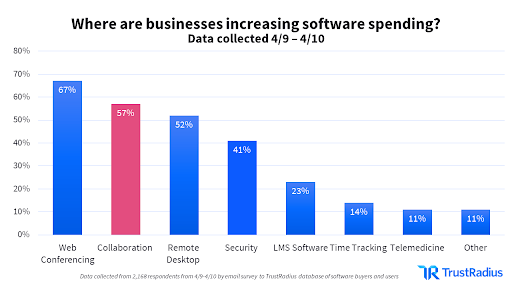
To overcome the common pitfall of “out of sight, out of mind,” it is crucial to implement a structured communication framework to manage a remote software development team.
Investing in the right project management tools empowers your remote team to collaborate effectively, stay organized, and deliver exceptional results, even when miles apart.
| Category | Tool Examples | Key Features |
| Real-Time Communication | Slack, Microsoft Teams | Instant messaging, file sharing, video calls, integrations with other tools |
| Project Management | Jira, Trello, Asana | Task management, sprint planning, bug tracking, Kanban boards, file sharing |
| Code Collaboration | GitHub, GitLab, Bitbucket | Version control, code reviews, issue tracking, project management features |
| Video Conferencing | Zoom, Google Meet, Skype | Video calls, screen sharing, recording meetings, integrations with other tools |
| Document Collaboration | Google Docs, Microsoft Word Online | Real-time co-editing of documents, version history, file sharing |
| File Sharing | Dropbox, Google Drive | Cloud storage, file sharing, access control, version history |
| Whiteboarding | Miro, Mural | Digital whiteboards for brainstorming, collaborative design, real-time collaboration |
All of these tools are important for remote software development team management. Use them to facilitate task management and project tracking. The refinement of communication practices through the use of these modern tools can uncover opportunities for enhancing efficiency and team harmony.
Therefore, being a CEO or CTO, make sure your management team leverages the right set of communication and collaboration tools to manage remote software development teams.
4. Choose the right methodology and project management tools
As a business leader, one of the key strategies you can opt in managing a remote software development team is choosing the right methodology, setting SMART goals, and leveraging powerful project management tools.
Adopting an agile mindset is key to the success of managing remote software development teams. How? You may have this question.
Well, Agile methodologies enable remote software development teams to break down projects into manageable tasks.
Implementing these practices in a remote setting helps teams adapt efficiently to changes in project scope, timelines, or technology. The core benefits of adopting Agile practice help streamline the complexity and fluidity of remote work environments.
But what if your project has a fixed deadline and a well-defined scope? You can opt for DevOps culture. DevOps helps remote teams deliver software faster even if it has a fixed scope and deadline.
DevOps, a culture and set of practices that bridge development, operations, and security, can be a powerful ally.
Here is a list of some common software development methodologies commonly used by business leaders.
| Methodology | Description | Pros | Cons |
| Agile | Iterative development with short cycles for flexibility. | Adaptable, promotes collaboration | Requires real-time communication, labor intensive |
| Waterfall | Linear, sequential phases with clear deliverables. | Easy to understand, manage | Inflexible, slow, costly |
| RAD | Condensed development for rapid application creation. | Fast, low investment | Requires stable team, deep user knowledge |
| DevOps | Culture and practices for collaboration between development and operations. | Faster time to market, improved quality | Requires cultural shift, not for all customers |
| Lean | Applies lean manufacturing principles to reduce waste in development. | Improved efficiency, faster development, empowered teams | Requires disciplined, committed team, additional training |
| Scrum | Agile methodology for fast-paced projects in short sprints (typically 2 weeks). | Faster development, empowered teams, flexible | Not for large projects, needs experienced team, careful planning |
You can leverage elements from different approaches to create a software solution that best fits your project’s needs and manage them efficiently even if you are working remotely.
5. Offer Flexible Work Hours
In the high-stakes world of software development, the line between work and personal life can often blur, leading to increased stress and burnout among team members.
Each quarter, an increasing number of American companies are opting for fully flexible and hybrid work arrangements. Therefore, the percentage of companies mandating full-time in-office work continues to decrease.

Acknowledging this, fostering a healthy work-life balance within remote software development teams becomes not just beneficial but essential.
Herein, flexible working hours emerge as a vital element to meet this need. This allows developers the autonomy to organize their work around their lives.
Flexibility respects individual working styles and personal commitments. The reason why 71% of remote workers state they are better able to balance their work and personal lives.
6. Acknowledge Achievement by Providing Rewards
Creating a supportive team environment is equally important. It’s vital to cultivate a sense of belonging and purpose among remote developers, where their contributions are visibly appreciated and celebrated.
By implementing these measures, managers can significantly improve retention rates, and maintain a high level of engagement and code quality. Ultimately, contributing to the long-term success and stability of the remote software development team.
Having this said, acknowledging the achievements of either in-house developers or remote developers encourages a culture where work output is valued and interacts to work in that environment for a long time.
7. Measuring and Monitoring Remote Team Performance
Measuring and monitoring the performance of remote developers involved in any project is good practice for managing a remote software development team.
Business leaders can establish Key performance indicators (KPIs) and objectives and key results (OKRs) in alignment with project goals. It will provide quantifiable measures of success.
There are various tracking tools that managers can leverage to oversee progress in real-time. In short, this approach will let you identify any bottlenecks or delays promptly.
Furthermore, make sure you have regular feedback sessions with your remote software developers. It is an essential step in managing the team remotely as it allows for the adjustment of strategies and the acknowledgment of accomplishments. In turn, this approach motivates team members and keeps them aligned with project objectives.
Key Takeaways- Incorporating a mix of quantitative and qualitative assessments offers a comprehensive view of team performance, facilitating informed decision-making and continuous improvement in managing remote software development teams.
8. Fostering Team Engagement and Motivation
During the remote software development setting, managers have to focus on team engagement and motivation activities for better management.
Organizing virtual team-building activities, such as online escape rooms or trivia contests, can break the monotony of work and strengthen interpersonal relationships. This is highly crucial for maintaining motivation for your remote team.
You can even try providing platforms for team members to share knowledge or lead mini-workshops on their areas of expertise. These are the smart ways to manage your remote software development team.
9. Encourage and Facilitate Continuous Learning
In the fast-paced world of technology, continuous learning is vital for keeping remote software development teams at the forefront of innovation.
As several industry experts, such as former Director of Microsoft Lili Cheng, responsible for the AI developer platform suggest, -
Regular exposure to new challenges significantly contributes to the technical and cognitive growth of software developers.
Therefore, it is true to say-
Software development isn’t about routine, it’s about continuously conquering new territories of innovation. Providing these learning opportunities isn’t just a necessity but an investment in the team’s future proficiency.
Hence, you can allocate dedicated “learning hours” during the workweek. This will help them explore new technologies or work on personal projects. Significantly, enhance skill sets and motivate team members. Implement this if you want your remote team to be updated with the latest tech.
10. Schedule is Everything
The ultimate rule when dealing with a remote software development team is to keep your scheduling to a fine art. Aside from establishing the plan of action for the successful performance of the project, an effectively developed schedule ensures cooperation among team members working in different geographical locations.
To do that, it is crucial to have clear and agreed-upon working hours and effective communication to recognize that everyone has their own lives outside of work. Such means as calendar sharingậu lets everyone see everyone else’s schedule and coordinate pre-arranged meetings or collaborative sessions during the time when people are free.
Therefore, selecting a flexible yet ordered scheduling system contributes to efficiency, as well-organized timetables ensure on-time delivery of quality works.
11. Ensure Data Security and Compliance
Data protection and compliance are important factors when it comes to working remotely with a software development team. This poses a risk of data leakage and non-compliance to industry standards due to the fact that the team members are scattered all over the place. In order to reduce these risks, there must be strict security measures which should be understood and followed by all the members of the team.
Encrypt all communication channels and apps for managing projects and sharing sensitive data to ensure complete privacy. Daily and weekly security and compliance checks should be conducted to detect any potential risks that need to be taken care off immediately.
Moreover, protection of work resources, like email and company Cloud, through two-factor authentication and VPNs should be in practice when using any company’s resources.
Security awareness training sessions relative to security policies and the roles and obligations related to data security make it crucial to remind the actors and stakeholders to adhere to the best practices and security measures.
Achieve Success in Managing Remote Software Development Teams With ScalaCode
As per the State of Remote Engineering survey- 75% of software developers have the desire to work remotely at least three days a week. Whereas, 57% of them stated that to have full-time work-from-home flexibility. But the question is- are you able to manage them efficiently?
Addressing this challenge is critical for many leaders. As the trend of employing remote and on-contract software developers grows, CEOs and CTOs are increasingly focused on mastering the management of remote software development teams.
To help out in this, we have listed down the best practices to perform. You can optimize productivity and manage your remote software development team successfully.
Besides, at ScalaCode, we provide businesses with the flexibility to hire remote software developers on-demand, armed with the necessary technical skills and tools for successful remote working. With our solutions, leaders can focus more on project outcomes and less on management complexities.
Here are reasons why most business leaders consider us to hire remote software developers from us-
- Find the world’s top software developers, designers, and IT consultant
- Hire 3x faster with fully pre-vetted candidates
- Save up to 65% with global hires
FAQs
Q1: How to manage a remote software development team?
Here are some quick tips for managing a remote software development team-
- Hire the right remote team members
- Improve your onboarding process
- Set realistic goals
- Use best-in-class tools
- Check-in regularly
- Use a project management framework
- Cultivate the right company culture
Q2: What are the benefits of hiring remote developers?
As a business leader, you can acquire various advantages by hiring remote developers:
- Increased flexibility
- Boost productivity
- Access to global talent
- Cost efficiency and competitive pricing
- Faster time to market
- Time zone advantage
- Data and security control
- Working overtime
Q3. What are the different challenges that business leaders face while opting remote software development team?
Remote work has been expanding rapidly in the software development industry. According to the 2022 State of Remote Work Report by Buffer, 97% of employees want some form of remote work to continue.
Yet, despite its popularity, many CEOs and CTOs of startups find managing a remote software development team overwhelming.
One of the challenges that business leaders encounter when managing remote software development teams primarily stems from the lack of physical presence.
It can make it harder to:
- Quickly chat with colleagues:
In an office, you can easily grab someone for a question or to discuss an issue. Remotely, you need to set up calls or messages. This can make it slower to solve problems and share information.
It can be tough for managers of remote software development teams because they can’t just call everyone into a meeting room or chat quickly in the hallway.
- Cultural Differences:
Remote teams often consist of individuals from various cultural backgrounds. These differences, if not properly managed, can affect team cohesion and the overall working atmosphere. Besides, while working remotely, it’s tougher to get to know people and feel like you’re on the same team when you don’t see them in person.
- Tracking Productivity:
Without the ability to physically oversee the team’s work, many of the CEOs and CTOs find it challenging to monitor productivity. They believe they might not be able to assess the quality of the output accurately.
However, these are not something that can’t be overcome. Whether it is the establishment of better communication among the team or checking the productivity of the employee, there are tools available in the market to solve these problems.
In fact, these challenges require a shift from conventional management tactics to more innovative and flexible strategies. Startup leaders have to adapt modern tools and techniques to manage their remote software development team.
Q4. What are the different tools that are often used in managing remote software development teams?
Some commonly used tools for the proper management of remote software development teams are:
- Slack
- Google Workspace
- Zoom
- Trello
- Asana
- Jira
- Microsoft Teams
- GitHub
- Basecamp
- Toggl Track
- Clockify
- Hubstaff
- Todoist
- Lessonly, LLC
- Dropbox
- Miro
- ProofHub
Q5. How often should I schedule check-ins with my remote team?
Regular check-ins are vital. For casual yet structured conversations, it is best to opt for weekly meetings while the performance and development-related issues may be discussed in the bi-weekly or monthly meetings.
Q6. What are the best practices for onboarding new remote developers?
A structured onboarding process, including clear documentation, virtual meet-and-greets, and assigning a mentor, can significantly ease the transition for new remote developers.
Q7. How can I ensure effective communication across different time zones?
Leverage asynchronous communication tools for daily updates and find overlapping hours for real-time meetings to accommodate everyone’s schedules.
Q8. Can remote teams be as productive as in-house teams?
Absolutely. Each project must have clear goals and objectives, open communication, as well as proper equipment and tools to potentially achieve or even excel compared to teams working in the same physical location.
Q9. Which is the best company to hire remote software development teams in India?
ScalaCode is the best company to let business leaders hire remote software development teams in India. ScalaCode is an IT outsourcing company that has top remote developers, designers, and consultants. Here is a flexibility to hire dedicated (full-time), hourly, or part-time remote developers for any kind of software projects. 48 hours is an average time to onboard the developers on a project.