

AI in manufacturing is no longer a futuristic dream, but a reality that big businesses are already living. Artificial intelligence in the manufacturing industry offers multiple outcome-focused advantages like predictive maintenance, increased efficiency and productivity through automation, improved quality control via real-time defect detection, and much more. These proven benefits prove that it’s worth investing in for new and existing manufacturing businesses to make data-driven and faster operations.
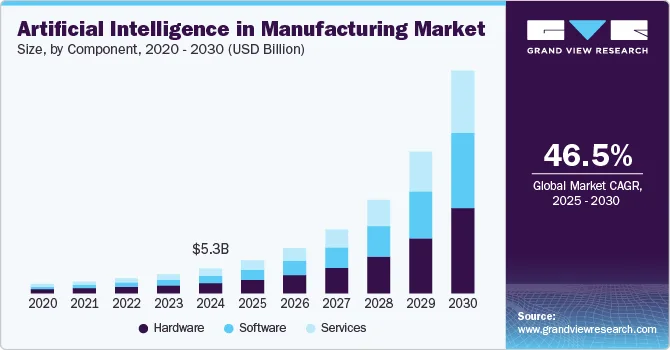
If we look at the AI in the manufacturing market today, then according to a report by Grand View Research, the global artificial intelligence in the manufacturing market size was estimated at USD 5.32 billion in 2024 and is projected to reach USD 47.88 billion by 2030, growing at a CAGR of 46.5% from 2025 to 2030. Based on this data, AI in manufacturing is experiencing explosive growth and long-term digital transformation in the industry.
Stay tuned with us to know everything about AI for manufacturing, like benefits, use cases, future scope, etc.
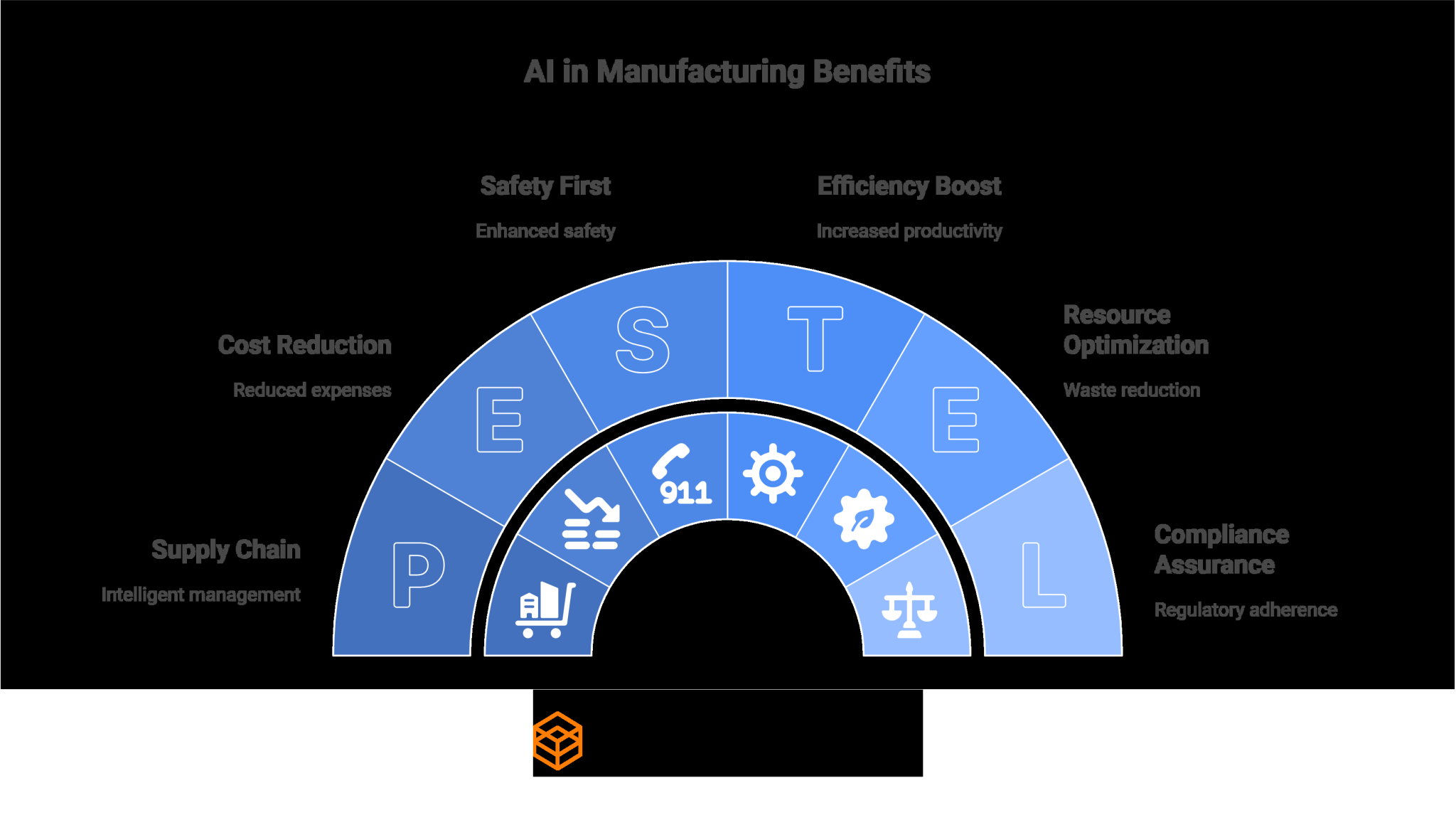
Top 6 Benefits of AI in Manufacturing
First, let’s look at the top benefits of AI in manufacturing industry that will help you learn how AI can be beneficial for your manufacturing business. This is not only a smart solution, but this will also enable you to conduct better operation control.
1. Reduced Operational Expenses
The very first benefit of using AI in manufacturing is that it helps in reducing the cost of operation, as it is capable of catching problems at the initial stage. Once we know the bug, we can resolve it on time. This not only helps you save money but also saves you from emergency repairs. Besides this, it also automates repetitive regular tasks to save time, money, and effort so that your squad can utilize the time for other tasks.
2. Enhanced Product Quality
AI solutions for manufacturing help in enhancing the product quality and help you serve the best to your audience. AI tools flag problematic items faster as compared to the manual inspection process; this not only helps in increasing the reliability but also cuts down on the rework. In addition to that, AI-driven quality control systems use computer vision and machine learning to check the quality of each and every product.
3. Accelerated Time-to-Market
AI for advanced manufacturing gives you the chance to accelerate the design cycle and testing phase, which helps organizations create products much faster. Along with that, it also helps in speeding up the innovation process by utilizing generative AI to design intuitive designs. This smart choice will not only give you the chance to keep your head up in the competitive market, but this will also help you in serving your customers fast.
4. Intelligent Supply Chain Management
AI applications in manufacturing use vast amounts of data and predict consumer demands with better accuracy, and let you serve exactly what people want. Not only this, but this will also help you in optimizing the inventory systematically and streamlining supplier relationships. As a result, this informs you about the inventory so that you will never go out of stock. Other than that, you can easily monitor inventory levels, identify supply chain bottlenecks, and predict demand fluctuations.
5. Boost Efficiency and Productivity
By automating tasks and streamlining management processes, AI in manufacturing helps your business team to be more productive and efficient. Not only this, but using artificial intelligence in the manufacturing industry means you can take data-driven decisions, as it provides real-time insights. Unlike the traditional method, here you will see less human error, making the process more seamless and hassle-free.
6. Enhanced Safety
AI systems in manufacturing improve safety and security, as they use computer vision and real-time monitoring to identify early risks. In addition to that, it helps organizations to keep an eye on the manufacturing process by monitoring and ensuring the safety and quality. Moreover, AI-powered cyber tools always oversee network activity for attacks and unusual behavior of machines to automatically block the threat.
How AI Transforms Manufacturing: Real Use Cases with Measurable Impact
In this section, let’s look at how AI is transforming the manufacturing business by taking some real-world examples of AI in manufacturing.

1. Equipment Health Monitoring
AI systems have sensors that monitor equipment in real-time and identify anomalies and predict failures and interruptions before they can lead to downtime. Applied in such industries as electronics and pharmaceuticals, this proactive form of maintenance results in higher utilization of equipment, fewer expensive breakdowns, and less expensive maintenance.
2. AI-Powered Quality Assurance
With computer vision and machine learning, the quality inspections are automated, and the defects that cannot be seen by the human eye are detected. BMW and other manufacturers are among the appropriate AI in manufacturing examples that implement AI-controlled cameras on assembly lines to achieve high-precision welding and component placement that would save defects and waste by a considerable margin and improve the quality and safety of products and the working environment.
3. Smart Supply Chain Management
AI optimizes stock, transportation, and demand forecasting through the analysis of both real-time and past data. Walmart and Unilever apply AI to manage the stock dynamically, reduce the stock-out situations, and enhance the responsiveness and rate of supply chains. This leads to the increased level of services, lower logistics costs, and enhanced allocation of resources.
4. Intelligent Robotics and Automation
The robots have AI capabilities that enable them to work with greater accuracy, efficiency, and safety in the manufacturing process; they are collaborative robots (cobots) or SCARA robots, as well as autonomous mobile robots. They minimize human mistakes and perform repetitive or dangerous duties, and dynamically change according to the production requirements to improve production efficiency.
5. AI-Driven Design and Innovation
Generative AI is used to explore huge possibilities of design in a short amount of time and optimize material usage, production factors, and performance. Generative design is applied in industries such as AI in Automotive and aerospace to shorten the product development cycle and develop innovative and efficient products, which decreases the time-to-market.
6. Data Analytics for Decision-making
Machine learning algorithms are used to process massive sensor and production system data to give actionable information. This helps in getting ahead of time, with better production planning, energy conservation, and quality control, thus leading to more productivity with less input costs.
7. Customer Demand Forecasting
AI models use historic sales, seasonal data, and other external data to predict customer demand with precision. This allows manufacturers to be able to adjust production schedules and supply chains near real-time and reduce overproduction or shortages, and be as responsive to market changes.
So, these were the top AI use cases in manufacturing that summarize that using AI in the manufacturing industry is not a luxury anymore, but a necessity. For businesses that want to automate their manufacturing process and want to serve the best quality products to their customers, integrating artificial intelligence into the legacy manufacturing system is important.
8. Cobots
Cobots in manufacturing are programmed to do important things such as handling harmful substances, fixing screws on a vehicle body, putting heavy parts in place, or even cooking a meal. Cobots will help humans perform dangerous tasks; human operators can immediately control this technology remotely. Additionally, cobots can be programmed to detect the defects in the product and remove them from the rest of the production line. This will help the manufacturers to save time and resources rather than performing quality checks and manual inspections. This will definitely allow you to ensure a higher level of customer satisfaction.
Moreover, the world’s largest cobot manufacturer is Universal Robots. It has almost half the market share.
Here are the historically common Industrial Robot Applications:
- Arc Welding or robot welding.
- Spot Welding.
- Materials Handling.
- Machine Tending.
- Painting.
- Picking, Packing, and Palletizing.
- Assembly.
- Mechanical Cutting, Grinding, Deburring, and Polishing.
9. Assembly Line Optimization
AI implementation in Assembly Line Optimization has emerged as a game-changer in manufacturing. Artificial Intelligence is employed in assembly line optimization for the betterment of efficiency, production processes’ accuracy, and flexibility. In this, by analyzing past performance metrics, real-time sensor data, and machine learning algorithms, it improves workflow, reduces downtime, and employs predictive maintenance. AI-driven computer vision systems can identify anomalies or flaws to ensure product quality.
By changing the production parameters in response to demand variations, intelligent automation lowers waste and helps to improve the utilization of resources. Artificial intelligence turns assembly lines into data-driven and flexible environments through adaptation and continuous learning that helps boost output by lowering costs and sustaining high standards.
For instance, Volkswagen is the perfect example of a manufacturing business using AI in Industry 5.0 to optimize assembly lines. To improve the caliber and effectiveness of Volkswagen’s production operations, they utilize AI-driven solutions. It examines the sensor data from the assembly line using ML algorithms to streamline operations and predictive maintenance requirements.
10. Energy Management and Sustainability
AI algorithms can monitor energy consumption patterns and optimize energy use in manufacturing operations, lowering costs and reducing environmental impact. Manufacturers may reduce their energy consumption and carbon emissions significantly by monitoring equipment efficiency, identifying energy-intensive processes, and implementing energy-saving solutions.
AI in Net Zero manufacturing has emerged as an opportunity to enhance carbon capture technology and environmental monitoring that helps to control greenhouse gases. Many manufacturing industries are adopting net-zero carbon emissions. Artificial Intelligence is significant to achieving net zero by enabling smart energy systems, optimizing resource use, and enhancing efficiency across manufacturing industries. Therefore, AI is an important tool to mitigate climate change and achieve net-zero emissions in the global effort.
11. Customized Product Development
AI technologies enable mass customization by assessing client preferences, market trends, and design restrictions to generate individualized items on a large scale. Manufacturers may provide bespoke solutions to individual clients by utilizing AI-driven design tools and manufacturing processes, enhancing customer happiness and competitiveness.
Good Read: Top SaaS Product Ideas
12. AI in CNC Machine
Artificial Intelligence (AI) is transforming CNC machining by significantly improving accuracy, productivity, and automation. AI in CNC machining helps achieve two main objectives: efficiency and productivity. As data is generated during production, AI analyzes it to enable engineers and skilled operators to adjust the machine or remove impediments that slow it down, allowing it to operate at peak efficiency.
AI algorithms are used to optimize cutting paths, predict machine maintenance needs, and facilitate real-time adjustments. These advancements result in minimized waste, accelerated production times, and reduced operational costs. AI-powered Computer-Aided Manufacturing (CAM) software revolutionizes the manufacturing process by seamlessly generating CNC programs from Computer-Aided Design (CAD) models.
Read more: Top AI App Ideas
Top Businesses Using AI in Manufacturing
If you are stepping into this new market of AI for advanced manufacturing, then this section is for you, as here we are going to discuss the big businesses that have already adopted AI in their manufacturing business. This will give you the blueprint of how you can use AI in manufacturing in 2026.
1. Amazon
Amazon is eagerly incorporating AI into its manufacturing process through AWS, which involves the use of collaborative robots and generative AI to enhance product quality.
2. Walmart
Walmart is a global retailer that leverages AI to optimize supply chains and enhance customer experience. According to a report, the implementation of artificial intelligence reduced their supply chain cost from $2 billion to $1.6 billion.
3. FANUC
FANUC is using artificial intelligence to enhance robot performance and for automated quality inspection. As a result, this integration helped them in reducing programming efforts and boosting automation.
4. Tesla
Tesla uses AI in multiple ways, like it uses computer vision to detect defects in real time and guide robots. It uses predictive maintenance to forecast failures and intervene before a breakdown.
5. ABB
ABB uses the combination of industrial data and generative AI to optimize manufacturing processes, maintenance, and robot autonomy. Additionally, the integration of generative AI helps them in building new product designs and improving production efficiency.
How to Implement AI in Manufacturing
After looking at how organizations are experiencing immense benefits from implementing AI in their manufacturing business. You must want to know about how to implement AI in manufacturing. In this section, we are going to talk about that. Below are the 5 easiest steps to implement artificial intelligence into your legacy manufacturing system.

1. Objective-First Use Cases
Initially, you need to take some real-world examples of AI in manufacturing so that you can get an idea of how existing organizations are utilizing AI in their manufacturing business. This will help you in designing the target easily, and this is also helpful in creating the roadmap for your manufacturing business success.
2. Assess Data Readiness
Now, after deciding to incorporate AI into your manufacturing business, the next step is to gather data. As AI is going to be trained by data and provide results based on that only, it’s important to pay attention to gathering all the relevant data.
3. Collaborate with an AI Development Company.
Now you have your plan and data, so now is the moment to get in touch with an artificial intelligence app development company that will help you guide your app idea to make it result-oriented. Along with that, connecting with an appropriate partner means you will also receive after-support services.
4. Launch Pilot Program
Launch a pilot program that will help you in serving a risk-free approach to validate AI’s value in your business and make necessary adjustments that need to be taken immediately. Not only this, but it also helps you in taking control over the manufacturing process from start to finish.
5. Track Performance & Improve
Finally, you must monitor the performance of your AI solutions for manufacturing. You can also call your AI partner in case you have any problems, and he/she will help you with the services in order to make sure that the solution is effective.
Cost To Implement AI in Manufacturing
After knowing the use cases, steps of implementation, and benefits of AI in manufacturing, you must want to know the cost of AI implementation. Remember, cost can vary widely based on use cases, complexity, and region. So, if you want to know the real cost of AI in manufacturing, including all factors, then you must contact an AI Development company. However, we will give a rough idea of implementing artificial intelligence in the manufacturing industry.
| Cost Component | Estimated Cost Range (USD) | Description |
| Basic AI Model Setup | $5,000, $20,000 | Initial purchase or licensing of simple AI tools |
| Custom AI Development | $20,000, $100,000+ | Developing tailored AI solutions from scratch |
| Hardware Infrastructure | $10,000, $500,000 | Servers, GPUs, sensors for data collection and processing |
| Cloud Services (Monthly) | $2,000, $30,000 | Cloud AI platforms like AWS, Azure, and Google Cloud |
| Pilot Program | $50,000, $200,000 | Small-scale test deployments |
| Full-Scale Deployment | $500,000, $1,000,000+ | Enterprise-wide integration and rollout |
| Maintenance & Support | $1,000, $10,000 annually | Updates, troubleshooting, and scaling |
Future of AI in Manufacturing
As you can see in the given image from Grand View Research, the AI solutions for manufacturing are going to increase exponentially in 2030. Businesses that have already adopted this latest technology and are going to invest in it may experience the highest ROI of all time.
We all know that Artificial intelligence is the future in all possible industries, and manufacturing is one of them. AI in manufacturing is getting so much hype because this amalgamation of AI and manufacturing not only provides benefits like increased efficiency and productivity through AI in automation, improved quality control via real-time defect detection, and cost savings. But also, it offers high-end security, which is necessary in this cyberattack era.
Along with that, this will help you in balancing data and human judgment, as AI can analyze vast amounts of information and can make predictions about all the possibilities. Moreover, recognizing patterns is another advantage of artificial intelligence in manufacturing that helps in analyzing user demand.
Also Read: Top AI Trends to Look in 2025-26
Conclusion
With all the stats, use cases, benefits, and future scope, you have understood the importance of using AI applications in manufacturing that boost efficiency and productivity through automation, improved quality control via real-time defect detection, and cost savings from optimized resource usage.
These advantages will change the way you deal with your manufacturing business challenges. Not only this, but with the help of AI, you can serve exactly what your customer demands with high-quality products. As a result, this will boost your customer retention rate, leading to an increase in the ROI of your business.
But there is one challenge here: you will only receive all these artificial intelligence in manufacturing benefits when you incorporate the correct AI tools into your manufacturing system. For that, you must find a partner who provides performance-driven AI app development services.
In the pool of multiple artificial intelligence app development firms, how would you find the best? Well, no worries; as your well-wishers, we will guide you through. Check out the next section.
Why Choose ScalaCode?
With 15+ years of experience, we have served 1200+ clients with a 95% retention rate, making us the perfect choice for manufacturing software development services. We deeply understand the target audience and vision of the business to offer the most appropriate digital solution to our clients with end-to-end security & compliance.
In addition to that, by leveraging our machine learning and AI, you can set a new benchmark in the competitive market. Our experts provide solutions beyond implementation.
Frequently Asked Questions
1. What are the 4 types of AI technologies in manufacturing?
The 4 key technologies that are applied to AI in manufacturing are machine learning, computer vision, natural language processing, robotics, and automation as well. Their applications are different: ML utilizes historical data to predict, computer vision is used to get images, NLP enables the system to interpret human language, and robotics/automation is used to automate the process and simplify it.
2. Which company uses AI in manufacturing?
Multiple big business players have already incorporated AI in their manufacturing businesses, like Siemens, BMW, Tesla, General Electric (GE), and Samsung.
3. How is AI used in manufacturing?
AI in the manufacturing industry is used in multiple ways, like quality control, predictive maintenance, supply chain optimization, and factory automation.
4. What is the future of AI in manufacturing?
The future of AI solutions for manufacturing is bright, as it helps in multiple ways, from saving costs to helping in making data-driven decisions. Not only this, but AI will ensure high-end security by keeping an eye on the inventory and product quality.
5. What are the top AI in manufacturing examples?
Well, there are multiple AI applications in manufacturing examples present in the market, but some major ones are predictive maintenance, AI-driven quality control, supply chain optimization, and intelligent automation.
6. How can ScalaCode significantly incorporate AI in manufacturing?
ScalaCode smoothly incorporates AI into your manufacturing business and makes an AI-driven solution that not only boosts productivity but also ROI as well. In addition to that, you must choose ScalaCode as your AI partner because we provide 1 month of after-sales support services to ensure the solutions serve you well.
7. How much time does it take to build an AI-based manufacturing solution?
The time of incorporation completely depends on the features and factors that you want to include in the solution. But in general, it takes somewhere around 3 to 18 months. To get the exact number, you can contact the AI for manufacturing companies.