

From healthcare to education, business to entertainment, managing staff to boosting ROI, AI enablement is transforming every industry.
We all know that, in this digital economic world, businesses cannot just rely on traditional workflows and outdated processes; to be at the top of the market, it’s time for organizations to buckle up… and get back in the game strongly.
But how would you do that?
Well, here the role of AI enablement comes into play, as it empowers businesses to integrate intelligent tools, automate repetitive tasks, enhance decision-making, deliver personalized customer experiences at scale, and so not.
AI enablement is the talk of the town, not only in India but in other countries as well.
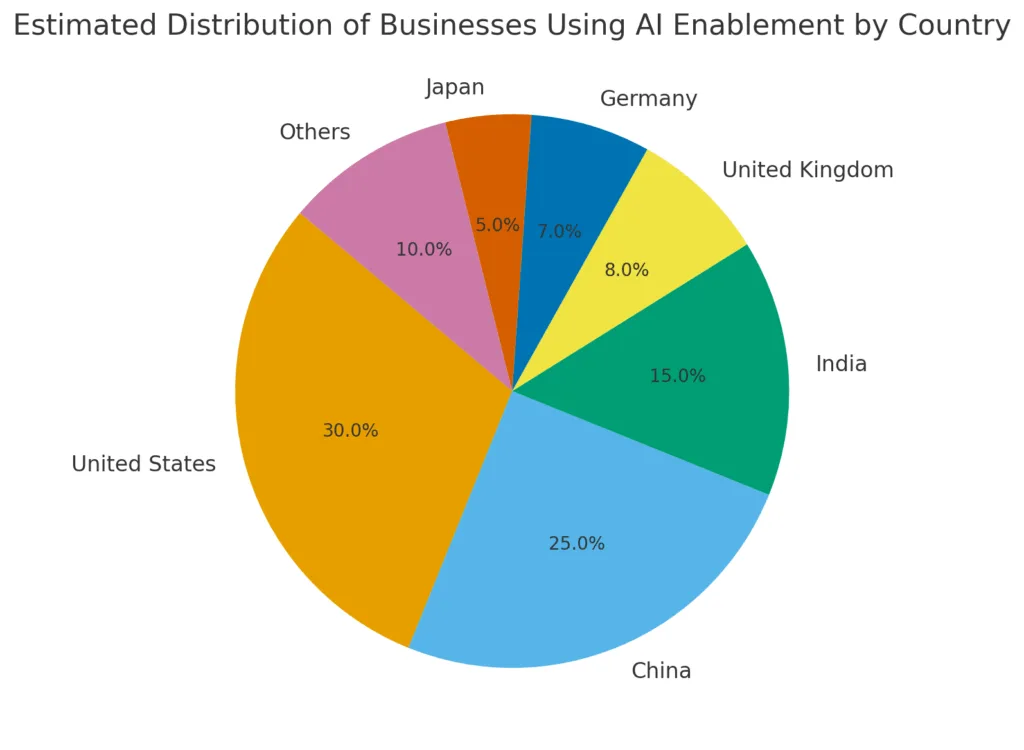
This pie chart clearly shows that the demand for AI enablement is growing day and day, as this offers multiple business benefits to organizations that use it correctly.
So, what are you waiting for? Read this guide on AI enablement, and get to know everything about it.
Let’s dive in…
What is AI Enablement?
AI enablement refers to the integration of AI in organizations. This includes multiple tools, skills, data, and infrastructure within the organization. In addition to that, it does not just involve using AI tools or running individual projects; it seeks to drive an AI-first culture that is inherently connected to the business strategy. This enables organizations to embrace greater efficiencies, innovation, and make better decisions across the organization.
To successfully enable AI, organizations must have a basic understanding of what AI is and can do, identify where it could be helpful, build the supporting infrastructure, and develop the talent and governance to help the organization responsibly develop and deploy AI.
In short, it puts AI into the hands of employees so they can more effectively and efficiently use AI technology to speed up workloads, eliminate errors, and do more creative and strategic tasks. If an organization’s workforce can effectively implement an AI-enabled technology, there could be several benefits, including operational cost savings, potential business growth, and improved customer experiences.
For example, Walmart began leveraging AI-enabled robotics and predictive analytics to ensure inventory optimization processes, while Coca-Cola is using an AI-enabled technology to improve product design and advertising efforts.
In both examples, these organizations are demonstrating that AI enablement transcends just a technology upgrade or augmentation; it is a fundamental change in how organizations do business and compete in a digital-first world.
This holistic view of AI also means organizations can begin to maximize the potential -if they consider potential issues such as poor adoption and misalignment in the structure for these initiatives, as shortfalls in trust can hinder AI initiatives from attaining the possibilities that AI can facilitate.
Difference Between AI Adoption, Implementation, and Enablement
Now, while scrolling on a search engine about enterprise AI enablement, you must have seen terms like AI adoption, implementation of AI in business, etc. After looking at these terms, they look like they are the same, but are they?
Let’s learn this with the help of the table given below;
| Aspect | AI Adoption | AI Implementation | AI Enablement |
| Definition | Integrating AI tools and technologies into specific workflows or departments | The technical deployment and configuration of AI systems within the IT infrastructure | Preparing the entire organization with skills, governance, and infrastructure for scalable AI use |
| Focus | To solve immediate business problems | Setting up AI software, hardware, and integration pipelines | Building a foundation of training, data policies, and culture |
| Scope | Limited to particular projects | IT and engineering teams primarily | Organization-wide |
| Goal | Achieve short-term business outcomes | Ensure AI technology runs smoothly | Enable sustainable, long-term business transformation |
| Duration | Short to medium | Medium term | Ongoing, continuous process |
| Ownership | Line-of-business leaders and end users | IT and engineering departments | Cross-functional teams including IT, compliance, and business leaders |
| Examples | AI chatbot for customer service | AI platforms like Azure OpenAI are in the cloud | Building AI Centers of Excellence and training programs |
We hope you have understood the difference between AI Adoption, Implementation, and Enablement. Now let’s move forward to learn how AI enablement transforms modern businesses.
How AI Enablement Transforms Modern Businesses?
AI-enabling infrastructure across all facets of a business drives multiple advantages through which it promotes the modern business. AI in business drives efficiency, innovation, and enhanced decision-making. In addition to that, AI enablement in companies also improves the adoption and empowerment. Moreover, businesses can unlock new growth opportunities and competitive resilience with the help of artificial intelligence in their business.

1. Unlocking Hidden Productivity
If you want to unlock the hidden productivity of your team, then you must integrate AI into your system as it helps in automating repetitive tasks and gives employees extra time to employee to ficusd on their creativity and productivity.
2. Operations & Automation
AI enablement in business helps organizations to manage their operations and automation. This is very helpful in the retail industry, as they need it the most at every stage. To know the demand to supply it to the market, then getting the reviews, and much more.
3. Crafting Hyper-Personalized Customer Journeys
The next is crafting a hyper-personalized customer journey; in any business, providing value to customers and their feedback is the most important thing. And AI can do it seamlessly by analyzing detailed customer data to tailor experiences that drive loyalty.
4. Scaling Innovation
Cloud-based AI tools are game-changers when it comes to experimenting with and scaling new products quickly. With Microsoft Azure, companies can effortlessly whip up prototypes for AI applications, significantly accelerating both their innovation cycles and time-to-market.
5. The New Quality Guardians
By harnessing AI-powered computer vision, manufacturers can spot defects as they occur in production, leading to more consistent quality and less waste. Meanwhile, General Electric leverages AI-driven predictive maintenance to cut down on downtime and keep quality standards high.
Also Read: Top 11 Use Cases of Computer Vision in the Retail Industry
6. AI as the Strategic Game-Changer
AI is the most strategic game changer, and companies that jump on the AI movement early can experience it in an even better way. For instance, Meta has woven AI into its advertising strategy, which has led to remarkable revenue increases and solidified its position as a market leader.
7. Accelerating Agile Transformation
By integrating AI into their daily business operations, companies can boost their agility, constantly fine-tuning both processes and strategies. This change will empower your employees to adapt swiftly and effectively to shifting market dynamics.
8. Empowering Human Creativity
When AI takes over the dull, routine tasks, it opens up room for fresh ideas and strategic thought. Across various industries, teams are turning to AI assistants to manage their daily operations, allowing people to channel their efforts into more valuable and creative endeavors.
9. Seamless Expansion
As businesses expand, cloud AI solutions seamlessly keep up, accommodating more customers and broader operations. In the logistics sector, companies use AI to enhance their route planning and streamline warehouse processes, ensuring they stay efficient as they scale up.
10. Building Resilience
AI takes risk detection and management to a new level by quickly detecting through complex data in ways that humans just can’t match. This capability is a game-changer for financial institutions, as they can now forecast and handle market risks more proactively, leading to greater stability in the industry.
So, this is how AI enablement can transform modern businesses if you are the one who want to experience these benefits for your organization, then you must contact an AI product development company.
Why Businesses Should Invest in an AI-Enabled Platform?
The AI-enabled platform is an investment that can help businesses to give a personalized experience, enhance operational efficiencies, and offer predictive analytics. In addition to that, it also facilitates faster innovation, provides a competitive advantage, and quality marketing optimizations.
1. Personalized Customer Experiences
The AI enablement in businesses helps to study the data of individual customers, learn their tastes, and provide real-time suggestions. For example, the illustration, streaming services like Netflix are also relying on AI to make specific suggestions to every user. Additionally, stores like H&M are relying on virtual assistants to mitigate cart abandonment and increase conversions.
2. Operational Efficiency
AI-enabling technologies boost automation that significantly increases the operational efficiency of any business. Moreover, AI in organizations simplifies operations, minimizes manual repetitive work, and more efficiently allocates resources to execute tasks at a faster rate and lower costs. For example, Walmart uses warehouse robots, which are controlled by AI, to manage inventory and provide customer service.
3. Predictive Analytics and Smarter Decisions
Organizations can also use AI in CRM to manage their business decisions. AI enablement in business helps companies to take data-driven decisions and make their business future brighter than ever. In addition to that, the AI tools are utilized to make predictions, assess risks, and plan strategically using large amounts of data. For example, Starbucks uses AI-driven analytics to forecast the sales trend.
4. Enhanced Innovation and Scalability
AI for enterprise enhances innovation and scalability at the same time through automating business processes and developing modular solutions that can be tailored to meet business demands. For example, the AI solutions provided by Microsoft Azure enable businesses to build, deploy, and manage applications innovatively and globally.
5. Competitive Advantage
AI-powered platforms enable businesses to give a competitive advantage to businesses that helps them in anticipating the real market trends. In addition to that, it also helps in responding faster than competitors by leveraging data-driven insights. Organizations can also use AI in their workflow to achieve agility and enhanced decision-making that allows them to lead in innovation and customer satisfaction.
6. Improved Quality Control
The next business benefit of AI enablement in business in 2025 is that it improves quality as it detects defects earlier in manufacturing processes to make your productivity even better. This process is also perfect for reducing waste and rework, as you will get to know the defect at an early stage. In addition to that, AI in business also helps organizations in predictive maintenance that minimizes equipment downtime and enhances product consistency.
7. Scalable Growth
AI in an organization will give you scalable growth, which means your business will be capable of being easily expanded or upgraded to handle increasing demands, growth, or larger workloads with the help of AI that too without significantly decreasing performance. Additionally, it will also help you in administrative and operational tasks, which enable you to manage larger customer bases.
8. Innovation Enablement
AI enablement in companies innovates every step, for example, it automates routine tasks, helps employees to focus on creativity, and strategic initiatives. In addition to that, Generative AI tools accelerate product development and marketing content creation. To better understand, you can check the Generative AI use cases and get to know how Generative AI enablement in business can foster a culture of continuous innovation and faster time-to-market for new offerings.
9. Effective Marketing and Sales
Marketing and sales are one of the major aspects of any business, and you will be shocked to know that AI can enhance marketing by delivering personalized campaigns, segmenting customers precisely, and optimizing ad spend. Now only this, but AI enablesment in business helps sales teams predict user behavior, conversion rates, and overall revenue.
Now that you know the business benefits of AI business enablement, you must want to try it in your business as well. But every successful business leader or manager knows that having a blueprint of new technology is a must before integrating it into the existing system. To implement AI in your business, you must use the best AI automation services.
Therefore, we have created the next section of real-world applications of AI enablement, where you can see how different industries are using this latest technology to boost their business.
Real-world Applications of AI Enablement
Here in this section of real-world applications of AI enablement, we have listed the top 12 examples that you can watch on, and understand how AI enablement works in different industries.
- Virtual Assistants: AI-enabled tools that already exist in the market, like Amazon Alexa, Apple Siri, and Google Assistant, use NLP to interact with customers. In addition to that, it also helps users to set reminders and control smart devices.
- Personalized Recommendations: The next example of AI-enabledment in real time is personalized recommendations platforms like Netflix and Amazon use AI to analyze the viewing and shopping behavior of their regular or non-regular customers.
- AI Chatbots for Customer Support: Customer support is something that is very hectic, and at the same time, it is very important to perform well in every product or service-related business. Therefore, Banks such as HDFC (Eva bot) and SBI (SIA bot) have their own AI chatbots to provide customer support.
- AI in Healthcare Diagnostics: Generative AI in healthcare, like IBM Watson and Google DeepMind, assists doctors in detecting diseases like cancer. In addition to that, it also helps in analyzing medical images, improving early diagnosis.
- Fraud Detection in Banking: With the increasing use of AI in businesses the fraud detection is also increasing day by day; hence, top banks deploy AI algorithms to detect fraud or unusual transactions to reduce risk for customers.
- Autonomous Vehicles: Today, automation is something that is loved by every generation, and autonomous vehicles are one of them. Organizations such as Tesla are the best example of AI-powered enablement in vehicles. Additionally, it also helps in driving self-driving cars, handling navigation, obstacle avoidance, and traffic response.
- Precision Agriculture: We all know that AI is revolutionizing every industry, and agriculture is one of them. This is one of the fastest-growing and stable businesses; hence, businesses are investing in it. Startups (e.g., CropIn) use AI and satellite imagery for yield forecasting, which also helps in irrigation management.
- Smart Retail Inventory: AI in retail is another example of AI-enabled. Retailers like Zara use AI to automate stock replenishment. In addition to that, it also helps in predicting demand and optimizing inventory flow.
- Intelligent Quality Control (Manufacturing): AI-powered computer vision (e.g., Zebra Medical Vision, Da Vinci Surgical System in medicine) is another perfect example of AI-enabled as helps in detecting defects in products or assists in surgeries.
- Personalized Content Feeds: Social media is something that uses multiple latest technologies, specifically AI, to fulfill the requirements of today’s fast generation. Platforms like Facebook, Instagram, and TikTok use AI to curate feed content and filter fake posts.
- Smart Traffic & Urban Planning: Cities such as Dubai and Singapore employ AI-powered traffic systems and analytics to manage congestion and streamline public utilities.
- AI Recruitment Tools: AI in the workplace, especially in recruitment, is very helpful. It helps the company in multiple ways, like screening resumes and matching candidates, etc. According to a report in 2025, AI recruitment is transforming global hiring, with 87% of companies now using AI-driven tools. The AI recruitment industry is valued at $661.56 million in 2023 and is projected to reach $1.12 billion by 2030, growing at a CAGR of 6.78%.
How AI Enablement Platforms Transform Business Operations
Investing in governed enablement AI is crucial for businesses in 2025 and onwards, as this helps you in aiming to harness the full potential of artificial intelligence. In addition to that, AI enablement will also provide the necessary infrastructure, tools, and governance to ensure AI technologies are strategically deployed. In this section, let’s look at the capabilities of the AI enablement platform for business:
1. Maximize ROI
AI enablement platforms help organizations in achieving maximum ROI in a shorter period of time as they cut down the time taken by humans. In addition to that, it can be effectively adopted and aligned with business goals, and provide you with the results that you achieve in a year. Moreover, AI enables businesses can avoid wasting on disconnected projects by providing clear workflows, data management, and performance insights.
2. Accelerate Business Agility
AI for entrepreneurs in 2025v is a blessing as new startups don’t have to employ multiple people to perform different tasks. As AI can perform daily business tasks, manage inventory, chat to customers, and solve their problems at once. In addition to that, these platforms enable faster deployment and scaling of AI solutions. AI in business also allows them to quickly adapt to market changes, and by knowing the trends, teams can focus on them innovatively.
3. Streamline Complex Workflows
AI enablement integrates AI across workflows to automate daily business tasks, and this also helps in streamlining the complex workflow. Big organizations adopt AI to streamline the complex task, as manually they take a lot of time and effort, and sometimes people get no result. In addition to that, AI in organizations also reduces errors and processing times while increasing overall productivity.
4. Ensure Scalable & Secure AI Deployment
A Secure AI deployment is something that enhances the business and also improves the ROi of the business in a minimum period of time. In addition to that, a robust AI enablement platform provides scalable infrastructure with built-in security, which is necessary in today’s world where fraud detection is important. AI in business not only helps in streamlining the deployment, but this also supports expanding AI usage without compromising compliance or risking data breaches.
5. Empower Data-Driven Decision Making
Deciding for an organization is a responsible task, and alumni, like project managers, leaders, and analysts, cannot take any risks in it. Here, enabling AI agents can help you in taking data-driven decisions and predictive analysis; in addition to that, it can also help you in understanding the latest market trends so that you know what people are demanding in the real world.
6. Foster a Culture of Continuous AI Adoption
In 2025, AI is just an introduction; according to some reports, the future of AI is vast and includes multiple such things that we cannot imagine. Hence, integrating such AI enablement platforms in the business also fosters the culture of adopting new AI services like support training, collaboration, and adoption tracking, helping organizations build AI literacy across teams, and much more.
7. Reduce Operational Costs
We have already said that AI in an organization supports automation, and automation in business simply implies that no human errors, no extra workforce, and no more different training, which simply reduces the cost. In addition to that, organizations also spend a lot on project management tools Jeera, Microsoft Project, SmartSheet, etc., but with the AI integration, companies can manage their project in one place.
8. Build Comprehensive AI Governance and Compliance
AI/ML enablement services include the embedding of governance frameworks, ensuring ethical AI use, data privacy, and regulatory compliance. This is necessary because we all know that AI fraud detection is also increasing day by day, but no worries, with the help of fraud detection software and AI, you can smoothly safeguard your business from legal risks and reputational damage.
9. Access Expert Support and Flexible Technology
Investing in AI enablers for your business in 2025 helps you provide access to expert support and flexible technology. This means that this will give direct access to expert vendors, continuous updates, and flexible technology stacks. In addition to that, this also reduces technical debt and accelerates AI innovation through best-in-class tools and support.
So, these are the solid top 9 reasons for investing in an AI Enablement Platform in 2025 and take its advantage. Now you must be thinking of implementing AI in your business, so you can hire AI developers. But before you hire them, you must know the steps of integrating AI in your business. In the next section, we have listed the easiest and smoothest steps of implementation.
How to Implement AI in Business?
Implementing AI in business requires a structured and strategic approach; hence, this needs simple but careful integration steps to ensure success and maximize returns. From planning to implementation, let’s look at what are the steps that can be performed in the integration process.
1. Identify Needs & Use Cases
Start by identifying what you want to serve to your employees and what sectors you want to automate with the help of AI. This can be done by thoroughly analyzing your business processes. Here, you will also get to know the real pain points or opportunities where AI can add value for your business and your employees, too. In addition to that, don’t forget to focus on areas with repetitive tasks, inefficiencies, or gaps in customer engagement that AI can improve.
2. Set Clear Goals
Now you know the areas where you need to implement AI in your business. Here, you can simply define specific, measurable, and time-bound objectives that are aligned with your overall business strategy. Now, in these steps, you can smoothly set a clear goal and explain it to the AI development company. By linking AI initiatives directly to business outcomes like cost savings, increased revenue, or customer satisfaction.
3. Check Data Readiness
After setting the goal, you must check data readiness, evaluating your data’s quality, availability, and compliance with legal standards is important, as only high-quality, well-organized data is essential for effective AI model training and deployment. In addition to that, this also addresses data silos, cleans inconsistencies, and implements governance policies to ensure privacy and security.
4. Select Tools & Partners
Till the 4th step, you know exactly what you expect from AI enablement in your business, and now you are ready to partner with an AI development firm. Here you can choose AI technologies, which are a crucial step, as this will decide your result, and match your business requirements and integration capabilities. Additionally, you must consider scalability, ease of use, and vendor support when selecting, and ensure the chosen tools.
5. Build & Pilot Models
Now, with the help of an AI development team, you can develop AI models tailored to your use cases and run small-scale pilot projects to check if it is working well or not. In the initial step, you can also test the technical challenges and user acceptance issues. Detecting issues early is also helpful, as you can fix them soon. Moreover, Pilots can also help you provide insights to refine models and implementation strategies before full roll-out.
6. Deploy & Integrate
Gradually integrate AI solutions into your current business processes to keep disruptions at bay. Make sure these AI systems seamlessly connect with your existing IT infrastructure. Offer support to users and keep a close eye on the deployment to address any hiccups and fine-tune performance.
7. Monitor & Improve
Keep an eye on how your AI is doing by regularly checking it against your KPIs, and don’t forget to gather user feedback to keep things fresh. Make sure you’re updating your models often so they can keep up with new data. By setting up a feedback loop, you can make ongoing tweaks and improvements, ensuring that your AI continues to deliver value and stays in tune with your business goals as they evolve.
So, these were the top 7 simple and easy steps that you can opt to integrate AI into your legendary system. Additionally, we are all aware of the fact that integrating any new or latest technology into the system comes with multiple challenges. Knowing those challenges before they generate is a great thing that an entrepreneur can do.
Here, we will help you as we are going to list all the common challenges that can happen while integrating AI into your business, with solutions in the next sections.
Key Challenges of Integrating AI-Enabled Platforms in Business and Their Solutions
Here in this table, we have listed the most common challenges and their solutions that developers and companies face while implementing AI AI-enabled platform in any organization.
| Challenge | Description | Solution |
| Legacy System Compatibility | Existing outdated systems can lack smooth AI integration, causing delays | You can use middleware or cloud migration to connect legacy systems with AI smoothly |
| Data Quality & Fragmentation | Disparate, inconsistent, and siloed data reduce AI model accuracy | You can implement robust data governance, cleansing, and integration to unify and secure data to use AI |
| Talent Shortage | Lack of skilled data scientists and AI experts slows down the process | Upskill employees, hire specialists, and collaborate with AI service providers |
| User Resistance & Change Management | Employees may fear disruption or job loss, resisting AI adoption efforts | Promote AI literacy through training and leadership, communicating benefits to build trust |
| Technical Integration Complexity | Integrating AI within mixed environments with diverse protocols and systems | Plan phased integration, use APIs, and foster collaboration between business and teams |
| Governance, Ethics & Compliance | Risks of unethical AI use and regulatory violations | Establish clear governance frameworks focusing on ethics, transparency, and privacy |
| Cost Management & ROI Uncertainty | High initial costs and unclear benefits | Begin with pilot projects, measure impact rigorously |
Future of AI Enablement in Business
The Future of AI enablement platforms is as bright as a shining star in the sky. According to a report by Statista estimates that by the end of 2025, the global AI market is estimated to be valued at around $244 billion, soaring to over $827 billion by 2030, with an impressive compound annual growth rate (CAGR) of about 27.67%.
On the other hand, another report by Grand View Research foresees that the AI market will grow from approximately $279 billion in 2024 to a staggering $1.8 trillion by 2030, reflecting a CAGR of 35.9%. This highlights the rapid adoption of AI across various sectors like healthcare, finance, retail, and manufacturing is increasing in the minute.
On the tech front, exciting developments such as agentic AI, autonomous agents capable of handling complex tasks independently, are taking the spotlight. AI models that can process different types of inputs, including text, images, audio, and video, are enabling more flexible and human-like interactions.
The combination of AI with edge computing promises quicker, localized processing for applications that require minimal delay, such as autonomous vehicles and IoT devices, with the edge AI market predicted to hit $66 billion by 2030. There’s a growing emphasis on AI governance and ethical frameworks to ensure that the widespread use of AI aligns with the values of transparency, fairness, and compliance with regulations.
Additionally, AI-as-a-Service (AIaaS) platforms are set to make AI more accessible, allowing even small and medium enterprises to tap into powerful AI tools without hefty initial costs. With 78% of companies already integrating AI into at least one business function, AI enablement is poised to become a vital component for gaining a competitive edge and driving innovation through 2030 and beyond.
Conclusion
With these wonderful stats and facts by credible sources, it’s time to sum up the blog!
At the end, this blog concludes that AI enablement is transforming businesses in multiple new ways. New and exciting developments like agentic AI, multimodal models, edge AI, and AI-as-a-Service are set to speed up adoption and broaden AI’s influence across various industries.
The AI market is anticipated to soar to nearly $1 trillion by 2030, injecting trillions into the global economy. This means that investing in AI-enabled platforms is more than just keeping up with tech trends, it’s essential for any business aiming for long-term growth and a competitive edge.
Moreover, companies that harness these advancements effectively can look forward to crafting highly personalized customer experiences, acquiring real-time insights, and developing autonomous workflows. All these elements combine to offer unparalleled flexibility in business operations.
But this can be done only when you partner with the top AI agents development company, which can seamlessly integrate AI into your existing system by understanding how AI can boost your business ROI.
Also Read: Top AI Development Companies in India
How ScalaCode Can Help You?
In the last section, we said that you must partner with an AI development company to achieve all the advantages of AI enablement in your business in 2026. Now you must want to know the best AI development firm, so no worries, ScalaCode is here to be your go-to partner for seamless integration of the best AI-enabled platforms into your business operations.
With over 15+ years of experience and a talented team of more than 250+ developers, we’re dedicated to crafting AI integration solutions that boost operational efficiency, improve customer experiences, and drive innovation. Our expertise spans industries like healthcare, finance, retail, and manufacturing, which enables us to develop tailored AI agents and automation platforms to address your unique challenges.
We’re all about delivering AI solutions that are scalable, secure, and future-ready, seamlessly integrating with your current systems, be it ERP, CRM, or cloud-based setups. But we don’t just stop at the initial development. At ScalaCode, we’re committed to ongoing optimization and training, ensuring your AI systems evolve with your business, maximizing your return on investment, and keeping you ahead of the competition.
Transform workflows, cut costs, and innovate faster with smart AI-driven solutions.
FAQs
1. What is AI Enablement?
In simple words, AI enablement is the process of preparing businesses to strategically use artificial intelligence in their workflow, managing teams, managing inventory, making predictions, etc. Additionally, AI enablement is the integration of AI in business to drive efficiency, growth, and better customer experiences.
2. What is the role of AI enablement in business in 2025?
The role of AI enablement in organizations in 2026 is to equip them with the latest technologies, data, infrastructure, and skills. This is required for seamless integration of AI into their operations. Moreover, AI in companies also ensures that projects are scalable, aligned to business goals, and deliver measurable results.
3. Who are AI enablers?
AI enablers include technology providers, data scientists, IT leaders, consulting firms, and software development companies who help organizations design, deploy, and scale AI solutions. They do it after studying your business, like what you are servicing, who your target audience is, what the latest trends in your niche are, etc.
4. What is an example of an AI-enabled device?
Well, in 2025 only there are multiple existing examples of AI-enabled devices that businesses are already using. Some of them are smart thermostats like Google Nest, Tesla Autopilot, Amazon Alexa, Sophia the Robot, and AI-Powered Medical Imaging Devices.
5. What is needed to enable AI?
AI is not a luxury anymore, but it is a requirement for every business, irrespective of its niche. Businesses that have already integrated IA into their business are ruling the market by automating their regular tasks, and those who are in the process will achieve this soon. Industries like manufacturing, retail, healthcare, finance, logistics, and legal sectors need AI the most.
6. Why is adoption and enablement important in AI programs?
Adoption introduces AI tools, but enablement ensures they are trusted, understood, and effectively they are important to achieve business goals. Without enablement, AI initiatives risk poor integration, low usage, and failure to deliver ROI, and this will lead to a wasted investment for any business.
7. How long does it take to implement AI Enablement for measurable results?
Well, it completely depends on which type of business you need AI to be integrated like you need AI in CRM, AI in automation, AI in retail, etc. Additionally, Larger, enterprise-wide AI enablement initiatives may take longer as they involve data preparation, training, system integration, and much more.