
Adaptive AI is a type of artificial intelligence that learns from data and modifies itself accordingly. Businesses prefer adaptive AI over traditional AI as it can adapt easily to rapidly changing situations. Adaptive AI for businesses is the use of artificial intelligence systems that can learn, evolve, and modify to changing conditions, tasks, or settings in a business context.
This is one of the major reasons for which adaptive AI for businesses has been used in various industry verticals for multiple purposes. In some places, it is used for route optimization, detecting fraud and many more functions. However, the potential of adaptive AI is more than you can imagine.
In this blog, we have explained adaptive AI for businesses along with adaptive AI use cases in various industries and the Adaptive AI challenges when implementing it. So, get ready to dive into the world of Adaptive AI.
What is Adaptive AI?
As the name suggests, adaptive AI is a subset of artificial intelligence that adapts itself to rapidly evolving data and environments. Businesses do not need to modify the AI algorithms repeatedly or often for the smooth functioning of the AI.
Adaptive AI learns from stored data using machine learning capabilities, and if there is an update in the data, which happens mostly, it changes itself. Businesses find adaptive AI smart and cost-effective because they do not need to invest in capital and resources to train AI often.
The Growth of Adaptive AI in Businesses: Latest Market Statistics
The implementation of adaptive AI in enterprises is accelerating, with recent market statistics demonstrating its disruptive influence. According to recent reports, the global market for adaptable AI solutions is expected to reach new heights, with a compound annual growth rate (CAGR) of more than 30% over the next several years.
Let’s explore the growth in the usage of adaptive AI in businesses in recent times, through the statistics.
- The global adaptive AI market was valued at USD 736.5 million in 2022 and is predicted to increase at a CAGR of 42.6% from 2023 to 2030.
- Gartner predicts that by 2026, companies that have embraced AI engineering methods to design and manage adaptive AI systems will outperform their counterparts by at least 25% in the number and time required to implement artificial intelligence models.
- North America appeared as the most prominent in the global adaptive AI market in 2023, accounting for 39.16% of total revenue.
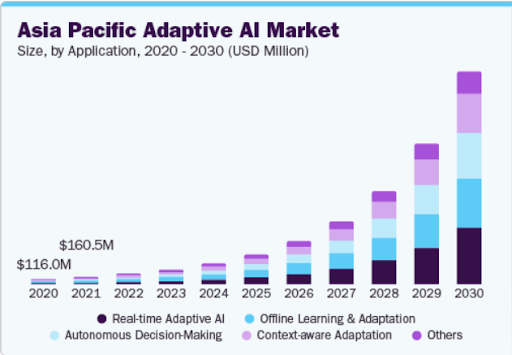
Therefore, these statistics show that the use of adaptive AI in businesses will grow in the future. Businesses that leverage adaptive AI will have an advantage over those who are not using adaptive AI.
Now, let’s move forward and explore the top use cases of adaptive artificial intelligence in various industry verticals.
Before dealing with different use cases, let’s have a look at the differences between Adaptive AI and Traditional AI.
Adaptive AI vs Traditional AI
Adaptive AI can dynamically learn, evolve, and customize answers depending on real-time data and changing situations, it outperforms classical AI. Adaptive AI, in contrast to static models, continuously improves its algorithms. Whereas traditional AI lacks the adaptability and responsiveness of adaptive systems, despite its effectiveness in set tasks.
Here is a brief comparison between adaptive AI and traditional AI
| Feature | Adaptive AI | Traditional AI |
| Learning Approach | Adapts and learns from new data and experiences. | Follows pre-defined rules and algorithms. |
| Flexibility | Flexible in adjusting to new tasks and scenarios | Limited adaptability to new or changing contexts. |
| Training Process | Continuously learns and improves over time | Requires periodic retraining or updates |
| Decision-making | Evolves its decision-making based on feedback | Decisions are based on fixed rules and logic. |
| Complexity | Can handle complex and dynamic environments | More suitable for static or well-defined tasks |
| Examples | Recommendation systems, self-driving cars | Rule-based systems, traditional algorithms |
Top Use Cases of Adaptive AI in Industries
Businesses are increasingly recognizing the competitive benefits of adaptive AI, such as improved personalization, operational efficiency, and decision-making capabilities. Retail, banking, healthcare, and manufacturing are key areas driving growth, with adaptive AI transforming operations such as consumer engagement, fraud detection, predictive maintenance, and supply chain efficiency.
Furthermore, advances in machine learning algorithms and improved access to big data are driving the adoption of adaptive AI across industries.
Here are some of the best use cases of adaptive AI in various industries:
1. Adaptive AI in Healthcare
Adaptive AI learns dynamically from clinical outcomes, patient data and medical research. It is transforming the healthcare sector by offering diagnosis, treatment regimens, and predictive insights.It increases resource efficiency, speeds up decision-making, and enhances diagnostic accuracy. Adaptive AI gives medical professionals the resources they need to provide better, quicker, and customized treatment, thereby raising the standard of both patient care and the delivery of healthcare. Adaptive AI has applications in everything from administrative task simplification to precision medicine.
- Personalized Treatment
Adaptive AI in healthcare is used to provide personalized treatment to patients. Adaptive AI analyzes patient data, such as past medical history, medication allergies, or any other requirements, and offers custom treatment recommendations, enhancing patient care.
- Medical Image Analysis
Healthcare experts leverage adaptive AI in medical image analysis for better diagnosis. They integrate advanced adaptive AI algorithms in image analysis systems, such as CT scans, X-rays, MRIs, and more.
These algorithms easily identify the anomalies in images and offer healthcare experts enhanced diagnosis results.
- Real-Time Patient Monitoring
Adaptive AI also makes real-time patient monitoring easy for doctors and healthcare experts. Patient information gathered from IoT devices, such as heart rate, blood pressure, and other vital signs, is evaluated by advanced adaptive AI algorithms.
If there is any sudden change in the data, it alerts the doctors and healthcare experts. Overall, adaptive AI enhances real-time patient monitoring.
2. Autonomous Vehicles
Autonomous vehicles, or self-driving vehicles, are gaining popularity significantly. Adaptive AI in these vehicles navigates unpredictable happenings, such as traffic jams, route diversions, and weather changes, and reacts to changing circumstances instantly.
3. Robotics
Similar to autonomous vehicles, robotics is also leveraging adaptive AI to enhance its capabilities. Adaptive AI learns from data and adapts itself to changing situations.
Considering this capability of adaptive AI, it is being used for controlling and managing robots in various industries.There is no need to update these robots with new data, as they learn from themselves, thanks to adaptive AI.
4. Training
Adaptive AI is also being used for training purposes in numerous sectors. From educating employees regarding new policies to training military personnel, adaptive AI plays a crucial role in providing training and education to the manpower.
This is why many leading businesses are hiring the best software development company in India, to develop custom systems empowered with adaptive AI.
5. Monitoring Operations
Another use case of adaptive AI in businesses is monitoring operations. Adaptive AI has been used in a variety of ways, from managing backend works to monitoring operations at the industrial level. For instance, adaptive AI is used in power and energy to optimize power supply and energy production based on increasing or decreasing demand and supply.
Adaptive AI helps businesses to analyze and understand changing circumstances and recommend the best ways to deal with a changing situation.
6. Credit Scoring
One of the top use cases of adaptive AI is credit scoring in the finance industry. Banks and financial institutions leverage adaptive AI algorithms to analyze credit scores of loan seekers based on their past borrowing history.
This analysis helps bank executives to make informed decisions regarding loan dispersals to the borrowers. Overall, adaptive AI plays a significant role in the finance sector by helping to analyze credit scores.
7. Fraud Detection
In continuation to credit scoring, adaptive AI helps significantly in identifying potential fraud and alerts the bank and finance firms.
Adaptive AI identifies the irregularities in the credit history, transactions, or KYC processes utilizing machine learning capabilities. If there are any irregularities, it informs the banks and financial institutions and prevents the chances of fraud.
8. Managing Risks
Adaptive AI is also used for risk management in the finance sector. In finance, risk analysts leverage the potential of adaptive AI to study the market, transactions, and investment opportunities to identify the earning potential as well as the level of risk involved.
By understanding the risk level, they can use better strategies to reduce risk and get more returns on their investments.
9. Agricultural Surveillance
When it comes to the use cases of adaptive AI, the agriculture sector is worth mentioning. Yes, adaptive AI is used for evaluating agricultural fields and identifying the best spots for particular crops.
For instance, agri-experts leverage adaptive AI to analyze the field and they found water holding capacity is high in that particular soil. Hence, they can use that particular land for growing crops, such as rice, that require more water. Moreover, adaptive AI is also used in drones and other agricultural equipment to collect and analyze data to make informed decisions regarding agriculture.
10. Route Optimization and Safety Monitoring
In logistics and transportation, adaptive AI is used for route optimization and monitoring the safety of consignments, vehicles, and drivers. Adaptive AI evaluates the possible routes and the traffic to recommend the fastest route possible in real-time. The same as in Google Maps, where the system suggests options of routes depending on the traffic in real-time.
Moreover, adaptive AI is also used to monitor the safety of the delivery vehicles and drivers by evaluating the distance covered by them. If there is any delay or a major change in the speed of the vehicle (usually slowing down or stopping for a long time), it alerts the logistics team to check the safety of the driver.
11. Personalized Products and Services Recommendations
Adaptive AI is used by retail and marketing to suggest personalized products and services tailored to customer’s needs and preferences. Based on the customer’s buying behavior and search history, the adaptive AI algorithms show relevant products or services that the customer is likely to buy.
Moreover, adaptive AI helps the marketing team with targeting marketing, and offers interesting deals with the product or service that the customer is thinking of buying. This enhances the chances that the customer will complete the purchase.
12. Dynamic Pricing Strategies
Another use case of adaptive AI in retail is it helps with dynamic pricing strategies. Adaptive AI algorithms analyze the demand and supply of a product or service, and other external conditions that influence the price, and offer retailers to set a particular price for that product or service.
13. Customer Service Chatbots
Adaptive AI also empowers the customer service chatbots used in retail and other businesses. The top AI developers integrate adaptive AI into the chatbot, allowing them to learn through the customer queries, and provide a relevant solution to a particular to particular query. Moreover, the chatbot adapts its answers as per the customer queries, thanks to adaptive AI algorithms.
14. Cybersecurity
Nowadays, there is a significant rise in the number of cyber-attacks and hacking scenarios. Major victims are the healthcare and finance sectors. However, adaptive AI is a solution recommended by cybersecurity experts to tackle unauthorized cyber attacks.
Adaptive AI identifies and alerts about unauthorized access or abnormal activity in the security systems. This way, cybersecurity experts know about the cyber attack beforehand, and take necessary steps to prevent it. Therefore, these are the top ways how adaptive AI is used in various industries. Now, let’s proceed to explore the benefits of implementing adaptive AI in businesses.
Bonus visit: Generative AI for Businesses: How Businesses Can Leverage It
Benefits of Leveraging Adaptive AI in Businesses
Adaptive AI is gaining popularity among businesses because of the benefits it provides. From enhancing decision-making to cost savings, adaptive AI has a lot to offer.
The benefits of leveraging adaptive AI in businesses are:
1. Improved Decision-Making
The major benefit of implementing Adaptive AI in business is that it helps with decision-making by analyzing dynamic data sets and providing insights to create strategies that benefit business.
2. Enhanced Efficiency
Another benefit of leveraging Adaptive AI in business is that it optimizes processes and workflows and boosts overall efficiency. Add one more line here
3. Personalized Customer Experiences
Adaptive AI benefits businesses by establishing stronger customer relationships. Adaptive AI gives you customization according to your choice. So, users of any industry can personalize their experiences.
4. Risk Management
Risk management is among the top benefits of Adaptive AI in businesses. It identifies and addresses potential risks in real-time, and helps businesses to tackle them effectively.
5. Cost Savings
Adaptive AI reduces operational costs and resource expenditure by automating the majority of operations. This maximizes profitability for businesses. So, these are the benefits of implementing adaptive AI in businesses. However, it is not as simple as it looks. Adaptive AI also brings some challenges to the table. Let’s learn about them in the next section.
Challenges of Implementing Adaptive AI in Businesses
Integration of adaptive AI also brings challenges for users. It is more complex than it looks. Hence, it is crucial to tackle these challenges effectively for a successful adaptive AI implementation in a business.
Top challenges of implementing adaptive AI in a business:
1. Data Quality and Availability
The data you use to train adaptive AI must be of high quality. Poor quality or irregular data can affect the functioning of adaptive AI and downgrade the result’s quality.
2. Skilled Professionals
Integrating adaptive AI into a business is not a child’s play. Hence, you need to find skilled AI developers who have expertise and experience in integrating adaptive AI into businesses.
3. Security and Privacy Risks
One of the major challenges of implementing adaptive AI into businesses is security and privacy risks. You must manage security risks, such as data breaches or cyber-attacks, associated with adaptive AI systems.
Moreover, you must implement cutting-edge security measures and protocols to protect your data and adaptive AI from potential cyber attacks. Hence, these are some challenges that you need to tackle while integrating adaptive AI into businesses.
Adaptive AI: What Does the Future Hold?
Adaptive AI has a bright future in various industries. We have already seen its use in different forms in numerous industries, ranging from retail to logistics, and more.
As the years pass and technology advances, there will be more innovation in adaptive AI, and it will be able to handle more complex challenges. More businesses will leverage adaptive AI in their daily operations to enhance decision-making, manage risks, build strong customer relationships, and more. However, it is crucial to tackle the implementation challenges that adaptive AI brings along with it. If tackled well, adaptive AI has the potential to take a business to new heights of success.
The future of adaptive AI has enormous potential to transform businesses and dramatically influence society.Technologies in adaptive AI will allow autonomous systems to make difficult judgments in real-time. It will allow for seamless cooperation between humans and robots, enhancing human capacities and enabling new types of teamwork and creativity. However, there will be greater emphasis on ethical issues and appropriate usage of AI technology.
Overall, the future of adaptive AI is defined by customized experiences, autonomous decision-making, continuous learning, ethical considerations, and collaborative intelligence. We can create a future in which technology enriches people’s lives, drives development, and promotes human well-being by using the potential of adaptive AI.
Also read: How AI is Used to Drive Digital Transformation for Enterprises?
Wrapping Up
In conclusion, adaptive AI plays a critical role in developing systems that truly understand how to get better and assist us more in the long run. It is an evolutionary artificial intelligence that is capable of modifying its behavior or making decisions in response to data, feedback, or dynamic circumstances. It involves more than simply the future. However, it’s altering the current system, enabling businesses to become more intelligent and adaptable.
The successful integration of adaptive AI is ensured by the thorough implementation procedure, which gives organizations the ability to make well-informed decisions, improve operational efficiency, and encourage more creativity.
For more such information, ScalaCode is here to assist you in improving the intelligence and adaptability of your operations. Our whole focus is on leveraging adaptive AI to grow your company.
Reach out to the best AI development company and implement adaptive AI to enhance your business’s productivity and take it to the next level of success. Contact Us at ScalaCode today, and together, let’s move things forward.