
The process of integrating cutting-edge digital technologies in industries and creating advanced business models to meet business goals is called digital transformation.
Earlier, sectors like healthcare, finance, retail, manufacturing, and others used to hire manpower to perform tedious tasks. Obviously, it is very time-consuming and costs businesses a lot of capital and time to hire and manage this manpower.
However, with time, as technology advances, industries shift towards emerging digital technologies like artificial intelligence, machine learning, blockchain, virtual reality, and others to replace humans in performing these tasks.
Over a period of time, the digital transformation showcased many positive results, such as increased productivity, fewer errors, time and resource saving, and more, transforming traditional industries into new, high-end technology-driven sectors.
In this blog, we will talk about how digital transformation is reshaping the traditional industries and why businesses should opt for it in this fast-paced, technology-driven world. So, let’s dive in.
Key Components of Digital Transformation for Businesses
Before diving into the digital transformation of industries, it is crucial to understand the key components of the transformation in depth. The digital transformation usually involves the following:
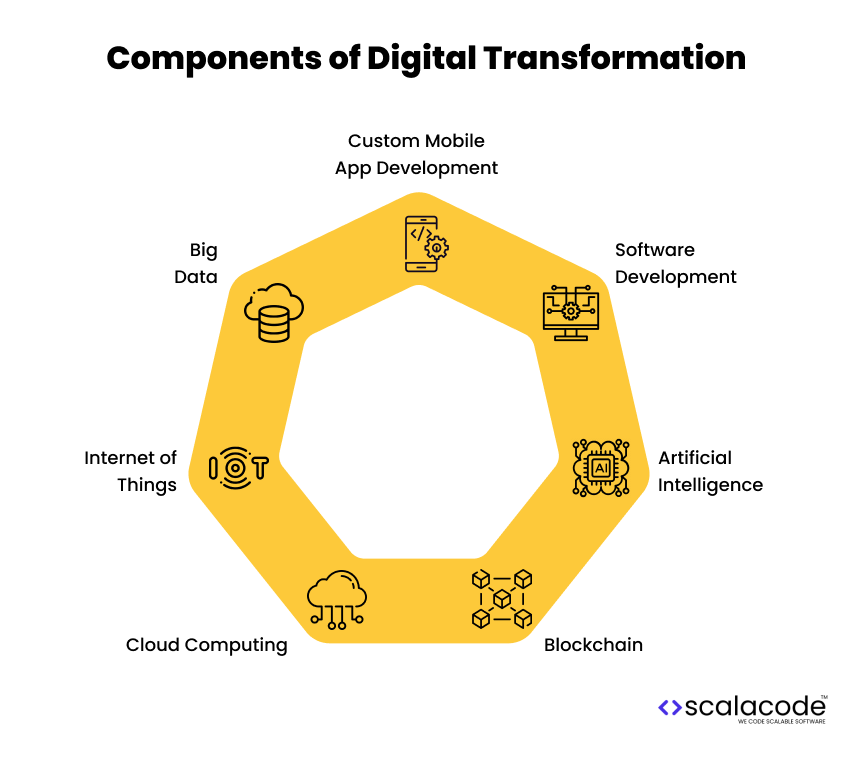
1. Custom Mobile App Development
Custom mobile app development involves building mobile applications that are designed to fulfill the particular needs of a business. A mobile app can help in increasing sales (by running the business 24/7, and catering to a wider customer base).
It also helps businesses streamline other processes, such as finance, recruitment, monitoring, and more. Hence, mobile app development is one of the key components that helps businesses transform digitally.
2. Software Development
Apart from mobile apps, software development also contributes to the digital transformation of businesses. Usually, software development is preferred by large enterprises, where the processes are complex and require more data and hefty technologies to carry out business processes.
Also Read: Top Software Development Trends
Suppose you look at large enterprises, like automobiles, energy, chemicals, manufacturing, and others. In that case, you will notice that they have built custom software that helps them streamline their day-to-day work efficiently with minimal resources.
3. Artificial Intelligence
Artificial intelligence is gaining popularity among industries looking forward to digital transformation. Earlier, only big corporations were using AI, but these days, medium-sized companies and startups have also understood the relevance of AI and they are integrating it into their systems.
Must Read: Top AI Trends
AI plays a key role in automating business operations and empowering systems to think just like humans. This way, the technology takes care of the basic operations and allows manpower to focus on other crucial tasks in a business.
Moreover, AI functions well when it is combined with its subsets like machine learning, adaptive AI, natural language processing, generative AI, and more. So, consider integrating AI and empowering it with its subsets to streamline your operations more efficiently.
4. Blockchain
Blockchain is a decentralized network that allows data to be stored in different nodes of the network. Whenever a transaction is placed, such as, new data is added to the network, all the participants get notified about it.
Businesses integrate blockchain because it enhances the security of their data and protects it from unauthorized access. For instance, unlike a centralized database, the data in the blockchain is distributed across different nodes. When an unauthorized person manages to access it, they will only access a part of the whole data.
Furthermore, the other participants will be notified of his presence in the network in real-time, and preventive measures can be taken to remove him from the network. This way, businesses can protect their data from cyber threats and carry out processes with ease.
5. Cloud Computing
Cloud computing is a virtual space where the delivery of various services can take place over the Internet. Mostly, it includes storage, processing power, and applications. The benefit of cloud computing is that businesses can store data, use different applications, and carry out various processes without needing to use physical hardware or software directly.
Leveraging cloud computing, businesses can access:
- Software: Known as Software-as-a-Service (SaaS)
- Platforms: Known as Platform-as-a-Service (PaaS)
- Infrastructure: Known as Infrastructure-as-a-Service (IaaS)
- Serverless computing, and more.
6. Internet of Things
Internet of Things technology is a key component when it comes to collecting data from different devices, machinery, and digital solutions, and managing these machines in a large interconnected network in real-time.
The IoT is used mostly in large enterprises, such as manufacturing, chemical, and energy, where it is difficult to manage and collect data from various machines established in different places.
Using IoT, businesses can connect and manage various machines and devices and get all the data accurately from the sensors attached to different machines, all in a single place and of course, in real-time.
This minimizes the efforts, manpower, and time required to go to machines, accessing and managing them, and collecting data manually.
7. Big Data
As they say, “Data is the new oil”, businesses have understood the importance of data and leveraging it in different aspects to streamline operations and develop products and services for their customers.
However, collecting data from different sources is a daunting task. Adding to this, many times, the data collected is not accurate, unstructured, missing, etc., which affects the overall planning and execution.
Hence, to tackle this, businesses nowadays are using Big Data. It is a technology that helps businesses collect vast volumes of structured and unstructured data at high velocity from various sources.
Good Read: Top 7 Big Data Databases
Later, this data is stored, managed, and analyzed using various processes and tools to get valuable insights required for creating new products and services or running operations efficiently with minimal resources.
Why is Digital Transformation important for Businesses in 2025?
Imagine you are participating in a race with an old car, whereas your competitors are having high-speed racing cars with cutting-edge features. What is the probability of you winning the race? Almost to zero.
Similarly, competing in a cut-throat market where businesses are using artificial intelligence, blockchain, virtual reality, the internet of things, and other technologies, it is necessary to upgrade yourself too; otherwise, you will be thrown out of the race very soon.
Many businesses have understood the importance of digital transformation and have started integrating digital solutions, making themselves ready for the competition in a technology-driven market.
To get a deep understanding, check the following current market statistics related to the digital transformation of traditional industries, and you will understand how businesses are working on transforming themselves digitally so that they can survive with ease.
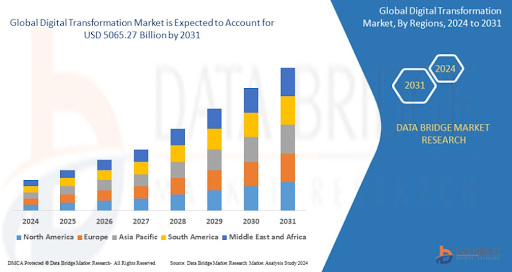
Source: Databridge market research
- The global digital transformation market was $929.94 billion in 2023, and it is estimated to be $5065.27 billion by 2031, expanding with a CAGR of 23.60% during the projected period.
- The United States of America is positioned as the most digitally competitive country in the world in 2023.
- The healthcare industry is the leader in adopting digital transformations in modern times.
- 56% of CEOs stated that digital transformation has resulted in growth in revenue.
- Artificial intelligence, Blockchain, Big Data, IoT, and Virtual Reality are some leading technologies that businesses integrate to transform themselves digitally.
So, these are the latest insights stating the situation of industries’ digital transformation. Now, let’s discuss the benefits of transforming industries by implementing cutting-edge digital technologies.
Explore more: AI in Digital Transformation for Enterprises
Benefits of Digital Transformation in Traditional Industries
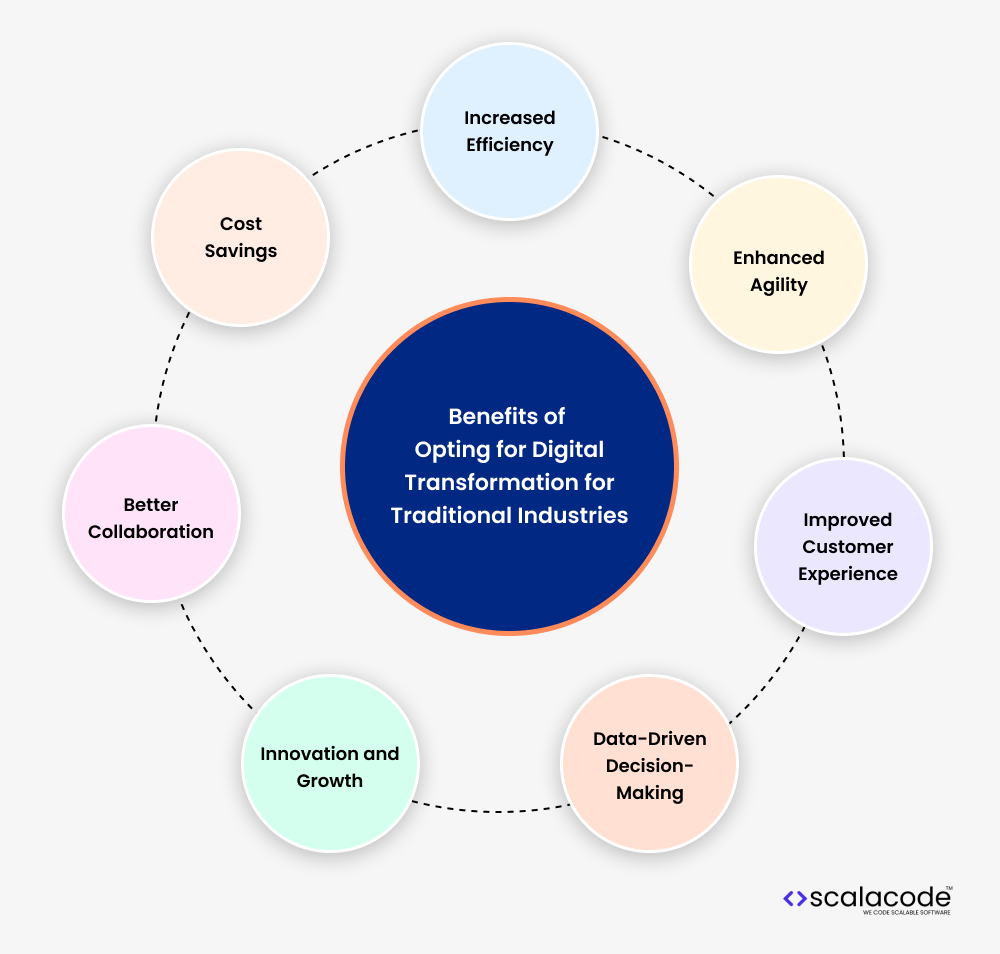
There are numerous benefits of transforming industries digitally. The top advantages are as follows:
1. Increased Efficiency
Transforming industries digitally streamlines operations and enhances their efficiency. Cutting-edge technologies such as Artificial Intelligence, Machine Learning, Big Data, and the Internet of Things (IoT) help with automating processes and allow for reducing manual tasks. This leads to faster and more accurate operations, leaving no room for errors.
2. Enhanced Agility
The market changes in the blink of an eye. New trends come and go, and businesses must adapt to these changes to stay competitive in the market. High-end technologies help businesses adapt to these market changes and emerging trends, and keep them competitive and relevant in the market.
3. Improved Customer Experience
Customer satisfaction is everything. If a business fails to keep its customers satisfied, it cannot survive in the market for a long time. Therefore, businesses must leverage emerging technologies, like generative AI, virtual reality, and blockchain to provide personalized and responsive customer services to enhance their satisfaction and gain their loyalty.
4. Data-Driven Decision-Making
Another benefit of opting for digital transformation is that it helps businesses make informed decisions backed by data. By accessing real-time data and using advanced analytics, businesses can understand what their customers want or what new strategies they need to make to enhance their experience and overcome challenges in the market, respectively.
5. Innovation and Growth
By introducing new technologies in businesses, you can create innovative products and services that your customers love, helping you gain a competitive advantage. Also, these technologies assist you in creating new business models and transforming your business, helping with driving growth and expansion.
6. Better Collaboration
Can you run your business using traditional communication techniques like writing physical orders or communicating by writing letters? In this digital era, you must leverage digital platforms and tools to communicate seamlessly with your teams to enhance your business’s productivity and innovation.
7. Cost Savings
Lastly, transforming a business digitally using emerging technologies reduces operational costs and increases your profits. In traditional industries where ten people do a particular task, it is now replaced by AI, performing the same task at a rapid pace without leaving a scope for error. Obviously, an AI-powered platform is much more cost-effective compared to ten men.
Read More: AI App Development Cost Estimation
Transforming traditional industries by leveraging brings numerous benefits to a business. That is why every industry is spending huge amounts of capital so that they can reap the fruits of it and stay competitive in the market.
Now, it is time to understand how digital transformation is reshaping traditional industries and how it can benefit your business.
How Digital Transformation is Reshaping Different Traditional Industries
Development of high-end digital solutions and emerging technologies in an industry, no doubt, can transform it as a whole, enhance its productivity and security, eliminate errors, and more.
In this section, we have discussed some top industries, the conventional challenges these face, and how new high-end technologies have resolved these challenges, completely transforming the sectors.
1. Healthcare
In recent years, healthcare has been one of the leading industries to embrace digital transformation. When we take a look at the conventional industries, there are many challenges, such as no proper patient care management. There were no facilities available to take care of patients efficiently.
Moreover, there was a high number of cases related to delaying treatment and diagnosis. It is difficult for medical experts to access patients’ past medical records to provide better treatment.
However, digital transformation helped hospitals and medical institutions overcome these challenges. In healthcare, hospitals installed Electronic Health Records (EHRs) for digitizing patient records, so they can be accessed by any authorized person at any time. Healthcare app developers also build telemedicine mobile apps to allow medical experts to provide remote patient care.
Moreover, emerging technologies like AI and Big Data played a crucial role in enhancing diagnosis accuracy, so that late and mistreatments can be avoided. Lastly, the use of AI-powered wearable devices rose so that patients could be monitored remotely and health issues could be detected in the early stages.
Also Read: Artificial Intelligence Revolutionizing the Healthcare Industry
2. Finance
Another key business embracing digital change is finance. The finance industry is always vulnerable to online fraud. Also, in conventional banks, there were issues with manual operations, which were very time-consuming.
Customers do not get the right services they are looking for. For example, the loan was available for the rich and middle class at the same interest rate. Moreover, the banks and financial institutions were also struggling with regulatory compliance challenges that affected their overall productivity.
The finance industry chose digital transformation to address all its past challenges. Financial institutions are currently building specialized fintech solutions to offer digital banking, peer-to-peer lending, and mobile payments.
Furthermore, prominent financial institutions are embracing emerging technologies such as artificial intelligence (AI) and blockchain to automate financial procedures, such as loan dispersals, identification verification, and tackling fraud.
To enhance customer experiences, banks and other financial institutions are now leveraging chatbots powered by generative AI. These chatbots can understand the context of customer requirements, using machine learning and natural language processing, and offer services that customers are actually looking for.
At last, to streamline regulatory compliance, the Regtech technologies have been implemented in the finance sector, so that productivity can be enhanced.
3. Manufacturing
Previously, the manufacturing industry faced many obstacles. The leading challenges are inefficient production processes, significant downtimes and machinery maintenance concerns, inconsistent product quality, and high operational expenses. All these obstacles negatively impacted revenue for many enterprises in the manufacturing sector.
However, the digital transition altered the manufacturing sector, and the industry is now operating at peak efficiency. Businesses in the industrial sector are deploying automated production lines and AI-enabled robotic systems to improve efficiency and eliminate errors.
They are also leveraging IoT technologies to transform traditional manufacturing into smart factories. They use sensors and IoT devices to monitor equipment and processes in real-time, anticipate maintenance needs, and reduce downtime.
Furthermore, they are using advanced analytics to examine enormous data sets in order to optimize production schedules, improve product quality, and manage inventories.
4. Retail
In retail, there were challenges related to inventory management. Many retailers were facing stockouts or overstock, which caused them losses. Hence, retailers use the best digital transformation services to address these difficulties.
They integrated AI and machine learning into their inventory management systems so that they can predict the accurate demand for products, using past data. The insights helped retailers manage their inventories effectively and fight challenges like overstock and out-of-stock.
But, this was not it. There were more challenges in the retail sector. The retailers who aren’t online were getting intense competition from budding e-commerce retailers like Amazon. And their customer reach was also limited due to their offline availability.
So, to compete with online retailers, they create online stores to widen their reach and run offline stores simultaneously. A perfect example of this is Walmart, which is an offline retailer but also has an online platform for customers who cannot reach out to their offline stores.
They leveraged the omnichannel strategies to provide customers with a uniform shopping experience, both online and offline. In their online platforms, they integrate AI to offer product recommendations based on specific customer needs, and generative AI-enabled chatbots to solve customer queries around the clock.
Retailers also integrated emerging technologies like blockchain and other high-end measures to enhance the security of online stores and protect users’ data.
5. Logistics and Supply Chain
The logistics and supply chain industry tackled traditional challenges like inefficient logistics and distributions by implementing the Internet of Things (IoT) and RFID to track shipments and inventories in real-time. These cutting-edge technologies help in enhancing visibility and transparency in the supply chain.
Moreover, logistics companies are transforming digitally by integrating Big Data analytics. This helps them optimize routes in real-time, so that packages reach their destinations on time, without incurring additional costs.
Additionally, companies like DHL are deploying AI-enabled drones and robots to make deliveries in local areas, resulting in lower transportation expenses and successful on-door deliveries.
Finally, logistics companies are also implementing blockchain technology to improve supply chain transparency and traceability.
6. Education
Students’ interest in studies is the most crucial factor that contributes to the success of an education business.
Therefore, to engage students, edtech companies are developing e-learning systems and interactive technologies such as virtual reality, mixed reality, and the Metaverse to create immersive learning experiences. Students learn better in these immersive experiences compared to conventional education methods.
Furthermore, leading educational institutions have also established digital administration systems to simplify administrative work and enhance digital communication, thereby improving communication among educators, students, and parents.
7. Energy
Last but not least, the energy industry has benefited significantly from digital change.
The energy companies began deploying IoT-enabled smart grids to better monitor and regulate energy distribution. They also deployed renewable energy technology, such as solar, wind, and hydro panels, to power the grid. This reduced the costs related to energy generation and benefited the energy businesses.
Furthermore, they used AI and predictive analytics to forecast energy consumption and optimize production and distribution efficiency. It also embraced blockchain to facilitate peer-to-peer energy trade while increasing transparency.
The digital transformation of the energy sector helped in overcoming conventional challenges like inefficient energy generation and distribution. It also helped in preserving the environment so that future generations can also enjoy the benefits of Mother Nature.
So, this is how digital transformation is contributing to reshaping the major traditional industries. If you also want to take advantage of technologies and transform your business, then explore the next section.
Also Visit: Why Digital Transformation Is Crucial for Business Growth
Real-Life Case Studies of Digital Transformation in Traditional Businesses
Here are some real-life examples of how traditional businesses benefited from digital transformation.
1. Nike
Nike is one of the leading sports apparel brands worldwide. The company usually sells its products through offline stores located in different parts of the world. Nike benefited from digital transformation when the company developed dedicated mobile apps so that their customers could shop for Nike’s products without needing to visit stores.
Over time, the app is equipped with advanced technologies like AI and machine learning that collect user data and recommend personalized products, fulfilling customers’ needs and increasing Nike’s sales. According to reports, Nike’s digital sales accounted for 26% of total sales in fiscal 2023.
2. Toyota
Toyota, one of the top automobile manufacturing companies, opened new doors of success through digital transformation. The automobile company integrated AI, advanced analytics, IoT, and autonomous robots in factories to streamline production and tackle different challenges that arise during the process.
Also, Toyota used technologies like CAD and 3D printing to create new automotive designs in real-time with minimal human participation. They also invested in virtual reality, allowing drivers to experience new vehicle driving experiences in a virtual environment.
In short, digital transformation has helped Toyota compete with rival automobile manufacturing giants and maintain its position in the market.
3. Quantflo
Quantflo is a leading player in the finance industry. The company created a state-of-the-art portfolio management system that addresses the dynamic requirements of financial professionals.
Quantflo’s portfolio management system helped in managing portfolios by analyzing data using AI and Big Data. The machine learning in the system helped finance analysts understand the investment potential of the clients and recommend various options, like stocks, real estate, digital gold, bonds, and more, to invest in.
How to Digitally Transform Your Traditional Business: Step-by-Step Guide
In this section, we have provided a step-by-step guide to transform your traditional business digitally.
Step 1. Analyze the Current State
First, conduct a thorough analysis of your current business. It includes the systems you are using currently and your business’s workflows and procedures for different operations.
Identify opportunities where technology can help you improve and increase your company’s efficiency.
Moreover, you can take references by studying your competitors and seeing how they use technology to achieve their aims.
Step 2. Create a Roadmap
After reviewing the existing situation of your business, you must develop a strategic roadmap for digital transformation.
For this, you can consult and employ a top digital transformation company in India. They can assist you in integrating cutting-edge technologies into your organization and increasing its productivity professionally.
Step 3. Execute the Plan
Now is the time to put your business’s digital transformation plan into action. Develop cutting-edge digital solutions like mobile apps and software and integrate cutting-edge technology like AI, Blockchain, the Internet of Things, and others into your existing systems and processes, to modernize your business successfully.
Step 4. Monitor
After executing the plan, you must monitor the performance of your business using different KPIs (key performance indicators). The KPIs can help you ensure that your organization is running well.
Also, you need to regularly upgrade your technologies and replace existing systems with new ones so that the systems work efficiently and your business grows.
So, by following this guide, you can digitally transform your business successfully.
Future Trends of Digital Transformation for Businesses
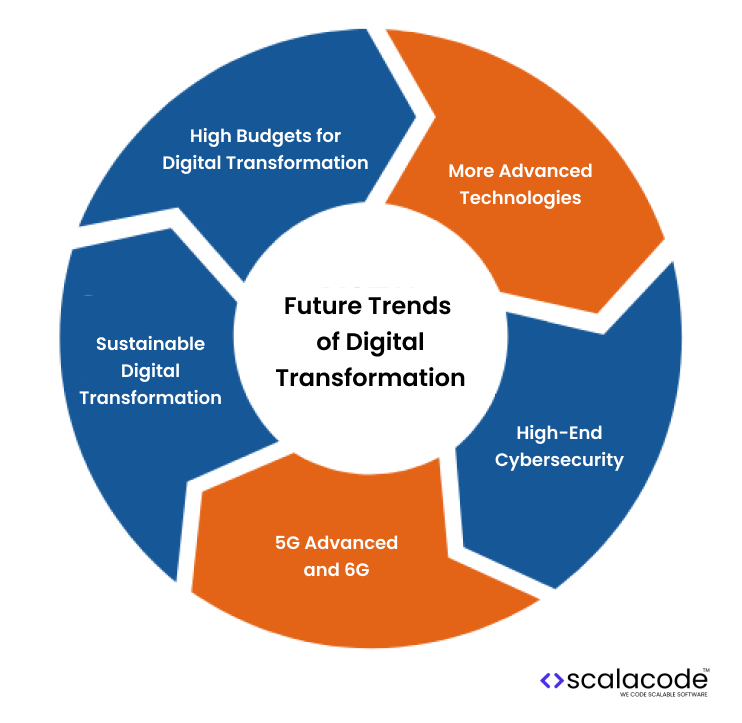
Now, let’s talk about what the future of digital transformation will probably look like. As we will witness innovation in technologies, more traditional industries will integrate cutting-edge technologies in order to stay competitive and survive in the market. As per our insights, the future of digital transformation would look like this:
1. High Budgets for Digital Transformation
In the coming years, more companies will invest in digital transformation. Not only this, but they will also increase their budgets so that they can access advanced technologies that empower the business.
Healthcare, finance, and manufacturing would be the leading sectors that will spend hefty amounts on their digital transformation.
2. More Advanced Technologies
Today, we are surrounded by AI, blockchain, IoT, virtual reality, and other similar technologies. In the next few years, we will witness innovations taking place in the technology sector to make these advanced technologies better.
Advanced AI algorithms, more realistic virtual reality-based environments, accurate data analysis, and more are some benefits that businesses get from innovations in current technologies.
3. High-End Cybersecurity
With innovations, there will be more risks of data being stolen or accessed by unauthorized persons. Therefore, businesses will invest more in cybersecurity to enhance the security of their databases and safeguard data from cyber-attacks and hacks.
There is also a chance that innovators combine cybersecurity with blockchain to take data security to a whole new level.
4. 5G Advanced and 6G
Many countries have started using the 5G network in the telecom sector. It offers better connectivity and high-speed data transfers between the devices.
In the coming years, a better version, named 5G Advanced will replace the current 5G. It will have more speed and better connectivity compared to existing 5G.
Moreover, followed by 5G advanced, there are more chances of introduction of 6G in different sectors for fast data transfers and better connectivity.
5. Sustainable Digital Transformation
Sustainable digital transformation is a process of digitally transforming traditional industries in a manner that does not affect the environment.
In the future, businesses will opt for sustainable digital transformation measures to digitally transform themselves while reducing carbon emissions and saving energy to protect nature.
Moreover, the government is also taking initiatives to set up Green Data Centers that are powered by renewable energy and designed for minimal environmental impact.
Explore More: Top Software Development Companies
Conclusion
Digital transformation is necessary for businesses in this digital era. If you are someone who isn’t using high-end technologies like AI, Blockchain, Big Data, and others, by now, then it would be difficult for you to compete with businesses that are using them.
With digital transformation, you can enhance your business’s productivity, improve customer experience, reduce errors, save costs, and more.
So, don’t sit back and act now! Contact the best software development company in India, and create custom digital solutions to transform your business digitally today.
FAQs
Here are some frequently asked questions related to digital transformation.
Q1. What is a digital transformation?
Digital transformation is a process of integrating cutting-edge digital technologies in industries and creating advanced business models so that business goals can be met successfully.
Q2. How can I transform my business digitally?
To transform your business digitally, you can opt for building custom digital solutions, like mobile apps, software, and other solutions tailored to your specific requirements.
Also, integrating cutting-edge technologies, such as AI, Blockchain, and IoT, into existing systems contributes to transforming your business.
Q3. How much does it cost to digitally transform my business?
The cost of digital transformation depends on many factors. The major ones are the requirements, technologies, technical team, and more. So, if you want to digitally transform your business, reach out to our experts today and we will provide you with a detailed cost breakdown for digital transformation for your business.