


The mental health app development is rotating its landscape by handing out innovative software solutions to support managing mental wellness. Recognizing and addressing mental health is significant in the current era. So, you need to think out-of-the-box solutions if you are looking forward to building an efficient mental health application. If we consider the figures, nearly one billion people in the world population are suffering from mental health issues, and traditional healthcare systems are not meeting the requirements of rising demands. Here, mobile app development companies for mental health come into play.
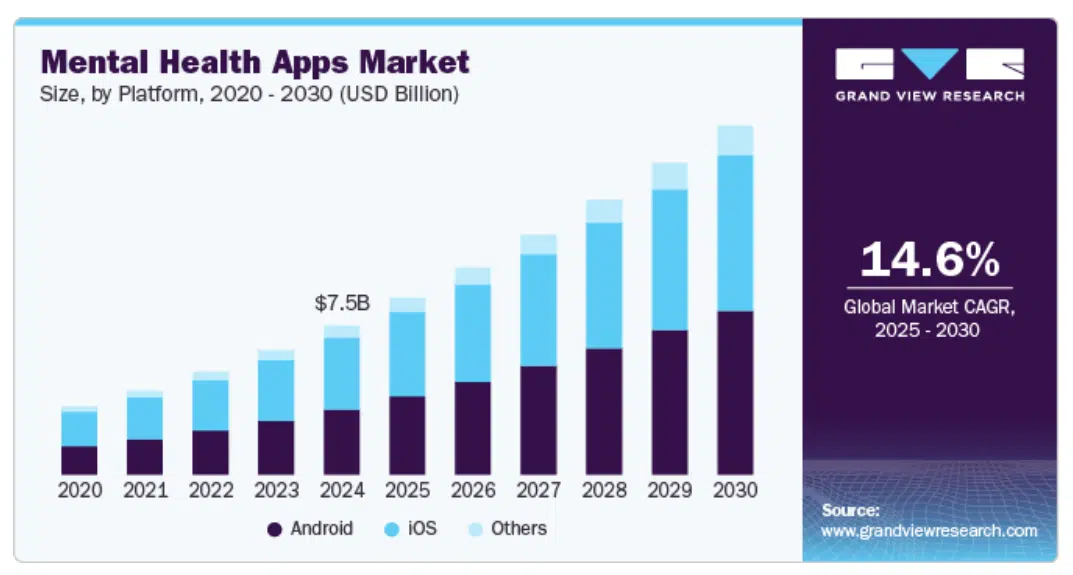
As per a report by Grand View Research, the global market size of mental health apps was estimated at USD 7.48 billion in 2024 and is expected to climb at a rate of 14.6% CAGR from 2025 to 2030.
Types of Mental Health Apps
With the emergence of new technology trends, mental health apps are upgrading their features to gain a competitive edge. Here are some of the major mental health app types:

1. Meditation & Mindfulness Apps
It aims to help users in various ways such as practicing relaxation, stress management, and emotional well-being through guided sessions. These apps typically include:
- Guided Meditation, Mental health specialists conduct sessions to help users focus, unwind, or improve their sleeping experience.
- Breathing Exercises, Box breathing and diaphragmatic breathing are the strategies used to manage anxiety levels.
- Sleep Stories & Sounds, Relaxing music or tunes, natural soundscapes, or narrating bedtime stories help to head towards a good sleep at night.
- Daily Affirmations & Mindfulness Reminders, Fostering a positive mindset and getting involved in vital self-care practices enhances one’s mental as well as emotional health.
- Progress Tracking, Users can keep a record of their previous sessions and track their meditation streaks.
Examples: Headspace, Calm, Insight Timer, Breethe
2. Therapy & Counseling Platforms
These applications help users connect with qualified, top-rated therapists to treat mental health problems. The mental health app development solutions are designed for individuals seeking professional counseling at their fingertips. There is no need to visit the therapist for the consultation. Features incorporated in the app are:
- Text-Based Therapy, End-to-end encrypted chat with therapists for ongoing sessions and consultation.
- Audio & Video Sessions, Virtual therapy sessions scheduled as per the user’s demand and convenience.
- Therapist Matching, Algorithms show the best recommendations to match the user with professionals based on their needs.
- Journaling & Self-Help Resources, Users have access to the articles, blogs written on mental health topics, and have the freedom to share their thoughts on the same.
- Subscription-Based Access, The apps give various offers or subscription benefits, including pay-per-session or monthly plans.
Examples: BetterHelp, Talkspace, Amwell, 7 Cups
3. Mood Tracking & Self-Assessment Apps
These mental health apps help in monitoring their emotional well-being by tracking moods, habits, routines, and mental health patterns over a certain time period. They commonly use:
These apps help users monitor their emotional well-being by tracking moods, habits, and mental health patterns over time. They often use:
- Daily Mood Logs, The app users can rate their mood and emotions with the use of sliders, emojis, or text inputs.
- Trigger Identification, These mental health apps provide AI-driven insights to help recognize patterns in mood swings or stressors.
- Activity & Habit Tracking, The users can track their daily activities such as sleep, exercise, and diet to establish a relationship with mental well-being.
- Personalized Reports & Insights, Visual data and trends aimed at facilitating users’ knowledge and understanding of their emotional health.
- Integration with Wearables, Using smartwatches to track physical activity and stress levels.
Examples: Moodfit, Daylio, Reflectly, MoodMission
Explore More: AI in Early Disease Detection
4. Community & Support Network Apps
The mental health app developers ensure that their solutions create safe spaces where users can connect with others for emotional support and shared experiences. The top features include:
- Peer Support Groups, The app enables topic-specific communities for users dealing with anxiety, depression, grief, etc.
- Anonymous Sharing, If the users want to share their thoughts but don’t want to reveal their identity, the app allows the same.
- Live Chat & Discussion Forums, It ensures real-time communication and moderated discussions for a better user experience.
- Mental Health Challenges & Encouragement, Community-driven activities help to increase user motivation and engagement.
- Expert-Led Groups, Few customized apps also include moderated discussions by mental health professionals.
Examples: 7 Cups, Wisdo, Sanvello, TalkLife
5. Cognitive Behavioral Therapy (CBT) Apps
CBT apps offer self-aid programs that are mostly rooted in evidence-based psychology. The aim is to help users manage mental health conditions like anxiety, stress, and depression. The app has multiple features including:
- Interactive Exercises, The CBT apps enable thought restructuring, behavioral activation, and exposure therapy techniques.
- Journaling & Thought Recording, The apps allow users to challenge negative thinking patterns.
- Personalized CBT Programs, The CBT mental health development apps enable step-by-step mental health plans tailored to the user’s concerns.
- AI-Powered Coaching, The app offers real-time virtual guidance based on CBT principles.
- Progress & Goal Tracking, It helps users to check their improvements over time.
Examples: Woebot, MoodKit, MindDoc, Sanvello
Explore More: Best AI Development Companies
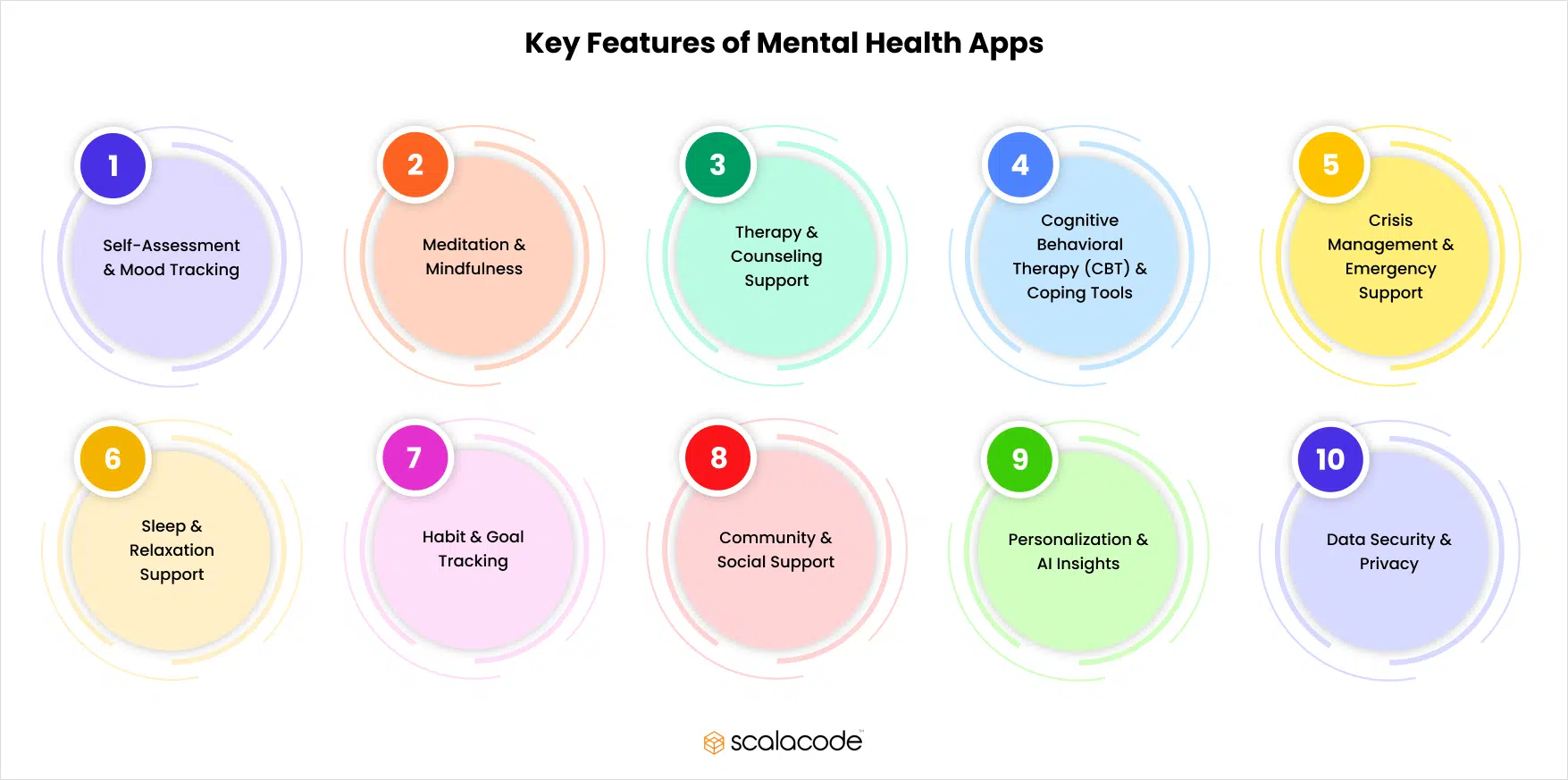
Key Features of Mental Health Apps
Mental health apps cater to a wide range of user requirements. The applications incorporate a huge range of features aiming to support emotional well-being, stress management, and mental health care. Here are some key features:
1. Self-Assessment & Mood Tracking
- Daily mood tracking & journaling
- Mental health self-assessments (e.g., depression, anxiety scales)
- AI-based emotional analysis
2. Meditation & Mindfulness
- Guided meditation sessions
- Breathing exercises
- Stress-relief techniques
3. Therapy & Counseling Support
- Access to licensed therapists (text, video, or audio sessions)
- AI-driven chatbots for support
- Peer support communities
4. Cognitive Behavioral Therapy (CBT) & Coping Tools
- Thought recording & challenging negative thoughts
- Exposure therapy exercises (for anxiety, phobias, and Post-Traumatic Stress Disorder)
- Self-help courses based on CBT principles
5. Crisis Management & Emergency Support
- SOS buttons to contact crisis helplines
- Suicide prevention resources
- Emergency contacts integration
6. Sleep & Relaxation Support
- Sleep tracking & guided sleep meditations
- White noise & calming sounds
- Bedtime reminders
7. Habit & Goal Tracking
- Daily self-care reminders (e.g., hydration, exercise)
- Goal setting for mental well-being
- Positive reinforcement & rewards system
8. Community & Social Support
- Forums for peer discussions
- Anonymous support groups
- Group therapy sessions
9. Personalization & AI Insights
- Tailored content recommendations
- AI-driven mental health coaching
- Personalized exercises depending on user progress
10. Data Security & Privacy
- End-to-end encryption for user data
- Anonymous usage options
- HIPAA/GDPR compliance for data safety (HIPAA stands for Health Insurance Portability and Accountability Act, and GDPR stands for General Data Protection Regulation)
Bonus Visit: Role of AI in Healthcare Industry
Challenges and Solutions in Mental Health App Development
Mental health app development comes with its own set of challenges. Given below are some major challenges, along with the ways to overcome them.

1. Data Privacy and Security
Challenge
Mental health apps handle critical data of users, which makes them a target for breaches. Users could be uncomfortable sharing their personal details.
Solution
- Carry out end-to-end encryption and secure authentication
- Adhere to data protection regulations (GDPR, HIPAA, or CCPA)
- Use unidentified methods and secure cloud storage to prevent unauthorized access.
2. Clinical Validation and Accuracy
Challenge
Mental health apps frequently offer therapeutic guidance, yet providing inaccurate or misleading or false information can be harmful to users.
Solution
- Connect and coordinate with licensed mental health professionals to ensure content accuracy.
- Base interventions on evidence-based techniques.
- Regularly update content with the new research on mental health.
3. User Engagement and Retention
Challenge
Users may fail to engage with it consistently after downloading the application. It will reduce its app’s effectiveness.
Solution
- Utilize gamification methods to hook clients. Some of the gamification methods are advanced, such as rewards and updates.
- Give personalized experiences through AI-driven suggestions based on users’ behavior or activities.
- Offer an assortment of substance groups to suit distinctive preferences.
4. Ethical Considerations and Crisis Management
Challenge
Mental health crises can emerge, and healthcare software development service providers must offer apps with the capability to handle emergencies responsibly.
Solution
- Include crisis intervention features, such as emergency hotlines and chatbot escalation to human support.
- Clearly state that the app is not a replacement for professional medical treatment.
- Implement AI-powered risk assessments. It will help to detect distress signals and suggest quick action.
5. Accessibility and Inclusivity
Challenge
All users have the same level of knowledge and digital literacy. It is possible that some of them may have disabilities affecting their ability to effectively use the app.
Solution
- Design the app using WCAG for inclusivity, where WCAG stands for Web Content Accessibility Guidelines.
- Provide text-to-speech features, changeable fonts, and real-time support in user’s preferred language.
- Ensure a simple, intuitive UI/UX. It must accommodate all age groups and skill levels.
6. Integration with Wearables and Other Digital Health Tools
Challenge
Many users wish that they could integrate mental health apps with wearables or other health platforms.
Solution
- Enable API integrations for activity tracking. Some of the commonly used self-care apps like Happify, Apple Health, Google Fit, and Fitbit.
- Use wearable data (e.g., heart rate, sleep patterns) to provide insights into mental well-being.
- Ensure seamless synchronization and real-time feedback for a comprehensive approach to mental health.
7. Monetization Without Compromising Accessibility
Challenge
Many mental health apps face difficulty in balancing revenue generation with affordability for users.
Solution
- Offer freemium models, where fundamental features are free, and premium features require a membership or subscription.
- Give rebates and other offers for the non-employed population and low-income users.
- Join hands with healthcare or insurance providers to offer access as part of wellness programs.
The challenges faced in the app development process can be ruled out through the proper implementation of solutions. AI development company offers quality developers who are well-experienced to tackle every situation.
Future Trends in Mental Health Apps
Mental health apps ideas to ensure a future-proof solution catering to the rising user demands. Artificial intelligence, data science, and immersive technologies boost user experiences. Let us discuss the top mental health app ideas that will dominate in the future in this section:
1. AI-driven mental health assistants
Users can experience a more empathetic and context-aware AI-driven virtual therapists who offers multiple perks:
- Customized emotional support using AI chatbots
- Voice & facial emotion recognition to identify distress
- Detection of thought patterns and cognitive distortions through AI-assisted journaling
Example: Artificial intelligence can track mood patterns and suggest solutions by analysing real-time data of users.
2. Hyper-Personalized Mental Wellness Plans
Generative AI in healthcare apps for mental illness will use ML to build dynamic mental health strategies that adapt to:
- User mood fluctuations
- Past app interactions & therapy sessions
- Physical health metrics
Example: The app might suggest breathing exercises, meditation, or therapist check-in if the user reports high anxiety levels. a short meditation, or a therapist check-in.
3. Virtual Reality (VR) & Augmented Reality (AR) Therapy
VR-based exposure therapy will aid the app users in confronting phobias, PTSD, or social anxiety in well-managed environments.
AR-guided mindfulness exercises will permit users to build a calming space irrespective of their whereabouts.
- Virtual calming rooms for stress relief
- AI-powered VR meditation & relaxation experiences
- Gamified VR therapy for younger users
Example: VR-powered “fear exposure therapy” can help users with social anxiety practice public speaking in a safe virtual setting.
4. Mental Health Wearables & Biometric Tracking
Apps will increasingly sync with wearable devices or gadgets like smartwatches, rings, and even neural headbands to:
- Track stress levels, heart rate variability (HRV), and sleep quality
- Detect early signs of burnout or depression
- Provide real-time solutions to cope with the problem based on biometric signals
Example: If a user’s heartbeat count spikes due to anxiety or any other reason, the app may signal for a relaxation exercise or suggest a quick break.
5. Blockchain for Mental Health Data Security
To handle the issues related to privacy and data security, blockchain will:
- Ensure anonymous therapy sessions
- Offer damage-proof mental health data
- Give users full access to their data
Example: Users can pick what information to share with therapists, researchers, or mental health app developers without putting their privacy at stake.
6. Gamification & Social Support Systems
Apps incorporate gamification elements that boost engagement and prevent therapy dropout rates:
- Daily mental health challenges & rewards
- Social leaderboards & streak tracking
- Peer support networks with AI-powered moderation
Example: A gamified self-care app that offers users to accomplish exhilarating tasks to earn eye-popping rewards and unlock achievements.
7. Workplace Mental Health Tech & AI Burnout Detection
More enterprises will look forward to integrating mental health apps into their existing wellness programs:
- AI-driven burnout detection (via work patterns & biometric data)
- Anonymous employee mental health check-ins
- Corporate mindfulness programs & stress-reducing tools
Example: If AI detects burnout risks, the app may recommend breaks, time off, or workplace meditation.
8. Psychedelic-Assisted Therapy Companion Apps
With the growth of legalized psychedelic therapy like psilocybin, MDMA, and ketamine, the mental health apps will:
- Assist users with psychedelic-assisted therapy
- Offer integration tools for post-therapy reflection
- Provide tailored journaling & therapist connections
Example: An app facilitates the users to prepare, navigate, and integrate their psychedelic experiences seamlessly.
Ensure your application is future-proof and incorporates the latest trends to boost revenue. Convert your idea into reality with reliable software development services.
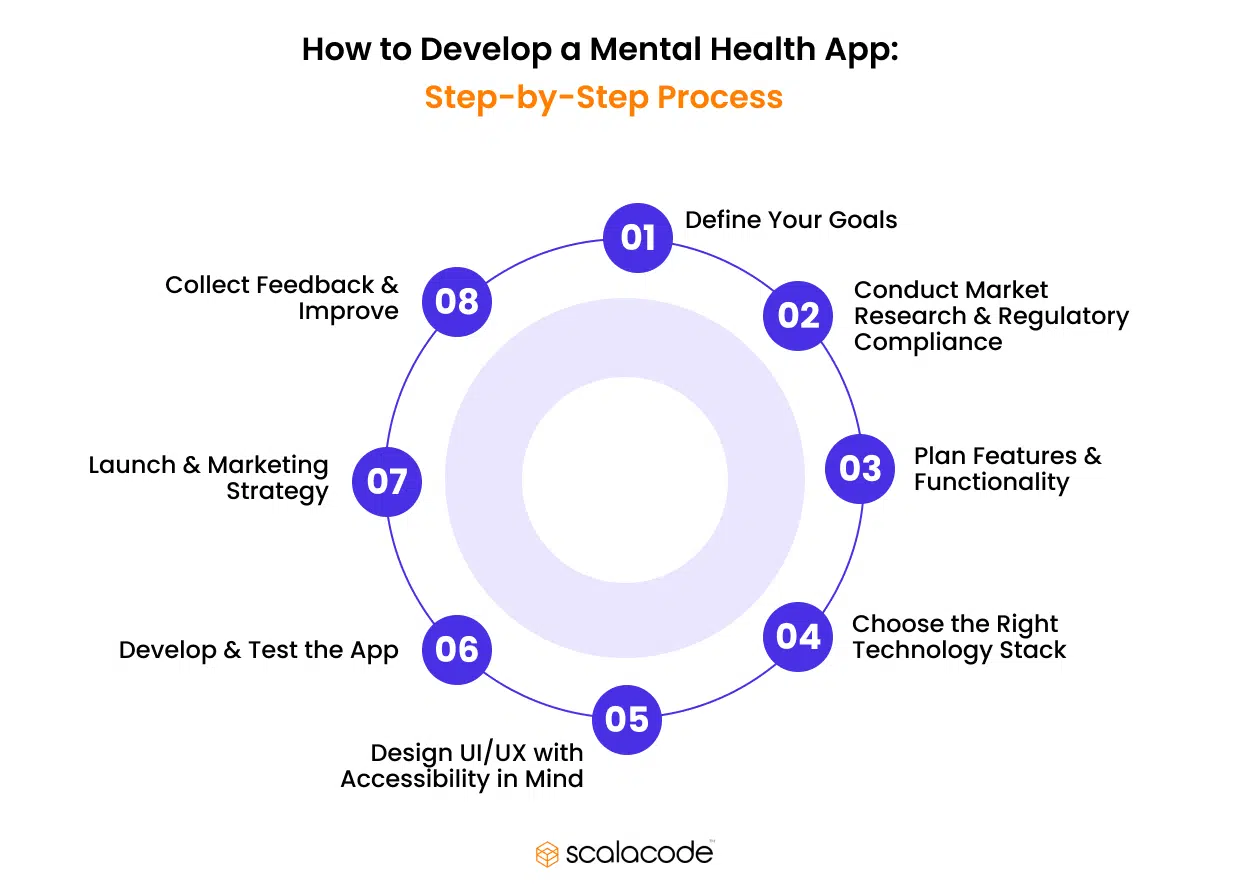
How to Develop a Mental Health App: Step-by-Step Process
Mental health app development needs rigorous planning, technical expertise, and a deep analysis of users’ rising requirements. Let us discuss a step-by-step approach to develop a mental health app:
Step #1: Define Your Goals
- Identify the purpose of your app
- Determine the target audience
- Research competitors and find out the gaps in existing mental health apps.
Step #2: Conduct Market Research & Regulatory Compliance
- Study market trends and user interest.
- Connect with mental health experts for insights.
- Ensure compliance with relevant regulations
Step #3: Plan Features & Functionality
Here are some essential features to consider:
- User profiles & personalization
- Mood tracking & journaling
- Assisted meditation & mindfulness exercises
- CBT-based self-help tools
- AI chatbots or virtual assistants
- Teletherapy or in-app live counseling
- Push Notifications for Motivation & Reminders
- Community support or peer forums
Step #4: Choose the Right Technology Stack
- Platform: iOS & Android or cross-platform.
- Backend: Node.js, Python, Firebase.
- Database: PostgreSQL, MongoDB, or Firebase Firestore.
- Security Measures: End-to-end encryption, secure authentication, and data anonymization.
Step #5: Design UI/UX with Accessibility in Mind
- Ensure that your design is clear, soothing, and user-friendly.
- Try to use calming colors and intuitive navigation.
- Make sure the app offers accessibility for all users, including those with disabilities.
Step #6: Develop & Test the App
- Start with an MVP with core features. MVP stands for Minimum Viable Product.
- Don’t forget to conduct beta testing with real users for genuine feedback.
- Perform security audits. Fix the bugs before launching the app.
Step #7: Launch & Marketing Strategy
- Publish on the Play Store & App Store.
- Implement App Store Optimization (ASO) to ensure improved visibility.
- Utilize social media, collaborate with mental healthcare experts, and engage influencers to boost outreach and credibility.
Step #8: Collect Feedback & Improve
- Analyze user behavior with analytics tools.
- Regularly update the app with new features and fixes.
- Engage with users through surveys and reviews.
It is important to hire mobile app developers to get quality assistance in building high-performing applications.
Also Read: Integrating EHRs into Your Existing Healthcare System
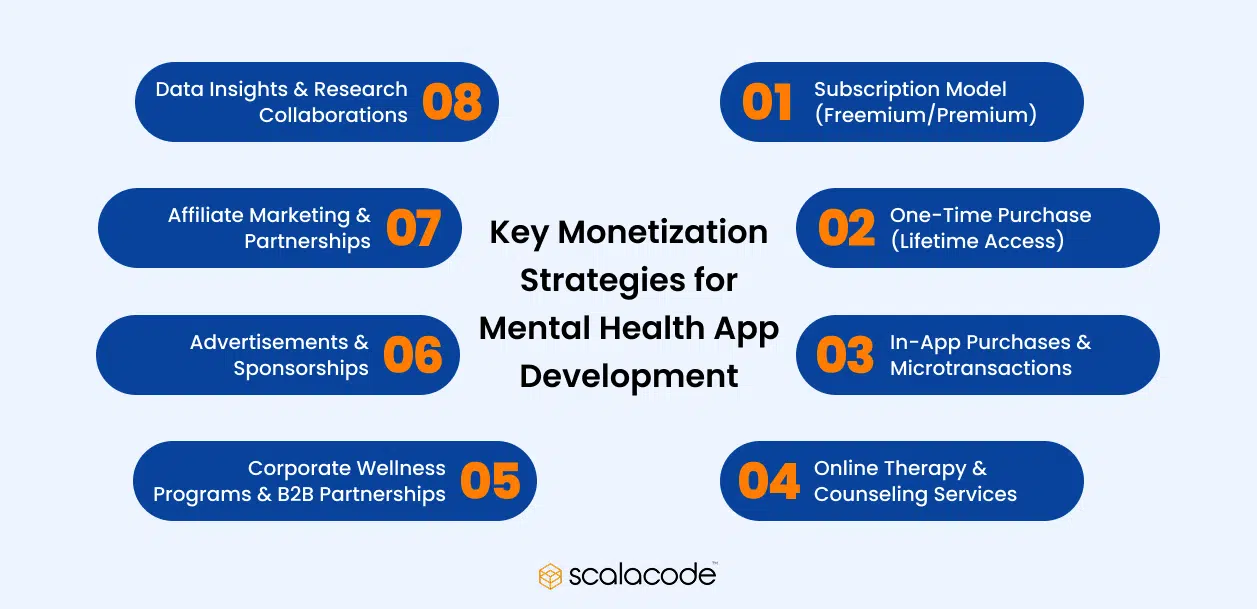
Key Monetization Strategies for Mental Health App Development
Here are some key monetization strategies for a mental health app:
1. Subscription Model (Freemium/Premium)
☑️ Offer basic features for free and charge for premium content. For instance, guided therapy sessions, advanced mood tracking.
☑️ Monthly, quarterly, or yearly subscription plans.
2. One-Time Purchase (Lifetime Access)
☑️ Charge a one-time fee for full access to the app.
☑️ Works well for meditation apps or self-help programs.
3. In-App Purchases & Microtransactions
☑️ Sell add-ons to attract users such as personalized therapy plans, extra meditation packs, or guided sessions.
☑️ Offer premium journals, AI-driven mental health assessments or soundscape.
4. Online Therapy & Counseling Services
☑️ Partner with licensed therapists and provide teletherapy or text-based counseling within the app.
☑️ Charge per session or offer subscription-based therapy plans.
5. Corporate Wellness Programs & B2B Partnerships
☑️ Partner with businesses to offer the app as part of employee wellness programs.
☑️ Charge companies per employee subscription.
6. Advertisements & Sponsorships
☑️ Partner with mental health organizations or wellness brands for non-intrusive ads.
☑️ Offer ad-free experiences for premium users.
7. Affiliate Marketing & Partnerships
☑️ Promote relevant products like wellness books, mental health courses, or therapy services.
☑️ Earn commissions on referrals.
8. Data Insights & Research Collaborations
☑️ Partner with mental health researchers (with anonymized data) for insights.
☑️ Ensure strict compliance with privacy regulations (HIPAA, GDPR).
Quick Wrap Up
The future of mental health app development is driven by cutting-edge technologies. The growing demand of mental health apps pushes the healthcare software development services providers to bring a complete solution catering to users’ needs. Ensuring regulatory compliance, better user experience, and user privacy will surely help to build a top-notch mental health app.
With the evolution of the industry, the mental health apps exhibit its potential to bridge the critical gaps in traditional healthcare. It makes mental wellness support more accessible and effective for worldwide users. Approaching custom health software development services is the one-stop solution for all your app development requirements.
Build a customized mental health app with AI-driven insights, real-time therapy support, and seamless user experience.
FAQs
Q1. Are mental health apps effective?
techniques like CBT, meditation, and professional counseling. However, you cannot overlook the need for professional medical consultation for severe conditions.
Q2. How can AI enhance mental health apps?
AI-driven features offer real-time mental health support through chatbots, emotion recognition, and personalized therapy suggestions. It helps users track and enhance their mental well-being efficiently.
Q3. Can a mental health app replace a therapist?
No, a mental health app can only expedite the processes by saving your time in booking therapy by providing self-help tools, guided exercises, and 24/7 support. However, it cannot replace professional mental health treatment for serious mental health conditions.