
Did you know? It is a global problem as over 50% of deaths globally are attributed to non-communicable diseases such as heart diseases, cancer, and diabetes, among others.
Statistics from WHO indicate that noncommunicable diseases (NCDs) are claiming the lives of 41 million people annually.
That is equivalent to approximately 74% of all annual deaths across the world.
That’s a really huge number!
But what is worrisome here is that the above deaths could have been avoided if only the diseases had been diagnosed early. Indeed, the early detection of diseases provides that advantage.
But to make this happen, we require technical support. Not surprisingly, the healthcare sector is constantly changing. It is becoming more complex.
It thus has been seen that with regards to digital technologies like Artificial Intelligence (AI), Machine learning (ML), Augmented Reality, 3D printing, Robotics, and others, there lies -
- improving clinical outcomes
- Reducing human errors
- speeding up the treatment process
- tracking data over time
- enhancing patient care
For instance, AI can analyze patient records and medical images to diagnose diseases accurately. Designing AI algorithms for early disease detection has been observed to significantly contribute to saving lives.
One such real-time example is-
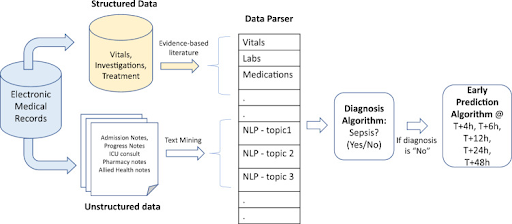
A research carried out in 2017 involving patients diagnosed with risk factors of stroke whereby, AI algorithms were employed depending on symptoms of initial stages and the genetic predisposition.
The study shows that the alert generated by the AI algorithm for early detection of sepsis had an accuracy of 87%.
So, how exactly does AI in early disease detection revolutionize healthcare? Let’s have a proper look into the matter.
Why Early Disease Detection Matters?
The WHO has indicated that over 70% of deaths occurring worldwide can be attributed to chronic diseases. Moreover, these may be prevented or diagnosed early in certain stages.

These diseases should therefore be detected early in order to be fought well. Treatment carried out in the early stage, not only offers health improvements but financial costs too. There is no doubt- Artificial Intelligence Revolutionizing the Healthcare Industry.
In short-
“The earlier the disease is detected, the higher the probability of its successful treatment.”
Furthermore, conventional diagnostic techniques mostly depend on signs that may manifest at a later stage of a particular disease.
This delay in making a diagnosis will inevitably affect the treatment outcomes and the overall well-being of the patient.
This is where AI comes into play. Implementation of AI and its various forms like Generative AI and Adaptive AI provides a strong new strategy for the early diagnosis of diseases.
How? Let’s move further to know the role of AI in early disease detection.
The Role of AI in Early Disease Detection
Artificial intelligence (AI) refers to the simulation of human intelligence in machines that are programmed to think and learn like humans.
It operates by learning from large amounts of data and making decisions or predictions based on this learning.
In healthcare, AI plays a crucial role in transforming early disease detection in several ways. In the context of disease diagnosis, AI algorithms are trained on large datasets of medical data to learn the patterns associated with different diseases.
Healthcare providers or organizations just need to grab help from the best software development company in India that can code AI algorithms.
Once the software is trained, these AI algorithms can analyze new patient data and identify the presence of a disease with a high degree of accuracy.
Moreover, there are several different subsets of AI that are used in disease diagnosis. Some of the important ones are-
- Machine Learning
- Neural Network
- Deep Learning

Besides, some of the methods used in AI for disease detection include:
1. Medical Imaging Analysis
One of the most exciting applications of AI in early disease detection lies in medical imaging analysis. AI algorithms can analyze X-rays, mammograms, MRIs, and other scans with incredible detail and accuracy.
Moving on, these algorithms can detect subtle patterns and anomalies that might be missed by the human eye. Ultimately, this can lead to earlier diagnoses of cancers, heart disease, and other conditions.
Furthermore, a study published in Nature Medicine in 2024 showcased the potential of AI in lung cancer detection. Researchers developed an AI system that analyzes chest X-rays. With that data, some radiologists were able to detect lung nodules, a potential sign of cancer.
This is particularly significant in areas with limited access to specialists, where AI can play a crucial role in early diagnosis.
2. Predictive Analytics
Another role of AI in early disease detection is through predictive analysis.
The technique of predictive analytics with AI can be a rich tool when it comes to preventing health complications.
What if -we say AI-based predictive analytics have predicted the emergence of the COVID-19 pandemic? Shocking!
And the answer is yes. BlueDot a firm based in Toronto that specializes in AI software development services warned on December 30, 2019, of emergent new unknown pneumonia in Wuhan.
But what no one knew was that just only nine days later, the World Health Organization released an official statement regarding the emergence of the novel coronavirus.
Apart from this, let’s have one more example. An AI model may estimate the likelihood of developing type 2 diabetes by checking age, weight, family background, and diet.
Using such information, practitioners may advise patients on changes to make to their lifestyles or medications. In that way, it can help them not develop the disease further.
Now, let’s explore the potential benefits of leveraging AI in early disease detection even further.
Benefits of AI in Early Disease Detection
Today, artificial intelligence is frequently used in digital transformation services for enterprises. AI in healthcare is now normal. The potential benefits of AI in early disease detection are numerous: You get to improve the quality of life for patients, save on healthcare software development costs, and even save lives.
To understand this in more depth, we have shared various benefits that AI brings to early disease detection:
#1. Enhancing Diagnostic Accuracy
One of the most significant advantages of AI is its ability to improve diagnostic accuracy. Traditionally, diagnoses are made based on the interpretation of medical images. However, humans can make errors.
This is where AI steps in. AI algorithms, trained on thousands of images, can identify patterns and anomalies that may be missed by the human eye. Thus, ensuring a higher diagnostic accuracy.
For example, AI systems that have been developed by AI developers have the potential to detect specific diseases. AI tools can detect cancers, such as breast cancer, more accurately than ever before. These systems can analyze mammograms (x-ray pictures of the breast) with precision.
#2. Early Intervention
Diseases, in their early stages, can be easily diagnosed by AI-powered software before the human body is irreversibly affected.
This early intervention capability of the implementation of AI is beneficial in minimizing the loss of lives. Also, it helps minimize the severity of the treatment needed by the patient and increases the quality of life.
#3. Speedy Diagnosis
Speed is a critical factor when dealing with many diseases. Since the capabilities of AI include speedy data interpretation, diseases can be identified at an early stage.
This, in turn, increases the rate at which the treatment process is initiated. Ultimately, this makes it easier for the patients to be treated and have a higher probability of being cured.
#4. Real-time Monitoring and Alert Systems
Artificial intelligence is not solely about predicting or even diagnosing diseases. Yes, you read that right. It is more than that. AI is also introduced to software solutions for constant, 24/7 tracking of a patient’s condition.
Wearable devices that track body statistics, for example-
- heart rate
- blood pressure
- Glucose levels can be used to detect disease.
These devices are usually AI-based. These systems can then process this data in real-time and if something abnormal is observed in the patient’s activity, then it informs the patient and the healthcare givers.
And for this busy life, this immediate feedback is important to avert serious health complications as they occur. Thus, smart AI-based devices are a beneficial factor in AI for early disease detection.
For example, smart wearables for diabetic patients can continuously monitor the increase in blood glucose levels and notify the patient to take their insulin or have a proper meal.
#5. Reducing Healthcare Costs
By detecting diseases early, AI can significantly reduce healthcare costs associated with advanced disease treatments. Early detection means-
- less invasive treatment
- fewer hospital stays
Overall, lowers the treatment burden on the healthcare system.
Moreover, this efficiency not only benefits patients but also helps healthcare facilities allocate their resources more effectively.
Bonus Visit: Generative AI in Healthcare
Real-Life Impacts of AI on Early Disease Detection
Besides the 2017 stroke prediction study, there are countless other instances where AI has made a difference. For example, Google’s AI algorithm can detect diabetic retinopathy with a high level of accuracy. In fact, in various aspects, Google Cloud Healthcare API is transforming healthcare providers.
AI has shown remarkable success in detecting early-stage diseases, often at times when human screening would likely miss them.
To truly understand the impact of AI, let’s look at real-world applications that have made significant strides in early disease detection.
1. Cancer Diagnosis
One of the most noteworthy contributions of AI is in the field of oncology. AI algorithms can scrutinize mammograms or skin lesions with remarkable precision. As a result, this often detects early signs of cancer. Plus, screening in terms of early detection helps in reducing mortality rates.
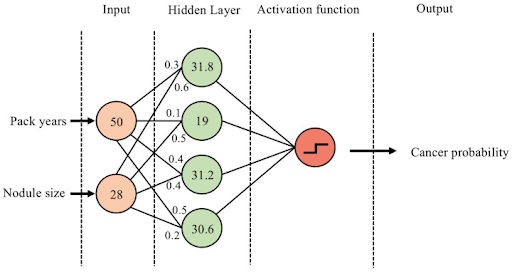
Numerous studies have shown the potential benefits of AI in early detection of cancer. For example, Muhammad et al. recently used an Artificial Neural Network (ANN) to predict the risk of pancreatic cancer. The checking factors were age, smoking, alcohol use, and ethnicity.
In simple terms, an ANN works like this:
- Input Layer: Takes in the data (e.g., age, smoking status).
- Hidden Layer: This layer has multiple nodes that process the input. Each node multiplies the input by a weight, adds a bias value, and then sends the result forward.
- Output Layer: Combines the results from the hidden layer and passes them through an activation function to make a prediction.
Isn’t it amazing how technology can provide such hope in such critical areas?
2. Predictive Analytics in Heart Disease
Another key area in which artificial intelligence demonstrated significant potential is heart disease. For this, the AI tool uses records from patient history, DNA profiling, and chronicle of the patients’ activities.
Taking this forward, AI can extrapolate and come up with the approximate probability of the patient being afflicted with heart disease.
For instance, Dawes TJW’s research shows AI can predict death periods for heart disease patients. The process took place by analyzing cardiac MRI scans and blood tests, tracking 30,000 heart points per heartbeat.
With eight-year health records, AI achieved 80% accuracy for five-year survival predictions, compared to clinicians’ 60%.
Moving ahead, we have more examples of how AI in the early detection of heart disease is impactful. Motwani M’s study also found AI superior in assessing five-year death risks for 10,030 CHD patients over traditional methods.
3. AI in Detecting Diabetic Retinopathy
Diabetic retinopathy is a condition that can lead to blindness if not diagnosed and treated early. Traditional screening methods require highly trained specialists and can be time-consuming.
However, with the implementation of AI, retinal images can be analyzed quickly, identifying those at risk much earlier than before. This leads to timely intervention and significantly reduces the risk of vision loss.
4. Alzheimer’s Disease
Current approaches for Alzheimer’s disease see the application of machine learning algorithms in analyzing neuroimaging data. This novel technology keeps growing in its ability to identify early signs of a potential user’s dementia even when no symptoms are visible.
This is a great improvement as the disease can be diagnosed early which will have a great impact on changing the condition of the disease.
5. Eye Disease
Even eye diseases are not left behind when it comes to diagnoses with the help of artificial intelligence. Through analyzing eye scans and retinal images, diseases like glaucoma and macular degeneration can be diagnosed in their early stages.
This early detection is useful because it will help people avoid their vision from getting worse.
6. Infectious Diseases
When it comes to global health in relation to infectious diseases, developments in AI include outbreak tracking and disease trend prediction given multiple interconnected data inputs.
Also, it is in the diagnosis of viruses where a doctor is able to determine if a virus is going to develop resistance or how dangerous it is going to be. One example of it can be applied in estimating the early stage of COVID-19, which highlights the significant usage of AI in handling epidemics.
7. Liver Diseases
Liver diseases are some of the numerous diseases that are known to affect human beings, and the good news is that if they are detected on time, then there is a tendency that the diseases will be controlled.
The majority of hepatology or liver-related diseases can now be diagnosed using MRI or ultrasound scans that are operated by Artificial Intelligence algorithms that are becoming efficient in diagnosing liver fibrosis or fatty liver.
These tools can also help in determining the probability of expanding liver disease and thereby enhance the well-being of patients.
8. Respiratory diseases
Another field that AI focuses on is respiratory diseases, like asthma or COPD, because diagnostic algorithms, for instance, can scan spirometry data or properly analyze sounds of breathing under these illnesses.
9. Bone and Joint Diseases
In the case of bone and joint disorders, diagnostic imaging involves AI in interpreting X-ray or MRI scans to detect the initial signs of osteoporosis or arthritis. Conditions that, when identified earlier, can reduce the patient’s outcome and the amount of pain the patient experiences can be identified.
Challenges Most Often Encountered in Integrating AI for Early Disease Detection
Of course, integrating AI into early disease detection isn’t without its challenges. Issues such as data privacy, security, and the need for massive datasets for AI training are significant hurdles.
Understanding these hurdles is key to effectively implementing AI solutions that can revolutionize healthcare.
1. Data Privacy and Security
For healthcare, one of the main issues is that the anonymity of such systems is the patient data’s privacy and integrity. Since AI systems will need to receive millions of patients’ personal and medical data, confidentiality and data protection rules become paramount. This is why there is a necessity for governments and healthcare providers to ensure that there are strict rules put in place, and also the need to invest in good cybersecurity solutions.
2. Ethical Considerations
Another challenge revolves around ethical issues. Questions about the transparency of AI algorithms, patient consent, and the potential for bias in AI-driven decisions are of paramount importance. It is essential to develop ethical guidelines for the use of AI in healthcare to ensure fairness, transparency, and accountability.
3. Access to Quality Data
Machine learning algorithms and artificial intelligence require enormous, versatile, and high-quality data samples for training and performance. Still, getting hold of such data may not be very easy. In other words, the data has to be complete, properly described, and random in regard to the population to prevent inequalities and increase the AI solutions’ credibility.
4. Integration with Existing Healthcare Systems
Integrating AI technologies with existing healthcare infrastructure poses practical challenges. Healthcare providers need to update their systems, processes, and workflows to accommodate AI tools.
Additionally, there must be a focus on training healthcare professionals to work alongside AI, ensuring a seamless integration of human intelligence and artificial intelligence.
So, what’s the solution? Collaborate with an AI-infused healthcare mobile app development company. Yes, healthcare professionals and organizations can take the help of experienced tech teams who are apt to deliver high-quality and secure AI solutions that match healthcare regulatory standards.
By working together, we can address these challenges head-on, ensuring AI is used responsibly and benefits all.
Explore More: Top AI Development Companies in India
The Future Prospects of AI in Early Disease Detection
Hence, the question arises, what’s in store for AI in early disease today? The probabilities are therefore bright without a doubt. This is so because, with time, AI technology is set to become deeper into the healthcare system.
Thus, it is evident that using AI in early dynamic detection is not something reserved only for the future, it is a reality today. Moreover, new technologies are being created for early signs of the diseases, hence improving early diagnosis for patients.
If we are to look at the horizon of medicine right now, we are at the threshold of a new age for medical science that could significantly enhance our ability to diagnose as well as manage diseases and provide quality patient care.
As a matter of fact, the idea of using AI for early disease detection is evidence that science can change our lives in a positive way. And so, the journey goes on, the healthcare advancing steadily for the time when people will be offered an opportunity to treat diseases before they turn into lethal threats.
Isn’t it comforting knowing that AI is driving this new era of healthcare?
Furthermore, the future might see more happening if you connect with the most reliable AI consulting and integration company in India. This partnership could redefine patient care, making healthcare more responsive, effective, and personal.
Wrapping Up
The role of AI in early disease detection cannot be overstated. It encompasses high precision, speed, and client-specific services that have the potential to save millions of lives due to early diagnoses of diseases. Obviously, the process of introducing AI in healthcare is not limited to these steps, but some work has been done already.
Every passing day demonstrates that the future of medicine is already here, and AI uses are in high demand.
So, as we look to the future, the question remains: how can we keep on advancing the capability of using AI in the early stages of a disease?
The answer appears obvious- it is with these technologies, supporting their advancement, and tackling these issues that we can change healthcare for the better. Isn’t that a future we should strive for? Yes we should, you can partner with an AI development company like ours to get innovative support to deal with various business challenges in the healthcare sector.
Elevate your healthcare practice now!