
Revolutionizing Patient Care with Cloud Computing in Healthcare!
Cloud computing for healthcare is transforming the healthcare industry by handling data, caring for patients, and finding new ways to improve services more effectively. The healthcare cloud computing market will develop from $39.4 billion in 2022 to $89.4 billion by 2027, due to its integral part in modernizing medical services.
Using clouds in healthcare goes beyond what’s trendy, it is now needed. Many hospitals and clinics have moved to the cloud to store large amounts of patient information, manage virtual care, and make sure doctors coordinate more effectively.
In reality, over four out of five healthcare organizations have begun using cloud applications, demonstrating how quickly the sector is advancing in digital infrastructure.
Thanks to EHRs, healthcare mobile apps, and AI diagnostics, cloud platforms now have unbeatable scalability and accessibility for all users. They allow healthcare professionals to decide more quickly and provide higher-quality patient outcomes.
At the same time, the quick switch to cloud computing can be daunting since you may end up with data breaches, compliance issues, and uncertain service from vendors. Healthcare leaders need to know about the benefits, types, and risks connected to cloud computing while guiding change.
In this latest blog on “cloud computing in healthcare,” you will get to know what exactly it is, cloud computing healthcare benefits, real-world examples, and much more.
What is Cloud Computing in Healthcare?
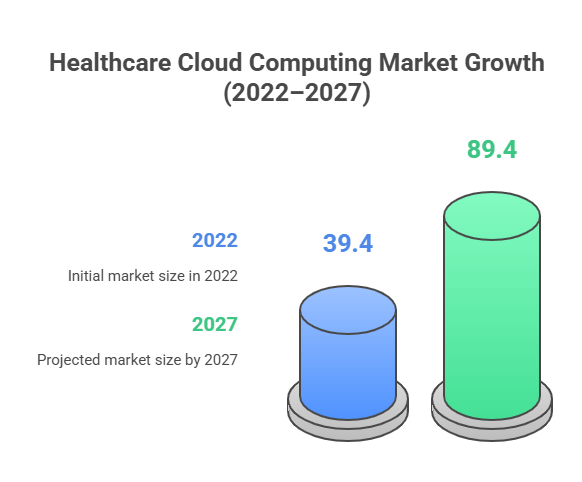
The market of cloud computing in the healthcare industry is going to increase in 2027 by a measure number.
Collecting, organizing, and processing medical information in healthcare with internet-based servers is known as cloud computing for healthcare. It allows healthcare providers to easily exchange and use patient data in the moment, which aids in making choices and improving patient care.
Normally, patient records and health software were saved on local servers, so sharing data was restricted and complex for other places. Through cloud computing, people can access data easily and safely from any connected device.
As a result, healthcare providers at clinics, hospitals, or remote places can easily access necessary health information quickly. Google Cloud Healthcare API also enables seamless integration between EHR systems and AI-based diagnostics using standardized protocols.
In addition, cloud computing makes it simple for staff from different departments and groups to work together. A doctor in one area can look at the findings from another doctor’s tests and provide appropriate treatment options online, avoiding the need for more tests.
Cloud computing healthcare industry makes it possible to integrate new innovations such as AI, ML, and the IoMT. Because of cloud infrastructure, these technologies are able to analyze large sets of data rapidly and use that information to warn about epidemics and arrange personalized care for patients.
A major benefit is the ability to restore services during and after disasters. Reliance on the cloud can mean healthcare providers still have their data when systems fail, are attacked, or are struck by natural disasters.
Cloud computing increases how well healthcare is provided, lends a hand in digital transformation services, improves workflow effectiveness, and centers care around the patient in the current medical scene.
Now, we have pronounced the name of the major benefits of cloud computing for healthcare, let’s look into it. In the next section, we will discuss the benefits of cloud computing in the healthcare industry.
Also Read: Digital Twins in Healthcare
Benefits of Cloud Technology in Healthcare
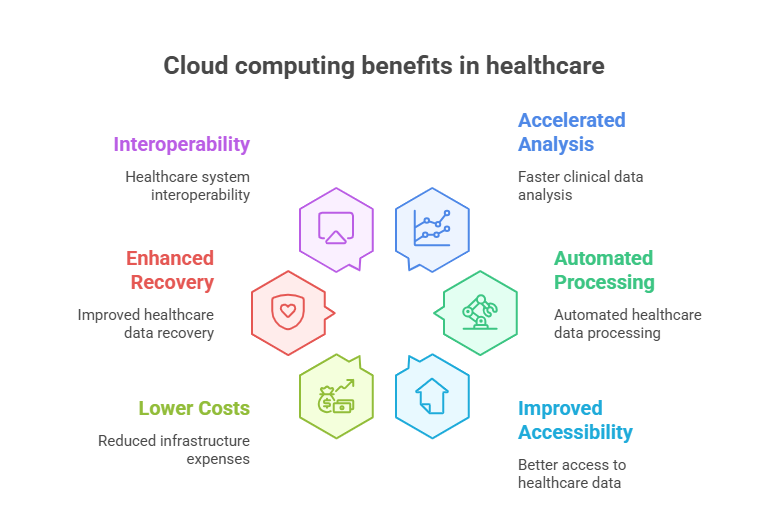
Well, there are multiple benefits of cloud technology in healthcare, but here we will be discussing some major ones.
- Accelerated Clinical Analysis: On Cloud platforms, doctors can instantly look at and analyze large files containing patient records. Because of this, both diagnosis and treatment can be improved.
- Automated Data Processing: When data processing is done automatically, cloud solutions reduce mistakes and save people’s time.
- Improved Patient Data Accessibility: Better Patient Record Accessibility with healthcare cloud computing professionals review and share a patient’s records from any place and at any time.
- Lower Infrastructure Costs: Using Cloud services simplifies on-site server maintenance and means less expense for new hardware and upkeep fees.
- Enhanced Data Backup and Recovery: Cloud companies provide strong data backup tools, meaning your information is quickly accessible if lost due to hardware or cyber issues.
- Interoperability: Cloud systems support many styles and types of software, making it possible for different systems and providers to share data.
These are the technical benefits of cloud computing for healthcare, and now it’s time to move forward to learn the types of cloud computing. In the next section, you will get to know the types of cloud computing in healthcare and their differences with the help of a table.
Explore how cloud computing in healthcare is transforming the industry across various sectors!,
What Are the Types of Cloud Computing in Healthcare
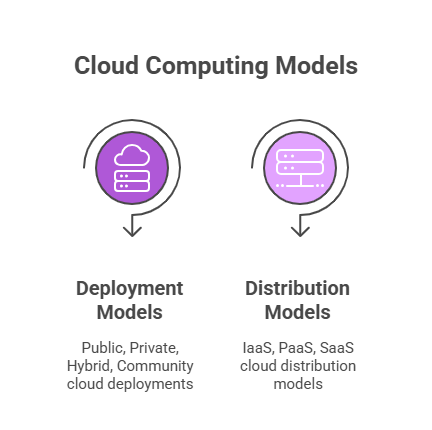
Basically, there are two types of cloud in healthcare: one is by deployment and the other is by distribution, and then they are further subdivided.
The first type of cloud computing for healthcare is by deployment, and it is further subdivided into 4 parts.
By Deployment
- Public cloud
- Private cloud
- Hybrid cloud
- Community cloud
Then comes the second type of cloud computing, which is by distribution. This type is also further divided into 3 parts.
By Distribution
- laaS (Infrastructure as a Service)
- PaaS (Platform as a Service)
- SaaS (Software as a Service)
These are the types of clouds in healthcare and their subdivisions. No,w to know the difference between both types, we have created a table below.
| Category | Type | Description |
| By Deployment | Public Cloud | Managed by third parties, accessible over the internet. |
| Private Cloud | Used exclusively by one organization, often on-premises. | |
| Hybrid Cloud | Combines public and private clouds for flexibility. | |
| Community Cloud | Shared by organizations with common goals or regulations. | |
| By Distribution | IaaS | Offers virtualized computing resources like servers/storage. |
| PaaS | Provides tools to build and manage applications. | |
| SaaS | Delivers software over the internet via subscriptions. |
Hope this table clarifies everything about the types of cloud computing in healthcare. As we have discussed before, stating this blog that we gonna tell you the real-world examples of cloud computing for healthcare. So, here in the next section, we will be discussing the same. This also aligns with best practices outlined in any healthcare software development guide.
3 Examples of Cloud Computing in Healthcare
Let’s look at the real-world examples of cloud technology in healthcare:
Microsoft
Microsoft is well known for cloud computing applications in healthcare, and it allows different health systems to exchange data and use artificial intelligence in diagnostics. Azure gives you the tools to share patient information and stay compliant with HIPAA rules, with strong analysis that helps predict future results.
Pfizer
Pfizer uses cloud technology to support the running of clinical trials around the world. Real-time cloud collaboration tools help the company share data easily between research teams worldwide, swiftly progress drug development, and increase the accuracy of the data.
eClinical Solutions
eClinical Solutions provides research-focused analytic tools built for the cloud. Managing clinical data, speeding up research, and following regulations are all made simpler by the cloud services available to pharmaceutical companies.
Cloud Computing for Electronic Health Record Management
You’re wondering with the heading, but cloud computing is also getting into electronics. Let’s learn.
- GHX
GHX relies on the power of cloud technology in healthcare is to simplify supply chain management in healthcare. Even though GHX is not a native EHR provider, it connects information about supplies with patients’ records to help hospitals with cost and result tracking. By using data analysis, healthcare delivery gains a more effective financial system.
- 1upHealth
1upHealth has developed a cloud solution for exchanging health data through APIs following the Fast Healthcare Interoperability Resources rules. As a result, healthcare providers can easily access and transfer patient details between systems, helping everyone make better, instant decisions.
- TigerConnect
TigerConnect is a platform designed for health teams that works in the cloud. You can share important medical information securely through messaging, use voice tools to collaborate and more easily coordinate patient care using videos.
- Consensus Cloud Solutions
A division of J2 Global, Consensus Cloud Solutions delivers data interoperability and exchange services using the cloud. It has features such as electronic fax, messaging, and data merging, which help connect outdated systems with today’s Electronic Health Record technology.
- Allscripts
Allscripts gives practices access to comprehensive EHR and management tools via the cloud. Digital platforms enable easy updates, allow information to be accessed from any device, and back up initiatives for value-based healthcare.
- NetApp
Healthcare organizations use custom NetApp cloud storage and data management services. The solutions allow healthcare providers to store large datasets and medical imaging while also meeting the rules set by HIPAA.
- ClearDATA
One of their main offerings of cloud-based healthcare is cloud infrastructure developed to the high standards needed in healthcare. Thanks to the HIPAA compliance, the platform provides storage, data analysis, and supports hosting applications while it also assures continuous control and risk avoidance.
So, these were the cloud services in healthcare that real-world big business players have opted for their business. This not only makes things seamless and faster, but cloud computing for healthcare also reduces the infrastructure costs.
Now, every successful business has a process that they always uses to calculate the risk of any new technology that they are going to integrate into their system. So, just like big players, you must be aware of the risks of cloud computing for healthcare in 2025 before implementing.
Must Read: Mental Health App Ideas
Risks of Cloud Computing in Healthcare in 2025
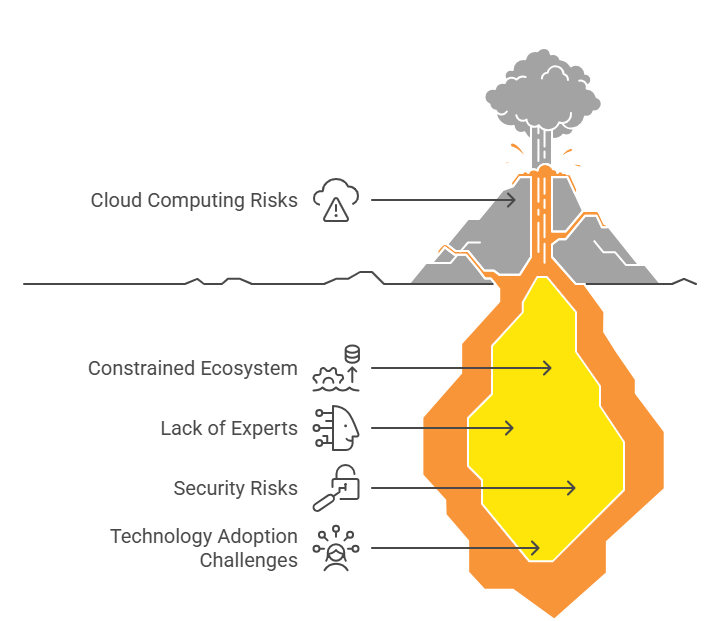
Many healthcare systems are seeing positive changes from using cloud computing, yet there are still hurdles in the process. There are a few important risks that healthcare organizations must overcome as 2025 progresses to fully use the cloud and secure data.
- Constrained Ecosystem
Despite the fast pace of technological development, many healthcare providers are still limited in their environment. Because of old systems, being stuck with one vendor, and limited cooperation, data transfer does not always work smoothly.
These bounds can prevent cloud solutions from operating as expected, leading to inefficiencies in operations and slowing any effort to use digital technologies. If each system uses its own standards, integrating them gets more difficult and more expensive.
- Lack of Experts
The dearth of skilled staff is a main issue when trying to properly implement cloud computing in healthcare. IT experts who grasp both the technology and the rules of healthcare in the cloud are becoming more sought after.
When nobody with proper experience handles cloud infrastructures, the organization might face extra risks, wrong settings, and non-compliance. Because of this skills gap, long-term success in cloud based healthcare is now threatened.
- Security Risks
Many healthcare organizations are still worried about security when adopting cloud technology. Because patient data is now stored and shared more through the cloud, the danger of data leaks, unauthorized access, and cyberattacks rises. In 2025, health organizations are likely to remain a major target for cyberattacks.
Security through encryption, strong passwords, and cleaning up your old data is vital, but it’s often not simple. Since the shared model is used in cloud environments, healthcare organizations have to keep security top of mind.
- Problems in Adopting Technologies
The fast development of technology frequently overconfounds healthcare organizations, primarily the smaller ones. Cloud computing for healthcare requires IT improvements as well as changes in how staff thinks and acts.
Unwillingness to change, expensive setup, not enough internal training, and unsure about the return can all discourage and slow adoption. Moreover, handling compliance and governance guidelines is an extra challenge during the migration.
If a cloud strategy is unclear or missing, organizations could encounter disruptions that impact both patient care and the way their administrative tasks are completed.
How To Avoid Risks of Cloud Computing in Healthcare
When digital transformation grows in healthcare, using cloud computing should be done with careful planning and not rushed. Starting with a smart and preventive strategy can keep you away from making key mistakes. There are three key points to keep in mind when making your move to the cloud.
- Decide Your Requirements
The initial process to manage risks is to study what your healthcare organization needs. Cloud services can differ, and so you should pick one that aligns with what you want to achieve. Would you like to share patient information more readily, lower your infrastructure expenses, or make collaboration among teams easier?
Establishing such objectives first helps find cloud services that fit the business’s need for flexibility, checks on regulations, and fit into its current infrastructure.
It is just as important to assess your compliance needs. All healthcare companies are required to follow rules such as HIPAA and GDPR strictly. It is important that your cloud service provider can confirm it meets the standards and offer records to verify this for you.
- Make a List of Things to Switch to the Cloud
When your goals are clear, you need to determine which applications, systems, or datasets should be put in the cloud. Let’s try out billing or administrative tools first, as they are less essential. As soon as you trust the cloud platform to be secure and efficient, you can start moving over patient information and clinical tools.
A phased method keeps disruption down and helps your team change smoothly. Such a review allows us to see if systems are linked in a way that might cause issues as the migration starts. By documenting and auditing at this point, you will learn what is moving and why it is necessary.
- Estimate the Particular Investments
Moving toward the cloud is not only about technology, it also means you’re making a financial commitment. A true investment estimate goes beyond the subscription price to include migration, staff training, continuous running costs and the possibility of system downtime.
Planning a budget carefully keeps you from spending too much and lets you predict the returns you’ll get in the future. Whether employees are hired inside the company or are outsourced from a provider, proper vetting of talent matters a lot.
Expert professionals can make the process safe, uninterrupted, and in accordance with regulations. Following these steps, healthcare teams can improve security around cloud solutions and start to build a flexible system focused on patients.
Effective personnel verification is crucial, regardless of whether workers are hired from within the organization or are contracted out from a provider. Hire remote developers with experience in health IT infrastructure can be necessary.
Now the blog comes to its end, and this is the time when you have calculated the risks, know the benefits, and have also learned to avoid the risks of cloud computing for healthcare. So, this is the time to let you know the future of cloud computing in healthcare.
Future of Cloud Computing for Healthcare?
In healthcare, the advancement of cloud computing is moving quickly, with most teaching focused on data and digital progress. Forbes predicts that the global healthcare cloud market will exceed $89 billion by 2027 because there is increasing demand for infrastructure that can handle large amounts of data instantly.
Cloud computing is now crucial for offering personalized treatment, advanced diagnosis using AI, and enhancing patient results. When providers have easy access to big data and its analysis, they can give patients focused, preemptive, and less costly care.
Cloud computing plays a role in facilitating the increase of telehealth, regular patient monitoring, and medical cooperation across countries. Cloud-native healthcare systems will give organizations greater agility, more secure networks, and a simpler method to use the latest technologies like IoT and blockchain.
It’s not only about data storage; it’s also about reforming healthcare by making it easier to access, better connected and more focused on patients. The digital foundation that supports the healthcare industry will be cloud computing in the future.
Here the blog ends… we have come a long way and we hope you have loved the information given in the blog.
Bottom Line
At Chicago’s Rush University Medical Center, cloud computing for healthcare depends on everyday regular activities. Everything from quick radiology diagnosis to discovering data in doctors’ notes is made possible thanks to this digital infrastructure.
Cloud technology enables doctors to discover other health conditions a patient may have, based on all the information they enter, even if it doesn’t make it into the final chart. Having this type of intelligence allows doctors to make more correct diagnoses, plan individualized treatments and promote better patient results.
They show how cloud technology is shaping both the healthcare given to patients and the way hospital systems are run today. As more people use the cloud, collaborating with the top healthcare software development company ensures your solutions are secure, fit for growth, and meet all required rules. Boosting work processes, providing remote healthcare, and adding AI for diagnostics will all rely on the cloud in the years to come.
Ready to explore cloud computing for your healthcare organization? Get in touch with our experts today!
FAQs
1. How does it cost you to integrate cloud computing into a healthcare system?
Integrating cloud computing into healthcare varies by scale and services but typically includes expenses for infrastructure, data migration, security, and compliance. Costs can range from thousands to millions annually, depending on organization size.
2. Use cases of cloud computing in healthcare
Cloud computing in healthcare supports electronic health records (EHRs), telemedicine, medical imaging storage, data analytics, and patient management systems.
3. Which is the most popular cloud platform in healthcare?
Amazon Web Services (AWS) is currently the most popular cloud platform in healthcare due to its scalability, compliance features, and robust data security.