
You’ll agree with the statement that Artificial Intelligence is not a new word or concept anymore. It’s changing the entire world. Not even a single industry is untouched by its power. From healthcare to eCommerce to marketing, every field is using AI to make processes better, efficient, and fast. Education is not an exception.
This technology changes the classroom surroundings in terms of the students’ learning styles and teaching style for teachers. Besides, AI is enhancing outcomes via its provision of personal learning, auto-grading, intelligent tutoring systems, and the reduction of administrative tasks in the classroom.
On top of that, AI-powered tools empower the customization of content, adaptive learning pathways, and early detection of students who are slipping behind. AI-driven software can break through in accessibility for disabled students and provide individually tailored career guidance in service of particular skills and interests.
Today in this blog, we will learn how artificial intelligence is changing the face of the education industry. We will study some use-cases and real-life examples for better understanding.
AI in the Education Industry: An Overview of Statistics
Artificial intelligence is creating a sensation across many industries, and education happens to be one of them. In education, AI serves many purposes, right from educational institutions located in different parts of the world.
Thanks to AI, students, parents, teachers, and educational institutions view education from an absolutely new dimension. This adds to the popularity of custom eLearning solutions with AI implementation.
Let us look at some statistics that resonate with the trend of growing usage of AI in education:
- A report by Global Market Insights has projected that AI in the education market will reach $80 billion by 2030.
- A Markets and Markets report projects global AI usage in online education to be as high as $3,683.5 million by 2023.
- According to various estimates, the global e-learning market will reach a humongous $1 trillion by 2032 at a compound growth rate of 14%.
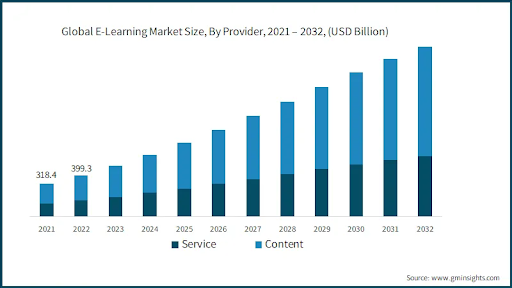
- The above figures reflect that AI is transforming the face of education—now, using AI technology and help of education mobile app development services, real-life examples are used to educate the students, and they understand it more effectively, easily and quickly.
Traditional vs. AI Teaching Methods
Here is quick comparison table that showcase how AI is bringing a change in our education system:
| Aspects | Traditional Methods | Artificial Intelligence |
|
Instruction |
Teacher-led instruction |
Adaptive, personalized learning |
|
Assessment |
Periodic standardized tests |
Continuous, real-time evaluation |
|
Feedback |
Delayed, often generalized feedback |
Immediate, personalized |
|
Content Delivery |
Fixed curriculum, textbooks |
Dynamic, multimedia resources |
|
Student Engagement |
Passive listening, note-taking |
Interactive, hands-on activities |
|
Pace |
One-size-fits-all |
Individualized learning speed |
|
Teacher Role |
Primary source of knowledge |
Facilitator, mentor |
|
Accessibility |
Limited to classroom hours |
24/7 access to resources |
|
Collaboration |
In-person group work |
Virtual collaboration tools |
|
Data Analysis |
Manual, time-consuming |
Automated, data-driven insights |
|
Grading |
Time-intensive grading for teachers |
Automated for objective assessments |
|
Personalization |
Limited personalization |
Highly customized learning paths |
How AI is Reshaping the Education Industry: Top 10 Ways
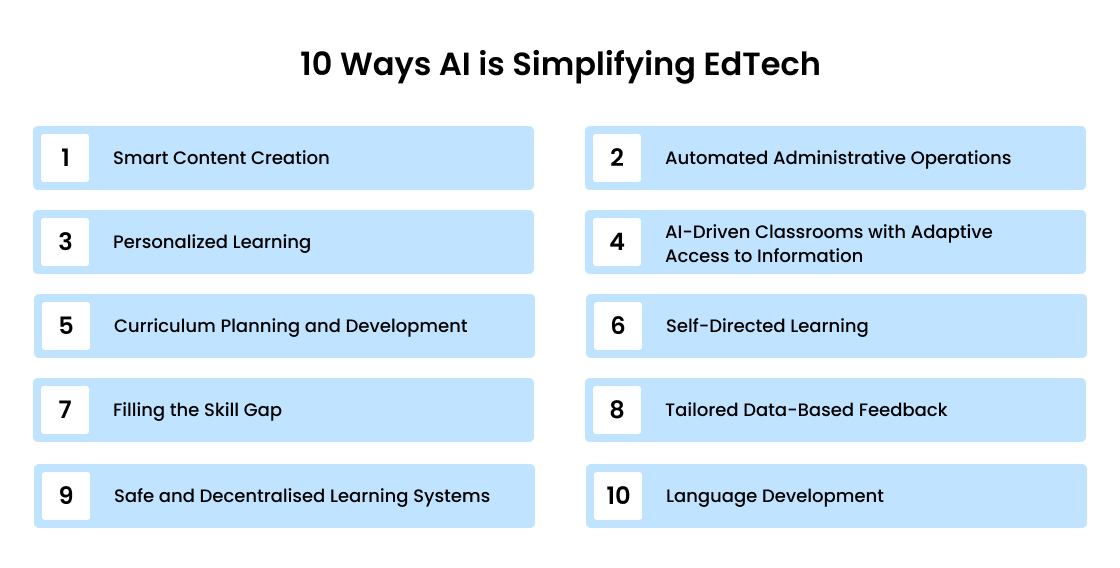
AI is transforming the education industry. It offers innovative solutions to improve teaching and learning experiences. Here are the top ways Artificial Intelligence is revolutionizing education:
1. Smart Content Creation
If there is an area in which AI applications are developed strongly for education, it has to be content creation. This intelligence-based innovation triggers comprehension at another level. This becomes a great blessing for a teacher or researcher since it enables them to create intelligent content, leading to more convenient teaching and learning. This is how just a tiny bit of AI-powered content creation looks:
Most of the traditional ways of teaching have no visual impacts in them, usually dependent only on lab experiments. AI-powered smart content creation has the ability to arouse real-life experiences through 2D and 3D visualizations, which enable students to perceive information in a more engaging way.
With the help of AI in education, digital lesson generation can be done in bits, using low storage study materials and interactive lessons in digital formats. This way, an individual is able to access the entire study curriculum at any point in time from any device without taking into remote consideration the limitations it poses for remote learning.
AI content updates in learning help users to develop information and frequently update it, therefore making these lessons current with the issues. The users also receive alerts of information hence this updating aids in preparing for later.
Explore More: Cost To Develop a Chatbot App Like ChatGPT
2. Automated Administrative Operations
While AI is present in school education and virtual classrooms, quite a good deal of value-adding tasks can be handled with this tech. In addition to the development of a customized teaching process, the tech is capable of doing homework checks, test grading, organization of research papers, maintenance of reports, and making of presentations and notes, among others.
It is for this very reason that the integration of AI solutions in the field of education has businesses banking for their day-to-day targets. Therefore, it can make a more knowledgeable and productive learning atmosphere through the automation of day-to-day activities.
3. Personalized Learning
Not every student can learn the same way. Some can grasp a new concept very quickly, while some need more time to understand it. The basic drawback that had been seen with some of the old systems of education was their incapability to customize the learning experience according to each student. This is where AI can make a vital difference in online education.
For example, Knowji is an AI-powered app that boosts vocabulary acquisition. It understands each individual’s requirements and provides solutions accordingly.
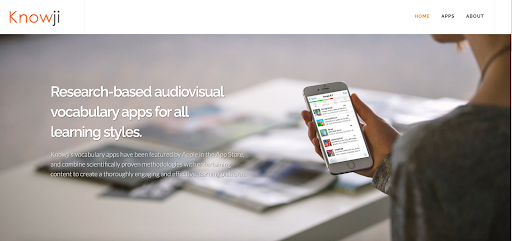
AI in education assures that the software is customized to become a complete fit for personal needs. Since machine learning supports the technology, the system will adapt to how a student processes and understands various lessons, subsequently reducing his load.
This application of AI in education will focus on the needs of each and every person through technology-embedded games, along with customized programs, amongst other features, in promoting effective learning.
4. AI-Driven Classrooms with Adaptive Access to Information
An educator can derive maximum benefits from AI in classrooms by adaptive access to information. According to a survey held by Forbes Advisor, over 60% of educators around the globe believe that an AI-driven classroom reduces and assists their daily teaching responsibilities to a large extent. Here’s how:
The AI-driven features themselves, such as multilingual support, make it possible to translate information into any language, which makes the teaching and learning in the institute accessible to each and every child conveniently.
Many such ‘disappeared’ students get help, attributed to such AI-driven support, like live subtitles during virtual lectures. Most of the teachers use AI-powered games, adaptive learning platforms, and auto-grading and feedback systems in their classrooms.
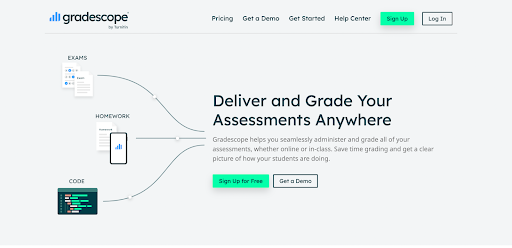
For instance, Gradescope is an AI app that helps in assessment grading and makes the entire process easy for teachers.
5. Curriculum Planning and Development
Artificial intelligence can make it much easier to introduce new curricula and revise the old ones because it is able to analyze trends in education, data from student performance, and lacunas in learning. This provides real-time insight into what one needs to do in order to update and align their curriculum material in line with changing standards of learning material.
It may also assist automatic matching of curricula with specific learning objectives for relevance and efficiency. This innovation will empower educators to make informed data-driven decisions in finding better ways to distribute resources and thus improve the overall quality and relevance of education.
6. Self-Directed Learning
It is self-directed learning with the aid of conversational AI systems, such as virtual assistants and AI chatbots for education. The enhanced system is empowered with natural language processing and machine learning algorithms that are focused on real-time support for assignments, questions, and doubts, along with valuable feedback to students. Finally, such interactive and deeply engaging learning experiences will make it easier to understand and retain concepts when using these tools.
Furthermore, the tools are accessible all day and all night time in order to support, provides help whatever hour during or after the traditional classes if the student requires it. Technologies of the kind that are in question here help an individual student in an individual manner, encourage a student towards self-learning, and allow a student to interact with educational content actively; hence, they are invaluable to academic development and successes.
Bonus Visit: Web3 in Education
7. Filling the Skill Gap
We are really in a dilemma: one in which there are so many out-of-school children who need to be kept within the system and, on the other hand, those currently in school are learning little or no skills at all that will ensure their smooth passage into the labor market.
All these competency gaps can be effectively bridged, and wide-ranging upskilling opportunities given to the students with the help of software and applications run by AI and ML. It not only benefits the students but also enhances the morale of this existing business workforce, giving it a company-wide commitment to innovation and digital transformation.
More importantly, the effect of AI use in the educational sector also extends to the learning and development (L&D) area in the business sector, which tries to analyze what the learning process for people is all about. The more the system is adapted to humans’ studying behavior, the more automated the learning is able to be.
8. Tailored Data-Based Feedback
Feedback is an essential ingredient in realizing any successful learning future, which can take place either in the classroom or in a working scenario. It is said that “teaching not with a view to pass content but teaching with feedback in mind”. Going on further, faithful feedback is important and so there is a need for AI in education to analyze and generate insights from everyday data.
A data-based feedback system will shift student satisfaction much ahead and remove the bias factor for learning, indicating the areas where their skills need improvement. It is, in essence, an individual performance feedback for a student, or any employee for that matter, whose data are stored in the system.
9. Safe and Decentralised Learning Systems
The education industry is churning up disruptive innovations with AI at a very rapid pace. However, it gets forestalled by problems such as data privacy, alterable data accessibility, and legacy certification processes, amongst others. Congenitally, in such scenarios, the AI-based decentralized solutions should turn out to be a blessing for the education sector.
A case in point is Nova, a learning management system based on the blockchain that, simultaneously, helps to solve the widespread authentication issues in the learning market. An AI-driven LMS with blockchain technologies allows millions of teachers and students to protect their solutions’ data and information.
AI software captures every action of an individual through web cameras, microphones, web browsers, and keystroke analysis in mouse action or other action performed by an individual.
10. Language Development
Artificial intelligence in language learning improved the process greatly by providing real-time feedback on grammar and vocabulary. Artificially intelligent platforms like Duolingo are tailored to base onto each way of learning and leveling up proficiency.
It is tending to lessons by increasing the level of difficulty and lesson content according to a user’s performance. Therefore, artificial intelligence continues to support the personalized studies that have been done for every student.
11. Special Education Support
Another paramount benefit of AI-driven gamification is that conversational reality is so well emulated that it is a rich and potent environment for language learners.
It provides individualized support to students with varied abilities, thus treating the abilities of this diversity uniquely in every student. More so, it helps in the early diagnosis of learning disorders to ascertain interventions.
Similarly, AI-enabled assistive technologies, such as applications with inbuilt text-to-speech and speech-to-text functionalities, empower students with blindness, difficulty in hearing, and even dyslexia, allowing for much easier access to educational content.
AI also facilitates the creation of an inclusive classroom through real-time translation services and captioning, so no individual is left behind during the learning process. All these serve as a very effective impetus not only for the learning efficiency of a student with special needs but also for bringing up equity and inclusivity in the educational setting.
The synchronization of dependency on AI in the education system is more than one can imagine. This is the reason behind EdTech startups and companies seeking AI technology solutions that have been successful in treating a wide range of pain points amongst its users. Provided you are part of this education sector, you may consider fusing in and leveraging a bulk of the advantages AI brings to the education sector.
Learn More: AI in Security
Advantages of AI in Education
Here are some important advantages of AI in education:
1. Personalized Tutoring
We all know that every child is unique; hence, with AI, it is possible to give personalized teaching to your child based on their learning ability and understanding.
2. Adjustive Feedback
AI offers feedback based on students’ answers. Hence it helps teachers love where the students are troubled which construct is green to them and where they take service. This makes the learning method efficient and fast.
3. Efficient Grading
With AI-backed grading systems, tutors greatly simplify the assessment method, improving consistency and saving time. This proves that AI is not only helpful for the students but for the teachers as well.
4. Better Speed
If a student gets stuck while working on any assignment, AI programs can offer quick, helpful assistance when a teacher is not available. The student can ask the AI questions, and the issue can be resolved.
Real-Life Examples of AI in Education
AI transforms education with adaptive learning experiences that help satisfy differences in abilities and needs among students. Here are a few examples of how the top global brands and IT consulting firms put AI together with education:
1. Duolingo
One of the best examples of an AI-driven language learning app is Duolingo. It has an engaging interface and a very customized approach. Duolingo has a green owl mascot who will remind one to practice daily, yet it adapts to each user based on his or her proficiency level.
Scoring gamification elements, together with smart technology, means that Duolingo has a perfect level of difficulty for continuous involvement in the process—hence, effective learning.
2. Khanmigo

Another good example is Khanmigo. This GPT-4-powered teacher effortlessly fits into an ocean of rich content available at Khan Academy. It covers subjects with personalized support, helps teachers in lesson preparation, and helps parents know what their child is going through.
3. Carnegie Learning
The third example that we want to list is perhaps one of the most effective examples of AI apps in K12 education, the Cognitive Tutor by Carnegie Learning. As per this advanced system, the way instruction is approached changes with each student’s performance and really does personalized instruction.
How Companies Like ScalaCode Can Help You in Implementing AI Solutions?
As discussed, AI has the ability to transform businesses and it even plays a huge role in the education industry. But, if you are thinking it’s hard to get an AI app, then you are wrong. With companies like ScalaCode, it’s possible to get an educational AI app fast.
This is a leading company in delivering state-of-the-art software development services. We know the power of AI and have expertise in delivering advanced AI apps. With a team of certified programmers, we ensure that you get the best solutions that take your brand value to the next level.
Also Check: Top Custom Software Development Companies
Final Thoughts
That’s all for this blog. There is no doubt that AI is going to change the education system completely. Not only education, but every industry is transforming due to this advanced technology.
However, you will always need the help of an eLearning app development company to build an AI app that actually works. So, you should always get help from a third-party organization. If you have any other doubts, please mention them in the comment section below. All the best for your AI educational app development.