
Are you an entrepreneur, wondering how artificial intelligence is driving innovation and growth in every industry? Well, AI is not just for scheduling your tasks, aligning your projects, etc., but it can do a lot more in industries like healthcare.
Have you ever thought of talking to an AI chatbot and asking your queries in such a difficult industry as healthcare? Maybe yes, or maybe no… let us tell you that this can happen in 2026 with the help of AI chatbots in healthcare.
According to a report by Research and Markets, the health intelligent virtual assistant market is forecasted to grow by USD 10.68 billion during 2023-2028, accelerating at a CAGR of 54.16% during the forecast period.
This huge number indicates that the future of AI chatbots for healthcare is bright enough, and in today’s blog, we are going to talk about their use cases, examples, benefits, and much more.
This blog will not only offer you the latest information about AI chatbots in the healthcare industry, but it will also provide you with a blueprint for all those capitalists who are planning to integrate AI chatbots into their healthcare business.
Let’s dive in…
What is an AI Chatbot in Healthcare?
Chatbots in healthcare industry are digital assistants that help doctors to interact with patients, caregivers, and health professionals via one of two conversational interfaces (text or voice). This helps them in reaching out to more people at one time and provides the needed medication immediately. In addition to that, these chatbots are based on the principles of natural language processing (NLP) and machine learning to process queries and provide information to smoothly automate routine tasks.
Moreover, it communicates with patients based on human-like conversations, allowing the patient to question the symptoms, medications, appointments, or mental health without necessarily direct human intervention. This saves the time of consulting a doctor and then starting the medication process, but here, if the user finds something wrong with their body, they can immediately start their treatment.
Along with that, AI chatbots in healthcare can also offer symptom checkers, refer patients to the correct care pathways, offer medication alerts, book appointments, and collect patient information for electronic health records (EHRs). Moreover, the smart agents will be present 24/7, and they will minimize the waiting time and answer frequently asked questions.
Their incorporation into telehealth applications is one of the most important steps taken by the industry in the process of digital transformation, and it allows engaging patients in a manner that will be scalable, efficient, and cost-effective. Additionally, it allows making sure that more complicated questions can be referred to a medical professional at any time.
Key Use Cases of AI Chatbots in Healthcare
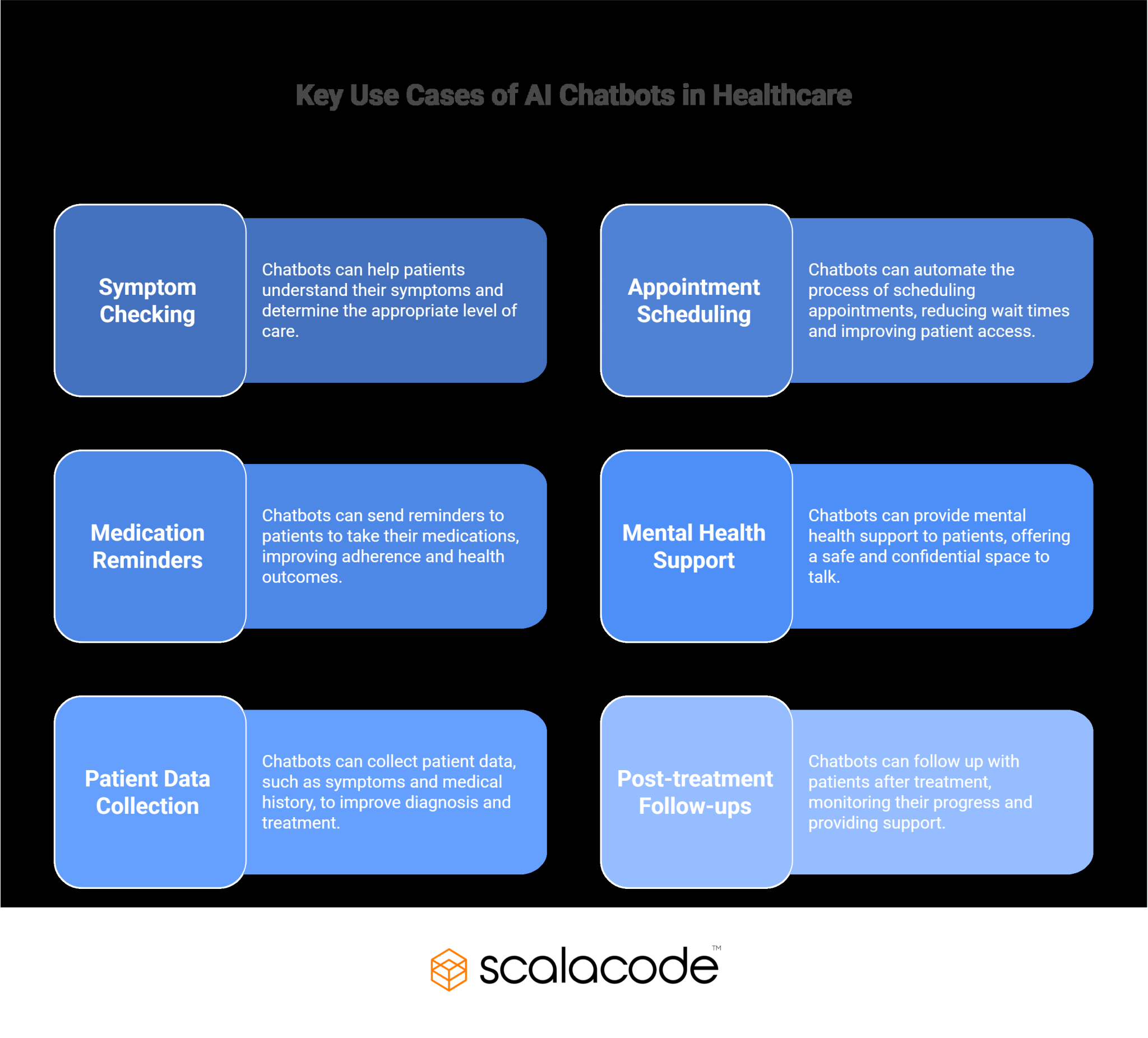
Now, after understanding AI chatbots in healthcare, let’s look at some of the best use cases of them to deeply understand how this jaw-dropping technology actually works. Below are some of the best use cases of AI chatbots in healthcare worldwide. Just thoroughly go through them.
1. Symptom Checking and Triage
An AI chatbot in healthcare helps in analyzing patient-reported symptoms using guided questions and provides initial advice. In addition to that, it also helps in suggesting that the patient take care of themselves or go to the doctor, depending on the patient’s condition. Not only this, but this also simplifies the process simplifies the triage process, minimizes unnecessary visits to the ER, and allows healthcare professionals to perform fast risk assessments.
2. Appointment Scheduling
Chatbots in healthcare also help in enabling the automation of booking, rescheduling, and cancellations through calendar synchronization, reminders, and real-time appointment confirmation. This saves on administration and enhances the convenience of the patients and the staff. In addition to that, this saves time for both patients and professionals; the patients can schedule the appointment time according to them, and professionals can connect with them online, sitting in their own place.
3. Medication Reminders
In this busy world where nobody has time to calmly have their dinner on time, but especially after COVID, taking care of their health is more important. Hence, the AI chatbot in healthcare can help you in notifying individuals with custom notifications of medication schedule, dose, and medication refill via application or text messages. This will help you in not forgetting your appointments, and this can also be utilized in setting reminders for maintaining adherence to medication and improving chronic disease management.
4. Mental Health Support
An AI chatbot for mental health also supports mental health-related issues and provides features such as CBT-based exercises and mood tracking. This will not only talk to you but also help you in providing the best meditation practice that you can do at that time. It also refers serious cases to healthcare professionals when necessary and offers immediate care. In addition to that, they provide 24/7 and confidential access to mental health resources and conversations.
Also Read: Best Mental Health App ideas for Startups
5. Patient Data Collection
Collecting data is something that is very difficult to gather, but not with an AI chatbot; it helps in collecting the data of every patient. In addition to that, AI chatbots in healthcare collect patient intake information, symptom updates, and feedback via automated dialogue and update EHRs, and assist in constant observation. Not only this, but it also helps in making care more personalized and making administrative employment easier.
6. Post-treatment Follow-ups
Chatbots in healthcare monitor patient progress after discharge, gather data concerning the symptoms or complications, and send a warning to a provider in case of problems. This helps the patient and doctor to learn if the medication is working for each and every patient or not. In addition to that, this also helps in constant involvement and contributes to the decrease of hospital readmissions and effective monitoring of the recovery.
Most Popular Real-World Examples of AI Chatbots in Healthcare
If you still want to know about the real-world examples that are doing really well in the market with the help of AI chatbots. Then we have got you covered in this section, where we have listed the top 5 real-world examples of AI chatbots in healthcare that will help in letting you know what features you must add to your AI chatbots.
1. Babylon Health (UK)
Babylon Health provides a world-renowned AI-based chatbot to get an instant medical consultation depending on the symptoms and health data reported by users. The site is connected to the NHS of the UK, providing the opportunity to conduct a virtual triage, which decreases the workload of healthcare professionals. The users offer 24 hours of technical assistance for both clinical and administrative problems.
- Offers 24/7 AI-driven symptom checking and health assessments.
- Integrates with national health services and digital record systems.
- Supports triage, appointment booking, and prescription renewals.
2. Ada Health (Germany)
The AI chatbot used by Ada Health assists its users in evaluating their symptoms and helping them make the right care decisions by presenting them with a smart question-answer interface. Its medical database is medically approved, and the underlying database has been adopted by millions of people across the world, hence clinical reliability. Ada will recommend, depending on the individual medical history of the user.
- Delivers highly personalized symptom assessment and health guidance.
- Available in multiple languages, improving global accessibility.
- Used by over 13 million users worldwide for early-stage triage.
3. Woebot (USA)
Woebot focuses on mental health services and integrates chatbots with evidence-based therapies, like cognitive behavioral therapy (CBT). Along with that, it also offers the user a stigma-free, safe emotional support and self-improvement environment. Woebot is available 24/7, and therefore, it makes mental health care more accessible.
- Offers CBT techniques and mood tracking through chat-based interaction.
- Supports users with anxiety, depression, and daily stressors.
- Immediate, confidential, and stigma-free support at any time.
4. Buoy Health (USA)
The chatbot created by Buoy Health is trained on an extensive medical knowledge base to assist users in symptom assessment and provide them with viable health instructions. This makes the platform more user-friendly, and this platform also refers patients to the appropriate care options, virtual, urgent, and self-care. And you must know that it is a collaboration of AI analytics with insurance providers and health systems.
- Provides an accurate, real-time symptom checker and triage recommendations.
- Connects users to proper care levels and follow-up services.
- Integrates with major US health systems and insurers.
5. Sensely (UK/USA)
Sensely is a virtual nurse that can help patients check their symptoms, make appointments, and care for their chronic conditions using AI in the form of an avatar. Its Molly avatar uses speech recognition and sends it to sources of health data to provide customized care. Sensely is biased towards remote patient monitoring and multilingual interactions.
- Utilizes a virtual nurse avatar for empathetic patient communication.
- Integrates speech, text, and remote monitoring technologies.
- Offers chronic care management and multilingual support.
What are The Benefits of AI Chatbots in Healthcare?
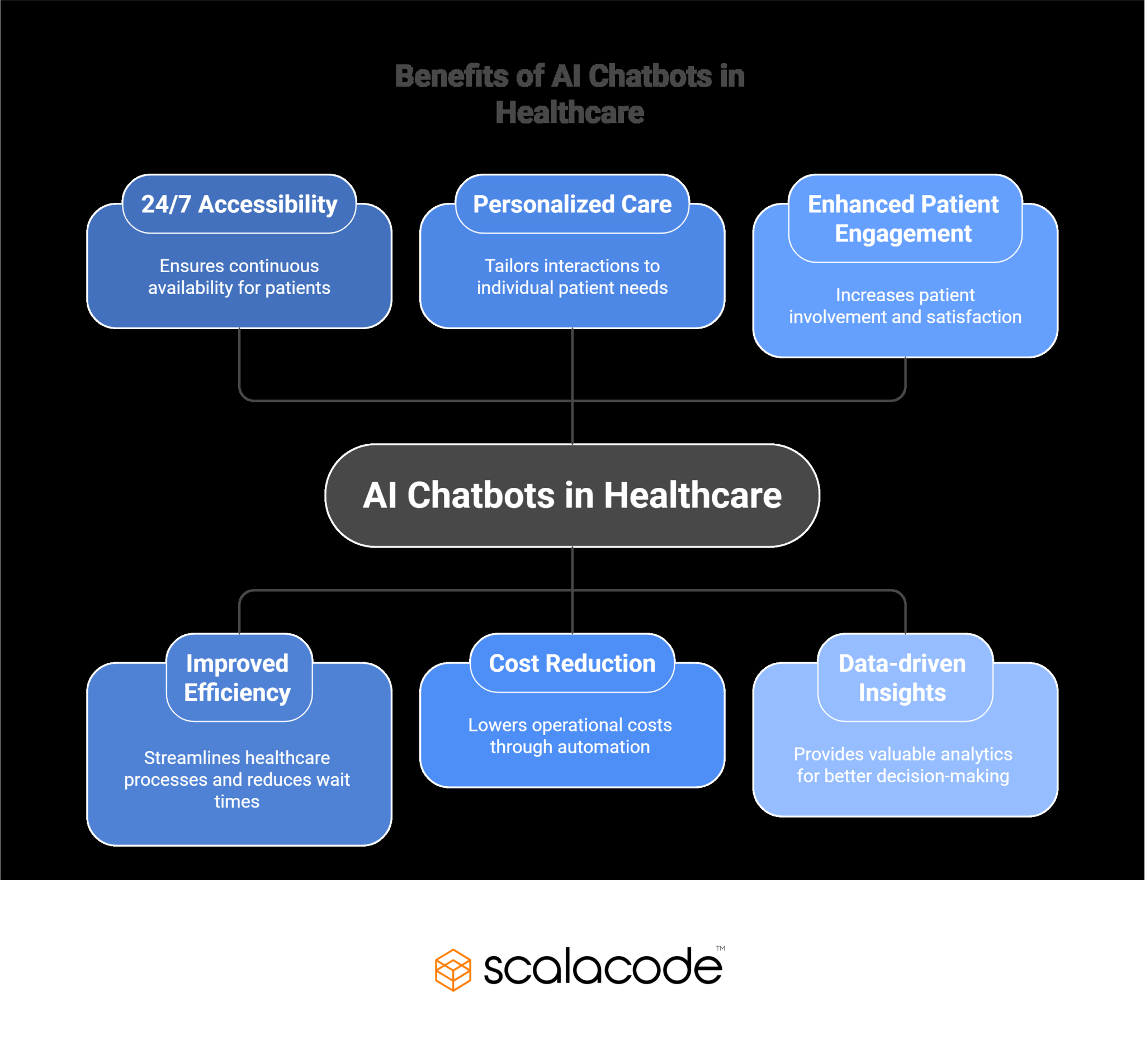
Chatbots in healthcare are transforming all industries, and healthcare is one of them. It is easy to manage with the help of an AI chatbot, and it also enhances patient experiences, streamlines operations, and enables data-driven decision-making. In addition to that, there are multiple benefits of AI chatbots in healthcare, and in this section, let’s look at all the major ones:
1. 24/7 Accessibility
With AI chatbots, users and professionals will have 24/7 accessibility and immediate access to medical information. In addition to that, they will also have the fastest assistance without the limitations of working hours. This will not only help patients to get a guide or help when necessary, but this will also be beneficial for professionals in making particularly crucial decisions. Moreover, these chatbots reduce the reliance on face-to-face visits and support the work of healthcare providers, and minimize the load on them.
2. Improved Efficiency
Another benefit of AI chatbots in healthcare industry is that they reduce the workload of healthcare employees by automating routine tasks like answering frequently asked questions, booking appointments, and conducting the initial analysis of symptoms. In addition to that, it also helps in automation that will reduce patient processing time and the errors involved in manual scheduling or data entry. Moreover, it enables clinicians and administrative staff to prioritize even more high-value and critical activities that enhance the overall provision of healthcare and thus shorten wait times.
3. Personalized Care
AI chatbots make use of patient-related information and data collected by them, such as medical history and real-time inputs, to provide personalized recommendations and advice. This helps the patient and professionals to improve the personalization, engagement, and trust. In addition to that, it has the capability of providing the best communication, which makes it more relevant and responsive. This individualized attention enhances compliance with therapy, earlier identification of complications, and the development of healthier outcomes.
4. Cost Reduction
The healthcare chatbot development reduces the organization’s extra expenses on automated repetitive administrative tasks and better utilizes resources. Triage using chatbots helps them cut down on the needless emergency room visits and hospital admissions that are expensive to the system. Furthermore, the use of constant monitoring and automated follow-ups will assist in preventing complications, reducing the cost of long-term treatment, and ensuring high-quality care.
Read in detail: AI App Development Cost Estimation: A Detailed Exploration
5. Enhanced Patient Engagement
Interactive chatbots will help patients to be more active in controlling their health by reminding them of important medical information and assisting them with motivation. These constant interactions increase medication compliance, frequent check-ups, and health promotion. The conversational format will lead to a closer bond between the patients and healthcare providers, enhancing satisfaction and general health literacy.
6. Data-driven Insights
AI chatbots can help healthcare professionals discover meaningful patterns and trends because of the large volumes of data obtained every time they interact with patients. Individual care plans, population health analytics, and clinical research can be based on this information. Feedback loops enable healthcare organizations to optimize their services, anticipate health outcomes, and develop treatment modalities using the evidence available in practice.
Besides these benefits, one can also improve medical training through immersive simulations, enhanced remote care via virtual consultations and monitoring, and innovations in diagnostics and treatment like augmented reality surgical guidance. But you can accomplish these benefits with Metaverse technology. Get to know the top Metaverse development companies globally for your metaverse-oriented AI chatbot.
On the other hand, the above-mentioned benefits of implementing AI chatbots in your healthcare business. If you also want to achieve these kinds of benefits in your business that help you in reducing costs on multiple things, then you must contact a top healthcare software development company.
Cost to Build An AI Chatbot for the Healthcare Industry
Now you know the benefits of incorporating generative AI chatbots in healthcare, and a smart business owner will now proceed to know the cost of building such a chatbot for their business. Well, here we are in this section. We have addressed the development cost, key factors, and budget optimization tips, so stay tuned…
- Basic Healthcare Chatbots: First, let’s talk about the basic healthcare chatbots that are specially designed for small businesses and startups. These can handle simple FAQs, appointment booking, and medication reminders, and their development cost ranges from approximately $8,000 to $15,000.
- Cost impact: There are only minimal integrations and common features, which keep the costs down, which is why they are appropriate for small clinics or independent practices.
- Cost can rise if multi-language support or basic NLP capabilities are added, typically increasing by $3,000 to $5,000.
- Conversational AI Chatbots: The next is conversational AI chatbots for the healthcare industry. These chatbots are specially for communication, and they are usually used by small and medium-sized businesses. These AI chatbots include natural language processing (NLP) for patient query handling and basic multilingual support, costing between $15,000 and $35,000.
- Cost impact: The increased complexity of NLP models and the complexity in interacting with patients increases development and training costs.
- Additional features such as voice interaction or real-time analytics can add $5,000 to $10,000 to the project budget.
- Advanced AI Chatbots: The advanced use of AI chatbots in healthcare is especially for medium-sized businesses to big enterprises that have been serving advanced services in the market for a long period of time. These chatbots are integrated with electronic health records (EHRs) and predictive analytics and comply with HIPAA. Costs start around $50,000 and can exceed that. The cost can also increase as a big organization will have multiple tasks and advanced services to serve on the plate; hence, the charges will also increase.
- Cost impact: Integrations of the systems and regulatory compliance make costs go high by a significant margin of up to $20,000 to $40,000 extra.
- The use of generative AI in healthcare, multi-system interoperability, and improved security features increases the costs even more.
Key Cost Factors Affecting Healthcare AI Chatbot Development
- Features and Complexity
- The first thing that exceeds the cost of building an AI chatbot in healthcare industry is the features of the chatbot and its complications. Features like human-like conversation ability, Symptom checking and triage, Multimodal interaction, Predictive analytics and chronic disease management, Seamless integration with healthcare systems, Inaccuracy and potential for harm, Data privacy and security, Explainability and the “black box” problem, etc., make the chatbot more advanced and increase the cost simultaneously.
- Approximate increase: $10,000, $30,000, depending on AI sophistication.
- System Integrations
- The next thing that increases the price is system integration; connecting chatbots to existing healthcare systems is not an easy task. EHRs in the existing healthcare systems (like Epic and Cerner) and third-party APIs involve significant development and rigorous testing for interoperability, and many other things are needed in this process. The testing team increases, the task increases, and the cost will automatically increase.
- HIPAA and other compliance-related engineering increase development cost by an estimated $15,000 to $40,000.
- Data Management
- Data management is something that is a very responsible task to perform, and one has to secure the data for a long period of time. Not only this, but the authorized person must protect the data from unauthorized hands. Here, the role of AI chatbots comes into play. You can build the most secure AI chatbot for your healthcare business with the help of an AI development company and protect and save your data simultaneously.
- Can add $5,000 to $15,000 based on data volume and quality requirements.
- NLP and AI Models
- Licensing advanced AI models like GPT-4 increases the cost of AI chatbots in healthcare, but utilizing these models is also necessary, as this is the main source of communication. In addition to that, using large language models and training AI also plays an important role in raising the cost bar.
- Increases project costs by $8,000 to $25,000, depending on model choice and customization.
- Security and Compliance
- The compliance with HIPAA presupposes extensive audits, encryption, safe data transfer, and continuous monitoring that contribute to the complexity of the development and the expenses of legal consultation.
- Estimated additional expenditure: $7,000 to $20,000.
- Deployment and Maintenance
- The extra fees for cloud hosting, scaling infrastructure for load, ongoing feature updates, and AI model retraining are recurring expenses. This all can increase the actual cost by 15-25% annually.
- Budget $5,000 to $15,000 annually, depending on scale.
Budget Optimization Tips to Control Costs
- Phased Development: Develop MVPs focusing on core functionalities first, then incrementally add advanced features, reducing upfront investment.
- Offshore Development: Employing external or offshore development teams can decrease hourly rates by 30-50% without sacrificing expertise.
- Pre-trained Models: Use pre-trained AI and NLP models to cut down training time and resource use, lowering costs by an estimated 20-35%.
- Prioritization: Align the budget by prioritizing patient-facing features that yield the highest ROI while postponing less critical functionalities to later phases.
Challenges and Implementation Tips of AI Chatbots in Healthcare
Now, if you are reading this blog till this section, then you must have an interest in building an AI chatbot for your healthcare business. First, you have to hire chatbot developers, as implementing AI chatbots is not that easy; it will need the professionals’ guidance and expertise. In this section, we have listed the challenges that one can face during the implementation process and hidden tips:
| Challenges in Implementing AI Chatbots in Healthcare | Implementation Tips |
| Data Privacy & Security Ensure compliance with HIPAA, GDPR, and other regulations by implementing robust encryption. | Use secure cloud solutions, encryption, and role-based access control. |
| System Integration: Integrate chatbots seamlessly with existing EHRs, hospital systems, and legacy infrastructure. | Plan for gradual integration, prioritize API compatibility, and test thoroughly. |
| Trust & User Acceptance: Build user confidence by ensuring high accuracy and transparency. | Educate users about chatbot capabilities, limitations, and privacy measures. |
| Handling Complex Cases: Develop protocols that escalate complicated or uncertain cases. | Incorporate escalation workflows and continuously train models with new medical data. |
| Cultural & Linguistic Barriers: Adapt chatbots to regional languages and cultural contexts. | Use multilingual NLP capabilities, local dialects, and culturally sensitive language models. |
| Regulatory Compliance & Ethics: Regularly update AI models to adhere to changing legal standards, address biases, and ensure ethical use. | Conduct bias testing, maintain transparency, and establish accountability frameworks. |
| High Implementation Costs & Scalability: Manage costs by phased development and focus on core functionalities. | Use modular development and cloud-based infrastructure, and prioritize features to control expenses. |
| Handling Data & Model Bias: Mitigate biases through diverse training datasets, ongoing monitoring, and validation. | Incorporate diverse data sources, perform bias audits, and involve domain experts. |
| Compliance with Legal & Ethical Standards Regular audits, clear accountability policies, and compliance checks are essential to align with legal ETHICS standards. | Regularly update privacy policies, conduct legal reviews, and integrate ethics into AI development. |
Future Outlook of AI Chatbots in Healthcare
We have seen that AI is changing healthcare, and this shows that the future of AI chatbots in medicine is very bright, as technological progress is rapid, the number of people who use the Internet is increasing, and more people need more affordable and more accessible care.
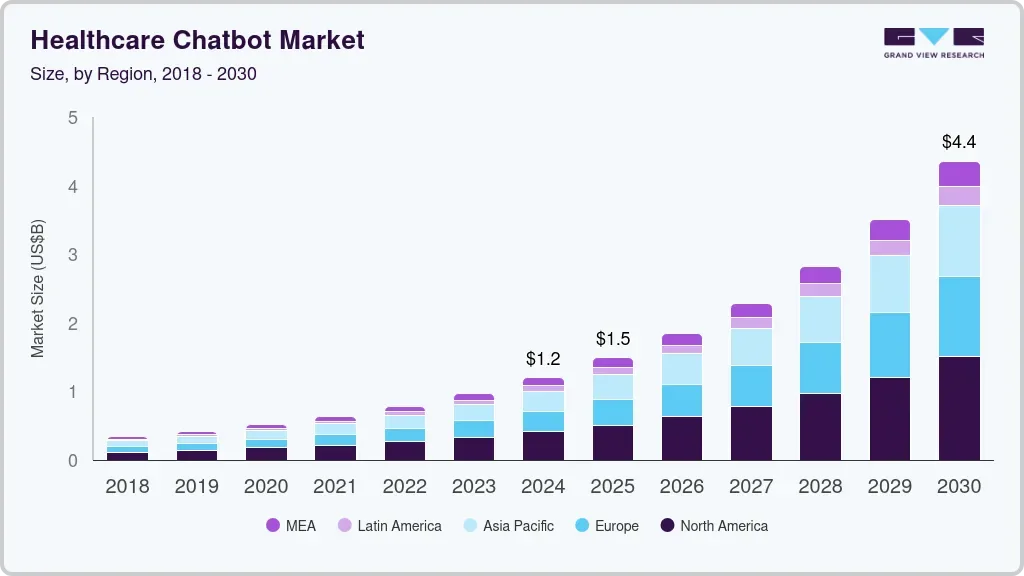
Grandviewresearch estimates that the size of the healthcare chatbot market worldwide will increase by a 24% CAGR between 2025 and 2030 to USD 4.36 billion in 2030. This development is propelled by interpenetration with telemedicine, EHRs, and the technology of NLP, which improves patient interaction and efficiency.
Key Trends
- Patient Engagement: AI chatbots will enhance real-time communication, personal care, and medication compliance, and decrease the workload of clinicians.
- Mental Health & Chronic Care: Mental health and chronic disease management chatbots are also expanding at a brisk pace, and mental health applications will grow at a rate of more than 31% CAGR.
- Global Adoption: North America is a dominant force in the market, and Asia-Pacific has the best market growth due to digital health programs and extensive smartphone usage.
Industry Impact
Administrative processes are being automated, diagnostics are assisted, and costs decrease with the help of AI chatbots, redefining the healthcare industry. A hybrid deployment model that involves the use of the cloud and on-premise systems provides data privacy and compliance. The providers are being transformed into revenue generators by new reimbursement policies, such as AMA CPT codes.
Read more: Top AI Trends
Conclusion
Ahhh… Quite a long blog, right? Well, True learning doesn’t happen overnight; it takes time!
At the end, this blog concludes that AI chatbots are transforming the healthcare industry because they help improve patient care, operational efficiency, and costs. In addition to that, they also provide 24/7 support, personal health advice, and automatic administrative features. These kinds of advancements and features make this technology more adoptable for healthcare businesses.
Reports indicate that AI chatbots can decrease hospital readmissions by 25% and enhance patient engagement by 30%, resulting in improved health outcomes. The chatbot market in the healthcare sector is expected to explode by the end of 2025, growing from the current USD 1.5 billion to more than USD 4 billion as a result of the future breakthroughs in natural language processing, telemedicine, and remote patient monitoring.
Other than that, we have listed multiple benefits of incorporating AI chatbots in healthcare, but one can only achieve those advantages when you partner with the top Generative AI development company. Who has experience in building such chatbots and takes care of security and compliance as well? You will get your answer in the next section. Keep reading.
Build a Smart AI-Powered Healthcare Chatbot, with ScalaCode
ScalaCode is the best AI chatbot development company, and we provide chatbots that are capable of providing 24/7 patient care, automated bookings, medication notices, and symptom tracking, and do not interfere with EHR systems. In addition to that, we integrate the latest technologies into the chatbot, like NLP and machine learning, which empower and provide personalized interactions that enhance patient engagement and efficiency.
Key Features of ScalaCode Healthcare Chatbot Development:
- 24/7 availability
- AI-driven patient interactions
- Integration with EHR and hospital management systems
- Intelligent symptom checking
- Personalized triage recommendations
- Automated appointment booking
- Multi-language and voice-enabled chatbot
- Advanced NLP experiences
- HIPAA-compliant secure data handling
- Scalable architecture
People Also Ask
1. How secure is patient data when using healthcare chatbots?
Patient data security in healthcare chatbots is completely secure when built with the help of a trusted AI app development company. Along with that, the security factor also depends on strong encryption, HIPAA/GDPR compliance, and secure cloud storage. If you partner with reliable and trusted providers who use end-to-end encryption and role-based access control to protect sensitive medical information from breaches or unauthorized access, then your chatbot will completely secure your patient data.
2. Are AI chatbots reliable for mental health support?
Patients can talk to the AI chatbots for their emotional and mental support, so, yes, this can be a great idea. By providing the initial emotional support, AI chatbots in healthcare can also help in mood tracking and coping strategies, but they’re not substitutes for licensed therapists. They are effective for early intervention and 24/7 availability, but should complement, not replace, professional mental health care.
3. What types of healthcare tasks can AI chatbots automate?
Well, AI chatbots in healthcare can automate almost all kinds of tasks; for example, appointment scheduling, symptom checking, prescription refills, patient onboarding, and follow-up reminders. In addition to that, they can also assist with FAQs, billing queries, and health education, which will also help in reducing administrative workload for healthcare staff.
4. How do AI chatbots improve patient engagement and adherence?
AI Chatbots can improve patient engagement and adherence in multiple ways, like how they offer personalized reminders, treatment updates, and interactive health guidance, encouraging patients to stay consistent with care plans. Along with that, it also provides 24/7 availability that helps in improving communication, motivation, and overall adherence to prescribed treatments.
5. What are the common challenges in implementing AI chatbots in healthcare?
Well, there can be multiple challenges while implementing AI chatbots in healthcare, but some major ones are ensuring data privacy, maintaining accuracy in medical advice, integrating with legacy healthcare systems, and addressing user trust issues. In addition to that, regulatory compliance and ethical considerations are also among the major challenges that can affect the implementation process or further results as well.
6. Can AI chatbots replace healthcare professionals?
No, AI chatbots do not displace healthcare professionals since the tools can only be used as a supportive tool in the triage, information delivery, and monitoring of patients, but not in complex medical decision-making due to a lack of empathy, expertise, and critical thinking.
7. What is the future outlook for AI chatbots in healthcare by 2026?
With AI chatbots by 2026, it is hoped that they will be more refined with predictive analytics, voice recognition, and real-time health monitoring. They will significantly contribute to preventive medicine and telemedicine, simplifying patient communication and enhancing the results.