
RAG development cost in 2026 ranges from $10,000 for a basic prototype to $150,000 or more for an enterprise agentic system. Most production deployments land between $25,000 and $60,000.
However, the final number of RAG development prices completely depends on factors like vector database choice, embedding model, complexity of the project, and the engineering team.
Here in this guide provided by ScalaCode, we will walk you through the actual RAG development cost in 2026 and why two projects with near-identical specs can differ in price.
If you’re weighing RAG for your own organization, ScalaCode’s RAG development services cover the full build, from architecture through production deployment.
What Drives RAG Development Cost
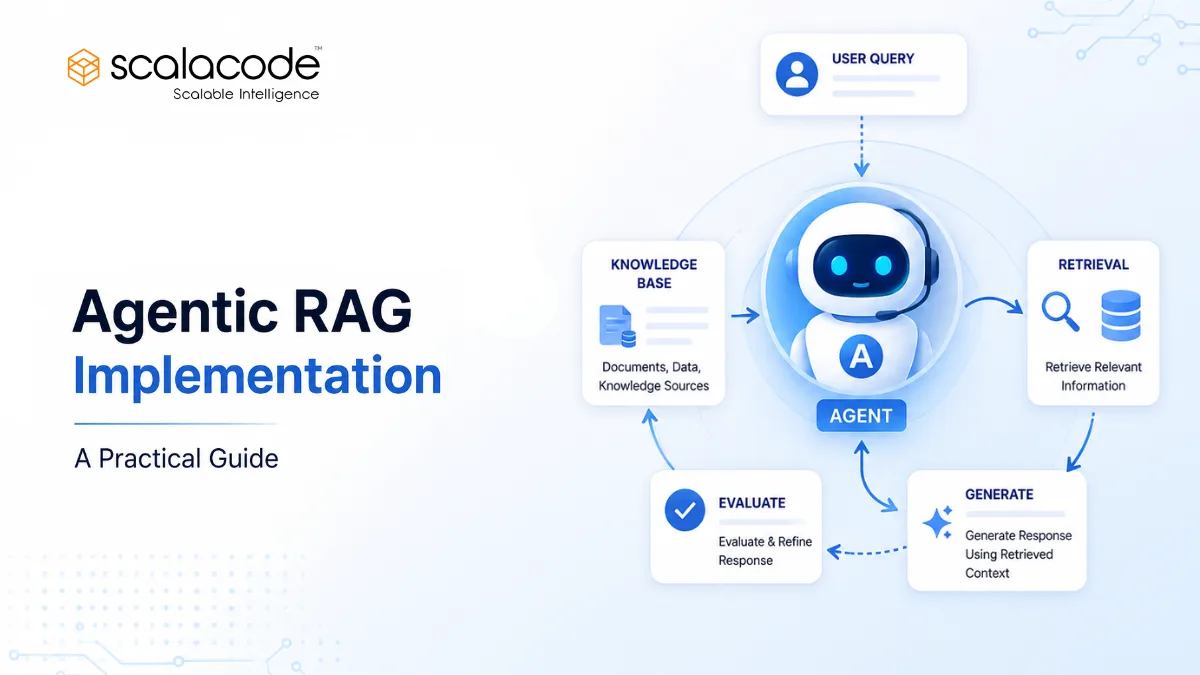
RAG development cost breaks down into five components wired together: ingestion, embeddings, vector storage, retrieval, and generation. Each behaves differently on your budget, and treating them separately is what separates an accurate estimate from a guess.
- Data ingestion and chunking ($2,000 to $15,000). Documents must be parsed, cleaned, chunked, and loaded before retrieval can be performed. This action is easy to implement. Ingestion is cheap, only $2,000-$5,000, when the PDF is clean and has selectable text. Scanned images, handwritten forms, and a dozen source systems bring it to the edge of $15,000.
- Embedding model selection covers the range between a $500 and $8,000 setup, plus $0.02 to $0.13 per million tokens ongoing. Additionally, embeddings turn your text into vectors; on the other hand, OpenAI’s text-embedding-3-small runs about $0.02 per million tokens with solid accuracy for English-only projects. Text-embedding-3-large costs more but handles multilingual content better.
- Vector database RAG development cost ranges from $0 to $3,000 a month, plus $1,000 to $8,000 for setup. This is where architecture choices hit your budget the most. Here you can also manage options like Pinecone or Weaviate Cloud, shifting cost from setup toward monthly operations; you pay more per query but own zero infrastructure.
- Retrieval architecture can cost you around $3,000 to $20,000 or more. This is the logic layer deciding what context gets pulled and passed to the model. Basic retrieval, a single vector search returning top results, costs $3,000 to $6,000 and hits roughly 60 to 70% accuracy on enterprise benchmarks.
- Hybrid retrieval combines dense vector search with keyword search and reranking, runs $6,000 to $12,000, and pushes accuracy to 80 to 88%. Agentic retrieval, where the model chooses its own retrieval strategy and can call multiple tools, costs $12,000 to $20,000 and up, but reaches 90% or higher.
This is exactly the territory covered in our piece on AI agent memory optimization, since agentic retrieval depends heavily on how well an agent remembers and reuses prior context.
RAG Development Cost Tiers
The components of RAG development cost only mean something once you translate them into full project budgets. These three tiers reflect what gets quoted and delivered across real 2025 and 2026 projects.
| Tier | Price Range | What’s Included | Timeline |
| Tier 1: Basic RAG | $10,000 to $25,000 | Single source, basic chunking, one embedding model, vector search, small LLM | 2 to 4 weeks |
| Tier 2: Production RAG | $25,000 to $60,000 | 3 to 7 sources, hybrid retrieval, eval harness, LLM gateway, authentication | 6 to 10 weeks |
| Tier 3: Enterprise Agentic RAG | $60,000 to $150,000+ | 7+ sources, agentic retrieval, multi-tenant, SOC2/HIPAA/GDPR compliance | 10 to 16 weeks |
- Tier 1 fits startups validating a concept and internal tools under 500 documents. It answers “can RAG work on our data,” not “is this ready for 10,000 users?”
- Tier 2 is where most enterprises land; customer support assistants, internal knowledge bases for 500+ employees, and document search over policy libraries all fit here. The gap between $25K and $60K comes down to source count, retrieval complexity, and compliance needs. A healthcare client that needs HIPAA-compliant ingestion and full audit trails typically adds $8,000 to $12,000 to the base build.
- Tier 3 applies to Fortune 500 companies and regulated industries where accuracy must be at least 90 percent, and every answer needs a citation trail. Each additional tool the agent can call adds five to ten days of development, so a system with eight tools typically costs $30,000 to $40,000 more than one with two.
Key Factors That Increase RAG Development Cost
- More data sources added, more RAG Development Cost: Custom connectors, authentication, and testing are required to connect SharePoint with Oracle databases, scanned PDFs, or CRMs.
- Accuracy Requirements: The higher the accuracy, the higher the RAG development cost. Reranking, query optimization, enhanced embeddings, and agentic retrieval workflows can all play a crucial role in improving retrieval quality.
- Compliance Requirements: RAGs become more costly due to compliance regulations such as HIPAA, SOC 2, or GDPR. Audit logging, access controls, and redaction of sensitive data are other features that need extra engineering.
- Data Volume and Infrastructure: Simple vector databases are sufficient for small collections of documents; however, enterprise-scale data requires distributed indexing, sharding, and optimized infrastructure, which comes at a higher cost.
- Development Team Location: RAG development cost will vary according to the location of your development team. Offshore teams may offer similar technical abilities for a much lower hourly rate than US teams.
How to Reduce RAG Development Cost Without Compromising Performance
- Lower RAG Development costs with Two-Stage Retrieval: utilize a readily available embedding model for the first stage and a more capable embedding model for reranking top results.
- Retrieved Context: Pre-processing retrieved content by summarizing it before feeding it into the LLM decreases the number of tokens consumed, which decreases inference costs and improves the relevance of the responses.
- Cache Frequently Asked Queries: Reduce the number of times that vector databases are accessed and reduce infrastructure costs in high-traffic applications.
- Large-scale embedding deployments can save on RAG development costs by avoiding recurring API charges from running open-source embedding models.
- Use a Simple Vector Database: Use solutions such as pgvector for smaller deployments. Only use a specialized vector database if the data size and traffic are too big not to warrant the expense.
RAG or Fine-Tuning For Your Budget
RAG makes sense when your data changes often and you need citations behind every answer. Fine-tuning makes sense when your domain vocabulary or output style is what actually needs adjusting.
| Factor | RAG | Fine-Tuning |
| Initial setup cost | $10,000 to $60,000 | $15,000 to $80,000 |
| Ongoing cost per month | $200 to $3,000 | $50 to $500 |
| Knowledge updates | Re-embed changed docs, minutes | Retrain model, hours to days |
| Best for | Changing data, citations needed | Stable vocabulary, style or brand voice |
The trade-off flips when you factor in updates: re-embedding a thousand changed documents costs pennies, while retraining a fine-tuned model runs $500 to $2,000 in compute plus engineering time. Most enterprises end up using both RAG for grounding and a fine-tuned model for handling generation style.
Real Build: A ScalaCode Case Study
A US-based legal tech company needed to search 80,000 contracts and case files spanning four formats: PDF, Word, scanned images, and emails. Lawyers were spending three to five hours per case tracking down precedent clauses, and manual searches kept returning inconsistent results.
The Tier 2 production build came to $37,500 total. Ingestion with OCR for scanned files ran $11,000. Embeddings using text-embedding-3-large added $1,500 in setup and $80 monthly. pgvector on AWS RDS costs $3,000 to set up and $120 a month to run.
Hybrid retrieval with reranking ran $9,000, the generation layer with context compression added $4,000, and the API plus chat interface cost $5,500. An evaluation harness rounded it out at $3,500.
Three months into production, query accuracy hit an 89 percent faithfulness score, average latency landed at 850 milliseconds, and lawyer research time dropped from three and a half hours to twelve minutes per case. The monthly operating cost settled at $340. The system paid for itself in about four months based on billable hours saved.
FAQ On RAG Development Cost
Q1. How much does a RAG pipeline cost to build in 2026?
A RAG pipeline costs $10,000 to $25,000 for a basic prototype, $25,000 to $60,000 for a production system with hybrid retrieval, and $60,000 to $150,000 or more for an enterprise agentic RAG. The vast majority of production runs will fall between $25K and $60K.
Q2. What’s the cheapest way to build a working RAG system?
The lowest-cost solution is to run pgvector on a managed Postgres database, manage their own embeddings, and deploy a smaller model, such as GPT-5.5 mini. Costs are around $10,000 to build and under $200 per month to operate, not quite as accurate as previously, at about 70 to 75 percent.
Q3. How much does a vector database cost per month?
The cost of a vector database ranges from $0 for pgvector (using existing Postgres infrastructure) to $300 to $800/month for Pinecone’s standard tier (1 million vectors) to $2,000+ for enterprise-scale clusters (beyond 100 million vectors).
Q4. Is RAG cheaper than fine-tuning over time?
Yes, if the data is frequently updated. RAG costs $200 to $3,000 per month, compared to fine-tuning, which costs $50 to $500 per month, but fine-tuning requires a full retrain, whereas RAG only needs to be updated every minute or so. A weekly update of knowledge makes RAG less expensive than a yearly update.
Q5. What hidden costs do enterprises usually miss?
OCR for scanned documents, compliance and audit logging, evaluation infrastructure, and re-embedding documents as they change are the most commonly missed items. The cost of generation tokens at scale does not come cheap either, as from 100,000 queries per month it costs anywhere between $2,000 and $5,000.
Q6. How long does a production RAG build actually take?
A basic prototype takes two to four weeks. A production system with hybrid retrieval takes six to ten weeks. Enterprise agentic RAG with compliance needs runs ten to sixteen weeks, and messy source documents are the biggest schedule risk across all three.
Q7. Should I choose a managed vector database or self-host?
If your team is constrained for DevOps bandwidth and is looking to ship fast, use managed Pinecone, Weaviate Cloud, or Qdrant Cloud. If you’re already using Postgres, you want control over the data’s residency, or you anticipate large numbers of queries, which can be costly if you’re paying per query, use self-hosted.
Get A Custom RAG Development Quote
Each RAG project will be unique in its form and function. The numbers here are suggested ranges from actual deployments and will vary with the data you have, your accuracy bar, and your compliance requirements.
Your document sources are reviewed and provided as an architecture report, with a cost estimate per component, a recommended tech stack that is appropriate to your scale, and a timeline with team composition at a RAG consultation with ScalaCode.
We’ve created RAG for legal tech, healthcare, fintech, and enterprise SaaS clients on a range from prototypes to enterprise deployments at $12k to $90k. In Noida, our engineering department operates at 40 to 60 percent of the typical agency costs in the USA, but not at the expense of architecture.
Get your custom RAG development quote from ScalaCode’s team.