
The mobile app market has shown tremendous growth, with an estimated projection to reach $626.39 billion by 2030. Many businesses want to leverage this market by building applications that not only fulfill the end-user needs but are also profitable.

However, to build a powerful mobile application, you need to choose an equally powerful mobile app development framework. From matching speed and accuracy to built-in features, such frameworks offer it all. You just have to find the suitable one for your app idea.
2026 is the year of human-first innovation. With trends like immersive experiences, hyper-personalization, and connectivity to wearable devices, it is important to find out the best mobile app development frameworks now, more than ever. And frameworks are evolving to keep up with this pace, too.
What’s New in Mobile App Development in 2026?
Well, there are multiple new things coming in mobile app development, and you should opt for the latest frameworks. This will help you in building faster, smarter, and more scalable mobile applications that align with evolving user expectations.
1. AI-assisted development workflows
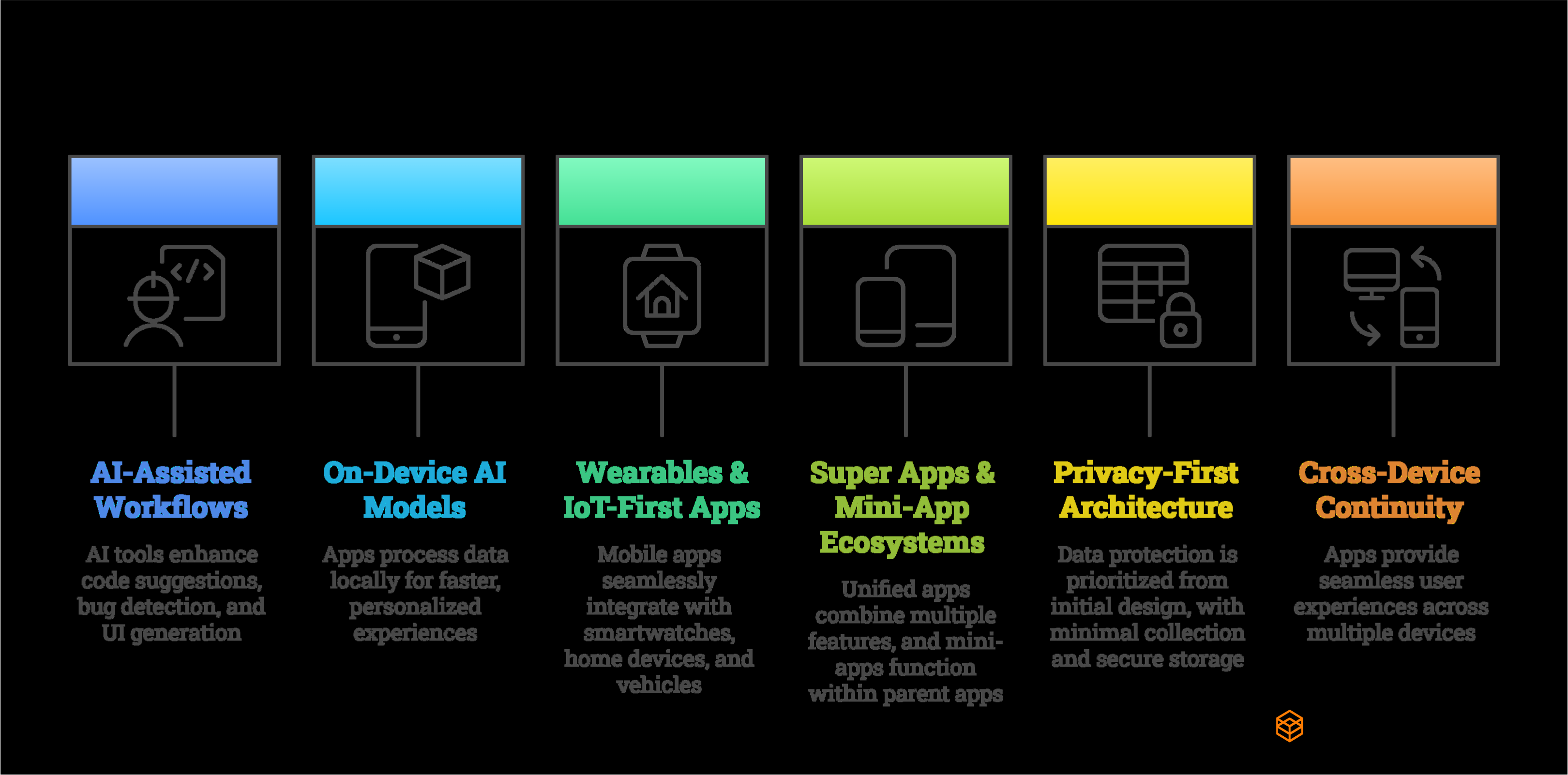
Nowadays, AI has become an integral part of the development lifecycle. This is because AI-powered tools used by developers to build applications assist developers with code suggestions, bug detection, UI generation, etc. In addition to that, you can hire an AI development company to build an app with an appropriate framework to help you in enhancing productivity by handling repetitive tasks and accelerating decision-making.
2. On-device AI models
In 2026, successful businesses will use on-device AI models that are capable of processing data directly on users’ devices without relying entirely on cloud servers. This overall approach helps in fastening the response time and enhancing user satisfaction. Additionally, On-device AI allows mobile applications to deliver real-time features such as voice recognition, image analysis, personalized recommendations, and predictive actions while reducing latency and server costs.
3. Wearables & IoT-first apps
The next are wearable and IoT-first apps that are no longer just restricted to smartphones, but now people carry their one device in their hand, like smartwatches. Wearables that are intelligence-based, like smart home devices, healthcare sensors, and connected vehicles, now play a central role in user experiences. Moreover, frameworks in 2026 are adapting to support seamless communication between mobile apps and IoT ecosystems.
4. Super apps & mini-app ecosystems
The other new thing that is going to take place in 2026 is the super app and mini app ecosystem. Based on current user demand, businesses are building super apps. Super apps are those apps that combine features such as payments, messaging, shopping, booking, and customer support under one unified interface. On the other hand, the mini app ecosystem allows multiple lightweight applications to function within a single parent app.
5. Privacy-first app architecture
Now, users and businesses are both taking an advanced step towards data privacy; hence, organizations are building high-end applications that are protected enough. In 2026, all mobile applications will be developed with a privacy-first architecture, where data protection is considered from the initial design stage. Not only his, but this will also include minimal data collection, secure local storage, encrypted communication, transparent permission management, and compliance with global data protection regulations.
6. Cross-device continuity
Last but not least, cross-device continuity, in simple words, implies that an application provides a seamless user experience across multiple devices, rather than interacting with an app on a single screen. Additionally, businesses are moving towards this facility; it helps in allowing users to start an action on one device and continue it on another without interruption.
Let’s design, develop, and scale your vision.
What Are Mobile App Development Frameworks?
Mobile app development frameworks are software tools that allow a developer to have access to pre-built components, toolsets, libraries, etc., that enable them to build mobile applications faster. These frameworks allow for the reuse of code and are structured in a consistent manner while delivering built-in functionality.
As a result, it provides the developer with a faster alternative to developing a mobile application from scratch and can also help to ensure the same level of performance, efficiency, and error-free application development across multiple devices.
Depending on the build type selected by the developer, the mobile application development frameworks provide a mechanism to develop native, cross-platform, or hybrid mobile applications through the use of either a single codebase or a shared codebase.
Overall, selecting the best mobile application development framework is a key factor affecting the performance, capability, maintenance, and overall customer experience of a mobile application as it relates to the overall success of a modern-day mobile application. You can hire mobile app developers to achieve all these and boost your business performance by 10X.
Top 7 Mobile App Development Platforms
Each framework has unique strengths. Some are ideal for performance, while others speed up deployment or reduce costs. In this section, we have listed the best frameworks for mobile development that you can opt for in 2026 based on your business goals and requirements.
1. Flutter
Flutter gives teams direct control over the interface. It renders its own UI and does not rely on native components. This allows consistent design across platforms and predictable behavior during updates. Performance is close to native when applications are structured well.
Flutter works best for products where design consistency matters and rapid iteration is required. It suits consumer-facing apps, MVPs, and platforms that need a single visual language across devices. Teams benefit most when they commit fully to Flutter rather than mixing approaches.
The trade-off is abstraction. Flutter sits between the app and the platform. When deep platform-specific features are required, custom native work becomes unavoidable. Teams must plan for this early or accept growing complexity later.

Must Read: Flutter App Development Cost
2. React Native
React Native builds on JavaScript and React. It connects shared code to native UI components through a bridge. This makes it familiar to web teams and easier to staff at scale. The ecosystem is large and mature.
React Native fits products that evolve quickly and rely on existing JavaScript expertise. It works well for applications with standard UI patterns and frequent feature updates. Many teams choose it to reduce hiring friction and onboarding time.
The cost appears in performance tuning and dependency management. Heavy animations and complex interactions require careful optimization. Long-term stability depends on disciplined version control and mobile application development framework upgrades.

Also Read: How to Hire React Native App Developers
3. Kotlin Multiplatform
Kotlin Multiplatform takes a different approach. It shares business logic, not the interface. Each platform keeps its native UI while using the same core logic underneath. This reduces duplication without sacrificing platform behavior.
This model suits enterprise environments with existing native teams. It works well for large systems where consistency in business rules matters more than shared presentation. It also fits regulated domains where predictability is required.
The trade-off is complexity. Teams must manage multiple UI codebases alongside shared logic. The payoff comes later, not at the start. This approach favors long-term products over rapid experiments.

Learn More: How To Hire Kotlin Developers
4. .NET MAUI
.NET MAUI matters to organizations already invested in Microsoft. It allows C# and .NET to span mobile, desktop, and cloud systems. For these teams, it reduces context switching and aligns well with existing tooling.
MAUI works best for internal enterprise applications and line-of-business tools. It supports shared development practices and integrates smoothly with Microsoft infrastructure.
Its limits show in highly customized consumer apps. UI flexibility and ecosystem depth lag behind more established cross-platform app development frameworks. Teams choosing MAUI usually do so for alignment, not experimentation.

5. SwiftUI
SwiftUI is tightly aligned with the Apple ecosystem. It is designed to work with Apple’s hardware, operating system updates, and development tools without abstraction layers. This alignment results in predictable performance and smooth system integration.
SwiftUI fits applications where responsiveness, animation quality, and platform conventions are critical. It is the right choice for products that rely on Apple-specific features or long-term OS compatibility. Teams building premium consumer apps or deeply integrated iOS products often choose native to avoid compromise.
The limitation is the scope. SwiftUI serves Apple platforms only. Teams must accept separate development efforts if Android support is required. The payoff is control, not reach.

Bonus Visit: How To Hire Swift Developers
6. Ionic
Ionic is built on web technologies. It wraps HTML, CSS, and JavaScript inside a native container. This allows web teams to ship mobile apps without learning a new stack. Development is fast and familiar.
Ionic works well for internal tools, dashboards, and content-driven applications. It suits products where consistency with an existing web platform matters more than native behavior. Maintenance is simpler when the same team owns both web and mobile.
The limits appear under load. Complex animations, heavy interactions, and offline-first behavior expose the cost of WebView-based rendering. As user expectations rise, performance gaps become visible.

7. NativeScript
NativeScript is a cross-platform mobile app development framework that allows developers to build applications using JavaScript, TypeScript, or Angular. In addition to that, it helps in delivering truly native performance, unlike web-based hybrid frameworks, and that too without relying on WebView rendering.
This framework is built for teams that want native UI components while maintaining a shared codebase. Not only this, but developers can interact directly with iOS and Android APIs, enabling deeper hardware access and more control over device-specific features.

A Quick Comparison of Top Mobile App Development Frameworks
Above, we have discussed the top 7 mobile app development frameworks in detail; now, let’s have a quick comparison of all of them in this section. This table will help you take a look at all the frameworks so that you can choose the most appropriate one for your business application.
| Framework | Platform Coverage | Performance | Best Use Case |
| Flutter | Android, iOS, Web, Desktop | Near-native performance with custom UI rendering | Startups, MVPs, and consumer apps requiring a consistent UI across platforms |
| React Native | Android, iOS | Good performance; requires optimization for complex UI | Apps with frequent updates and teams with strong JavaScript expertise |
| Kotlin Multiplatform | Android, iOS, Web, Desktop | Native-level performance for business logic | Enterprise apps with shared logic and separate native UIs |
| .NET MAUI | Android, iOS, Windows, macOS | Moderate to good performance | Microsoft ecosystem apps and internal enterprise solutions |
| SwiftUI | iOS, iPadOS, macOS, watchOS | Excellent native performance | Apple-first apps requiring smooth animations and deep OS integration |
| Ionic | Android, iOS, Web | Moderate performance (WebView-based) | Content-driven apps, dashboards, and web-to-mobile solutions |
| NativeScript | Android, iOS | Native performance with direct API access | Apps needing deep hardware access with a shared codebase |
How to Choose the Best Mobile App Development Framework?
Mobile app development framework selection is not a technical exercise alone. It is a product decision that affects cost, speed, and longevity. The wrong choice slows teams long after the first release.
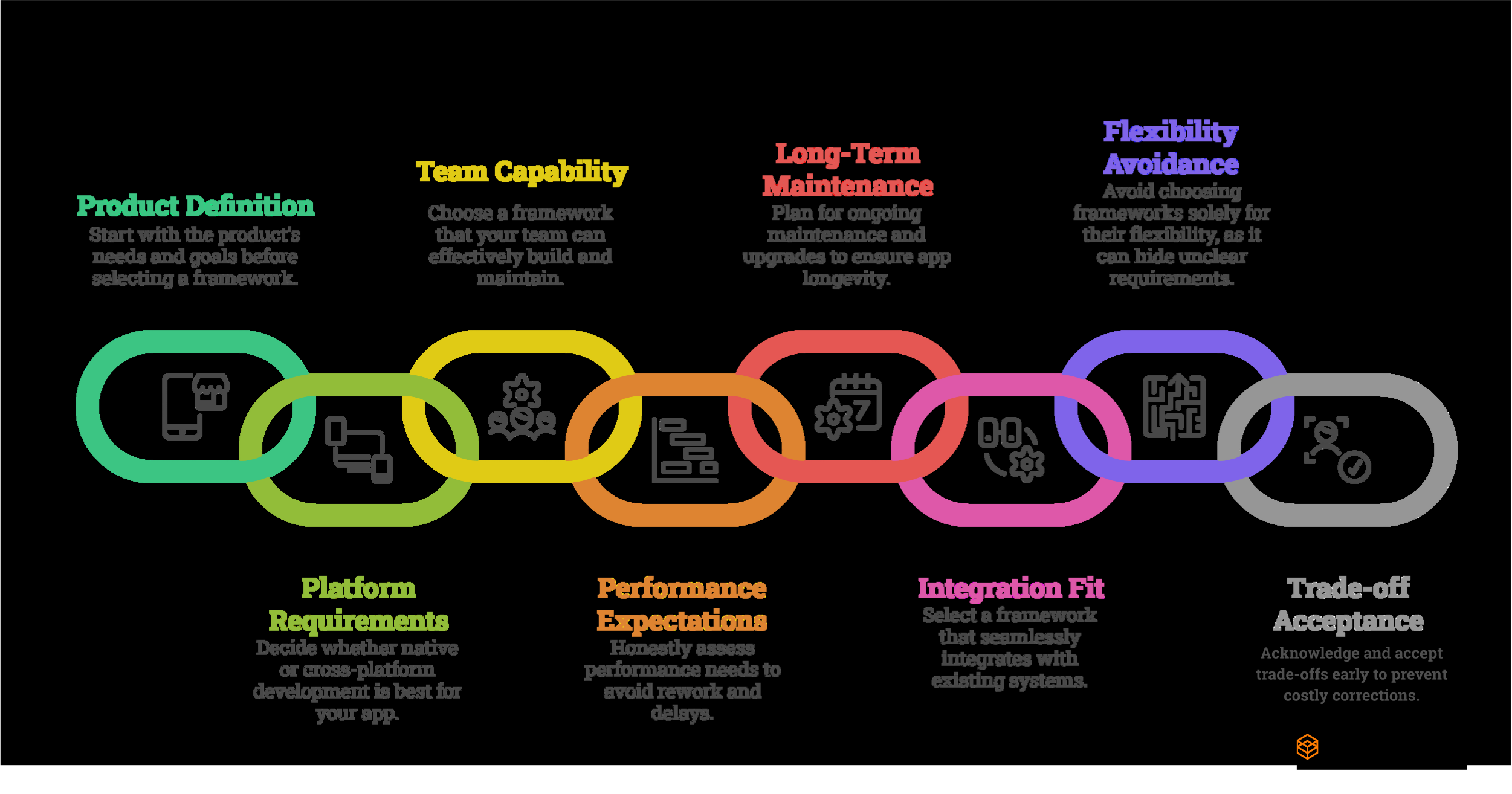
1. Start with the product, not the framework: Define what the application must deliver now and later. Performance needs, platform coverage, and release cadence limit viable options early.
2. Evaluate platform requirements first: Decide whether the app must feel native on each platform. If platform behavior matters, native frameworks reduce risk. If reach and speed matter more, cross-platform tools are suitable.
3. Assess team capability and hiring reality: Frameworks do not ship products. Teams do. Choose what your team can build, maintain, and scale without friction.
4. Measure performance expectations honestly: Heavy animations, real-time processing, and hardware access narrow choices. Ignoring performance constraints leads to rework.
5. Plan for long-term maintenance: Maintenance outlasts development. Framework stability, upgrade paths, and ecosystem maturity shape long-term cost.
6. Consider integration and ecosystem fit: Enterprise apps depend on APIs, services, and tooling. Frameworks that align with existing systems reduce operational overhead.
7. Avoid choosing for flexibility alone: Too much flexibility hides unclear requirements. Clear constraints lead to simpler architecture and fewer rewrites.
8. Accept trade-offs early: Every framework limits something. Acknowledging limits early prevents costly corrections later.
Learn More: AI in Mobile App Development
Common Mistakes to Avoid When Choosing a Mobile App Framework
Most framework failures do not appear in the first release. They appear during upgrades, scaling, and long-term maintenance. Teams usually fail not because they choose a weak framework, but because they choose with the wrong criteria.
The following mistakes account for the most costly rewrites and stalled products.

1. Choosing Based on Popularity Instead of Product Roadmap
Framework popularity does not predict long-term fit. Roadmaps define performance needs, platform features, and scaling limits. Ignoring future requirements leads to early architectural dead ends.
2. Optimising for Initial Speed Over Long-Term Stability
Fast delivery hides future costs. Frameworks that ship quickly often fail during major upgrades. Short-term speed increases long-term maintenance burden.
3. Ignoring Upgrade and Versioning Strategy
Every framework will change. Teams that do not plan upgrade paths accumulate technical debt. Large version jumps are where most projects stall.
4. Underestimating Performance Constraints
Assumptions replace measurement in many teams. Late discovery of UI or memory limits forces rewrites. Performance limits must be tested before the architecture is fixed.
5. Choosing a Framework the Team Cannot Maintain
Hiring and retention shape architecture more than features. A strong team on a simple stack outperforms a weak team on an advanced one.
6. Ignoring Ecosystem and Plugin Risk
Frameworks depend on third-party libraries. Unmaintained plugins create security and upgrade blockers. Ecosystem health predicts long-term viability.
7. Treating Cross-Platform as a Universal Solution
Not all code should be shared. High-risk flows often require native control. Forcing full reuse increases failure probability.
Conclusion
At the end of this guide, we conclude that choosing the right mobile app development framework in 2026 is not about following trends. It is about understanding the business goals and requirements and then choosing the correct framework accordingly.
You can also consult with a mobile app development company that can help you in building your dream and a result-driven mobile application. In addition to that, with an evolving user experience, you should also consider integrating high-end technologies like AI/ML, NLP, extended reality, if needed, and a lot more. All these new technologies make your application more satisfactory for the end user and help you boost your business.
You can also choose ScalaCode as your ultimate mobile app development partner, as we help businesses turn their app ideas into scalable and high-performing digital products. Not only this, but we have a strong team of experienced mobile developers, designers, and technology consultants. Furthermore, we focus on building secure, user-centric, and future-ready mobile applications.
Talk to our experts to start your app journey today.
FAQs
-
What is the best mobile app development framework in 2026?
Well, all the frameworks are best at their place; however, they offer different facilities, so based on your business goals and requirements, you should opt for your mobile app development framework. Additionally, an ideal framework is one that provides high performance, scalability, strong security, easy maintenance, and long-term ecosystem support.
-
Is Flutter suitable for long-term mobile projects?
Yes, Fluent is suitable for long-term mobile projects, but it comes with the condition of planning the mobile application structure satisfactorily. If your development team is following this condition, then they can definitely achieve strong performance, consistent UI, and long-term support from Google.
-
How does React Native compare with Flutter?
If we compare React Native and Flutter, then they can be compared on multiple factors like performance, development approach, UI rendering, ecosystem support, and team expertise. If we talk about React Native, then it works well for teams with strong JavaScript and React experience. On the other hand, Flutter uses its own rendering engine, which provides consistent UI and smoother animations across platforms.
-
Are hybrid app development frameworks still relevant in 2026?
Yes, hybrid app development frameworks remain relevant in 2026, especially for internal tools, dashboards, and content-based applications. However, they are not ideal for performance-intensive or highly interactive apps where native or cross-platform frameworks deliver better user experiences.
-
Will AI change mobile app development frameworks?
AI is significantly influencing mobile app development frameworks for more productivity and other business benefits in the long term. Though it is not completely changing the frameworks, it is making mobile apps more user-friendly after AI integration.