
The integration of Machine learning in IoT is revolutionizing industries by enabling smarter, faster, and more autonomous operations. This is proved by the latest reports from Statista, IoT devices proliferate across the globe, expected to reach over 19 billion by the end of 2025.
In addition to that, Machine learning in IoT devices gives opportunities for advanced analytics and automation to generate real-time data.
Recent market forecasts highlight the role of Machine Learning in the Internet of Things:
- The global machine learning market is projected to surpass $105 billion in 2025, with a compound annual growth rate (CAGR) of over 32%.
- The IoT market is expected to reach $1.56 trillion by 2029, continuing its rapid expansion.
- According to Gartner, by 2025, more than 95% of new industrial IoT deployments will incorporate AI and machine learning for real-time analytics, automation, and improved security.
- McKinsey estimates IoT, driven significantly by machine learning and advanced data analytics, could contribute $5.5 to $12.6 trillion in global economic value by 2030.
What is Machine Learning in IoT?
Machine learning in IoT is defined as the inclusion of sophisticated algorithms in the application of machine learning in IoT, to have devices that are capable of analyzing information, discovering patterns, and making intelligent decisions without being programmed.
The role of machine learning in IoT parsing through the huge data volumes created by IoT networks is to find useful insights that can be used to automate processes and make systems more efficient.
Machine learning in IoT also extends beyond the processing of data-it enables devices to understand user behavior, adjust according to different environments, and anticipate results to make better decisions.
As an additional example, ML models can be used on a set of connected sensors within a smart home, factory, or even a healthcare system to optimize energy consumption, identify anomalies, or predict when maintenance is needed.
Further, Machine learning in IoT security is very helpful in determining threats, avoiding cyberattacks, and maintaining the integrity of data. ML-driven IoT systems respond accordingly, adding additional security to the systems without interfering with the operations.
What is the Role of Machine Learning in IoT?
Machine learning in IoT is constituted by processing raw sensor data into something that is meaningful and that can take intelligent actions.
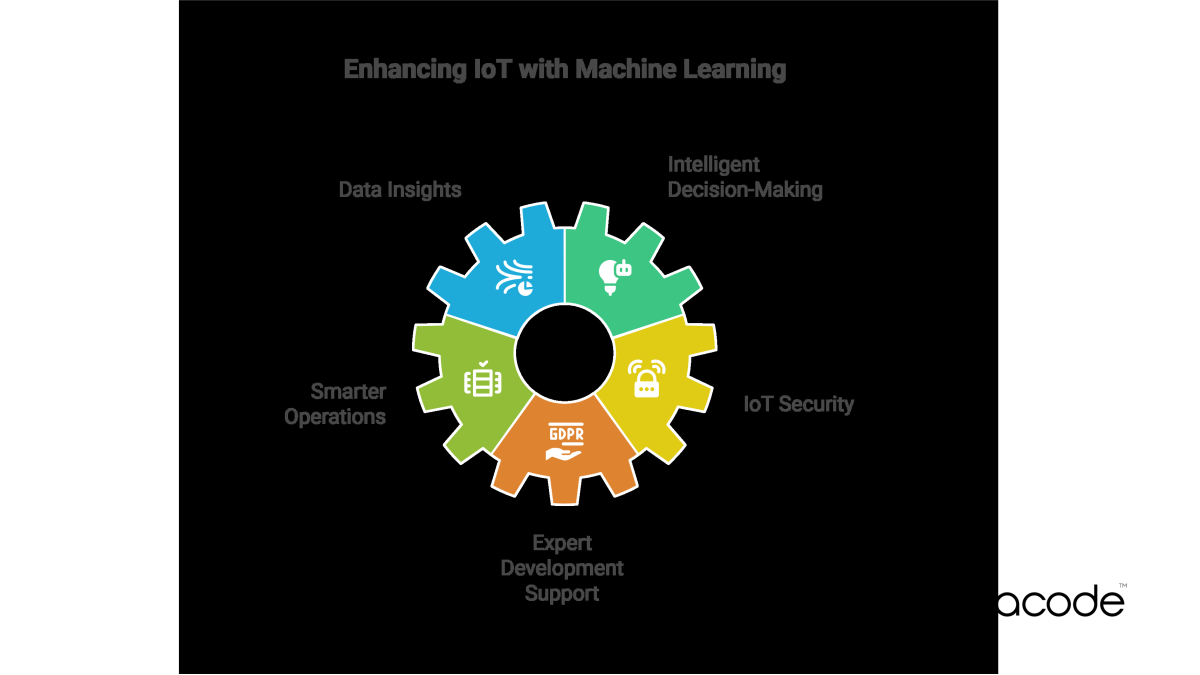
1. Turning Data into Insights
Machine learning in IoT is central to the analysis of huge volumes of sensor data, to the identification of patterns that are hidden in the data, and to the transformation of such data into useful insights. This transition of raw material to smart results enables businesses to produce smarter and quicker decisions.
2. Intelligent Decision-Making
Machine learning will be able to power the IoT systems and predict equipment failures, optimize resources, and adjust to environmental changes that happen on a real-time basis. This renders machine learning for intelligent decision-making in IoT of significant importance to such industries as logistics, manufacturing, and healthcare.
3. Smarter Operations with AI
With AI and machine learning in IoT, devices can learn over time by sniffing past behaviours, identifying anomalies, and taking actions. The result is predictive maintenance, fraud prevention, and energy management over networked solutions.
4. Strengthening IoT Security
The bigger the networks get in terms of IoT networks, the bigger cyber threats become. Machine learning supports IoT security, providing detection and identification of abnormal behavior in a device, detecting potential breaches, and preventing unauthorized access-enabling reliability and trust.
5. Expert Development Support
To take full advantage of such capabilities, companies tend to engage an IoT development company or an AI development firm. Such specialists create tailor-made solutions that combine AI models with the IoT infrastructure and guarantee scalability, security, and defined business profit.
What Are The Benefits of Integrating Machine Learning in IoT?
Integrating machine learning (ML) in the Internet of Things (IoT) delivers multiple transformative advantages of machine learning in IoT across various industries:
1. Enhanced Data Analysis & Pattern Recognition
AI involves big data analytics to work through massive amounts of information generated by IoT, allowing people to see hidden patterns and trends that the human mind may overlook. This allows informed decision-making that is data-based and allows companies to glean meaningful information out of a stream of sensor data.
2. Predictive Maintenance & Forecasting
Using real-time and historical sensor data that is analyzed, ML can predict when the machinery will break down and when maintenance is required. This preventive strategy will help to eliminate downtimes and keep equipment costs down, allowing them to last longer and implement minimal repairs.
3. Real-Time Analytics & Decision-Making
IoT products that use ML can analyze information and take action immediately to quickly adapt to shifting conditions. Such dexterity becomes important in such fields as zero-carbon automobiles, smart grids, and critical infrastructure.
4. Anomaly Detection & Improved Security
ML is great in identifying rare patterns and, therefore, cyber threats, intrusions, or device malfunctions can be identified early. Incidents in the IoT increase the reliability and dependability of the IoT ecosystems due to timely notifications.
5. Automation & Operational Efficiency
The main benefits of ML are that it allows automating some routine processes and optimizing resources consumed (energy, bandwidth, materials), and cutting human intervention. Activities are streamlined, operation speed increases, and accuracy improves.
6. Personalization & User Experience
By gaining knowledge about user behavioral patterns or preferences, ML will be able to personalize responses of IoT device functionalities, personalizing home thermostat settings or product suggestions.
Also Read: AI in UX Design: Transforming Future of User Experience and Behavior Design
7. Resource Optimization & Sustainability
ML can be used to determine patterns of consumption (energy, water, logistics) and optimize them so as to minimize waste, cut costs, and generalize practices within IoT networks towards being more sustainable.
8. Scalability & Edge Intelligence
ML models can now be pushed to the edge device, so that a large-scale IoT solution can be developed that has less latency and less reliance on centrally-hosted servers. Instead of bandwidth consumption and slow response times, data may be processed and compressed locally.
What Are The Machine Learning Algorithms Used in IoT?
The use of machine learning is critical in empowering IoT mechanisms to interpret real-time data and make decisions on the occurrence of anomalies, and make predictions. Here are some widely used machine learning algorithms in IoT:
1. Linear Regression
Linear regression is one of the most efficient algorithms of predictive analytics. It is often used in IoT to predict sensor measurements, e.g., changes in temperature, energy quantities used, or the performance of equipment. As an illustration, smart meters learn the electricity demand using the technique known as linear regression, which can help utilities to effectively distribute energy.
2. Decision Trees
Decision trees have proven to be useful for classification and decision-making of IoT systems. They can detect defective sensors, extrapolate device behaviour, or partition IoT data flows into classes. Examples include decision trees being used in industrial IoT to analyze incoming parts and see whether or not they are defective to improve quality control and reduce downtimes.
3. Random Forest
Random forest is an artificial intelligence that is a combination of several decision trees and helps to enhance accuracy and reliability. In IoT, it can be used most effectively when detecting faults and conducting predictive maintenance. A common example would be random forests being used by connected machines in factories to spot the first symptoms of failure and prevent expensive damage and downtime.
4. K-Means Clustering
K-Means is one of the unsupervised learning models that provides the grouping of IoT devices or sensor data based on similarities. Such is useful in the smart city scenario, such as in traffic management, where clustering can be used to cluster vehicles or traffic flow patterns to better route them. It aids in energy optimization because it classifies usage patterns in the various households or industrial units.
5. Support vector machines (SVM)
SVMs have high efficiency in IoT security since they perform very well in detecting anomalies. SVMs can recognize malware activity or attempts to access without the appropriate authorization by analyzing traffic patterns. They are also using them in healthcare IoT equipment to detect unusual patient readings, where timely intervention and safety are assured.
6. Neural Networks
Deep learning neural networks add powerful strength to an IoT system. They make more complex things, such as image recognition in surveillance cameras, speech recognition in smart homes, and predictive maintenance in industrial machines, possible. To take an example, by using neural networks, connected medical devices can scan patient scans in real-time and assist doctors with diagnoses in a reduced time.
What Are The Various Machine Learning Models For IoT Applications?
The principal types of machine learning in IoT are given below:
1. Supervised Learning Models
- Description: These models learn from labeled historical knowledge.
- Mandatory Algorithms: Decision Trees, Random Forest, SVM, k-NN, Linear/Logistic Regression, Neural Network.
- IoT Applications: Anomaly detection in sensor networks, Predictive load of industrial machines, Environmental monitoring.
2. Unsupervised Learning Models
- Description: These models learn the significance of unmarked facts.
- Popular Algorithms: Clustering (K-means, Hierarchical), Principal Component Analysis (PCA), and Autoencoder.
- IoT Applications: Fault segmentation on types of machine faults, cluster activation in smart home, detection of novel anomalies in a traffic problem, or usage data.
3. Reinforcement Learning Models
- Description: Learning is achieved by the models interacting with the environment and getting the results in the form of rewards or penalties.
- Popular Algorithms: Q-Learning, Deep Q Networks (DQNs), Policy Gradient Methods.
- IoT Applications: An automated control system (e.g., smart thermostats that adjust their settings accordingly to maximize efficiency), robotics, and dynamic energy management in smart buildings.
4. Deep Learning Models
- Description: Using complex pattern recognition on multi-layer neural networks.
- Popular Algorithms: Convolutional Neural Networks (CNNs), Recurrent Neural Networks (RNNs), Long Short-Term Memory (LSTM).
- IoT Applications: Processing images/video recordings via surveillance cameras, modeling sequences to predict things, using speech/voice recognition on smart devices.
Top Use Cases For Machine Learning in IoT

Here are the top use cases of machine learning in IoT for different niches:
1. Predictive Maintenance
- In industrial cases, ML is evaluated to predict equipment breakdowns, leading to a reduction of maintenance costs by up to 30%.
- Widespread in the manufacturing, automotive, and logistics industries to proactively avail of machinery and vehicle maintenance.
2. Process & Quality Control
- Anomaly detection in sensor streams can assist manufacturers and healthcare providers with adjusting to maintain a high level of quality in a product and waste reduction.
- Automated quality assurance Inspection Method- An ML-driven inspection system identifies flaws in assembly lines.
3. Smart Homes & Automation
- ML works to customize device functionality (e.g., thermostats, lighting, security cams) in terms of personal behavior and environmental conditions to comfort and energy saving.
- Allows automatic identification of threats, optimal use of appliances, and heuristic control.
4. Security Enhancements
- It processes extremely large volumes of real-time data streamed by the IoT and identifies abnormal patterns in order to respond quickly to cyber attacks on smart homes, smart cities, and smart critical infrastructure.
- Sophisticated models assist in the detection of data theft, malware, and fraud.
5. Logistics & Fleet Management
- Forecasts demand, optimizes routing, and maintains fleet health to reduce fuel consumption and improve supply chain delivery performance.
- ML integration enhances warehouse inventory, delivery through drones, and tracking the assets.
6. Personalized Experiences
- Wearables, retail beacons, fitness trackers, etc, use ML to personalize the health recommendations, marketing, and user interface.
- Improves customer satisfaction in retail, BFSI, and consumer Internet of Things markets.
7. Digital Twin & Simulation
- Dense sensor coverage and ML can produce virtual models of factory, urban, and environmental processes to drive innovation and risk-free optimization.
- It is used to support domestic manufacturing, planning of smart city infrastructure, and managing wider-scale infrastructure.
Must Read: Digital Twins in Manufacturing: Top Use Cases, Trends, and More
8. Precision Agriculture
- ML uses IoT sensor data (soil weather, crop condition) to do resource-efficient farming, monitor livestock, and predict yields.
- Automates irrigation and pest control decision-making to maximize ROI.
9. Healthcare Monitoring
- Owing to the combination of IoT-connected wearables, ML-enabled diagnostics, and health management systems, patient vitals are monitored, and health events are predicted.
- Enhances facility and real-time care management.
In IoT, ML can capture real-time insights to drive billions of dollars in cost savings and intelligent automation across industries, factories, and fleets, homes, hospitals, and cities.
How Machine Learning in IoT Can Transform Businesses?
Machine learning in IoT is redefining the overall operation of connected devices by adjusting their capability of processing information and forming patterns, and making independent decisions. Such synergies pave the way to smarter operations, more robust security, and personalized user experiences in the vertical.
1. AI-Powered Business Strategies
Among the most significant changes is the fact that even at the intelligent level, IoT systems can make their own intelligent choices, so they do not always have to be fed information continuously by humans. The models of machine learning enable associated gadgets to make predictions, assign resources in the best way, and adapt to a constantly changing environment.
2. Predictive Maintenance
Machine learning in the IoT is being used to enable predictive maintenance in the industrial setting. Sensors that are connected with each other gather information about the machines, and learning models examine the trends in performance to predict possible faults. This is less time-consuming, cheaper to repair, and raises productivity.
3. Future-Ready IoT Protection
With the increase in IoT networks, there are security issues. Machine learning is able to keep such systems safe by recognizing abnormal activity and detecting possible breaches, and blocking cyber threats as they come. This enhances stronger and proactive security of IoT.
4. Personalized User Experiences
The other significant impact is personalization. Machine learning can use user behavior and preferences to have IoT devices present customized experiences. Meantime, Smart homes, wearables, and connected cars are able to evolve according to the user and create seamless and customized experiences.
5. Driving Innovation Across Industries
In healthcare and manufacturing, logistics, and smart cities, the use of IoT and machine learning is breathing new life into the field of possibilities. Companies are collaborating with a business intelligence company or an IoT company to build solutions that maximize efficiency and minimize expenses, with the ability to introduce new sources of income.
What Are The Challenges of Integrating ML in IoT?
Although machine learning in IoT holds a lot of opportunities, it comes with certain challenges to businesses as far as successful adoption and integration are concerned. These vulnerabilities extend to technical intricacies, data security issues, and so on, and they would require the right knowledge and foresight.
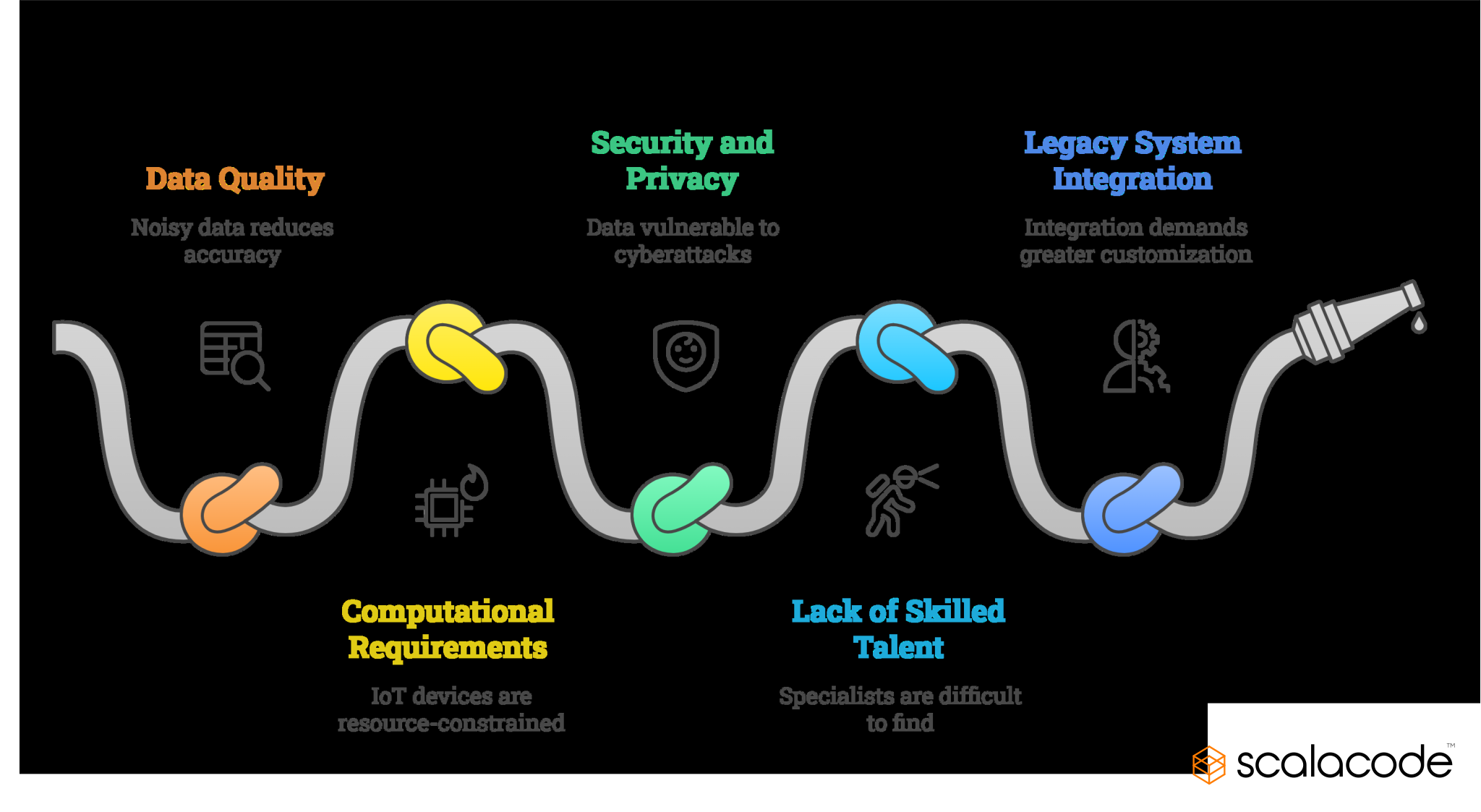
1. Data Quality and Management
IoT devices produce huge data, but a lot of that would be noisy, unstructured, or incomplete. Data quality is an input to the accuracy of ML models directly, and pre-processing and data product management are necessary practices.
2. High Computational Requirements
Running machine learning algorithms on IoT networks is highly computing- and storage-intensive. Most IoT devices are resource-constrained, and therefore, they require the support of cloud or edge computing to deploy complex ML models.
3. Security and Privacy Issues
Since there are billions of connected devices, the security of data and the privacy of the user are the key issues. The IoT system based on AI must be protected against cyberattacks and unauthorized access, which in many cases requires specialized knowledge of AI development and security.
4. Lack of Skilled Talent
The significant challenge is economic as well, since there is a lack of specialists capable of building and implementing ML-powered IoT solutions of their own. Most of the organizations are failing to recruit machine learning engineers or hire AI Developers with the appropriate skills to deal with the rather complex projects.
5. Integration with Legacy Systems
Various industries continue to use old sector infrastructure. It is hard to integrate the new ML algorithms with the older IoT systems, which would again demand greater customization, testing, and costs.
Explore More, Software Migration for Legacy Systems
Final Words
The intersection of machine learning and IoT is creating paradigm-shifting change across industries, bringing more intelligent, more rapid, and more streamlined business operations. As connected devices generate enormous data, the real utility of such data is the transformation of it into actionable insight.
Here, machine learning in IoT is particularly useful to improve the decision-making process, assist predictive maintenance, reinforce IoT authentication, and enable individualization of user experiences.
The real challenges that businesses experience include poor data quality, high computational requirements, privacy concerns, and the need to integrate them with legacy systems. Most importantly, there is a scarcity of competent professionals who can help companies develop and construct ML-enabled IoT solutions with scale.
Hiring an experienced AI development company or considering the option to hire machine learning engineers and AI developers is the most brilliant move to eliminate such barriers. These professionals not only develop customized solutions but also make sure that it is scalable, secure, and worth the long run of your IoT ecosystem.
This is because the future of any organization is determined by its ability to leverage on the power of machine learning in IoT. In case you need to move your IoT systems to the next level and make them more intelligent and future-proof, it is high time to take another step and innovate your business.
How Can ScalaCode Help You?
ScalaCode specializes in providing end-to-end solutions integrating the capabilities of IoT and advanced machine learning techniques. Working with machine learning in IoT, we enable companies to derive insights based on data, improve the efficiency of operations, and strengthen their security within a network of connected environments.
With a team of committed professionals, we make sure that the IoT platform you are integrating is not only scalable but also future-proof. Be it a single project or a complete end-to-end design of an AI-based IoT solution, our team at ScalaCode has the knowledge and scalability to keep you one step ahead in a digital race.
Why Choose ScalaCode?
- Expertise in IoT and AI-driven solutions
- Dedicated option to hire machine learning engineers and AI developers
- Secure, scalable, and customized IoT solutions
- Proven track record across multiple industries
- End-to-end development and ongoing support
Frequently Asked Questions
1. What is machine learning in IoT?
ML in IoT is the combination of ML algorithms with IoT devices to overcome the speeds and volumes of real-time data. It helps machines learn with patterns, take effective actions, and enhance efficiency independently.
2. What makes machine learning better in an IoT?
Machine learning enhances IoT by offering predictive analysis, improved decision-making, better automation, and detection of anomalies. This results in lower expenses, optimized processes, and enhanced user experiences across industries.
3. What are the advantages of the application of machine learning in IoT?
The gains are prediction of maintenance, real-time analytics, enhanced security, personalization, and more intelligent automation. The capabilities can enable organizations to minimize downtimes, save money, and deliver delightful customer satisfaction.
4. What is the connection between machine learning and IoT security?
By detecting abnormal activity and identifying cyber threats, as well as counteracting unauthorized access, machine learning is used to improve the security of IoT. This enhances data integrity and supports overall protection of a device and the networks to which the devices are linked.
5. What has machine learning to do with IoT?
Machine learning holds significance for IoT because it transforms raw data into useful insights. It aids business forecasts on what will happen in the future, enhances IoT security, and opens up prospects for innovations.
6. Which industries are using machine learning IoT technologies?
Machine learning in IoT is being utilized in the industries of healthcare, manufacturing, logistics, smart cities, and energy to a great extent. It assists in the optimization of operations, anomaly detection, and real-time insights specific to each industry.
7. What is the role of intelligent decision-making of IoT enabled through machine learning?
Real-time analysis of data will enable machine learning to identify trends and predict the results using IoT devices. This allows making intelligent decisions, which saves human resources and increases system accuracy.
8. What are the obstacles to implementing machine learning in IoT?
Major issues to be faced are issues of data quality, large computation requirements, security issues, as well as integrating legacy systems. Most firms also find it hard to get machine learning engineers who have the necessary skills.
9. What are the ways businesses can solve the integration problem of IoT and ML?
Businesses can address the issue by embracing cloud/edge computing to handle the data, maintain its management, and collaborating with an AI development agency. It is also important to employ talented AI and ML developers.
10. Which machine learning algorithms are deployed in IoT?
The common algorithm applications include linear regression, decision trees analysis, random forest, K-means clustering, support Vector machines (SVM), and neural networks. All have use cases such as anomaly detection, forecasting, or image recognition.