
The new era of insurance is a transformative phase. With dynamic risk landscapes, rapid technological advancements, and a growing demand for personalized customer service, AI in insurance has become quite crucial.
Insurers are now using artificial intelligence to streamline operations, enhance risk management, and deliver tailored services that meet the evolving expectations of their clients. From automating claims processing to improving customer interactions through intelligent chatbots, AI is reshaping how insurance companies operate.
This blog takes a closer look at what’s driving the transformation. We will unveil use cases, challenges, and what the future holds for it. So, without any further ado, let’s get started.
Factors Driving the Adoption of AI in Insurance
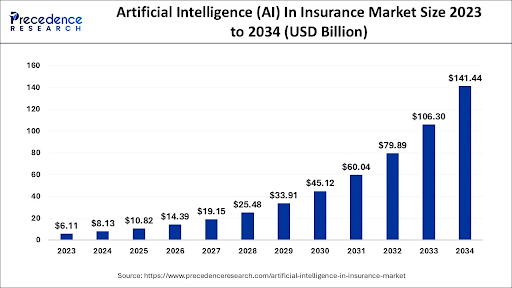
AI-enabled solutions are assisting insurers in expanding their market share and enhancing profitability. Look at this statistics that showcases that the global AI in insurance market size is predicted to reach around USD 141.44B by 2034, growing at a CAGR of 33.06 percent between 2024 and 2034.
Several key factors are propelling the integration of AI technology in insurance:
1. Rapid Advances in Machine Learning and AI Technologies
New frontiers in data extraction value have opened up through fast-paced changes in AI and machine learning. For instance, the use of large language models (LLMs) gives smart information of various documents to enable claims and enhance accuracy in fraud detection.
Then, generative AI may still be a developing capability, but this is being touted as being able to synthesize data with a degree of reasoning that might open considerable opportunities for insurance.
2. The Availability of Larger Datasets
Third-party data is now critical. This is because it combines internal information with external information such as consumer credit, marketing analytics, social media insights, purchasing patterns, criminal records, weather data, and claims history. The higher the level of such information, the greater the basis for more precise underwriting, risk modeling to process claims in due course, and marketing chances in the market.
3. Rise in Demand for Customer Service
With the introduction of AI-driven tools like chatbots and virtual assistants, insurers can fulfill the growing need for instant and personalized customer service that is available 24/7. Natural language processing technology empowers these solutions wherein machines can understand and respond appropriately to customer queries so that human agents can focus on more complex issues.
4. Modern Cloud Data Platforms Capabilities
State-of-the-art cloud data platforms, in this case, Snowflake, offer a highly cost-effective and high performance solution for the efficient storing and processing of the volume of data. The structured, semi-structured, as well as unstructured dataset supports utilizing insurer datasets for training as well as polishing their AI models. Such scalable computing resources enable efficient management by teams of AI and ML workflows.
Applications of AI in Insurance
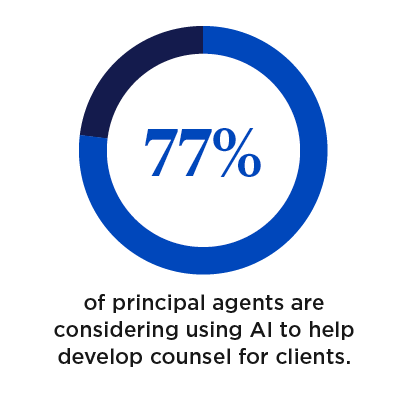
Insurance is a field that is an early adopter of data analysis. It will uniquely utilize the powers of AI to revolutionize how an insurer will function and relate to its customers. There are seven main applications demonstrating how AI plays a part in transforming insurance:
1. Effective Settlement of Claims
AI ensures quick settlement of claims and also greatly reduces turnaround time regarding handling and settling of claims. This is so since AI, through forms in claims, documents, images, and videos, has ranked incoming claims to weigh them based on their complexities and urgency and acts with prompt response for effective, fast settlement.
2. Strategic Risk Management
Through the AI-based predictive models, filtering high-diversity datasets from various sources is quite easier and quicker. It makes better forecasting of insurance trends and identification of risks possible.
3. Customized Coverage
AI in insurance can offer personalized coverage tailored to the needs of each individual and his or her specific risk factors. Insurers can now analyze customer data to create customized products and pricing in a matter of minutes. For example, telematics data from a driver’s smartphone helps insurers provide discounts for good driving behavior, offering competitive, risk-based pricing.
4. Better Customer Service
Virtual agents and chatbots based on NLP will make the customer interface smart by providing intelligent answers to queries and speedy access to policy information. Thus, 24/7 support would lead to timely support and high satisfaction rates. AI will also enable the system to carry out sentiment analysis, where service issues are detected early and resolved within due time.
5. Advanced Fraud Detection
The major challenge that insurance faces is fraud. They lose billions of dollars annually. With AI, predictive modeling, and anomaly detection, all patterns and discrepancies leading to fraudulent claims are detected before all the insurers’ revenue is stripped away.
6. Cost Saving through Automation
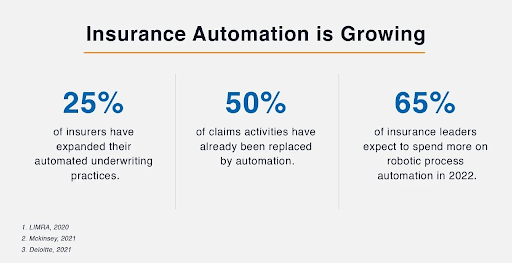
AI automatically performs dull clerical tasks, which minimizes the opportunity for human error. It also facilitates processes so that experienced underwriters and claims processors can focus on other complex tasks. For instance, NLP can easily pull out significant information from the claims documents.
7. Improved Usage of Data
The data accumulated is so massive that insurance professionals get confused. Aggregating and analyzing all these data through AI tools provides more insight into supporting better client contact as well as better decision-making insights.
Advantages of Using AI in Insurance Companies
Implementing AI in the insurance industry is a task that poses significant security-related challenges, but the advantages are huge and can contribute immensely to making operations much more efficient and customer-friendly. Here are five main benefits of using AI in insurance agencies:
1. More Productivity
It simply means that AI can sort through millions of pieces of information in a split second. It also means that insurance professionals will spend fewer hours doing tedious jobs such as retyping the same piece of information or processing similar claims.
In fact, the automation of data entry and claims processing enables more staff to move on to the kind of critical thinking or creativity work required at more elevated levels, thus elevating overall productivity and the general sense of job satisfaction of staff since they are given work that means something towards achieving the objectives of an organization.
2. Lower Costs
With each process, AI cuts on cost by virtue of speedy procedure. By automating every other claims review or client inquiries, it saves significantly the heavy human resources incurred within those functions.
Every such time-consuming process tends to decrease which subsequently leads to reducing the agency’s operational cost, which insurance companies will consequently pass onto their customers as a better bargain for their services resulting in high job satisfaction retention; therefore lower hiring costs, training, and loss in turnover.
3. Better Customer Experience
AI enriches the customer experience, and communication is faster and more customized. Using tools like chatbots and virtual assistants, a customer can get access to information and support that he needs in an instant.
Hence better engagement and satisfaction. Trust is established through easy communication because customers value prompt, accurate answers to their questions. The feeling of being valued and understood creates loyalty towards the insurance agency, which then gives way to a long-term business relationship.
4. Data Management
It will come to be realized how an insurance industry generates humongous amounts of data from such sources as claims, policies, customer interaction, and so much more. The AI tools efficiently manage it and then analyze the data to provide clear insights into the same for the insurer to use in decision-making.
Here, AI helps insurance companies to provide better products and services by showing a clear picture of needs at the client’s level and market trends. Improved risk assessment and underwriting lead to better business decisions consequently.
5. Elimination of Human Error
Because of manual input and transfer, entry and transfer are associated with human errors. Mistakes in data could imply miscalculations of operations. AI processes data and analyzes data that would eradicate any such error since the data would be treated consistently and accurately.
For example, when AI derives data from claims documents, then the chance of error causing financial loss or a breach of compliance reduces. It makes data more integral; thus, AI promotes the trust of clients and regulatory bodies toward a more trusted and effective operational environment.
Use Cases for AI in Insurance
Let’s have a look at some of the use-cases of AI in insurance:
1. Personalized Insurance Pricing
AI in insurance allows for personalized insurance pricing techniques. Using an individualized pricing strategy, based upon a person’s risk profile, it will be easier for the insurer to attract various customers. In this direction, Metromile has launched pay per-mile insurance, which has a correlation with driving behaviors.
2. Risk Assessment and Underwriting
AI-based systems rely on algorithms and big data to analyze risk factors and potential outcomes. Swiss Re uses AI for the highly detailed analysis of life insurance risks; in that way, the entire underwriting process is streamlined.
3. Customer Service Chatbots
Smart chatbots allow customers to be served at any time while they self-service their policies and claims online, which increases satisfaction and lowers the cost of operations.
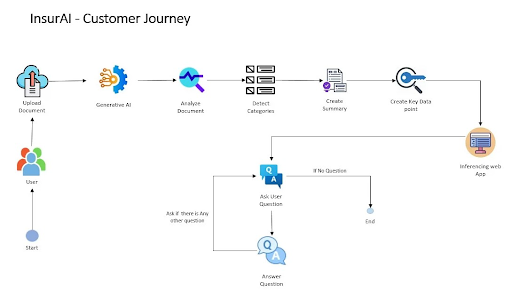
One example is Geico’s virtual assistant, Kate. It helps customers with policy queries and updates anytime.
4. Automation of Claims Processes
AI-based solutions verify the claims data and validate the details of the policy. This enables fast payments and customer satisfaction.
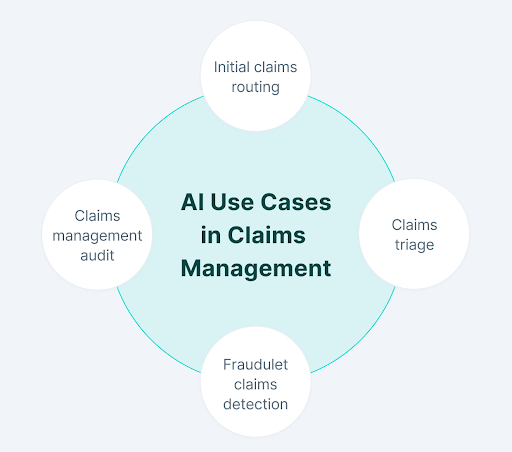
In the case of Lemonade’s AI, Jim processes the claims in a few seconds. AI tools, applied by Allstate, quickly point out anomalies in the pattern of claims data and prevent fraudsters from continuing such activities.
5. Claims Damage Estimation
Computer vision algorithms enable quick damage assessment through image and video analytics. ICICI Lombard applies AI for speedy assessment of motor insurance claims and contacts customers for any missing information.
6. Business Process Automation
AI automates routine tasks such as data entry and compliance checks. Hence, this enhances operational efficiency and reduces costs. Zurich Insurance has already successfully implemented automation for a number of data processing tasks.
Also Check: Generative AI for Legal Firms
Top Technological AI Trends in Insurance
The insurance industry is experiencing a massive revolution since more and more companies embrace artificial intelligence. Seven trends shape the future of insurance through AI:
1. Predictive Analytics
Predictive analytics is the use of AI to analyze past data and make predictions for future trends. The insurers apply the technology to better risk assessment, optimize pricing, and claim management. Anticipating the behavior of customers and fraud will be possible to help companies make informed decisions.
2. Chatbots and Virtual Assistants
Chatbots and virtual assistants, driven by AI, are the new faces of customer service in the insurance industry. They offer instant support related to inquiry, submission of claims, and management of policies. The customers will be assured of getting support all day and night. In this way, customer satisfaction is increased, and human agents will be free to handle other complex jobs.
3. Fraud Detection and Prevention
AI detects fraud much more effectively as it examines trends and anomalies in claim data to find potentially fraudulent behavior. Through machine learning, suspicious trends are likely discovered much better than ordinary methods, so the losses and sound financial integrity on the part of the insurance firm are maintained.
4. Automated Claims Processing
Claims processing is becoming efficient with the help of AI technologies, which automate the extraction and analysis of data. Natural language processing (NLP) and computer vision can easily interpret claim documents and help insurers evaluate damages and reach conclusions that are faster and more accurate.
5. Customized Insurance Products
With huge volumes of data, insurance companies can exploit AI to create customized insurance products that cater to the needs of individual customers. An analysis of their lifestyle, driving habits, and health factors would provide coverage options and pricing tailored to each customer and lead to customer loyalty.
6. Risk Assessment and Underwriting
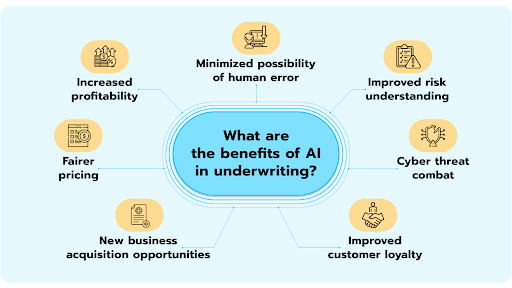
Artificial intelligence is changing the face of underwriting with the capability to analyze complex datasets at better efficiency. Machine learning models analyze a wide range of factors and achieve more accurate risk assessments and better pricing.
7. Integration of IoT
The integration of AI with IoT devices changes the monitoring of risk by insurers. For example, smart home sensors and telematics in vehicles provide data in real time that can be analyzed through AI systems to act proactively and provide customized insurance solutions.
Limitations of Implementing AI in Insurance
While AI is a transforming force for the insurance sector, there are still numerous limitations that may hinder the practical implementation of AI in an insurance company:
- Data Dependency: AI models require robust data. Poor data or incomplete datasets may result in incorrect outcomes.
- Regulatory Barriers: The process is complicated by the numerous regulatory requirements for data privacy and protection, and the implementation process requires careful compliance measures.
- Skill Gaps: It lacks professionals with experience in AI and machine learning, making developing and maintaining efficient AI systems challenging.
- Cultural Resistance: The employees may fear that new technologies can replace or change their jobs and cause a delay in the process.
- Infrastructure Needs: The implementation of AI requires more investment in technology and infrastructure, which can be a barrier for some organizations.
- Bias in Algorithms: AI systems may propagate some biases existing in training data and cause unfair outcomes. It is highly critical to keep track of the scenario since fairness needs to be determined.
Thus, the above limitations explain how a trusted AI app development company can help your business efficiently tackle these challenges with its advanced fintech software development services. Let’s know more about it in our next section.
How ScalaCode Can Help You to Surpass All the Hurdles?
ScalaCode is the top mobile app development company in India with experience in delivering AI solutions for the insurance industry. We help solve AI implementation challenges through clean, compliant data.
Our highly skilled professionals develop robust AI apps upon demand and help you cope with the change within your organization. We also give advice on scalable infrastructure and possible easy rollout without massive investments.
With our continuous monitoring system toward fairness and accuracy, ScalaCode helps your business unlock the complete potential of AI technology for growth and innovation.
Explore More: Cost to Develop an AI-enabled Fintech App
Final Thoughts
In simple words, AI is revolutionizing the insurance sector by making a difference in efficiency, reducing costs, and improving customer experience. As the technology advances, so will the opportunities in this area, leading to more innovative development areas.
If you are thinking of building your own insurance app powered-by AI, the ScalaCode is a one-stop destination for you. Hire a dedicated development team in India from us as we have years of experience in delivering cutting-edge mobile apps. So, what are you waiting for? Contact us today and get your app.
FAQs
Can AI replace insurance agents?
AI is able to automate everything that, traditionally, an insurance agent would do, such as doing a lot of data analysis and providing customer support in a manner that AI certainly cannot do in place. In fact, AI is more of serving as the tool through which agents’ capabilities should be enhanced to focus only on more complicated customer interactions and, therefore, building relationships.
How can AI improve insurance customer service?
AI can improve customer service because it provides round-the-clock support through chatbots and virtual assistants, solves the most frequently asked questions very fast, and reduces the claims process to expedite results and improve customer satisfaction.
What role does data play in AI for insurance?
Data plays a significant role in AI for insurance as it powers the machine learning algorithms. Quality and large amounts of data enable better risk predictions, customized policy prices, and improved fraud detection.
Would there be risks in using AI in the insurance business?
There would be data privacy issues, algorithm bias, and reliance on data quality. The ways to minimize those risks are about complying with rules and being transparent about AI processes.