
In an era where businesses generate over 328.77 million terabytes of data daily, managing data governance has never been more critical than in 2026. It’s just the start of the year; there are multiple businesses that are unable to bring measurable results to the table. This is because the traditional methods often fall short, struggling with compliance, quality control, and security amid this deluge.
Here, the role of AI in data governance makes the difference; it is a game-changing technology that revolutionizes data governance through automating complex tasks, uncovering hidden insights, and ensuring regulatory adherence at scale.
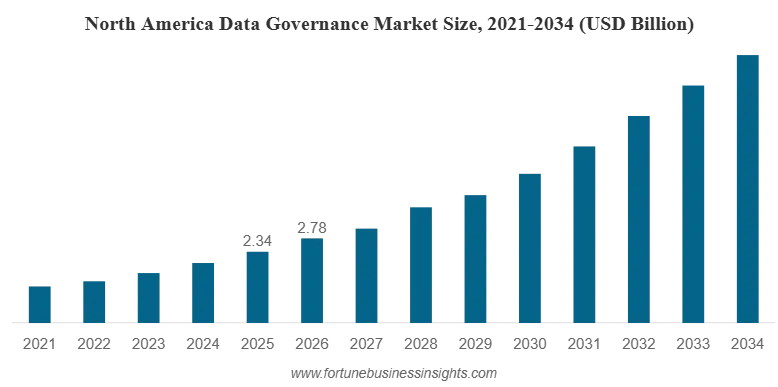
According to a report by Fortune Business Insights, the global data governance market size was valued at USD 5.38 billion in 2025. The market is projected to grow from USD 5.38 billion in 2026 to USD 24.07 billion by 2034, exhibiting a CAGR of 20.50% during the forecast period. North America dominated the global market with a share of 43.50% in 2025.
In this blog, we will discuss artificial intelligence in data governance, its benefits, the real-time use cases, applications, and all the notable points. So, if you are someone who is planning to invest in AI for future growth, then you have come to the right place.
Let’s dig deeper…
What is AI in Data Governance?
AI in Data Governance is the application of artificial intelligence to personnel to automate, keep track of, and optimize the management, security, and utilization of data within organizations. Rather than using a number of manual processes, AI systems continuously identify data, check quality, implement policies, recognize risks, and conduct real-time compliance.
One of the new ideas in this field is the AI agent in data governance. An AI agent is more of an intelligent digital assistant that carries out governance functions, including sensitive data scanning, data lineage, access controls, and compliance violations, without human attention. These agents have the capability to process large amounts of structured and unstructured information, learn patterns, and enhance governance decisions over time.
Simply put, AI in data governance allows data management to be smarter, faster, and more scalable, yet provides the ability for human control of the strategic management and the ethical decision-making process.
What Are The Challenges of Traditional Data Governance
Although conventional data governance models were previously successful in a formalized, centralized setting, they tend to fail to support the requirements of contemporary data-centric organizations. With the shift to cloud systems, hybrid systems, and real-time systems, these constraints are more evident in companies.

1. Rigidity and Lack of Flexibility
The conservative models of governance are based on rigid rules and unchanging policies. They tend to be hard to modify in cases where business requirements, regulations, or data sources are changed. In the absence of smart automation or GenAI in data management, companies find it challenging to revise policies in real-time.
2. Slow Decision-Making and Data Access
Access to data is slowed down by manual approval processes and disjointed systems. Business teams prefer to wait until IT or governance approvals are made, and slow down the analytics and decision-making. This is a bottleneck that prevents agility in competitive markets.
3. Poor Scalability
With the rapid increase in the volume of data, manual governance cannot be efficient in scale. The conventional solutions could not accommodate multi-cloud, big data, or real-time data streams, and thus, an increase in these parameters would be expensive and complicated without current AI integration services.
4. Limited Data Visibility and Ownership
Many organizations lack a clear view of where data originates, how it flows, and who owns it. Without automated lineage tracking and intelligent monitoring, governance becomes fragmented and inconsistent.
5. Difficulty Managing Modern Data Types
Conventional governance applications are biased to structured databases and have difficulties with unstructured data in the form of emails, documents, images, and multimedia. The analysis of such diverse formats is impossible without intelligent automation and the use of AI.
6. High Manual Effort and Operational Overhead
Governance teams spend significant time on repetitive tasks such as data classification, quality checks, and compliance reporting. This increases operational costs and the risk of human error.
7. Low Business User Adoption
The last but not least challenge that developers face while implementing AI in data governance is low business user adoption. Complex governance processes often discourage business users from engaging with governance frameworks.
Comparing AI-Powered Data Governance and Traditional Approaches
While scrolling for data governance in the age of generative AI, you must have heard of traditional approaches. So, here in this section, let’s look at the core difference between an AI data governance system and a traditional data governance system.
| Aspect | Traditional Data Governance | AI-Powered Data Governance |
| Monitoring Method | Manual monitoring and periodic reviews by data teams | Continuous, automated real-time monitoring using AI models |
| Data Classification | Manually defined rules and tagging | Automated classification using machine learning and NLP |
| Data Quality Management | Reactive issue detection after errors occur | Proactive detection of inconsistencies and anomalies in real time |
| Compliance Enforcement | Manual audits and checklist-based compliance checks | Automated policy enforcement and real-time compliance alerts |
| Scalability | Difficult to scale with growing data volumes | Easily scales across large, complex, and multi-cloud environments |
| Risk Detection | Issues identified after incidents or reports | Predictive risk detection and anomaly identification |
| Metadata Management | Static and manually updated metadata | Dynamic, AI-driven metadata updates and organization |
| Audit Readiness | Time-consuming audit preparation | Instant audit trails and automated reporting |
| Human Involvement | High dependency on manual processes | Reduced manual effort with human oversight for decision-making |
| Efficiency & Speed | Slower due to manual workflows | Faster and more efficient through automation |
How Businesses Can Use AI in Data Governance: Real-Time Use Cases
Before you hire data engineers to integrate artificial intelligence into your data governance system, you must learn about the real-time use cases. Knowing them will help you better understand AI in data governance and how you can use this technology to its best for your business.

1. Real-Time Data Classification and Tagging
With the help of AI, structured and unstructured data are automatically analyzed to determine the type and sensitivity. It is capable of labeling personal information, financial data, or confidential data within a short time. This saves labor and makes sure that data is processed in line with governance policies. It also enhances search and control access between systems.
2. Continuous Data Quality Monitoring
AI is constantly checking datasets, and therefore, errors, duplicates, missing values, or inconsistencies are identified. It does not have periodic checks but rather real-time quality alerts. This assists organizations in having proper and accurate data. The quality of data is improved, and it provides more confident business decisions.
3. Automated Compliance and Policy Enforcement
AI will automatically examine the use of data in accordance with internal policies and regulatory standards. It is able to implement retention policies, limit unauthorized operations, and indicate policy violations. This minimizes the compliance risks and manual surveillance. It also maintains audit trails on a continuous basis.
4. Live Data Access Control and Monitoring
In real time, AI follows those who access data and the way they are being utilized. On the detection of an unusual or suspicious activity, it may send alerts or block access on the spot. This enhances security and reduces the threat of insiders. It guarantees access to sensitive information by authorized users.
5. Intelligent Data Lineage Tracking
AI traces the entire path of data between its source and destination, between systems. It is automatically used to monitor the data transformation and sharing. This enhances the level of transparency and also eases the impact analysis. It also assists organizations in following up on wrongs or compliance problems fast.
6. Proactive Risk and Anomaly Detection
AI determines unnatural patterns in data, conduct, transactions, or access operations. It makes early screening of possible fraud, breaches, or even violations of policy. This has proactive monitoring that minimizes the operations and compliance risks. Companies have an opportunity to react more quickly to new threats.
7. Real-Time Data Privacy Management
Sensitive data like PII or other financial information is automatically recognized by AI. It is able to use masking, encryption, or restrictions in the form of privacy rules. This makes it adhere to data protection laws consistently. It also enhances customer trust and the security of data.
8. Dynamic Metadata Management
Metadata is updated by AI when data on various platforms is modified. It also creates and standardizes metadata automatically to enhance discoverability. This enhances the accuracy of governance and the uniformity of data. It is particularly handy on hybrid and multi-cloud systems.
9. Instant Audit and Reporting Support
AI provides real-time compliance reports and keeps audit logs. It monitors access, changes, and enforcement of policies. This saves on the time taken in the preparation of audits. Organizations stay on top of the audit with minimal manual work.
Industry-Wise Applications of AI in Data Governance
Before you invest in AI governance tools, you must be aware of the real-time applications that are already using artificial intelligence to automate tasks, boost productivity, minimize time & efforts, and a lot more.

1. AI in Data Governance for Banking and Finance
AI consolidates data and analytics governance, automating the process of SOX compliance and minimizing bias in data models through lineage tracing and access control. AI-based fraud detection and customer service are secure with platforms such as Databricks Unity Catalog, which reduces the cost of data egress by 20% in comparison to Block. According to Deloitte, AI enhances risk management and compliance with regulations in terms of finance.
2. Healthcare Data Governance with AI
The implementation of AI includes HIPAA by end-to-end encryption, PHI de-identification, role-based access, and automated access controls to tools, diagnostics, and chatbots. Breaches are avoided by continuous monitoring, and consent management and model protection in AWS/Azure are provided by vendors such as Momentum. This is a tradeoff between innovation and privacy in EHR and telemedicine.
3. Retail and E-commerce Data Governance
AI manages unstructured social media and IoT data to ensure personalization, ensuring the integrity, transparency, and fairness principles. There is real-time processing of sensor/beacon velocity and automated quality control and edge computer adaptations. Cross-functional task forces incorporate AI in supply chains to make demand forecasts and ensure compliance.
Also Read: Use Cases of Computer Vision in Retail
4. Manufacturing and Supply Chain Governance
AI simplifies the administration of data mesh in predictive upkeep and stock and relies on continuous learning pipelines for market changes. It automates anomaly detection across silos to guarantee data veracity in IoT-heavy settings to enable agile operations.
5. Government and Public Sector Data Governance
The interoperability framework and ethics are standardized under AI, and data lakes assist in servicing citizens through bias mitigation and secure sharing. Initiatives supported by McKinsey encourage open data and training on AI-ready governance, which invests in the cloud to ensure scalability. Ethical codes provide transparency in making decisions.
Future Trends of AI in Data Governance
AI data governance is evolving, and in the future, we might get more advancements in this field that we will discuss in this section. According to reports, 80% of organizations will adopt unified structured/unstructured approaches by 2030.

1. Autonomous data governance systems
In the future, there can be some autonomous data governance systems that will run with the help of agentic AI to enable self-governing platforms that proactively enforce policies, detect anomalies, and adapt to data changes without human intervention. Some reports suggest that, by 2027, 70% of data governance tool buyers will prioritize such automation to cut manual work, with the zero-trust model verifying AI outputs becoming standard by 2028.
2. AI-driven data mesh and data fabric
In the future, AI-driven data mesh decentralizes ownership with federated governance, while data fabric uses metadata automation for hybrid/multi-cloud unification. This trend depicts that powering AI/GenAI at scale via edge-to-core connectivity can help businesses access trusted, real-time data from anywhere. In addition, organizations can break down data silos, improve cross-team collaboration, accelerate analytics, and ensure consistent governance across distributed systems.
3. Generative AI in governance workflows
The next future trend is generative AI in data governance; this may help businesses in generating prompts, outputs, and synthetic data, shifting from static to adaptive controls with bias/toxicity checks. Along with that, with generative AI facilities, data governance teams can prioritize unstructured data governance for GenAI, using platforms for cataloging, quality, and vector security.
4. Regulatory AI and compliance automation
Last but not least, AI in data governance may offer regulatory AI and compliance automation. This means that in the future, artificial intelligence may monitor regulations in real time, automate audits, and flag compliance risks, evolving into agent-driven enforcement for the EU AI Act and beyond. Not only this, but this can also help your business reduce compliance costs, minimize legal risks, improve audit readiness, and maintain transparent documentation across systems.
How ScalaCode Helps Enterprises Implement AI in Data Governance
Implementing AI and data governance requires more than just adopting new technology; businesses that are looking to integrate this into their legacy system must be aware of the advantages of having the right development or integration partner. And here the role of ScalaCode comes into play: the right strategic approach, the correct architecture, and deep domain expertise are all part of integration and bringing the best results to the table.
We are an experienced LLM development company; we closely look for the business needs and requirements, and then we provide the most appropriate solution to our customers. Not only this, but our experienced developers and analysts work closely with organizations to assess existing governance models, identify automation opportunities, and integrate AI-powered solutions for data classification.
Here’s how ScalaCode helps:
- Governance Assessment & Strategy
- AI-Powered Data Classification
- Automated Compliance & Policy Enforcement
- Data Quality & Risk Monitoring
- Scalable Cloud & Hybrid Integration
- Dedicated AI Experts
Conclusion
At the end of this blog, where we have discussed “AI in Data Governance: Use Cases, Applications, and Future Trends,” we conclude that traditional governance approaches are no longer enough to make any business successful.
On the other hand, AI in Data Governance is transforming how organizations manage, secure, and trust their data by automating classification, improving data quality, strengthening compliance, and enabling real-time risk detection.
In addition to that, artificial intelligence not only protects or improves your daily tasks, but it will also enhance governance by reducing manual effort and allowing teams to focus on strategic decision-making. Moreover, it will provide you with everything from real-time monitoring to regulatory automation, and AI-driven governance ensures data remains accurate, secure, and compliant at scale.
However, to get immense measurable results from AI in your data governance system, you must connect with an AI development company. Partnering with an experienced artificial intelligence company will help you design and deploy customized AI-powered data governance solutions aligned with your business goals.
Frequently Asked Questions on AI in Data Governance
1. What is AI in Data Governance?
Well, AI in data governance refers to less intervention of humans to make the process faster and error-free. Not only this, but with the help of artificial intelligence, you can automatically manage, monitor, and protect data instead of doing everything manually.
2. How does AI improve data governance?
Artificial intelligence in data governance helps in multiple ways, as it automates tasks, classifies data, detects errors, monitors data quality, identifies sensitive information, and enforces policies in real time. All of them help businesses in reducing their manual work, reducing errors, and boosting the productivity of the team.
3. Is AI-powered data governance secure?
Yes, AI-powered data governance is secured; however, you must integrate the security tools properly. If your development team is able to implement a secure system for an AI-powered, data-governed system, then you can easily identify sensitive data, detect unusual activities, and enforce access controls automatically.
4. Can AI help meet regulatory compliance requirements?
Yes, AI plays a major role in regulating compliance requirements; it can automatically track data usage, monitor access logs, enforce privacy policies, and generate audit-ready reports. Which, as a result, helps organizations comply with regulations such as GDPR, HIPAA, and other industry-specific standards.
5. Which industries benefit most from AI in data governance?
Well, most of the industries are getting benefits from AI in data governance. However, industries that have large amounts of data, like healthcare, eCommerce, manufacturing, telecommunications, and government sectors, can get the best out of it.