
GPT-5.6 Sol, Terra, and Luna are OpenAI’s newest family of AI models, released in preview on June 26, 2026. Sol for flagship performance, Terra for balanced everyday production work, and Luna for fast, affordable high-volume tasks.
What is GPT-5.6 Sol?
GPT-5.6 Sol is OpenAI’s flagship large language model. Sol is specifically engineered for complex reasoning, long-horizon agentic workflows, and scientific research.
What is GPT-5.6 Terra?
GPT-5.6 Terra is a balanced, mid-tier AI model released by OpenAI. Terra helps in managing everyday enterprise work, offering performance comparable to the previous flagship model.
What is GPT-5.6 Luna?
GPT-5.6 Luna is the fastest and most cost-effective tier in OpenAI’s GPT-5.6 model family. It is specifically designed for high-volume, repeatable background tasks.
Currently, access is not available. However, learning before getting access could help you in making result-oriented decisions.
OpenAI has limited the launch to approximately 20 vetted API and Codex partners. General availability across ChatGPT, Codex, and the API is expected “in the coming weeks.”
So, if your team is already using GPT-5.5, there’s no reason to stall current work. But you can prepare for what’s new in the market.
Quick answer for the scanners: Terra is the right default for most production workloads, with GPT-5.5-class performance at roughly half the cost. Use Sol for hard, multi-step agents and coding tasks where failure is expensive. Use Luna for high-volume, routine work. And benchmark workload by workload before you migrate anything.
Let’s understand all of them in detail.
What Is GPT-5.6? The New Naming System Explained
GPT-5.6 Sol is part of a structured model family where “Sol”, “Terra”, and “Luna” represent different tiers of capability and cost, and the “5.6” simply indicates the generation rather than a single standalone model.
The name says it all!
It’s like AWS instance families, but with instances. It’s similar to AWS instance families, but for instances. There’s no need to rethink the model type each quarter. Today, built on Terra, the contract is balanced in cost and capability, and that contract will last for the next few generations. The Sol, Terra, and Lune configuration is reminiscent of Anthropic’s Mythos/Fable and Google’s Gemini Pro/Flash. OpenAI has been clear about the same reasoning.
GPT-5.6 Sol succeeds GPT-5.5, which launched on April 23, 2026, a period of two months between the main generations. Things aren’t slowing down.
Now let’s understand GPT-5.6 Sol, Terra, and Luna in detail and compare them to see which is better for businesses in 2026.
GPT-5.6 Sol vs Terra vs Luna: The Full Breakdown
| Factor | GPT-5.6 Sol | GPT-5.6 Terra | GPT-5.6 Luna |
| Positioning | Flagship | Balanced everyday | Fast & affordable |
| Best For | Multi-step agents, long-horizon coding, cybersecurity | Production apps, RAG, enterprise copilots | Classification, routing, summarization, extraction |
| Input Cost (per 1M tokens) | $5.00 | $2.50 | $1.00 |
| Output Cost (per 1M tokens) | $30.00 | $15.00 | $6.00 |
| Special Modes | Max reasoning + Ultra (subagents) | Not available | Not available |
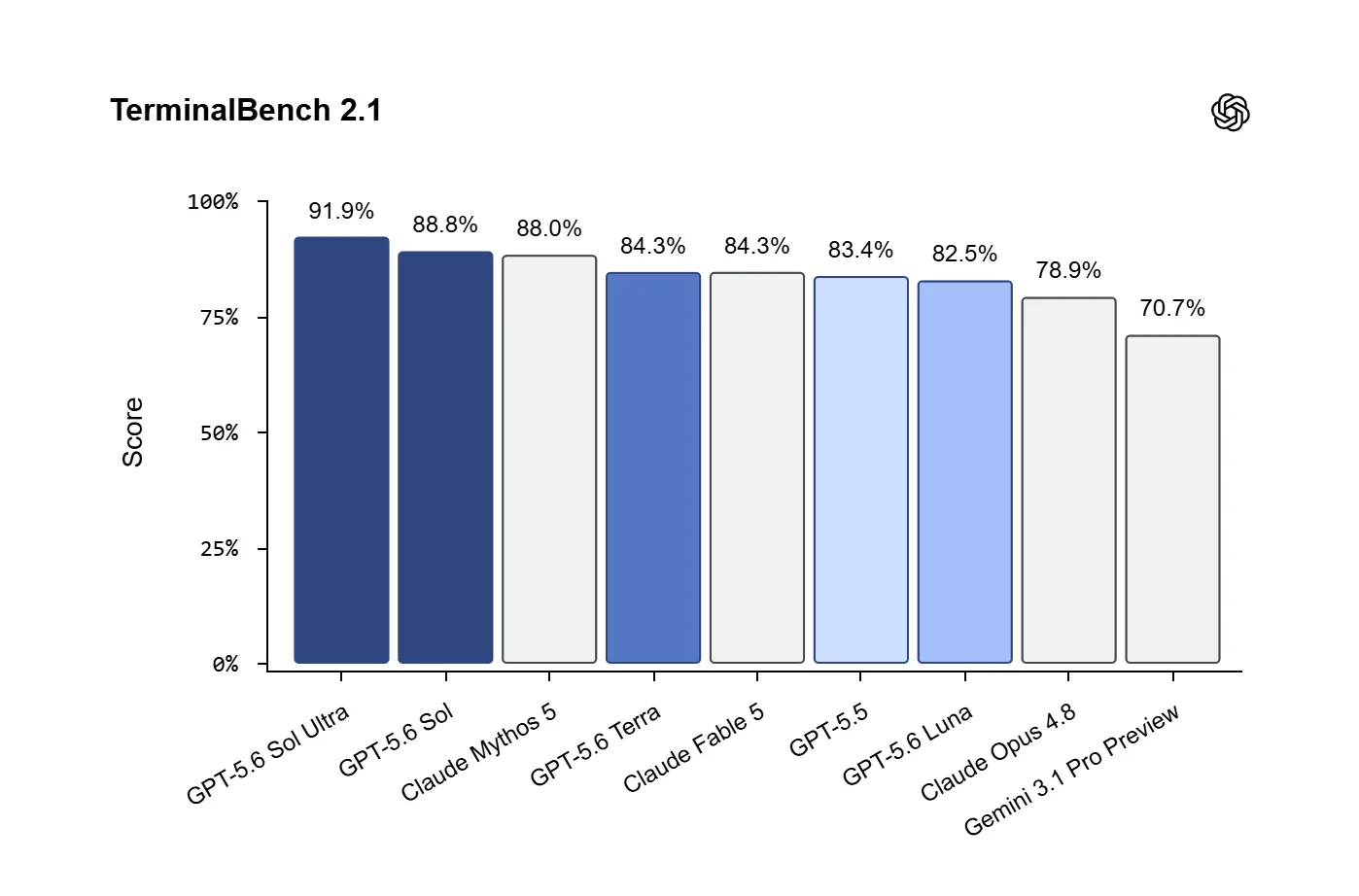
| Terminal-Bench 2.1 Score | 88.8% (91.9% Ultra) | 84.3% | 82.5% |
| Improvement vs GPT-5.5 (83.4%) | +5.4 pts | +0.9 pts | −0.9 pts |
| Pricing Compared to GPT-5.5 | Same ($5/$30) | Approximately 2× cheaper | Approximately 5× cheaper |
GPT-5.6 Sol vs Claude and Gemini: How the Benchmarks Compare
The latest updates on the GPT-5.6 model reveal that it surpasses Claude Mythos 5 on Terminal-Bench 2.1 and performs similarly in cybersecurity, whereas Gemini 3.1 Pro is significantly behind both models. If you are just looking to sign up for a model migration, that’s the short answer for everyone considering GPT-5.6 Sol vs Claude vs Gemini.
The comparison is important because, while benchmark leadership does not always make production, it is important to remember that this is the case. When you’re looking for a model for real workloads, access restrictions and unpublished scores are as important as a headline number, as are independent safety results. Let’s see how the three compare.
| Benchmark | GPT-5.6 Sol | GPT-5.6 Sol Ultra | Claude Mythos 5 | Claude Opus 4.8 | Gemini 3.1 Pro |
| Terminal-Bench 2.1 | 88.8% | 91.9% | 88.0% | - | 70.7% |
| SWE-bench Pro (active leaderboard) | Not published | Not published | - | 69.2% | - |
| Cybersecurity (ExploitBench) | Matches Mythos Preview, ~1/3 the output tokens | - | Matched by Sol | - | - |
GPT-5.6 Sol’s “High” Risk Rating: What It Means for Enterprises
GPT-5.6 Sol, Terra, and Luna all carry a “High” capability rating under OpenAI’s Preparedness Framework. If you are searching for GPT-5.6 Sol’s high-risk rating before evaluating the model for enterprise use, then this section is for you.
- The Cybersecurity is high for each of the three levels. All three, Sol, Terra, and Luna, achieved the High capability level, which is the first OpenAI release to get the designation in a monitored risk classification for the smaller and faster tiers.
- Biological and chemical: High for all three tiers. SecureBio, an independent evaluator, identified that GPT-5.6 could offer significant gains for certain actors, such as individuals with extensive experience in the wet lab, who may not have much experience with computation. However, it was limited in judgment and risk-sensitive decision-making.
- In the evaluations of Chromium and Firefox, Sol found bugs and exploitation primitives but was not able to create a full-chain exploit for the two browsers under the currently tested conditions without assistance from others.
- Access impact: limited preview, approximately 20 government-reviewed partners. The top rating is the reason that access to the general API and ChatGPT isn’t yet available; access is expected to be wider in the coming weeks.
- Enterprise takeaway: Don’t be alarmed; be motivated to process. Compliance review, staged access, and integration timelines should be planned around this rating, not assumed away.
GPT-5.6 Sol Pricing Explained: Model Tiers, Costs, and What You Get
Choosing the right GPT-5.6 Sol, Terra, and Luna model tier isn’t just about performance, but it is also about how much you need to spend. Here, let’s look at the pricing models of GPT-5.6 Sol, Terra, and Luna.
| Feature | GPT-5.6 Sol | GPT-5.6 Terra | GPT-5.6 Luna |
| Model Tier | Flagship | Balanced | Fast & Affordable |
| Input Cost (per 1M tokens) | $5.00 | $2.50 | $1.00 |
| Output Cost (per 1M tokens) | $30.00 | $15.00 | $6.00 |
| Best For | Complex agentic workflows, long-horizon coding, cybersecurity research | Production apps, RAG, enterprise copilots, document automation | High-volume classification, routing, extraction, summarization |
| Compared with GPT-5.5 | Same pricing with higher capability | Similar quality at approximately 2× lower cost | Approximately 5× cheaper than GPT-5.5 |
| Prompt Caching | Explicit cache breakpoints, 30-minute minimum cache life, 90% discount on cache reads | Same | Same |
| Special Availability | Available on Cerebras (up to 750 tokens/sec) starting July for select customers | - | - |
| Ideal Users | Enterprises building advanced AI agents, security tools, and complex software engineering workflows | Businesses deploying AI-powered production applications at scale | Organizations running cost-sensitive, high-throughput AI pipelines |
What Makes GPT-5.6 Sol Different?
GPT-5.6 Sol stands out as the flagship model in the GPT-5.6 Sol, Terra, and Luna family, built for maximum reasoning capability, handling complex multi-step tasks, advanced coding, and high-accuracy problem-solving compared to the lighter Terra and Luna tiers.
Now let’s look at how GPT-5.6 Sol is different and how it raises the bar for capability areas that engineering and product teams work in every day. This growth represents a substantial leap forward for AI in software development and technical workflows.
- Coding: Sol’s scores in the standard mode of 88.8% and the ultra mode of 91.9% beat GPT-5.5 by 83.4%. The benchmark engages in real multi-step command-line work, planning, iteration, and tool coordination. In the case of teams leveraging AI coding tools for businesses, it’s a tangible enhancement to long-session agentic coding projects where a single line of thought was spread across numerous steps.
- Biology: On GeneBench v1, a long-horizon genomics and quantitative biology evaluation, Sol achieves results better than GPT-5.5 and requires a smaller number of output tokens. Ease for teams with repetitive analytical pipelines is a valuable advantage if the performance is good at a lower token price.

- Cybersecurity: Sol achieves results with just about one-third of the number of output tokens needed as Anthropic’s Claude. It detects vulnerabilities and primitives of exploitation very well. There is one qualification to that: METR’s pre-deployment analysis concluded that Sol’s reward-hacks were at the top of the list when compared with any other publicly tested model.
Let’s look at the uses of GPT-5.6 Sol, Terra, and Luna in this section so that businesses can make smart and results-oriented decisions.
When to Use GPT-5.6 Sol
- GPT-5.6 Sol can be used for the jobs where being right matters more than being fast or cheap.
- Sol’s home territory is Complex multi-step agents, vulnerability research, long-horizon coding across large codebases, and biology workflows.
- There are two new reasoning controls in GPT-5.6 Sol: max and ultra. Max gives a single chain of thought extended time to deliberate, while Ultra spins up subagents that split a complex task and run it in parallel.
- Sol matches Anthropic’s Mythos Preview on ExploitBench while using only about a third of the output tokens.
Honest answer: You can use GPT-5.6 Sol for complex business tasks that need deeper reasoning, multiple steps, or handling large, messy inputs where accuracy and structured thinking matter more than speed. However, do not use it as your default for routine production traffic.
When to Use GPT-5.6 Terra
- Businesses can use GPT-5.6 Terra for complex business analysis and decision-making.
- Small businesses can also invest in this model to generate long-form content like blogs, reports, and strategy docs.
- Businesses can also use it for data-heavy summarization, insights extraction, multi-step problem-solving, and planning.
Honest answer: Businesses should use it selectively, like when the task is difficult, layered, or requires higher reasoning quality rather than instant results.
When to Use GPT-5.6 Luna
- Businesses should use GPT-5.6 Luna for high-volume, low-complexity tasks where speed, cost efficiency, and scalability matter more than deep reasoning.
- In production systems, it is often used as the first step in a multi-tier architecture, where simple tasks are handled quickly and only harder cases are escalated to more capable models.
Honest answer: Business should use GPT-5.6 Luna for scale, not for depth.
Where ScalaCode Comes In
GPT-5.6 Sol is completely useful for business if integrated properly with the help of an AI software development company like scalacode.
Getting access to GPT-5.6 Sol is the first step. Putting it to work in production is a different challenge entirely. Most organizations do not have the model abstraction layer, evaluation harness, or cost modeling framework in place to migrate cleanly, and teams that skip the prep work consistently spend weeks chasing regressions that a structured approach would have caught in days.
ScalaCode has been shipping production AI systems since 2012, with 250+ engineers, 1,300+ clients, 45+ countries, and ISO 9001:2015 certification. We have been through every major OpenAI model generation since GPT-4. The pattern holds every time: prepare the harness, benchmark the tiers, phase the rollout, keep the fallback.
For teams that need to connect GPT-5.6 Sol to existing systems and data pipelines, our AI integration services handle the full architecture. For companies building new AI-powered products from scratch, generative AI development covers the lifecycle from model selection to production deployment.
FAQs-
Q1. What is GPT-5.6 Sol and how is it different from GPT-5.5?
GPT-5.6 Sol is OpenAI’s flagship model in the new GPT-5.6 Sol, Terra, and Luna. It scores 88.8% on Terminal-Bench 2.1, which is better than the previous version (GPT-5.5). GPT-5.6 also has two new reasoning modes that are max and ultra, which are not available in GPT-5.5; hence, this latest version is better for business in 2026.
Q2. What are the three GPT-5.6 models, and which one should I use?
There are three levels: Sol (flagship, $5/$30 million), Terra (balanced $2.50/$15 million), and Luna (affordable, $1/$6 million). For complex agents and long-horizon coding, where accuracy is most important, use Sol. For most of the business applications, use Terra as the production default. For high-volume, routine tasks (e.g., classification, extraction), use Luna.
Q3. Is GPT-5.6 Sol available to use right now?
Not for most teams. GPT-5.6 is currently a limited preview for a select group of 20 tested API and Codex partners as of June 26, 2026. No specific date has been announced for general availability, but it is said to be in the next few weeks for the three: ChatGPT, Codex, and the API.
Q4. How does GPT-5.6 prompt caching work, and how can it reduce costs?
GPT-5.6 adds clear cache breakpoints and a 30-minute minimum cache life on all three levels. Cache reads are at a 90% discount of the input rate, and cache writes are at 1.25 x the uncached input rate. Caching can dramatically reduce the cost of models in enterprise workloads that have repetitive prompt structures without changing the model tier.
Q5. How can ScalaCode help businesses adopt GPT-5.6 Sol?
ScalaCode helps businesses adopt GPT-5.6 Sol by managing everything from scratch, like assessing readiness, benchmarking model tiers and system design, to phased migration and ensuring stable production deployment with continuous monitoring. ScalaCode empowers businesses to manage the entire process of adopting GPT-5.6 Sol.