

The automotive industry is moving towards electrified mobility.
Key Takeaway
- According to the forecasting experts at Auto Forcast Solutions, approximately 138 battery electric vehicle ( BEV) nameplates will be being built in North America, with about 45 million BEVs on the road by 2030.
- In a recent study by EY, boosting electric vehicle uptake in the US will require more than 400,000 public charging points by 2025, rising to more than 1.1 million by 2030.
- According to the US Department of Energy, the company’s superchargers account for about 60% of the total fast chargers in the US and Canada.
- Approximately 160,000 EV charging stations are in the U.S., and the number of fast-charging locations is far lower.
The industry is facing challenges due to large-scale adaptation and charging infrastructure. This is where the Tesla EV supercharging system came into the spotlight.
It seems that Tesla had the foresight to understand the need for a robust and fast charging network more than ten years ago when it began investing heavily in the North American Charging Standards (NACS).
But what does it take to develop an EV supercharging system like Tesla’s, and what are the associated costs?
In this blog, we’ll discuss the cost of developing EV supercharging stations like Tesla and the factors influencing costs and benefits.
So, let’s get started with a short brief about Tesla EV supercharging systems.
What is a Tesla Supercharger?
A Tesla Supercharger is designed to connect vehicle owners to a nearby charging station. It offers fast charging speeds; any electric vehicle can be charged in under one hour.
The Tesla Superchargers network is vast, with over 5,000 sites worldwide, more than 1,000 of which are located in North America.
The best thing is that each location has multiple charging points, enabling multiple electric cars to be charged simultaneously.
Types of Tesla Superchargers
There are three types of Superchargers available globally: V1 Superchargers, V2 Superchargers, and V3 Superchargers.
Compared to V1 and V2 superchargers, V3 is an advanced supercharger, providing 250kW charging speeds. V1 and V2 superchargers offer 150kW speeds. However, V3 can be upgraded up to 324kW.
Besides the charging speeds, there are no significant features or functionalities to discuss here.
However, since V1 and V2 stations are operational, you may not always get the maximum speed of 250 kW. Luckily, Tesla’s Supercharger map clarifies the available speeds.
How Does the Tesla EV Supercharger Function?
Tesla’s Superchargers are easy to use. Simply place your electric car next to the station, plug into it, and wait for the cable’s lock to be locked correctly.
The Tesla supercharger application starts with power on. You’ll see a green light, which indicates that it is starting. You don’t need to do anything to charge your car, as it is quite simple.
Regarding other public charging stations it requires drivers to confirm their chargers through their smartphones.
Tesla charging stations are associated with great features, such as
- Electric car owners can easily track the progress of their recharge through the car’s central display.
- Users can also know how many miles are added, how quickly you’re charging, how many miles are left in your battery, and how much you need to pay.
- If you can’t physically visit your station, you can view all the information in your Tesla app.
- The thing to keep in mind is the speed at which you charge may vary throughout the recharge session.
- More than four vehicles are connected to the EV charging stations at the same time or location, as they’ll share the energy. That’s why you may not get 250kW.
- Another common feature of electric vehicles is that the charging speed slows down as the battery capacity increases.
- This is especially noticeable when you reach the 80% mark when the charging speed becomes so slow that it cannot be called fast charging. Disconnecting the plug and driving is better than waiting for a 100 percent charge.
- The most important thing to remember is that lithium batteries charge less quickly, and regular charging can damage them. So, limit your supercharger use to long car trips or road trips and use slower AC charging for everyday driving.
Also Read: Generative AI for Businesses
Benefits of Tesla Supercharger Cost Stations
The cost of developing a Tesla EV charging system can be quite high. However, the benefits that they provide far outweigh the costs. So, let’s explore the essential benefits associated with these stations.
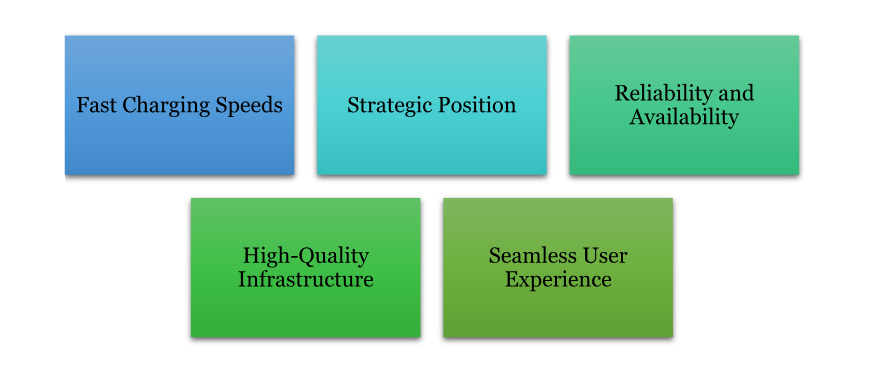
1. Fast Charging Speeds- Tesla superchargers provide high-speed charging, enabling owners to charge their electric cars quickly without any hassle. This makes long-distance travel more accessible, convenient, less expensive, and less time-consuming than conventional charging methods.
2. Strategic Position- The best thing is that it can be found even on highways and transport routes, providing Tesla owners quick access to charging infrastructure. This wide coverage reduces the fear of range and helps encourage the use of electric vehicles.
3. Reliability and Availability- Tesla has strived to improve and maintain the Supercharger network, ensuring that chargers are safe and easily accessible. Tesla owners can count on these stations for fast charging, increasing their cars’ efficiency and convenience.
4. Seamless User Experience- Tesla Superchargers are designed to provide the best user experience. Charging electric cars through Tesla Superchargers is quite easy, thanks to simple connectors and clear instructions. Their intuitive and easy process helps to improve the overall happiness of Tesla owners.
5. High-Quality Infrastructure- They are commitment to the highest quality extends beyond its Supercharger stations. Their infrastructure is designed to withstand various weather conditions and heavy use, ensuring long-term reliability and durability.
Different Charging Capabilities in EV Charging Systems
Electric vehicle (EV) charging systems come in three levels, denoted as L1, L2, and L3, where the letter ‘L’ stands for level. Each level delivers great power delivery capabilities, but L1 is slower than Level 3.
Let’s get started.
Level 1 (L1) Charging
Level 1 charging is the most basic form, utilizing a standard 120-volt AC household outlet. It provides a slow charging speed, typically adding 2-5 miles of range per hour.
A full charge for an electric vehicle using L1 chargers takes about 40 to 50 hours. Despite its slower pace, L1 charging is convenient for those with limited access to higher-powered charging stations or for situations where charging time is not critical.
Also, L1 charging is much easier to install in residential settings without requiring significant infrastructure upgrades.
Level 2 (L2) Charging
Level 2 charging is faster and uses a 240-volt AC power source, similar to that used by many larger household appliances. The automotive industry is moving towards electrified mobility.
L2 chargers typically provide 10-60 miles of range per hour of charging, making them suitable for home, workplace, and public charging for all EVs.
Fully charging a battery electric vehicle with a Level 2 charger takes 4 to 10 hours. L2 chargers are popular for daily charging needs, balancing speed and convenience.
They can be installed in various locations, such as residential garages, workplaces, and public parking areas, significantly enhancing the accessibility of electric vehicle charging infrastructure.
Level 3 (L3) Charging
Also known as DC fast charging, Level 3 is the fastest charging method available. L3 charging delivers direct current (DC) to the battery, charging it significantly faster than AC.
For instance, Tesla’s Superchargers can provide hundreds of miles of range per hour and fully charge an EV in 60 to 90 minutes. Found mainly along highways, L3 chargers support long-distance travel and reduce range anxiety.
Although they are not as widespread as L1 or L2 chargers due to higher costs and specialized equipment, advancements are making them more accessible and affordable, boosting global EV adoption.
What’s the Cost of the Tesla Supercharger?
The price you’ll be charged for supercharging will be automatically charged because each supercharge station is linked to a separate Tesla account. Hence, you don’t need to carry your credit card or cash.
The price may vary depending on the location and time. Prices are based on the pre-minute or number of units (measured in kilowatt-hours or kWh).
However, passive charging may also be applied to vehicles plugged in after a charging session. Fees are not fixed; you’ll be fined according to the location. You’ll be charged according to the minute of consumption, not based on the electricity.
There are four tires. Tire 3 covers speeds between 100kW and 180kW, while the most expensive Tier 4 covers speeds above 180kW.
In the past, Tesla offered free supercharging to select customers, including those who purchased their cars before a specified date or received these credits through a referral program.
What is the development cost of building an EV Supercharger system like Tesla?
The cost of building a Tesla EV Supercharging system involves various significant components, features, and factors that can influence the final costs. The development cost can range between $50,000 to $250,000.
However, hardware installation, features, maintenance & operations, power supply, grid upgrades, networking, software, and complexity level can influence the cost of developing EV fast charging stations.
Let’s see the significant factors that affect the final cost of developing a Tesla EV Supercharger system,
| Cost Components | Average Costs |
| Hardware and Installation | $10,000, $50,000 |
| Software development | $25,000, $100,000 |
| Power Supply and Grid Upgrades | $15,000, $200,000 |
| Total Cost | $50,000, $250,000 |
Regular Maintenance- This approach ensures smooth operations. Regular maintenance can influence the price of developing Tesla Supercharger software. It involves various processes, such as cleaning, repairs, regular inspection, and component replacement.
Power supply and grid upgrades- Fast charging stations consume a lot of power from the grid, often requiring local power infrastructure upgrades. This may involve installing new transformers, cabling, or a new substation, all of which add to the total cost of a Tesla Super Charger.
Software and networking- If you want to develop EV charging stations, you may require various things. Network setup is a key component that assists you in managing billing, remote monitoring, intelligent functionalities, and user identification.
Hardware and installation- This process involves the installation of a charging station, and you can count on a custom software development company to develop one. Tesla is recognized for its fast charging capability, as it consumes up to 250kW of high power. Hardware costs include the charger unit, construction, electrical work, and other overhead expenses.
How can ScalaCode assist you in building your EV charging software like Tesla?
ScalaCode is a renowned software development company with extensive expertise in creating full-stack EV charging software tailored to your specific needs.
Backed by skilled developers and cutting-edge capabilities, we have delivered more than 1500+ projects globally to our clients.
No matter what software you need, we’re here to meet your needs in the best possible way.
Also Check: Top Custom Software Development Companies
Conclusion
Over the past few years, the shift towards sustainable living has spotlighted the electric car market.
Electric vehicles are becoming popular around the country due to their cost-effectiveness and the increasing awareness of environmental sustainability.
Luckily, Tesla understands this need and offers reliable and robust EV charging, enabling EV users to charge their vehicles without hassle. Through the application, users can effortlessly navigate to EV charger stations.
So, if you want to turn your dream into reality, you can hire mobile app developers in India. The company specializes in developing smart EV charging stations by leveraging artificial intelligence and machine learning, among other modern technologies.
AI development services will also help you develop a multitude of solutions for the electric vehicle industry, including charging software.
FAQ
Q1. How to Create an EV Fast Charging System Like Tesla Supercharger
To develop a fast-charging system like the Tesla Supercharger, you need to:
- Install a high-powered charging unit and connect it to the grid.
- Develop EV charging management software to enable fast charging operations.
Q2. What time is required to develop an EV Fast Charging System like the Tesla Supercharger?
Developing a fast-charging system like the Tesla Supercharger involves several steps. Depending on its overall complexity, the software development process can take 6-12 months.
Sourcing the charging unit typically takes less time than developing the software. It may take about 10-18 months to operationalize your fast charging system fully.
Q3. How Much Do Tesla Superchargers Cost?
The cost of developing a Tesla Supercharger is based on its software and hardware integrations.
However, the average cost can range between $50,000 and $250,000, depending on the feature complexity level and software and hardware installation. The hardware component will be more expensive and require significant investment, but the rewards are proportionate.