
Software-as-a-service (SaaS) is undoubtedly a clear choice for the construction industry in a hunt for versatility, functionality, and accessibility in a vibrant and evolving business environment. While we step into 2026, we cannot think of SaaS as just a delivery model. SaaS has a commendable journey of becoming a digital backbone for diverse industries like healthcare, manufacturing, education, and retail, streamlining operations, enhancing collaboration, and enabling data-driven decisions. SaaS trends are transforming how enterprises deliver value in the competitive world.
Gartner says–by the year 2028, 75% of organizations will shift their focus to backup of software-as-a-service (SaaS) applications. Earlier, it was recorded to be 15% in 2024. SaaS-driven applications are on the verge of becoming a preferred choice for new and modernized deployments. According to Gartner’s recent prediction, the global market valuation of end-user SaaS is expected to reach nearly $300 billion in 2025.
Watch this quick video to discover the top SaaS trends shaping the software industry in 2026 and how your business can stay ahead of the curve-
Core Features That Define Modern SaaS Solutions
It is critical to analyze the reasons for what contributes to making SaaS incredibly strong, as more businesses migrate to cloud-driven solutions. Let us discuss some of the prominent features that a cutting-edge SaaS market trends solution must have in this section.
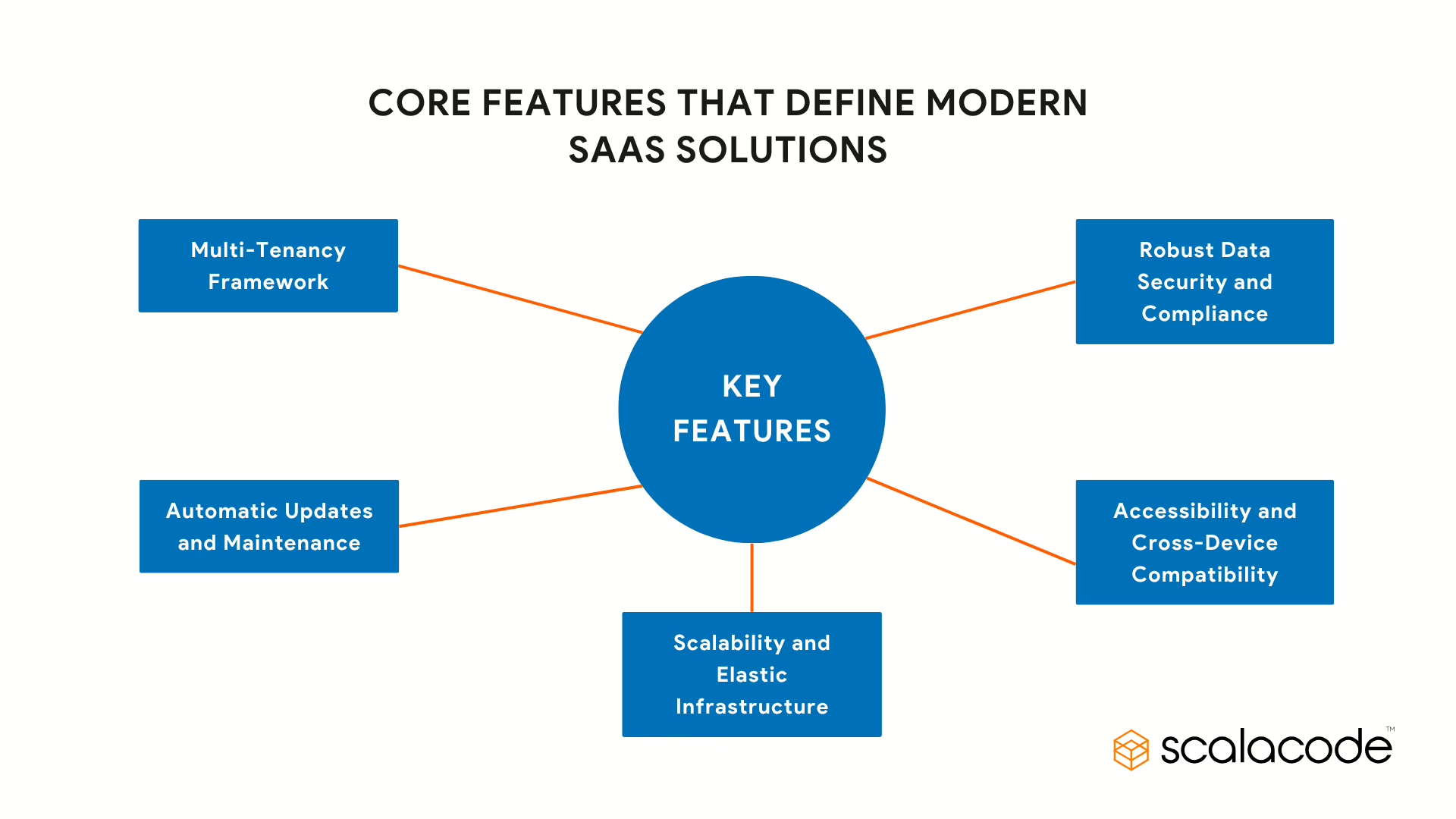
1. Multi-Tenancy Framework
Advanced SaaS platforms are generally developed on shared instance models or multi-tenancy models. It enables a single software instance to cater to a broad range of tenants and keep their data safe and secluded. Such an outline gives a boost to scalability and streamlines updates and maintenance.
2. Automatic Updates and Maintenance
The providers of solutions embedded with SaaS trends handle updates, feature rollouts, and bug fixes in a unified way. It does not require user intervention at all. By giving the customers access to the newly added features, it ensures minimal disruption.
3. Scalability and Elastic Infrastructure
SaaS-based solutions are delivered to help the business gain a competitive edge and witness remarkable growth. It doesn’t matter whether you are onboarding twenty users or twenty thousand; the core architecture can dynamically scale to fulfill the demand, usually driven by cloud platforms (AWS, Azure, or Google Cloud).
4. Accessibility and Cross-Device Compatibility
Leveraging the cloud-native structure, SaaS apps are easily accessible from any place having internet connectivity through desktops, mobile devices, and tablets.
5. Robust Data Security and Compliance
Security is a cornerstone in SaaS adoption trends and solutions. Industry-leading platforms enforce encryption, data backups, role-enabled access controls, and adherence with universal standards (GDPR, HIPAA, and SOC 2) to protect sensitive information.
Top 10 Game-Changing SaaS Trends
2026 brings a flood of cutting-edge tools to reshape the software development methodologies and how it is embraced by users, with the SaaS contribution to transform their traditional limitations. These top 10 SaaS trends depict a vibrant prioritization of smart automation, hyper-customization, security-focused infrastructures, and modular scalability.
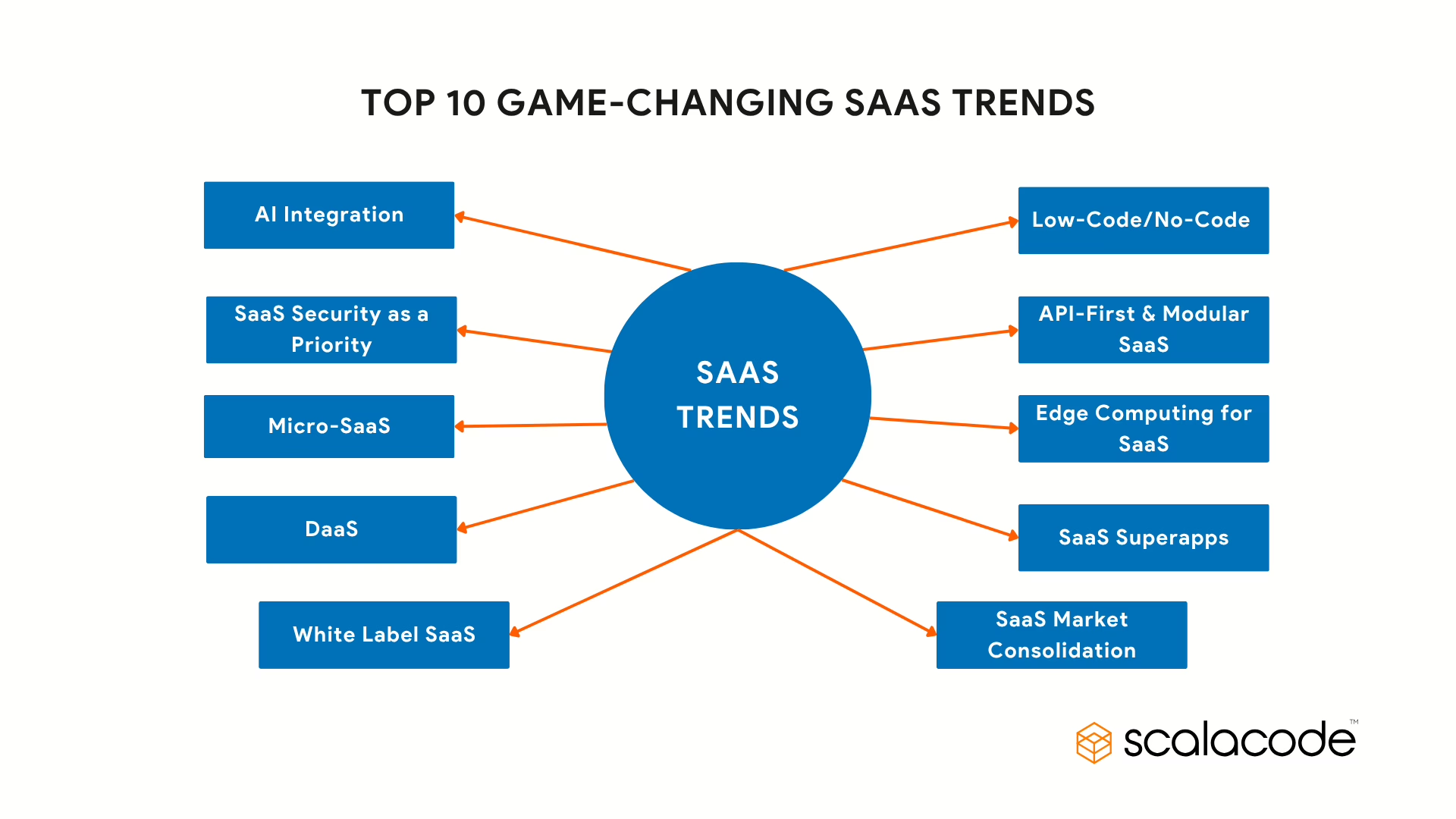
1. Artificial Intelligence (AI) Integration
Baked into the DNA of SaaS products, AI is making the solutions more impactful. SaaS platforms are utilizing machine learning to offer accelerated, personalized, and smarter experiences—from superior chatbots and AI-based analytics to automated decision-making and predictive customer behavior.
Scope:
Artificial intelligence is integrated across domains—from predictive CRM tools and smart automation/digitalization to smart HR platforms and AI-driven analytics engines.
Benefits:
- Enhances hyper-customization
- Automates/digitalizes regular workflows
- Boost decision-making with real-time insights
Key Features:
- Natural Language Processing (NLP)
- Predictive modeling
- Autonomous work process
- AI-driven insights
Limitations:
- High data reliance for precision
- Legal and privacy concerns
- Susceptibility to algorithmic bias
2. SaaS Security as a Priority
With the rise of remote work, data breaches, and evolving regulations, security is a top-tier concern. SaaS companies are implementing zero-trust security models, advanced encryption, multi-factor authentication, and compliance automation to protect user data.
Benefits:
- Builds trust with enterprise clients
- Ensures regulatory compliance (e.g., GDPR, HIPAA, SOC 2)
- Prevents costly data breaches
Scope:
Applies to all industries handling sensitive data (finance, healthcare, legal, e-commerce). Security is now a key differentiator.
Key Features:
- End-to-end encryption
- Zero-trust architecture
- Role-based access controls (RBAC)
- Automated compliance monitoring (e.g., GDPR, SOC 2)
Limitations:
- Higher development and compliance costs
- Complexity in managing multi-tenant environments
- Constant need to adapt to new threats
Also Read: Top SaaS Product Ideas of 2026
3. Micro-SaaS
It’s a myth that bigger is always better. But this is not always true. Micro-SaaS startups are thriving through laser-driven tools developed for domain issues. Developed by teams that are small in size (or individual founders), these platforms integrate flawlessly with current ecosystems, adding high value with cut-down complexity.
Scope:
Crafted for hyper-niche applications or use cases. A game changer in marketing, productivity tools, and browser-driven plug-ins.
Benefits:
- Lower surplus and launch swiftly
- Work on solving specific bottlenecks
- Ideal for small-scale startups or side hustles
Key Features:
- Minimalist functionality
- Low functioning costs
- Faster time-to-market
- Create to work smoothly with current ecosystems (e.g., Notion add-ons)
Limitations:
- Limited market size
- Not suitable for platform changes (e.g., Shopify/Slack APIs)
- Lower scalability
4. Data-as-a-Service (DaaS)
DaaS represents the methodology to mine the data. SaaS trends are reshaping companies into data hubs, delivering on-demand access to curated, analytics-ready, and enriched data through APIs or dashboards.
Scope:
Widely utilized in different industries like finance, marketing, analytics, logistics, and AI training. Enable businesses to gain insights without needing to build data pipelines.
Benefits:
- Allows real-time intelligent decision-making
- Minimizes the requirement for the internal data framework
- Strengthens AI, customization, and reporting tools
Key Features:
- On-demand data access via APIs
- Data refinement and enrichment
- Scalable storage
- Subscription-backed data monetization
Limitations:
- Inconsistencies in data quality
- Privacy and validating risks
- Integration vulnerabilities with older/legacy systems
5. White Label SaaS
Companies can rebrand and resell the currently functional software under their brand name with white-label SaaS. By combining this model with white label SEO, agencies can expand their service portfolio without additional development costs. It is an open invitation for enterprises, consultants, and influencers to introduce their products into the market and measure their revenue.
Scope:
Highly suitable for online agencies, resellers, consultants, and non-technical entrepreneurs who desire to introduce SaaS solutions under their brand name.
Benefits:
- Ensure affordability while launching products instantly
- Develop repetitive revenue streams
- Customize software without any need to begin from scratch
Key Features:
- Brand-flexible dashboard and UX
- Personalized niches and branding
- Pricing models for resellers
- Ready-to-launch pre-designed modules
Limitations:
- Restricted backend customization
- Reliance on the real SaaS solutions provider
- Shared support and feature rollout timelines
6. SaaS Market Consolidation
The SaaS industry report shows that the global market valuation is increasing and becoming crowded. Vast platforms are capturing niche players to broaden services, rule out competition, and develop end-to-end ecosystems. Assume Adobe is acquiring Figma or Salesforce is taking over Slack.
Scope:
Targeting well-developed markets such as marketing automation, CRM, ERP, and cloud collaboration, where huge players eliminate or take over smaller competitors.
Benefits:
- Result in immensely unifying, feature-rich platforms
- Cut off integration struggles for users
- Compels startups to enhance specialization or innovation
Key Features:
- Mergers & acquisitions
- Platform integration
- Cross-platform integration
- Expanded ecosystems
Limitations:
- Minimized competition is equal to less innovation
- Unification setbacks and UX inconsistencies
- Limited available vendors
Must Read: SaaS Application Development Guide
7 SaaS Superapps
Similar to Asia’s Superapps, for example, WeChat, SaaS Superapps are multi-capability systems that package CRM solutions, interaction, payments, and analytics into a single seamless experience. It is suitable for SMBs and individual entrepreneurs desiring simplicity and power.
Scope:
Mainly aims at SMBs and individual entrepreneurs who desire all-in-one platforms for CRM, communication, project management, and finance.
Benefits:
- Minimizes app overload
- Provides single login, single dashboard, all-in-one tools
- Enhances user retention with convenience
Key Features:
- Integrated interface for a huge number of tools
- Smooth internal integrations
- Personalized modules and plug-ins
- Single login and billing
Limitations:
- Capable of becoming bloated or highly intricate
- Threat of “jack of all trades, master of none”
- High knowledge ramp-up for non-tech users
8. Edge Computing for SaaS
For latency-intolerant applications, for example, think IoT, AR, and real-time collaboration, edge computing acts as an invisible weapon. After data processing near the user’s device, the B2B SaaS trends is able to deliver high performance, even in remote areas.
Scope:
Crucial for on-demand SaaS trends application in industries (IoT, smart logistics, autonomous systems, real-time analytics, and AR/VR).
Benefits:
- Allows on-demand analytics and communication
- Cut off server load as well as network latency
- Significant for businesses such as logistics, manufacturing, and gaming
Key Features:
- Local data processing
- Offline capabilities
- Lower latency
- Geo-centric content delivery
Limitations:
- Look for investment in the edge framework
- More intricate network layout
- Security threats at various endpoints
9. API-First & Modular SaaS
Next-generation SaaS is modular. API-first platforms are primarily designed to ensure smooth integration with other legacy systems, providing businesses the opportunity to automate, customize, and scale. We just cannot consider APIs as technical tools. Instead, they are truly strategic assets.
Scope:
We can now expect API-first development in modern SaaS infrastructure, mostly in fintech, logistics, DevOps, and health tech.
Benefits:
- Promotes ecosystem unification
- Permits businesses to leverage “plug and play” functionality
- Accelerate innovation as well as time-to-market
Key Features:
- Modular architecture
- Developer-focused documentation
- Webhooks & SDKs
- Interoperable, plug-and-play capabilities
Limitations:
- Needs a powerful developer ecosystem
- Inadequately documented APIs can often lead to integration issues
- Risk of security vulnerabilities if APIs are exposed
10. Low-Code/No-Code Capabilities
The developer’s unavailability cannot be denied. Here, low-code/no-code is an ideal solution. These tools, paired with APIs, enable users from non-tech backgrounds to develop workflows, social media posting automations, and automatic email campaigns and more without the need to write proper code. We can confidently say that 2026 and the upcoming years belong to the generation of the citizen developer.
Scope:
Utilized across business processes, HR, marketing, and even product development teams. It is suitable for SaaS startup trends and small-scale businesses having limited engineering resources.
Benefits:
- Accelerate product development
- Cut off dependency on IT teams
- Stimulates innovation across all sectors and departments
Key Features:
- Drag-and-drop interaction points
- Pre-built templates and plugins
- Intuitive workflow builders
- Business rule auto-execution
Limitations:
- Constrained scalability for intricate logic
- Threat of “shadow IT” without administration
- Vendor dependency on proprietary platforms
Build future-ready SaaS platforms that scale with your business.
FINAL THOUGHTS
The innovations restructuring 2026 and beyond prioritize agility, broad accessibility, and intelligence as the latest SaaS trends constantly redefine the ways businesses operate. The B2B SaaS trends ecosystem is in the process of shifting its focus to being more modular, user-centric, and secure, from AI-enabled platforms to powering no-code/low-code. Such revolutionary innovations aren’t only about technological movements—they display thoughtful transformation in the way value is added and delivered.
Businesses must align with emerging trends in the SaaS industry to stay competitive. We can say that embracing such changes now will surely shape intelligent and adaptive tech ecosystems for the future. Partnering with the right saas development company is essential to add these benefits to your solutions.
Frequently Asked Questions
1. What are the current SaaS trends in 2026?
Entering the year 2026, prominent enterprise SaaS trends 2026 comprise AI inclusion, SaaS-based security, Data-as-a-Service (DaaS), Micro-SaaS, superapps, edge computing, white-label platforms, API-first architecture, market consolidation, and low-code/no-code tools. These cutting-edge tools are continuously redefining the way SaaS product ideas are transformed into solutions and how they are measured and delivered. It also speeds up the MVP development services for newly established businesses and enterprises.
2. Why is AI integration important for SaaS business trends in 2026?
Artificial intelligence empowers intelligent capabilities such as predictive analytics, smart self-execution, customized UX, and NLP-focused support. It minimizes manual business processing, enhances user experience, and enables SaaS platforms to transform real-time focused data and user behavior.
3. Why are micro SaaS trends unstoppable in 2026?
Micro-SaaS points to high-precision software products primarily crafted to eliminate niche issues. It is frequently built by individual founders or small-sized teams. It is becoming a high-value innovation because it does not require high capital. Moreover, it seamlessly integrates with prominent platforms and offers high ROI for targeted use cases.
4. How does edge computing impact SaaS platforms?
Edge computing is responsible for data processing at the point of code generation, minimizing delays and optimizing responsiveness. It focuses on the on-demand or offline applications, particularly for MVP development services that certainly require the validation of user experience.
5. What are the benefits of low-code/no-code SaaS platforms?
The low-code/no-code SaaS platforms enable users who do not possess coding experience to develop apps, automate workflows, and continuously prototype ideas. They promote agility, cut off the dependency on IT teams, and offer accessible innovations across every department.
6. How does API-first architecture enhance SaaS platforms?
We can say that API-first SaaS platforms are primarily designed with unification in mind, allowing uninterrupted connections with external tools, internal systems, and other services. Such modular methodology supports accelerated innovation, streamlines scaling, and permits businesses to customize their solutions as per their specific needs.