
Artificial intelligence is rapidly transforming the way businesses operate, streamlining and automating daily tasks from automating routine tasks to enabling smarter decision-making. Big business players believe that AI has become a key driver of innovation and efficiency across industries; hence, they have already done the process of AI implementation in business.
If we look at the stats, then according to Deloitte, companies are achieving returns from AI in areas such as customer experience (74%), IT operations (69%), and decision-making (66%), proving that AI is no longer experimental.
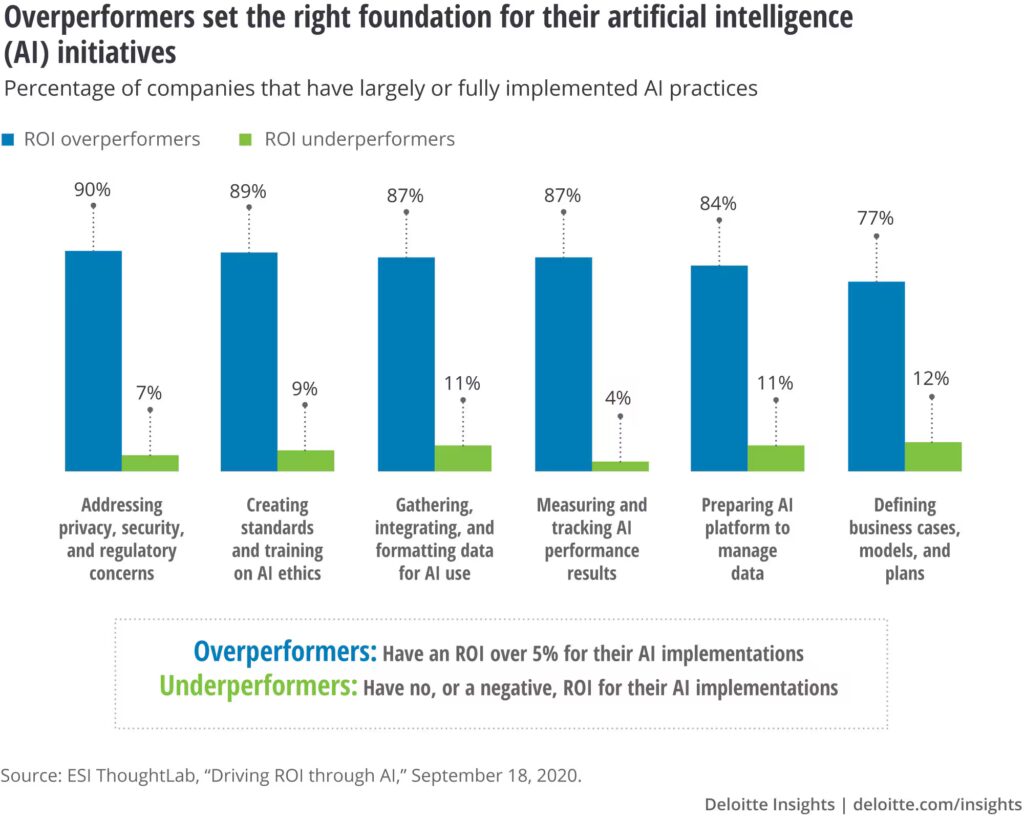
So, if you are the one who wants to learn about how to incorporate AI into your business, then you are reading the right blog. Here in this blog, we are going to discuss key benefits, proven strategies, and real-world examples to help you understand how AI can drive growth, efficiency, and long-term competitive advantage.
What is AI Implementation in Business?
AI implementation in business refers to how a company prepares and utilizes artificial intelligence (AI) tools to improve efficiencies, automate processes, and provide valuable insights through data.
This is accomplished by defining possible uses for artificial intelligence, analyzing business challenges that can be addressed using AI applications, preparing data that will be used with the AI applications, creating new AI models that meet the business need, and implementing the newly developed AI models into currently used company processes.
Companies can also use technologies such as machine learning, natural language processing, and predictive analytics to automate repetitive processes (such as emailing, data entry, or customer service) and improve the customer experience, while also informing more strategic business decisions.
When companies are successful at implementing AI applications within their business operations, they can reduce costs, improve productivity, and create a competitive advantage in a rapidly growing digital business marketplace.
Why AI Implementation is Important for Modern Businesses
Artificial intelligence has emerged as a digital transformation for organizations in different sectors. Companies nowadays are capable of generating huge amounts of data and compete in very competitive markets.
With the application of AI solutions, businesses are able to process a large amount of data, automate their operations, and make smarter decisions that facilitate growth and efficiency. The following are the primary reasons why AI applications are essential to contemporary businesses.

1. Increasing data-driven decision-making
To make a strategic decision, modern businesses are dependent on data. The AI technologies are capable of processing and analyzing vast quantities of structured and unstructured data much quicker than human beings. Advanced analytics and predictive models enable companies to recognize trends, predict demand, and make informed decisions that minimize risks and enhance overall business performance.
2. Automation of repetitive processes
Some of the common business activities include repetitive and time-consuming activities, including data entry, customer support responses, inventory tracking, and report generation. The automation tools that include AI are able to handle such tasks effectively, and employees work on other, more strategic and creative tasks. This not only improves productivity but also minimizes the cost of operations.
3. Competitive advantage through innovation
Those companies that innovate with AI technologies tend to have a major competitive edge. AI can help companies to double their speed of innovation, create smarter products and services, and react quickly to the changes in the market. Companies that are able to embrace AI in their business process can enhance efficiency, improve the quality of products, and outperform the competition.
4. Enhancing customer experience
The digital age has resulted in high expectations of customers. The analysis of customer behavior, preferences, and purchase patterns assists businesses in offering custom experiences with the use of AI. Artificial intelligence chatbots, recommendation systems, and smart virtual assistants enable enterprises to offer quicker service and customized suggestions along with flawless communications within the digital platforms.
Top Advantages of Implementing AI in Business
The implementation of artificial intelligence technologies in organizations could be a great benefit to organizations in various industries. As a strategic implementation, AI assists companies with optimization, decision-making, and providing more efficient services to clients. The following are some of the main advantages of AI applications in business.

1. Improved Operational Efficiency
Enhanced operation is one of the largest benefits of AI applications in business. Robotized technologies can delegate tedious work, simplify operations, and minimize human error rates. Through automation of common activities like data entry, report creation, and customer queries, the businesses can save time and eliminate operational expenses without compromising their accuracy and consistency.
2. Data-Driven Decision Making
The AI allows organizations to process big data volumes in a short period of time and derive quality information. Businesses can recognize trends, predict market trends, and make better decisions with machine learning algorithms and predictive analytics. This assists companies in minimizing uncertainty, maximizing strategies, and reacting better to the dynamics of the market.
3. Enhanced Customer Experience
The AI technologies enable companies to offer customers more personalized and efficient experiences. Intelligent customer support systems, AI chatbots, and recommendation engines are tools that assist companies in addressing the requests of customers immediately and offer them personalized product or service recommendations. Through this, the businesses will be in a position to enhance customer satisfaction and establish better relationships with the audience.
4. Increased Productivity
AI will enable employees to spend time on more valuable tasks by automating time-consuming procedures and giving them smart insights. Organizations can devote more time to innovation, strategy, and problem-solving instead of undertaking routine organizational activities. The result of this is increased productivity and the use of human resources in the organization.
5. Better Risk Management
AI plays a crucial role in identifying potential risks and preventing business losses. AI systems can analyze historical data and detect unusual patterns that may indicate fraud, security threats, or operational risks. With predictive capabilities, businesses can take proactive measures to minimize risks and improve overall stability.
To achieve all these benefits, you can hire AI developers who have the expertise to design, build, and deploy intelligent solutions tailored to your business needs. Along with that, a skilled integration team can also help you in identifying the right use cases, developing custom models, and integrating AI seamlessly into your existing systems.
AI Implementation Strategy for Businesses
Now, after knowing about implementing AI in business, you should know the implementation strategies that may help you in ensuring successful adoption. In addition to that, a well-planned AI implementation strategy helps organizations reduce risks, maximize return on investment, and integrate AI smoothly into existing workflows.

1. Define Clear Business Objectives
In the first step, you need to define clear business objectives. Here, you must know about the concerned areas that you need to solve through artificial intelligence implementation. As a result, this will help you enhance data analysis. Not only this, but defining clear objectives helps organizations align AI initiatives with overall business goals.
2. Assess Data Readiness
Well-structured data is the foundation of any AI model; businesses should evaluate whether they have sufficient, high-quality, and well-organized data to train AI models effectively. As a result, this will ensure proper data governance; without reliable data, AI systems may produce inaccurate results.
3. Choose the Right AI Technologies
Next, you need to choose the right AI technologies for integration. This matters because this will ensure that AI solutions effectively address specific business needs. Additionally, this will include the analysis of different AI tools depending on your requirements, such as ML for predictive analytics, NLP for chatbots, or computer vision for image recognition.
4. Build the Right AI Team
Integrating AI into business also includes hiring the right AI development company, and if you are looking for this, then you should look for a skilled team. A skilled team that includes data scientists, AI engineers, software developers, and domain experts.
5. Start with pilot projects
Instead of integrating AI throughout the entire organization right away, firms should start with modest test initiatives. Before full-scale adoption, pilot projects allow AI technologies to be tested in real-world circumstances, possible obstacles identified, and performance measured.
6. Scale AI Across the Organization
Once pilot initiatives are successful, firms can gradually expand AI solutions across departments and processes. This process entails integrating AI systems with current tools, refining models using performance data, and continuously optimizing AI applications to optimize their usefulness.
Read in detail: AI in Business Strategy: A Roadmap to Digital Transformation
Steps to Implement AI in Business Successfully
Before investing in a conversational AI development company for AI implementation in business, you should know the integration steps. Here in this section, we will talk about the steps that are involved in AI implementation.

1. Identify high-impact AI use cases
The first one is to determine those places where AI is able to be of the greatest benefit. Businesses are encouraged to strive to find those use cases that are real problem solutions, are more efficient, or provide better customer experience. High-impact areas should be given priority to ensure the achievement of quick wins and confidence in the adoption of AI.
2. Prepare and organize data
An AI system is dependent on data. To make sure that the data is relevant and accurate, businesses should gather, clean, and organize it. Properly prepared and quality data enhances the work of AI models and results in more credible results.
3. Select the right AI tools and platforms
Selection of the appropriate tools and platforms is the key to the successful implementation of AI. Businesses have the option of using cloud-based AI systems, machine learning systems, or custom-designed systems that meet their objectives and infrastructure, depending on the needs of the business.
4. Develop AI models
The second step is to develop AI models after the data and tools are prepared. This is done by training machine learning algorithms with prepared data to undertake certain tasks such as prediction, classification, or automation. Effective and appropriate testing must be done.
5. Integrate AI with existing systems
AI solutions must be connected with the current business systems, like CRM, ERP, or other enterprise applications. It is seamlessly integrated so that AI does not interfere with the existing workflows.
6. Monitor performance and optimize models
Implementation of AI is not a single process. Companies have to constantly evaluate AI model performance and make adjustments to it on the basis of real-time data and feedback. Frequent optimization will ensure accuracy, efficiency, and value in the long run.
Real-World Examples of AI Implementation in Business
The active application of AI to real business issues, efficiency, and enhanced customer experiences is present across industries. The following are some of the practical examples of the use of AI in various sectors.

1. Retail
In the retail business, AI is popular as a tool for customized product suggestions, demand forecasting, and inventory control. The e-commerce sites use the behavior, purchasing history, and preferences of the customer to recommend suitable products and, in the process, boost sales and customer satisfaction. The AI can also assist retailers in estimating the demand trends and optimizing inventory.
Also Read: Top Use Cases and Applications of Computer Vision in Retail
2. Healthcare
AI is essential in healthcare, which offers early medical diagnosis, medical imaging analysis, and continuous patient monitoring. The systems powered by AI help doctors diagnose conditions with more precision and speed, analyzing medical data in large volumes. Predictive analytics also aids healthcare professionals in anticipating patient risk, enhancing treatment plans, and improving overall patient outcomes, in addition to reducing the operational burden.
3. Finance
In finance, AI is commonly applied in fraud detection, credit scoring, risk assessment, and algorithmic trading. It is able to process huge volumes of data in real-time to determine suspicious actions and stop financial fraud. AI is also applied by financial institutions to support the automation of decision-making services, enhance precision in risk assessment, and offer customers personal financial services.
4. Manufacturing
Manufacturing companies leverage AI for predictive maintenance, quality control, and process automation. AI systems monitor machine performance and detect potential failures before they occur, minimizing downtime and maintenance costs. Additionally, computer vision technologies help identify product defects during production, ensuring consistent quality and improving overall operational efficiency.
Must Read: AI in Manufacturing: Use Cases, Benefits, and Future Scope
Challenges in AI Implementation and Their Solutions
While implementing AI in business, developers may face some challenges. In this section, we are going to discuss the challenges and their solutions.
| Challenge | Solution |
| Data Quality Issues | Ensure proper data collection, cleaning, and validation processes. Invest in data governance frameworks to maintain the accuracy, consistency, and reliability of data. |
| High Implementation Costs | Start with small pilot projects and scale gradually. Use cloud-based AI solutions to reduce infrastructure costs and optimize budget allocation. |
| Lack of Skilled AI Professionals | Hire experienced AI developers or partner with an AI development company. Also, invest in employee training and upskilling programs. |
| Integration with Legacy Systems | Use APIs and middleware to enable smooth integration. Modernize existing systems gradually to support AI capabilities without disrupting operations. |
| Ethical and Privacy Concerns | Implement strong data security measures and comply with regulations. Ensure transparency in AI models and follow ethical AI practices to build trust. |
How can ScalaCode help you?
To take AI integration services, you need to trust someone who has years of experience in the domain. When it comes to a reliable AI development company, one that can beat the services of ScalaCode, we help businesses adopt AI technologies efficiently by providing end-to-end AI development and integration services.
Not only this, but we also support our customers from identifying the right AI use cases to developing custom AI solutions and integrating them.
- We help businesses identify the right AI opportunities
- We help businesses in building tailored AI models and applications
- We seamlessly integrate AI solutions with existing platforms
- We use the latest AI technologies to build smart solutions
Conclusion
AI is no longer a futuristic concept, but it has become a crucial part of every business, irrespective of industry. AI implementation in business improves efficiency and enables data-driven decision-making to enhance customer experiences and manage risks. In addition to that, it has multiple benefits like increased productivity, reduced operational costs, faster decision-making, improved accuracy, and the ability to scale operations efficiently.
To achieve all these benefits, you can connect with a result-driven AI automation company that can seamlessly integrate artificial intelligence into your business. Not only this, but they can also help you in identifying the right AI use cases, building custom AI solutions, integrating AI with your existing systems, automating complex workflows, and continuously optimizing AI models to ensure long-term business growth and performance.
FAQs
-
How long does it take to implement AI in a business?
It depends on the integration complexity, data availability, and integration requirements. Based on these factors, development teams will provide you with the approximate timing for the integration process.
-
Do small businesses need AI implementation?
Businesses can choose to implement AI regardless of their team size. In addition, small businesses that adopt artificial intelligence at an early stage can reduce extra costs and, not only that, help with customer support automation, sales forecasting, marketing analytics, and inventory management.
-
What type of data is required for AI implementation?
An AI system typically requires structured or unstructured data such as customer behavior data, transaction records, operational data, and historical performance data. However, well-structured data helps businesses improve their business AI models.
-
Is AI implementation expensive for businesses?
Well, the cost of AI implementation depends on factors such as project complexity, data infrastructure, required tools, and development resources. If you belong to a small-to medium-sized business, then you can start with smaller AI projects or cloud-based AI solutions.