
TryStyle was launched to solve a fundamental challenge in fashion eCommerce: helping users confidently explore and visualize outfits before purchasing. Traditional online shopping experiences lack the in-person “try-on” feel, leading to uncertainty, increased returns, and reduced conversion rates. TryStyle bridges this gap by enabling consumers to digitally try on clothing using AI technology from any location via an intuitive mobile-first interface.
TryStyle required a scalable, AI-driven virtual try-on solution that enables users to visualize outfits in real time with high accuracy in fit, size, and styling. The platform needed to deliver a seamless mobile-first experience, support mix-and-match outfit combinations, and integrate with existing eCommerce systems for product synchronization. It also had to ensure realistic garment rendering, personalized user experiences, and secure handling of user data, while ultimately reducing return rates and improving conversion through increased purchase confidence.

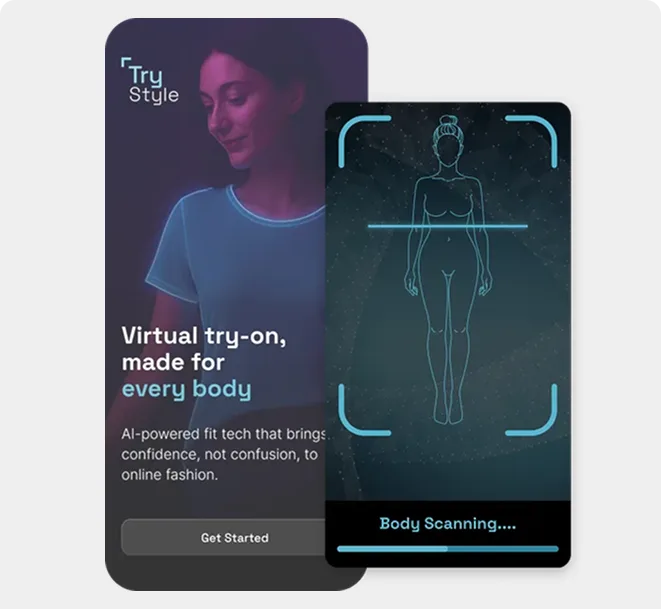
To tackle these challenges and meet strategic goals, the TryStyle solution consisted of the following components:
The core feature of the platform allows users to upload a photo (or use live camera input) to see clothing overlaid realistically on their body silhouette. This interaction helps users preview fit, style, and aesthetics without physical garments.
TryStyle incorporates a scrollable discovery feed where users can explore outfits, tap to try-on looks instantly, and collect inspiration. This turns passive browsing into interactive engagement.
Users build a personal profile with favourite looks, manage saved try-ons, and curate a digital wardrobe that reflects their unique style.
Integration of social sharing tools enables users to share their virtual try-ons with friends or on external platforms - enhancing virality and user retention.
The app is engineered for iOS (and potentially Android) with smooth navigation, efficient image processing, and responsive UI interactions tailored to mobile usage patterns.

For garment detection and photo output generation.
Native or hybrid mobile frameworks optimised for iOS/ Android delivery.
Backend support for user media, storage, and asynchronous processing.
 Python
 Flutter
 PyTorch

Online shoppers often abandon purchases due to lack of confidence in fit and appearance. This “try-before-buy” gap adversely affects conversion rates.
Without a means to accurately visualise outfits, online fashion retailers suffer significant returns , which drive logistics costs and inventory inefficiencies.
Traditional fashion discovery in apps and websites is static and product-centric. Users lack interactive ways to explore complete outfits and express personal style preferences.
Delivering a fluid, responsive experience , especially one dependent on real-time image processing and augmentation , requires careful architectural planning and optimisation.
Real-time virtual clothing try-on with user photo input.
Digital wardrobe and favourites management.
Social sharing and style interaction tools.
AI and image processing for garment overlay and styling effects.
High-performance mobile rendering adapted for iOS devices.
Scalable architecture supporting media uploads and user galleries.



I had a vision but needed technical execution, ScalaCode transformed it into a working platform with creative precision.




Recognized by Industry Leaders & Valued by Global Clients