
Do you know AI in security has become the new normal today? That’s correct.
Think of your business as a contemporary smart home fitted with all the latest gadgets. Now, what if, amid all this technology, the primary security system is an old rusty lock? It feels outdated, right?
Since this old lock represents traditional security measures, it is no longer effective against advanced cyber threats that can harm or infiltrate your home. This leaves your valuable things like data and information exposed.
So, how do you adapt to these evolving threats? The solution lies in integrating AI into your security systems. This blog will delve into how artificial intelligence can bolster your company’s security and keep it up to date with the latest threats.
Why AI Security Systems and Not Traditional Ones?
Most people believe that older methods are the best. This is why they choose traditional approaches, citing that modern technology is too complicated and seems to keep changing. Nevertheless, this is a mistake; in the event, they become easy targets of cyber-attacks.
Traditionally, businesses have depended on traditional security tools such as firewalls, antivirus programs, and intrusion detection systems to protect digital assets. Though these methods can provide basic protection, they have proved ineffective in handling current cyber threats. Modern security requires visibility and control beyond the network perimeter, which is where a secure web gateway software becomes essential. An SWG helps inspect and control web traffic in real time, block malicious content, and protect users regardless of where they connect from. Be it AI in software development or AI in security, it’s doing wonders.
With cyber criminals constantly looking to develop better tools, it is essential that only advanced and updated security solutions are deployed in businesses. AI security allows for a new level of defense for businesses to stay ahead and outsmart malicious attackers.
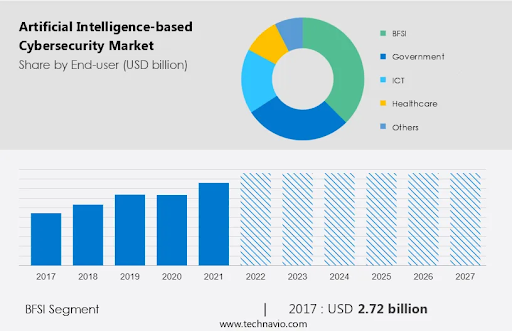
Here are some statistics to highlight the above statement. According to MarketsandMarkets, the Artificial Intelligence in cybersecurity market size is supposed to raise around $38.2B by 2026 at a CAGR of 23.3%.
Another study by Gartner mentions that the average general security technologies deployment rate has risen from 57% in 2020 to 93% in 2024. This growth showcases how AI is growingly recognized as a critical tool in the battle against cyber dangers.
Due to higher demand, the demand for an AI consulting company is growing rapidly. However, before knowing how such companies can help you out, let’s figure out some keyword benefits of AI in security.
Key Benefits of AI-Powered Security Solutions
1. Advanced Threat Detection
Artificial Intelligence (AI) is able to detect threats in a security system that the traditional methods cannot. AI algorithms can study patterns and behaviors. Moreover, they are able to find strange events, such as unknown threats, very well.
An analysis of the findings of a study conducted by IBM can reveal that the companies, on average, take nearly 280 days to identify and contain a breach. However, the fast detection of AI is what can substantially decrease this time by only decreasing the potential damage.
Per the Ponemon Institute report, the use of AI in cybersecurity could bring a decline of 12% reduction in the costs of breaches by the organizations compared to the ones that are not using AI. This is an indication of more savings as well as better protection of sensitive information, helping organizations reduce overall Cybersecurity risk.
2. High-Speed Working
The high-speed operation of machine learning makes it possible to finish the scan of information and deactivate the alert before potential damage is done. AI enhances business security through its ability to learn and reason about various processes without human intervention while rapidly analyzing vast norms and principles.
This allows AI to process complex security-related information in a fraction of the time it would take a human, enabling faster threat detection and more effective protection measures. In short, a swift perception tool and a quick remedy process are very important.
-
Faster and More Agile Decision-Making
AI in security systems can detect threats in real-time, significantly reducing the chances of vulnerability. Companies using AI and automation technologies see the shortest time to identify and contain a breach. If a breach is detected, we must act swiftly to minimize the consequences of such a cyber incident.
-
Automated Responses
The use of AI in security leads to automated responses, which further help safeguard your system against breaches. For example, AI handles the alert based on pre-programmed set actions after it has been observed.
Imagine the scenario of a machine learning tool finding out about an unauthorized access attempt in your database, similar to someone who is not working for your company but can still log in. The tool will then immediately communicate the situation to your IT department, block access to your data, and isolate the affected systems.
-
Incident Response Orchestration
AI in security systems corresponds to replies across diverse security tools and protocols. This orchestration guarantees a complete defense method for your system, from implementing measures like turning off compromised servers to updating firewall rules or deploying patches. This guarantees that your business is performing smoothly without any disruptions.
3. Managing Vulnerabilities with Precision
The traditional methods of identification and management of vulnerabilities are majorly manual and, in most cases, reactive. Now, AI changes the security system by continuously scanning and giving real-time insights, unlike periodic scans. This ensures that new vulnerabilities are identified immediately after their emergence.
- Automated Vulnerability Assessment
The AI is automated to scan the vulnerabilities, assessing its severity and potential impact. This gives your IT department clear visibility on which problems to focus on first. It thus frees human resources that otherwise can be effectively focused on strategic security initiatives.
- Predictive Analytics
Apart from automation and prioritization of serious threats, AI also makes use of historical data in predicting the vulnerabilities that could happen. Traditional systems check after the threat has been done, latest technologies like AI predicts before it happens. This means that proactive measures will be taken, and your system will be secured in advance, thereby improving your security posture.
4. Handling Big Data
AI is tailored to manage and analyze mammoth volumes of data and information, much beyond human capacity. It will give you utilities to take that data and transform it into actionable security insights, empowering you to make the right decisions. Let’s face it: Analyzing big data can be a great challenge and an absolutely dire need today, and security in AI helps you do it.
-
Automation and Efficiency
AI relieves the burden on your human experts by automating repetitive and time-consuming security tasks, allowing them to handle more complex issues and work more efficiently. It continuously monitors network traffic, user behavior, and system performance, automatically flagging anomalies when detected.
-
Incident Response Automation
AI can execute predefined responses to the threats identified, like isolating affected systems or blocking suspicious IP addresses. For example, in this case, your employee mail ID is restricted to being accessed with a particular laptop or system or IP address only.
So, when you try to access your employee mail ID from an alien device, an automated threat notification comes to your IT department. AI will block that suspicious IP address; any unknown or unauthorized device can’t access your mail ID. That is the power of AI in security.
-
Security Policy Enforcement
AI helps enforce security policies consistently and ensures uniformity in their application within an organization. This reduces the chances of human error and hence improves your system’s protection level.
Now that you are aware of AI in security and how this increases business for you, let me look at a real success story to set this straight.
Currently, as we discuss this, many companies have already installed AI into their security systems and are, of course, drawing huge benefits from it. A good example can be cited in JPMorgan Chase, one of the world’s largest banks.
JPMorgan Chase put in place AI-powered security measures for the detection of fraud and its checking. The bank then applied machine-learning algorithms that analyzed transaction patterns and further identified, in real time, any anomalies. This greatly reduced the fraudulent activities. A report said they saved hundreds of millions by evading fraud and making operations more efficient.
3 Real-World Examples of AI in Security
1. Darktrace: AI-Powered Threat Detection and Analysis
Artificial intelligence powers Darktrace, transforming threat detection and analysis in cybersecurity. Their AI continuously monitors network traffic and user behavior, learning the patterns that define “normal” for each unique environment.
Further, with machine learning and anomaly detection algorithms at its heart, Darktrace can identify small deviations from usual patterns, which may indicate a cyber threat.
2. CrowdStrike: AI-Enhanced Malware and Ransomware Protection
CrowdStrike uses AI to power next-generation protection from malware and ransomware. The company’s Falcon platform applies machine learning and behavioral-based detection to identify malicious software before it harms systems or encrypts files.
It provides for the analysis of such attributes in files and processes, including behavior, structure, and context. AI can identify patterns of the known malware family and a new threat that has never been seen before based on suspicion of behaviors.
3. Exabeam: AI-Driven Insider Threat Detection
Exabeam solves the most complex challenge of insider threat detection with AI. The solution uses machine learning and UEBA to monitor and analyze user activities across a network.
Basically, it builds baselines of behaviors for every user and entity based on login parameters, such as average times of logins, resources accessed, and patterns of data transfer. Thereafter, it monitors deviations from the built baselines, which might be indicative of malicious insider activities or compromised accounts.
How ScalaCode Can Help You to Develop an AI-based Security Application?
ScalaCode is a leading name in custom software development services providers. Our team of professionals has years of experience creating the latest mobile apps. From AI to Machine Learning, they do it all.
At ScalaCode, we know how to develop customized AI apps related to security or data analysis. It most likely offers AI integration into existing systems, data preparation, design, and training services, with constant support.
Final Thoughts
The future and AI go hand in glove; it is already going to play a central role in business security. With machine learning, predictive analytics, and automated response systems, organizations can stay ahead of evolving threats and protect what matters.
Security AI advantages are not based on technological superiority much as one that creates a resilient, adaptive, and intelligent security ecosystem.
Further evolution by AI in the many years ahead will bring more sophisticated solutions that continue to transform the business security landscape. You can hire a trusted AI development company anytime for perfect AI solutions.
FAQs
What is AI-powered security?
AI-powered security is the application of artificial intelligence to improve and automate security systems and processes.
What is a good example of Artificial Intelligence in security surveillance?
One clear example of AI in security is intelligent video analytics. This technology can automatically detect suspicious activities from real-time camera feeds, enhancing the effectiveness of security surveillance.
How is AI used in security?
AI is used in security for facial recognition, anomaly detection, and predictive analysis of potential threats.
How is AI used in threat detection?
AI algorithms in threat detection scour large datasets to identify patterns and signs of potential security threats, thereby making the threat identification process quicker and more accurate.